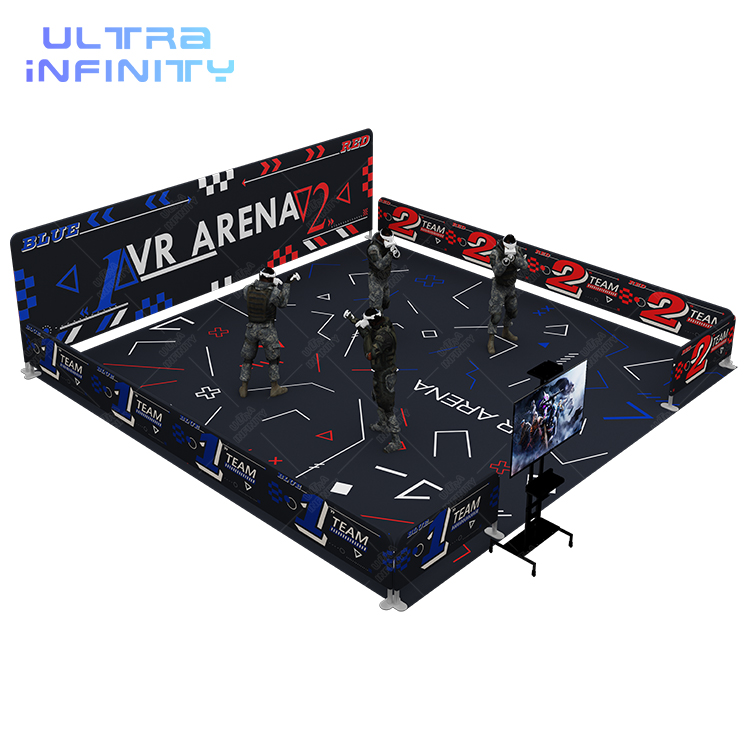
A VR theme park is not one purchase. It is a sequence of hand-offs between three parties, and the phrase one-stop describes the middle of that sequence rather than all of it. The supplier can carry you from a floor plan to a running, calibrated, staffed set of attractions. The supplier cannot obtain your building permit, certify your floor, underwrite your liability, license your music, hire your operators or take responsibility for the electrical work behind the connection point.
The answer is one table, so here it is before the commentary: six gates, the party that owns each one, and the payment each gate releases.
| Gate | What must be verified before it is passed | Who owns it | What the gate releases |
|---|---|---|---|
| 1. Space feasibility | Real dimensions taken on site, not from a lease drawing: clear height to the underside of services, column grid, slab capacity question raised, egress routes measured, and the percentage of the room conceded to aisles, queue, boarding and the safety ring | You, with your landlord and a local licensed professional. The supplier reviews and rejects plans, it does not certify a building | Nothing yet. This gate buys the right to specify |
| 2. Layout freeze | The zone-by-zone drawing is signed off, which is what fixes the equipment list. Every downstream line (power, freight volume, install days, staffing) is derived from it | Supplier designs, you sign. The signature is the deliverable | Equipment deposit. Do not release it against an unsigned plan |
| 3. Equipment and paper scope | Every unit on the frozen layout, each with its own line for specification, quantity, term, named place of delivery, and the license basis for the content that runs on it | Supplier | Production payment, against a pre-shipment inspection report rather than a photograph |
| 4. Freight, duty and clearance | Incoterm plus named place written down, crate volumes and gross weights, the four adders that sit between the invoice and your door, and who your customs broker is | Supplier moves it, your broker clears it, you own the paperwork trail | The balance that pays for the goods, released on dock inspection before you sign the delivery note |
| 5. Site preparation | Electrical service and dedicated drops where the machines will stand, clear height confirmed against the tallest machine envelope, floor fixings and anchoring route, water and waste if the food and beverage zone needs them, network backbone to the comms room | Local licensed contractor, plus AHJ sign-off. This is the gate the equipment vendor does not own, and it is the one that delays projects | Site readiness payment to the contractor, not to the equipment supplier |
| 6. Commissioning, acceptance and handover | Every unit powered, calibrated, running its full content set at rated duty, staff trained against a written list, acceptance sheet completed unit by unit, and the warranty clock start point agreed in writing | Supplier performs, you witness and sign | Retention. This is the only gate that still has your money behind it, and it is the only one with real leverage |
That boundary is not a complaint about the industry. It is the thing that decides whether a project finishes on budget. Most troubled installs fail at a hand-off that nobody was named in: the landlord believed the equipment vendor was handling the permit, the vendor believed the general contractor knew the ceiling clearance was structural, and the operator discovered at the end that the person who signed the permit application was the person now legally answerable for the work.
This guide is the owner and money view of the project. It adds no new cost, capacity or revenue number of its own, and where a figure below belongs to one of those owner pages it is named, attributed and linked at the point of use rather than blended with a rival page. Worked examples from those pages are reproduced once, at their original values, with the link in the same sentence; nothing here averages two pages to make a third number that neither one publishes. For the wider package concept, read what a full-venue entertainment solution actually includes, and for the attraction-by-attraction version of a VR park see the VR theme park solution page.
The construction industry has had this table for decades. The RIBA plan of work is a staged process for designers and clients, and the instrument it publishes alongside the stages is a design responsibility matrix: a grid of decisions with a column that says who is answerable for each one at each stage. General construction practice, not a VR rule, but it is the single most useful thing a venue owner can copy, because equipment projects fail in exactly the cells where two parties each assumed the other held the pen.
The table in the short answer is that matrix rewritten for a multi-attraction VR build. The stage names and the owner assignments are our own project guidance, assembled from the delivery pages this site already publishes; the gate column is the practical test your staff can actually perform.
Two of those rows do the most work. Gate 2 is where a project either becomes buildable or stays a picture, because the published protocol pages are blunt about the order of operations: the layout is frozen and signed, and only then is the equipment list fixed. Gate 5 is where projects actually stall, because it is the only gate that depends on somebody who is not on the equipment invoice.
The single most reliable predictor of a project that drifts is a whole-venue quotation that arrives as one number. Not because the number is wrong, but because a lump cannot be compared, cannot be phased, and cannot be attributed to a party when something slips. This site already publishes the argument for splitting it, in the context of a sports hall: see how a sports hall gets planned zone by zone before anyone buys. Ask for the whole-venue contract to be broken into seven deliverable lines rather than one lump sum, and note that on a multi-zone project that page says four of them are where the surprises live.
Those seven lines are a zone-planning and equipment-supplier view of scope, and one of them says outright that electrical and structural work belongs to your contractor. Read across the six gates above and you get the practical test for any supplier, from us or from anybody else: can their paper be split along the same lines, and does each split line name an owner.
| Deliverable line | Who typically performs it | The evidence that makes it comparable |
|---|---|---|
| Space planning and zone mix | Supplier, working from your measured plan | A dimensioned drawing with the circulation subtraction shown, not a mood board |
| Equipment supply | Supplier | Model by model, with quantity, term and named place |
| Freight, duty and clearance | Supplier to the port or door per the stated Incoterm; your broker for entry | Crate volumes and gross weights before you compare two freight quotes |
| Site preparation and services | Your licensed contractor and the AHJ, not the equipment vendor | A drawing set your contractor can price, with machine-by-machine electrical requirement |
| Installation and commissioning | Supplier crew, on your site, on your power | Day count, daily rate and travel terms as three separate figures |
| Training and documentation | Supplier | A written syllabus and a signed attendance record, because that record is your insurance evidence later |
| Aftercare, spares and service | Split: supplier for parts and remote support, a local party for labor | An SLA that states response, dispatch and what happens when it is missed |
Two timing traps live inside that table. The first is who you buy from. Buying direct from an overseas factory and buying from a local distributor are different projects on the calendar, and the published comparison puts factory-direct orders at three to six months from deposit to dock, set by the manufacturing queue rather than by your reopening date; a supplier who promises an install date without saying which of those two paths is being used has given you a wish, not a schedule. The second is that a fast dispatch promise and a door-to-door reality are not the same number, and both appear in this category. Ask for the dispatch promise and the transit estimate separately and write them both down.
For the audit that should happen before any of this is awarded rather than after, see how to audit an equipment factory, and for the buying-form decision behind the seven lines, manufacturers or distributors and how to buy commercial equipment as a package.
Payment structure is a schedule question disguised as a finance question. The equipment quote guide on this site puts it plainly: a deposit-to-shipment balance structure means the machine is paid for before it is inspected. Once you have accepted that shape, the only protection left is making each release conditional on something a person can physically verify.
The same guide works that arithmetic through one machine from invoice to docked cost, in the VR arcade equipment quote checklist, and the reason it is worth opening is that the gap between the two totals is made of four adders most quotations do not carry as separate lines. It also names the two lines that are almost always missing: the site preparation line, because the vendor assumes your building already complies, and the destination charges line, because the vendor assumes you have a broker. Those two assumptions are exactly what the site-preparation gate in this article exists to break.
| Release point | What it should be conditioned on | The trap at this point |
|---|---|---|
| Deposit on order | A signed, dimensioned layout and a model-level specification, not a concept render | Paying a deposit against a plan you have not frozen, so every later change is priced twice |
| Pre-shipment balance | A pre-shipment inspection report naming your units, with software versions and the content list on it | Paying on a photograph of a similar machine, or on a packing list with no serials |
| On arrival | Dock inspection before you sign the delivery note | Signing clean and opening later. Freight claims die the moment the driver leaves, and the party that shipped is the only one who can pursue them |
| On installation | Day count and daily rate agreed as separate figures before the crew is booked | A bundle that hides travel and living costs until the invoice arrives, which the buyer carries unless the quote says otherwise |
| On acceptance and handover | A unit-by-unit acceptance sheet: powered, calibrated, run through its content at rated duty, staff trained, documentation received | Withholding nothing, because the contract released every payment at delivery and the supplier has no remaining reason to close a punch list |
On the last line, the industry vocabulary is worth learning properly, because it is the difference between leverage and a conversation. The standard contract forms define retainage as a percentage of each payment the owner withholds until a specified project milestone or until project completion, and they state that the contract should clearly say how much is withheld and when it is released. The same source defines the final release around substantial completion, a passed final inspection and completed punch-list items, and notes that unless the contract specifies milestone payments, the default is monthly billing. Substantial completion and a closed punch list are two different moments; a project can pass the first and still owe you the second.
Note what that source does not do: it gives no percentage. Anyone telling you that a specific holdback is standard is quoting their own habit, not a rule. What we would tell a client to write down is the mechanism and the trigger: something is withheld, the amount is stated in the contract, and the release is conditioned on a document you will personally hold.
One more clause that costs more than people expect: the warranty clock. The published quote guide asks whether the clock starts at shipment, at arrival or at commissioning sign-off, and points out that those three dates can be two months apart and one whole peak season. Two projects with identical hardware and different start points have different effective coverage, and only one of them can be compared to the other.
Equipment delivery and permission are two independent clocks, and the expensive projects are the ones where the owner assumed they were the same clock. A machine can be crated, shipped, cleared and standing on its feet while the paperwork that lets guests enter the room is still in a queue at a municipal counter.
The clearest thing to understand before anything is filed is who signs. The City of San Jose states it directly on its technical review page: whoever signs the building permit application is responsible and potentially liable for all activity under the permit, and the same page recommends that the applicant be a licensed contractor. That single sentence decides a large part of your organisational chart, and it is not a sentence any equipment supplier can sign on your behalf.
| Authority | What its own page states | What it does not tell you |
|---|---|---|
| Illinois ride permitting | Every owner must first submit a completed application packet to the Department of Labor, and permitted rides are inspected prior to initial operation and annually thereafter | Whether your jurisdiction classes a headset attraction as a ride at all. That is a local determination |
| Washington state | Annual inspection by a third party certified by the state labor and industries route, a certificate of liability insurance no less than 1,000,000 dollars per occurrence, temporary power inspected by the state or the city electrical inspector, and an allow-three-days response window on paperwork | That this transfers to your market. It is a state-specific program |
| City of San Jose technical instruction | Whoever signs the building permit application is responsible and potentially liable for all activity under the permit, and the city recommends that the applicant be a licensed contractor | What your own municipality writes into the same rule. This is one city instruction, not a national standard |
| City of Mountain View technical review | Initial review around four weeks and resubmittals around three weeks, a fast-track path at two and two, and payment confirmed before staff can begin review of a permit | Whether your project is eligible for fast track, and what the reviewer will ask for |
| England planning | A standard application decided within eight weeks unless it is unusually large or complex, in which case the period can be extended to 13 weeks | Whether your change of use needs permission at all, which is a different test |
| This site, gaming venue permits | The approval timeline runs 3 to 6 weeks, with electrical at one to two weeks, fire at one to two weeks and property sign-off in the final week | That this is your jurisdiction. It is a planning range for a typical venue build |
There is a design-standard question that sits underneath all of this and that no supplier can answer for you: whether your attraction is legally an amusement ride at all. ASTM F2291-22a is the design guide for amusement rides and devices and it is written for designers, engineers, manufacturers, owners and operators, but its own scope excludes rider-controlled devices and coin-operated or home-use equipment. That is a real limit on what the standard settles: a headset free-roam attraction is not automatically inside it, and the determination of how your jurisdiction defines the category is a question for your authority having jurisdiction, not for a catalog.
The same discipline applies to structure. The 2021 International Building Code sets minimum design live loads for assembly use in its occupancy table, and our source register records 60 pounds per square foot for fixed seating and 100 for movable seating plus the associated lobbies. Those are design minima inside a code a jurisdiction may or may not have adopted in that edition, and they are not a floor certification for your slab. Whether a first floor in a shopping center can carry a loaded motion platform is answered by a licensed structural engineer with the drawings, not by a load table.
The permit consequence of getting this wrong is not a fine arriving politely later. The published permit guide on this site names the three outcomes that matter: a shutdown order, a lease breach and an insurance denial. For the route itself, read what fire and electrical permits a gaming venue needs, and for the life-safety layout that has to be drawn before equipment is positioned, how to plan evacuation routes for a gaming venue.
If one gate deserves the most paranoia, it is the one where a supplier assumes your building already complies. The clearance and power requirements for rotating motion equipment are not preferences; they are the dimensions of a machine that moves, and a room that misses them by forty centimeters cannot be fixed by installing faster.
| Preparation item | What the published work states | How the failure shows up |
|---|---|---|
| Clear height | A minimum clear ceiling height of 3.6 to 3.8 meters above finished floor for a 360 rotating chair, with 3.8 to 4.2 meters recommended unobstructed | Light fixtures, ductwork and sprinkler drops that were never on the lease drawing, discovered after the machine is crated |
| Electrical supply | Dedicated three-phase drops capable of supplying 15 kW to 22 kW with stable voltage regulation for high-torque motion units | A service that is adequate on paper and trips at the moment several units start inside the same second |
| Pre-install electrical audit | Roughly USD 400 to USD 800 for a professional audit, described as a fraction of the cost of a delay | An opinion instead of a measurement, which is what gets written on the delivery note |
| Site preparation spend | USD 1,500 to USD 3,200 for the power drop and safety fencing on the worked example | A budget that contains the machine and nothing that surrounds it |
| Cost of getting it wrong | A two-week opening delay on that worked example is put at USD 10,800 in lost gross ticket sales | The cheapest line in the whole project becoming the expensive one |
| Circulation subtraction | 25 to 35 percent of the room taken by aisles, queue, boarding and the safety ring before any machine footprint is counted | A layout that fits in the drawing and not in the room, and a queue that forms in the fire route |
One warning about clearance numbers, because this is where readers get badly burned by a comparison. Two figures circulate in this category that look like rival versions of the same thing and are not. The published clearance work describes a spectator buffer measured from the motion arc: 1.2 meters minimum, and 1.5 to 2.0 meters where a safety fence is installed. A separate fleet-scaling page gives 3.5 meters of perimeter safety clearance around a rotating chair. The first is a keep-people-out distance measured from where the machine sweeps; the second is a reserved working envelope for the machine and its people. They answer different questions, they are measured from different origins, and a plan that mixes them produces a room that satisfies neither. When you compare quotes, ask which origin a clearance is measured from before you compare the number.
Power has the same trap in a different form. The 15 kW to 22 kW figure above is circuit allocation for a class of machine, not the consumption of the machine itself, and a nameplate rating is not a supply requirement either. The published fleet and setup pages handle the difference between rated draw and what the panel must carry, so read what ceiling and power a 360 VR chair needs and how much electrical power a venue needs before you let anyone size a service from a spec sheet.
The published clock for a single free-roam arena runs to roughly 30 days from order to first paid session. Inside that clock the guide is specific: the arena is designed to assemble in two to three days, calibration takes about 4.5 hours, staff training is scheduled as one day, and the soft launch is deliberately priced 20 to 30 percent below the target rate so the first fortnight is a test rather than a promise.
Do not average that clock with the other numbers in this category, because they are measuring different scopes. A multi-attraction build can be described as operational in as little as 45 days when the space is already compliant, on the VR theme park solution page; a machine-level go-live can be quoted at two to four weeks from equipment arrival on how to build a profitable social sports club; and a whole-venue project adds the fit-out and the permit clock on top of both. The honest reading is that delivery is the shortest of the three durations and the one everyone plans against. If you want the sequencing argument in its own words, how fast a single VR arena goes live is the page that owns the day count, and how long a bowling equipment install really takes is the useful counterweight, because that page keeps its equipment clock and its building clock as two separate numbers rather than one.
| Evidence item | What verified means in practice | What a weak version looks like |
|---|---|---|
| Assembly report | Frame, barriers, screen mounts and connections complete against the frozen layout drawing, with the as-installed dimensions on the same page | A signed delivery note, which proves a truck arrived |
| Calibration record | Positioning verified across the whole play or motion envelope, including the corners, at the time of day the venue is busiest | A calibration done in an empty hall on a Monday morning |
| Content run list | Every title in the delivered library executed end to end, at the player count you will sell, not loaded and glanced at | A library count on the invoice with three games ever opened |
| Network commissioning | Access point placement and concurrency tested in the room, with the headset traffic separated from guest traffic on the design that was specified | A router supplied and configured by whoever was on site that week |
| Staff training record | A named syllabus, a signed attendance sheet and a competency check on gearing, safety stops and the incident procedure | A walkthrough with the crew while the manager takes notes on a phone |
| Acceptance sheet | One row per unit, signed per unit, with the warranty start date written on the same line | One signature at the bottom of a page that lists eight machines |
Two of those rows are worth extra attention because they are where a one-stop claim most often becomes a fiction. The first is network commissioning. For all-in-one free-roam headsets the wireless does not carry video frames, it carries multiplayer session data, which keeps bandwidth requirements relatively low but makes latency and reliability critical, and an LBE platform provider states that separating headset traffic onto its own network segment removes most of that risk. The same provider is explicit that most of that configuration happens on site and offline, in the space, which is not work that a platform or a remote support team can perform. If your one-stop quote contains a machine list and no network design, the gap will be discovered on the first busy Saturday.
The second is the acceptance sheet, and this is the point where the payment ledger in the previous section either has teeth or does not. The precedent pages on this site are consistent that you sign acceptance per unit only after the run list is complete: what equipment comes with a complete shooting simulator setup, how a chair simulator is checked before it is bought, and what a lane acceptance actually verifies. Take whichever of those formats matches your equipment and put its checks into your own contract, because acceptance you have written is the only acceptance you can enforce.
Handover is where a project becomes a business, and it is also the part a delivery scope can describe without ever owning. Six items need an owner on day one, all of them covered by pages on this site that carry the numbers, so this section names them as project boundaries and points at the detail.
| Boundary | What to settle in the contract | Where the numbers live |
|---|---|---|
| Spares and consumables | A physical shelf at handover, sized as a share of capital rather than a promise, with the wearing parts named per model | what the equipment quote checklist covers, the fleet scaling guide and how to maintain a commercial VR racing simulator |
| Headset life and hygiene | Pad and cover system, the wipe chemistry the manufacturer accepts, replacement cadence in sessions, and who pays when a unit fails early | how often commercial VR headsets need replacing and how often you should sanitize VR headsets between sessions |
| Content license scope | Title by title, which commercial license model applies at your player count, and what happens to the library if you move or resize | how often 9D game libraries should refresh |
| Service response | What the SLA guarantees in writing: response time, dispatch, parts availability, and the remedy when they are missed | what an equipment SLA should guarantee in writing |
| Staffing and training | Headcount per shift by attraction class, and a written day-one competency list | how many staff per arcade shift and what training new VR staff need before day one |
| Age and rider rules | One posted number per attraction, matched to the strictest applicable source, enforced by staff who are not the host | what age and height rules each VR attraction should enforce |
On spares, a discipline note, because three different published bands in this category are routinely added together into a number that exists nowhere. One page expresses spares as about 10 percent of capital expenditure and describes the result as a shelf box rather than a promise, and it is published in what an equipment quote puts in the spares line. A second page puts the replenishment clock in one row of its sourcing comparison, 20 to 40 days from a factory against 2 to 5 days out of local stock, in manufacturers or distributors. Two pages, two questions, and the gap between them is the practical difference between a spare sitting on your own shelf and a spare sitting in a warehouse on another continent. Another expresses a spare pool as a percentage of headset units. A third gives one spare per four units in service. Three denominators, three different questions, never a sum.
On hygiene, the honest version is uncomfortable and worth stating, with one condition attached about what it is. The published work is a body of clinical and in-vitro studies of headsets and shared interfaces, not a survey of your floor: within that setting it reports that no standard operating procedure for disinfection of these devices exists, that greater efficacy is found on non-porous surfaces than on porous ones, and that the ultraviolet studies report log reductions rather than sterilization, with one noting there was no experiment in which all bacteria were killed. Read it as evidence that a cleaning promise needs a specification behind it, not as a measurement of risk in any particular venue. The manufacturer guidance for a common headset interface is equally plain about not using alcohol or chemical cleansers on the facial interface. If your one-stop package includes a cleaning promise and no consumable specification, the risk sits with you.
The buying logic, in one paragraph: choose by the gate you are worst at, not by the machine you like most. A shopping center operator with a landlord, a building management company and a fire officer between the plan and the opening should be buying the most project scope they can get in writing. An operator putting equipment into an already compliant room is buying a supply and commission contract, and paying for a full project wrapper they do not need is just margin given away.
| If your situation is this | Buy the most of these gates | And read these first |
|---|---|---|
| Shell space, no approvals yet, landlord involvement | Gates 1, 4, 5 and the permit clock alongside 2 and 3 | planning an indoor entertainment center from an empty space and what it costs to open a sportainment center |
| Existing venue adding a VR zone to a compliant floor | Gates 2, 3, 6; keep 5 local and short | how to plan a multi-attraction venue and two VR arenas vs a row of shooters per meter |
| Destination park at 500 square meters or more | Everything, with a named project owner on the supplier side | the step-by-step business plan timeline and what equipment a VR arena needs |
| Mixed-format floor where the mix itself is undecided | Buy the layout before the equipment | how many VR chairs fit in 50 square meters, how to choose and price a chair simulator and the format family map for the VR theme park solution page |
| Comparing a franchise wrapper against an independent build | Whatever makes the responsibility line unambiguous | franchise or go independent and what a full-service bowling lane package includes |
Three questions to put to any one-stop supplier, in this order, and treat the willingness to answer them as information in itself. Which of the six gates in this article are inside your contract, in writing, and which are explicitly not? Who signs the permit application in your market, and what is their relationship to your licensed contractor? And when the commissioning checklist is complete, what document am I holding that releases the final payment?
If you would rather see your own floor plan answered than a table, that is what our free 3D layout design service does: send the measured plan and we come back with which zones fit, where the circulation subtraction lands, what the room cannot take, and which of the six gates you would be buying from us versus from somebody local.
There is no cost model here. No dollar figure in this article originated here: the landed-cost example belongs to the equipment quote checklist, the preparation and delay bands belong to the ceiling and power guide, the fleet and uptime bands belong to the fleet scaling guide, and the launch economics belong to how to launch a profitable VR arena and what a 2026 VR arena setup really costs and how to budget commercial VR equipment. A hub that repeated those numbers would make them drift, which is how a category ends up with four incompatible cost pages.
There is also no legal, code or structural conclusion here. The permit windows quoted in this article belong to the named authorities that publish them, the standards references describe what a document says within its own stated scope, and none of it tells you what your jurisdiction requires. A licensed professional in your market answers that, and on the amusement-ride classification question even the relevant design standard does not settle it for you.
The stage names, the owner assignments, the release conditions and the evidence table are our own project guidance for multi-attraction builds. They are written to be argued with. A contractor with a better division of scope than ours is not an obstacle to your opening; a contract with no division of scope at all is.
The project questions that decide a contract, answered with the published owner-page figures attributed to the page that owns them and our own guidance labelled as ours.
Design and zone planning, the equipment list, the freight and duty paperwork to a named place, installation and commissioning on site, staff training and aftercare. What it does not include is the permit application, the structural and electrical work behind your connection point, your insurance, your point-of-sale and payment licenses, the local labor that maintains the machines, and your hiring. The value of a one-stop scope is measured by how many hand-offs it genuinely removes, which is why the division of responsibility belongs in the contract rather than in a sales conversation.
It depends on the authority, so ask yours in writing. One city we have read states the rule directly. The City of San Jose writes that whoever signs the building permit application is responsible and potentially liable for all activity under the permit, and it recommends that the applicant be a licensed contractor. Other jurisdictions word it differently and some make the property owner the applicant by default, so the answer you need is the one your own authority gives you in writing. An equipment supplier is generally not that party. Establish this before you give anybody a deposit, because the answer decides who you instruct, who you insure and who you chase when a review comes back with questions.
Scope by scope, not end to end: a single free-roam arena runs to roughly 30 days from order to first paid session, with two to three days of assembly, about 4.5 hours of calibration and one day of staff training inside that window. Longer multi-attraction timelines in this category assume fit-out and approvals alongside equipment, and the plan-review clock in some jurisdictions runs four to thirteen weeks on its own, entirely in parallel. Ask any supplier which of those clocks their quoted number contains.
A unit-by-unit acceptance record: assembly against the frozen layout, calibration verified across the full envelope at busy hours, every delivered title run end to end at the player count you will sell, network commissioning done in the room, training recorded with names and signatures, documentation delivered, and the warranty start date written on the acceptance line. Retainage is a mechanism whose amount and release conditions belong in the contract; what matters practically is that at least one payment survives until you are holding a document you can point at.
To you and to your licensed contractor, and this is the line that most often gets misread. The published requirements are concrete enough to plan: clear height of 3.6 to 3.8 meters minimum for rotating motion equipment with more recommended, dedicated three-phase drops sized at 15 kW to 22 kW, a pre-install electrical audit costing a few hundred dollars, and 1,500 to 3,200 dollars of power and fencing preparation on a worked example, all of it published on what ceiling and power 360 VR chairs need and belonging to that page rather than to this one. A vendor quotation that assumes your building already complies is not hiding a cost so much as postponing one.
Not until you know what each is measured from. A spectator buffer of 1.2 meters from the motion arc, or 1.5 to 2.0 meters with a safety fence, and a 3.5 meter perimeter working envelope around a rotating chair, are two different questions with two different origins, and both appear in this category. Same with rated power versus circuit allocation. Before comparing two suppliers, ask what a clearance is measured from and what a power figure describes.
A split along deliverable lines rather than a lump sum: space planning, equipment, freight and clearance, site preparation, installation and commissioning, training and documentation, and aftercare. Each line should name who performs it. A quote that cannot be split is a quote you cannot price against a competitor and cannot phase across a financing schedule.
Ask, in writing, before you buy. Commercial location-based licensing is priced by several different models, including per session, per credit, per concurrent seat, per fixed location and per event, and a consumer license for the same title does not cover a business running it for paying customers. The model your supplier uses decides whether a relocation is a paperwork update or a repriced library.
Yes, and it can be you with a checklist. The reason is structural rather than distrustful: at least one gate in every build depends on a party who is not on the equipment invoice, and somebody has to be accountable for the seam between the supplier crew and the local contractor. One-stop is a scope claim. A responsibility matrix is the evidence.
Send us your measured floor plan and tell us which gates you already have covered locally. Our team will come back with a zone-by-zone layout, an equipment list with each deliverable line separated, the site preparation requirements written as a drawing your contractor can price, and a statement of what is inside our scope and what belongs to your licensed professionals - starting from the Free Roaming VR Arena 2.0, the four seat 9D cinema chair and the single seat VR 360 motion chair, with the free 3D layout design done first.