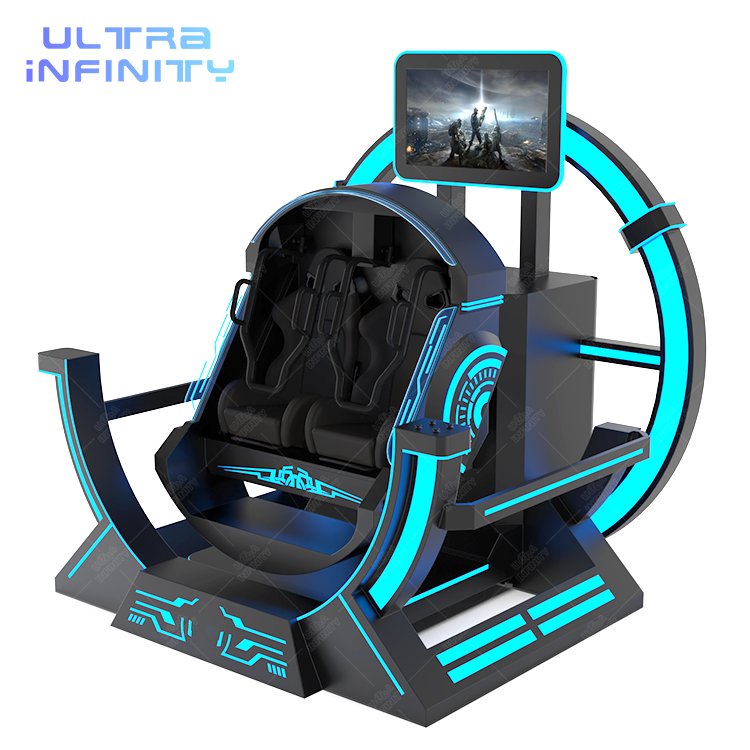
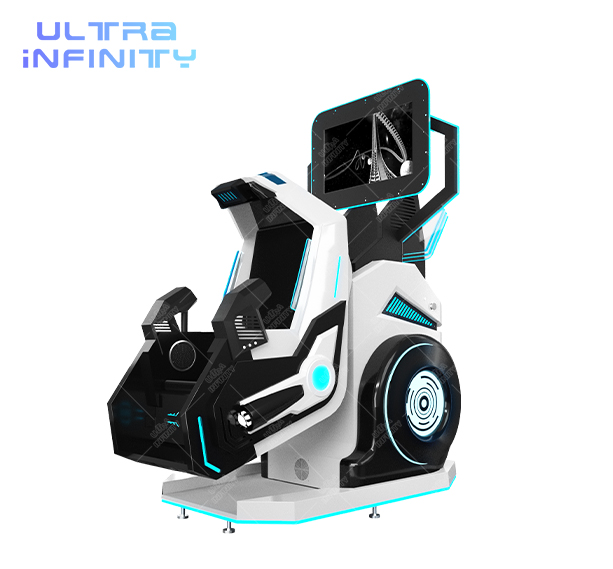
A chair roller coaster simulator is a motion chair plus a headset plus a content library, sold as one ride. The chair is the capital cost, the headset is the disposable, and the library is what decides how many times a guest comes back. Buyers who treat it as a single machine usually under-budget the parts that keep it earning; buyers who treat it as a ride programme usually get the configuration right the first time.
So here is the short version of the decision, before the detail. If your traffic arrives in pairs, couples and families, buy the two-seat build, because a pair on one track turns a queue of spectators into one paid session and doubles the ticket value of a single cycle. If your traffic arrives as solos and walk-ups, or your floor is tight and you want the lowest entry cost, buy the single seat first and add a second machine later. Everything else on the spec sheet is downstream of that choice.
Based on our VR 360 Motion Chair specification, the base yaws through a full 360 degrees and pitches 45 degrees, runs on 110-240V, and ships with a library of 70+ titles and a playing time of 2 to 5 minutes per ride. The two-seat V2 build of the same chair carries a pair on one track. Those four lines - two axes, voltage, library size, ride length - are the whole product. The rest of this guide is about turning them into revenue.
This is the purchase decision that operators most often rush, and it is the one that is hardest to reverse. A single-seat chair and a two-seat chair run the same content and feel the same to ride. What changes is who pays, how often the ride turns, and what the machine is for.
| Single-seat 360 chair | Two-seat 360 chair | |
|---|---|---|
| Who pays per cycle | One ticket | Two tickets, or one higher-priced pair ticket |
| Best-fit traffic | Solo walk-ups, older children, quiet weekdays | Couples, friends, parents and children, group bookings |
| Queue behaviour | Turns faster, but a pair takes two cycles | A pair is cleared in one cycle - the queue moves in pairs |
| Floor and power | Smallest footprint and the lower electrical allocation | Same motion profile in a wider frame, higher rated draw |
| Staff handling | One restraint, one headset, one reset | One briefing covers two riders - lower labour per ticket |
| Typical placement | A row of two or three singles, arcade style | One hero unit at the front of the zone, or beside an F&B counter |
| Best used for | Proving the concept with the lowest capital outlay | Maximising revenue per cycle and per square metre |
The economics behind the table are straightforward. A ride that clears one rider per cycle and a ride that clears two riders per cycle cost roughly similar amounts of staff time, queue space and reset work. The two-seat build therefore earns more per hour at the same ticket price, and it earns the same per hour at a lower ticket price - which matters if you want to hit a $5 to $8 price point without giving up throughput.
The counter-argument is real too. Singles suit venues with tight floor plates, they let you start a two-machine row without committing the capital up front, and a solo rider on a two-seat chair can feel like a wasted seat during off-peak hours. Venues that run both usually place a two-seat 360 rotating VR chair roller coaster simulator as the hero unit and one or two single-seat VR 360 motion chair roller coaster simulators alongside it for solo traffic, which is the configuration we recommend most often.
One practical test before you choose: watch your own floor for a weekend and count how often guests arrive in twos. If the answer is most of the time, the two-seat build is not a luxury, it is the correct product. If guests mostly arrive alone or with one adult supervising a child who will not ride, the single seat is the better first purchase.
Coaster chair quotes vary widely for machines that look identical in a brochure. In our experience the variance sits in seven lines, and every one of them is a question you can ask in writing before you pay a deposit.
Two reconciliation points save arguments later. First, the machine-rated draw and the circuit allocation are not the same number, and a supplier who quotes one when you asked for the other is not being evasive so much as imprecise - the rated draw describes the machine, the allocation describes the installation. Second, ceiling height and floor loading are building questions that no equipment supplier can answer for you, which is why the pre-installation survey matters more than the brochure: as published in that same clearance guide, an electrical and clearance audit costs roughly $400 to $800 and site preparation for the power drop and safety fencing runs about $1,500 to $3,200, against the cost of a delayed opening.
If you want a single sentence to take to your facilities contractor: a coaster chair is a 360 degree rotating, 3.8 m clearance, three-phase machine that needs a dedicated circuit, a rated floor and an interlocked restraint before it is allowed to move.
Once the machine is on the floor, the ride programme is four operating choices: how long a ride is, how the queue is shaped, what is sold at the counter, and what happens after the ride. Each one is adjustable, and together they decide whether the chair is a novelty or a line item in your revenue report.
Start with cycle length. Our chair specification lists a playing time of 2 to 5 minutes per ride, and the venue data in this cluster shows what that means in practice: a single-seat 360 chair on a 2 to 3 minute cycle runs 12 to 16 sessions per hour, and the visible rotation cycles inside a track run 15 to 20 seconds. Shorter cycles mean more tickets per hour; longer cycles mean a better ride and a longer average dwell. The usual compromise is a short default track with longer premium tracks sold as an upgrade, which lets one machine serve both a rush-hour queue and a quiet-evening experience.
Then shape the queue so the ride sells itself. As our venue guide to 360 rotating chairs and concourse footfall sets out, a chair pulls a pause rate of 20 to 25 percent of passers-by, up from a 5 to 8 percent baseline, and extends dwell from seconds to minutes. That pause rate is an asset only if the queue is visible and the counter is inside the sightline; a chair hidden behind a partition sells tickets to nobody.
Finally, decide whether the chair attaches to another spend. In food and beverage venues the honest version of this is that the ride is priced as a check attachment rather than as a standalone attraction: as published in our guide to 360 motion chairs and F&B sales, ride-only pricing there sits at $5 to $8 per session, a food-attached bundle discounts the pair, and the venue sees an F&B spend lift of 22 to 35 percent and an average check attachment of $4 to $8 per guest. A chair beside a bar counter is a different business from a chair at the end of an arcade aisle, and the price list should say so.
The most common pricing mistake with a coaster chair is setting the ticket from the machine cost instead of from the floor plan. What matters is how many paid sessions a day the location can realistically deliver, and what guests in that location already pay for a comparable three-minute experience.
| Venue type | Typical ticket per ride | What drives the number |
|---|---|---|
| Bar, restaurant or hotel lounge | $5 to $8 | Priced as a check attachment, bundled with a drink or dessert |
| Mall or concourse unit | $10 to $15 | Standalone spectacle pricing, spectator conversion carries the queue |
| Family entertainment centre | $8 to $12 | Card or wristband pricing, discounted multi-ride bundles |
| Multi-ride bundle | 10 to 25 percent below single-ride price | Used to convert a one-time rider into a repeat rider in the same visit |
The payback arithmetic follows from those two numbers - ticket price and sessions per day - and it is worth doing on paper before you order, because the answer changes the configuration. As published in our clearance and power guide, a commercial 360 chair in a normal mall or FEC setting reaches full capital payback in roughly 4.5 to 5.5 months at $10 to $15 ticket pricing, and the equipment band for a venue-grade chair is $6,000 to $12,000 and up, as set out in our guide to what a VR chair costs. If your venue is a bar with a $6 ticket, the same maths produces a longer payback, which is why the F&B venues in this cluster price the ride as an attachment and count the food lift as part of the return.
A worked example makes the levers visible. Take a two-seat chair at a $10 pair ticket, running 12 cycles an hour at a 40 percent utilisation across a ten-hour day: that is 48 paid cycles, or $480 a day, before any bundle or F&B attachment. Halve the utilisation and you have $240 a day, which is still a chair that pays for itself inside a year. The variable that moves fastest is not the ticket price - it is the utilisation, and utilisation is what the seating position, the sightline and the queue design buy you.
If you are still deciding whether a chair belongs on your floor at all, the two companion guides are the honest ones: whether a VR chair is worth buying sets out the cases where a chair fails, and what a VR chair costs breaks the price into build, content and install. This article assumes you have already decided the category is right and you are choosing between configurations.
Ask every supplier for the same ten lines, with quantities and ratings, and compare like for like. A quotation that cannot itemise these is not a quotation for a venue machine; it is a price for a box.
Then run an acceptance procedure before you sign the handover sheet. The list below is the one we use; it is short, and every line maps to something that is expensive to discover a month after installation.
Installation itself is fast once the room is ready: on-site mechanical assembly, wiring, safety curtain calibration and test rides typically take one to two days with a trained technician, as published in our clearance guide. The slow part is the building work, which is why the sequence that protects your opening date is survey, then circuit and flooring, then delivery - never delivery first.
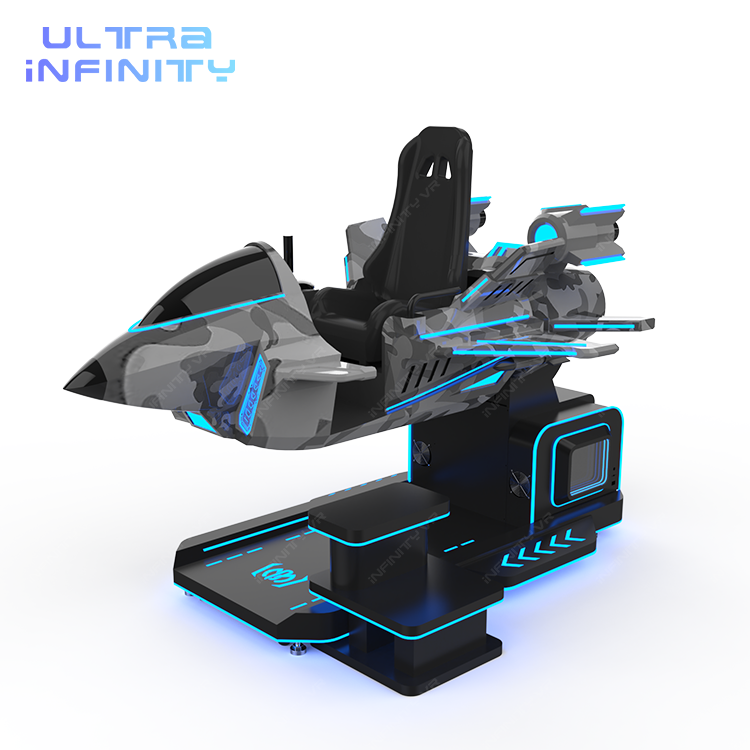
When you are ready to compare configurations, the VR simulator collection lists the single-seat and two-seat coaster chairs with the wider motion range, and the free 3D layout service maps the machine onto your own floor plan with clearances and power runs before you commit. For a mixed floor, the same motion language covers speed and altitude on the VR Thunder Fighter flight and coaster simulator, and the two-player 9D cinema gaming chair covers seated guests who want a story rather than a launch.
The buying questions operators ask before they place a coaster chair order, answered directly.
A powered motion chair with a VR headset and a coaster library. The base yaws a full 360 degrees and pitches 45 degrees in time with the track on screen, so the rider feels the movement they are watching. Our chair ships with 70+ titles and a 2 to 5 minute playing time per ride.
Buy two seats if guests mostly arrive in pairs - a pair clears in one cycle, which raises revenue per hour at the same staff cost. Buy the single seat first if your floor is tight, your capital is limited, or your traffic is mostly solo walk-ups. Many venues run one two-seat hero unit plus singles alongside it.
Venue-grade motion chairs sit in the $6,000 to $12,000 and up band, as published in our VR chair cost guide, with install, power and site preparation on top. Budget the survey and site work separately, because the room is often the larger line item.
Based on our chair specification the machine runs on 110-240V with a rated draw in the low single-digit kilowatt range. For the installation, plan a clear ceiling height of at least 3.8 m, a dedicated three-phase allocation of 9.5 to 15 kW per chair, and a 3.5 m perimeter safety clearance - the full figures are in our ceiling and power guide.
A single-seat 360 chair on a 2 to 3 minute ride cycle runs 12 to 16 sessions per hour. A two-seat chair clears a pair in each of those cycles, which is the throughput argument for the pair build. Longer premium tracks reduce sessions per hour, so sell them when the queue is short.
Price from the floor plan, not the machine cost. Typical bands are $5 to $8 where the ride attaches to an F&B check, $8 to $12 in a family entertainment centre on card or wristband pricing, and $10 to $15 as a standalone mall attraction. A bundle at 10 to 25 percent below the single-ride price converts a one-time rider into a repeat rider.
At $10 to $15 ticket pricing in a normal mall or FEC setting, a commercial 360 chair reaches full capital payback in roughly 4.5 to 5.5 months. Lower ticket venues take longer, which is why food and beverage venues price the ride as an attachment and count the food lift as part of the return.
Ceiling clearance, the dedicated circuit and breaker rating, the floor dynamic load rating, the perimeter safety clearance, and the queue and approach layout. An electrical and clearance audit typically costs $400 to $800 and site preparation about $1,500 to $3,200, against the cost of a delayed opening.
On-site assembly, wiring, safety curtain calibration and test rides usually take one to two days with a trained technician. The building work is the long lead item, so the safe sequence is survey first, then circuit and flooring, then delivery.
Ask both for the same ten lines: footprint with service clearance, motion axes with rated travel, payload per seat, rated power, circuit allocation, ceiling and floor requirements, restraint and safety system, installed content list with licence terms, headset and spare provision, and warranty terms with spares pricing. A supplier who cannot itemise those is selling a box, not a ride.
The VR simulator collection shows the single-seat and two-seat coaster chairs side by side, and the free 3D layout service places both on your own floor plan with clearances and power runs - so the seat-count decision is made against your real space, not a brochure.