VR is hot right now. Everyone wants to try it. But that's exactly the problem — they want to try it once. Most VR venues I've seen have the same issue: a customer walks in, does one experience, ticks the box, and never comes back. The novelty wears off faster than you can recoup your equipment cost.
I've watched venues spend $80,000 on VR headsets only to realize they've built a place people visit once, not a place people book for parties. The owner is stuck resetting experiences between customers, managing cables, and praying for walk-ins. That's not a business. That's an expensive hobby.
The difference between a VR venue that fails and one that thrives comes down to one thing: replayability. Can a group of four friends come back every month and have a different experience? Can a birthday party book 10 kids and keep them all busy for two hours? If the answer is no, your VR business has a ceiling.
I made the same mistake with my first VR setup. Bought six headsets, thought I was set. Learned the hard way that hardware without variety is just an expensive rental. Here's what actually works.
The venues that win aren't the ones with the fanciest headsets. They're the ones with variety and social play. A free-roam VR arena where four friends can play together beats a solo headset experience every time. A racing simulator with side-by-side seats creates competition that brings people back to beat each other's lap times.
I watched a small venue in the UK triple their revenue just by adding a VR arena alongside their existing headsets. Suddenly groups of 6-8 could play together. The party bookings went from zero to filling every Saturday within two months. They didn't buy more headsets — they bought the right format.
Another operator I know swapped his single-player VR chairs for a 9D cinema and a VR racing setup. The cinema runs group shows (up to 6 at a time). The racing sim runs tournaments. His per-customer revenue went from $12 to $38 because groups stayed for multiple experiences.
The formula is simple: give groups a reason to stay, compete, and come back. Solo headsets don't do that. Multiplayer, free-roam, and shared experiences do.
A free-roam VR arena fits 4-6 players per session. At $25-35 per person, that's $150-210 per 20-minute round. Run 3 sessions per hour, 8 hours a day — one arena can generate $3,600-$5,000 per day in peak hours.
Weekly VR racing tournaments bring competitive gamers back every Friday. Entry fee + drink specials + podium prizes. One venue I know runs 32-player brackets every week — that's $800 in entry fees alone, every single Friday.
VR parties are the new laser tag. A 2-hour party package for 8 kids at $40/head = $320 per booking. Add food and drinks, and you're looking at $500+ per party. Most VR venues run 4-6 parties every weekend.
Companies are always looking for something cooler than a conference room. VR arena team battles are a huge hit with tech companies, gaming studios, and creative agencies. Corporate bookings average $800-$1,500 per group.
Free-roam multiplayer VR is the only format that brings groups back. Friends want to play together, compete, and beat each other's scores. A solo headset is a one-time thing. A VR arena is a weekly ritual.
Venues with 3+ different VR experiences see average spend of $38-45 per person vs $12-18 for single-experience venues. Customers stay 2-3 hours instead of 20 minutes. More time = more food, more drinks, more return visits.
VR arena and racing sims are self-service after setup. One staff member can manage 4-6 stations simultaneously. No pinsetters, no ball returns, no maintenance headaches. Gross margins run 70-80%.
Indoor VR is weather-proof and season-proof. Rainy weekends, school holidays, summer heat — families and groups need indoor activities. Our VR operators report 40-60% higher winter revenue than summer.
Based on data from 30+ VR venues running this equipment mix.
VR venues with multiplayer arenas and variety experiences recoup investment faster than any other format. Group bookings are the key.
Multi-experience venues see 3x higher per-customer spend compared to single-experience setups.
VR arena and racing sims run with minimal staff. One attendant can manage 4-6 stations with software-automated session management.
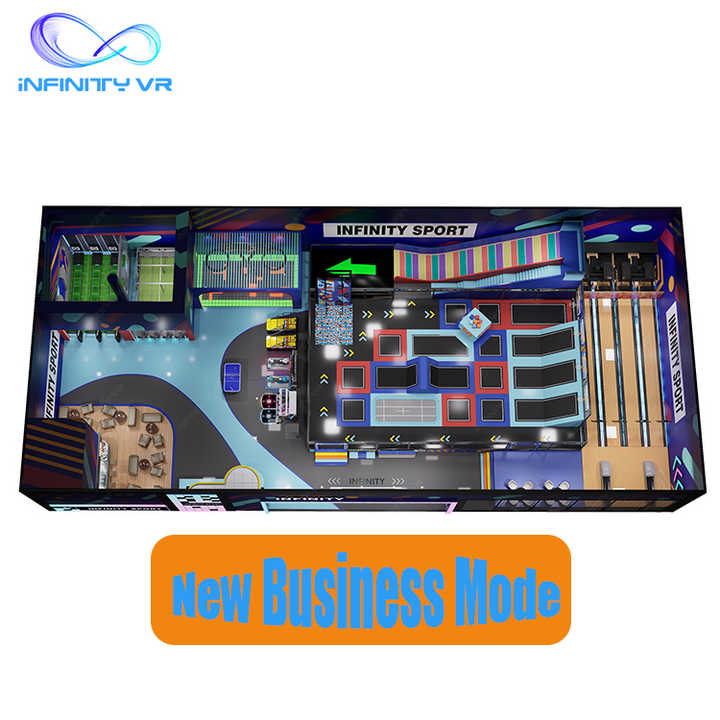
The VR Arena is the anchor attraction. Add racing sims, sports club, and theme park experiences to create a full VR destination that keeps groups entertained for hours.
Free-roam · 4-6 players · Multiplayer
View →Multi-sport · Social · Competitive
View →9D Cinema · 5D/7D · Group shows
View →6-Axis motion · Tournament ready
View →Tell me about your space — I'll put together a layout and equipment list that fits your market and budget.
Explore VR ArenaPart of the Infinity NextPlay Solutions Series. Built for real venues, proven in the real world.