If you have 40 to 120 square meters and a ceiling you cannot raise, the VR question is not whether VR works in your venue. It is which of two very different objects you are about to sign for. A VR simulator pod is a machine: it arrives on a pallet, it has a floor plate you can measure with a tape, a nameplate wattage printed on a spec row, a net weight in kilograms and a playtime in minutes. A large VR arena is a room: the product is the clear floor you lease around it, the headsets are the least expensive part of the build, and the paper you sign is a licence plus a fit-out contract, not a purchase order.
That distinction decides what small space means, because the two formats are measured in different units. Our own pod sheets print a plate and a wattage; the arena operators print a play area and a player cap. So before any comparison, one honest warning about the data: nobody publishes the number operators actually want. We read supplier listings, operator licensing pages and one public SEC filing across four sourcing passes, and there is no published figure for how many pods you can fit in a given room, and no supplier prints sessions per hour on a product page. What does exist is per-machine print. This article therefore compares named machines against named arenas and shows you every division it performs.
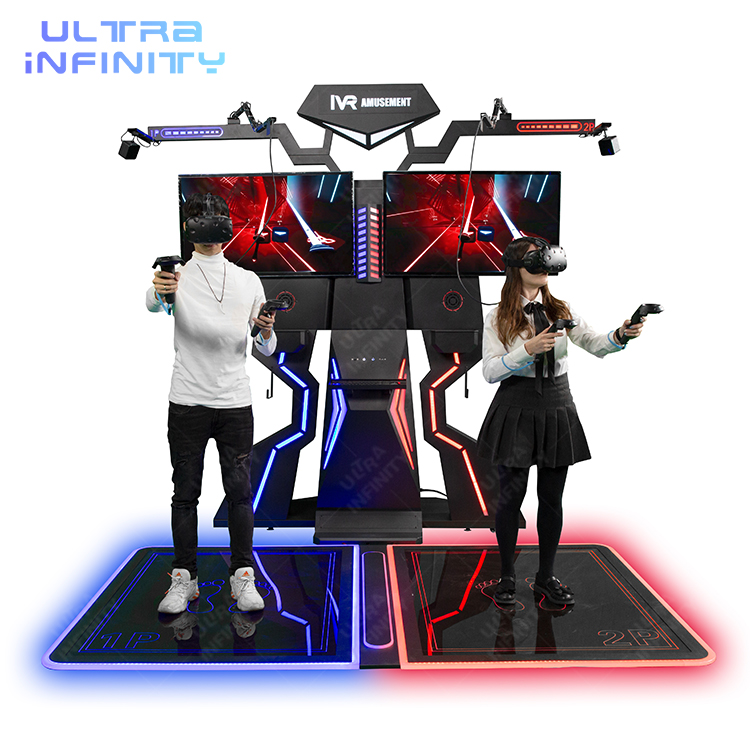
On the arena side, the smallest published play areas from a major free-roam operator are 98 sq m for a 6-player arena and 128 sq m for an 8-player arena, reported by Zero Latency in its own licensing FAQ, with ancillary zones listed around them and a server room of about 2.5 to 3.5 sq m. The franchisor Sandbox VR publishes a whole suite of approximately 4,000 to 5,500 sq ft (372 to 511 sq m) and does not publish the play area on its own. On the pod side, the plate on our VR Terminator shooting simulator sheet is L1327 x W1000 x H2380 mm for one person. That is 1.33 sq m of floor and 600 W. The gap between those two numbers is not a marketing gap; it is a different business.
One more boundary before the numbers. Our site already owns the money questions this topic raises, and this article will not restate them: what a session costs per player and per group belongs to VR arcade pricing, what the format earns per square meter belongs to the revenue per square meter model and the arena launch payback build, and the US market-by-market cost stack belongs to how much it costs to open a VR arcade in the USA. What is kept here is the physical and contractual sheet: floor, height, volts, kilograms, minutes, licences and warranty terms.
Start with what a pod actually occupies. Table 1 is eight named machines, one from our own one-person pod sheet, one from our own standing platform sheet, and six from supplier listings, each with the figures that page prints. Nothing in it is an industry average, and the pages behind this table are separate documents and must not be blended: the wattages below are nameplate ratings printed per machine, and two of them are idle-to-working bands rather than one number, which is why they are shown as ranges.
| Machine (who prints it) | Plate and height | Mass | Nameplate power | Supply voltage |
|---|---|---|---|---|
| Our VR Terminator pod (own sheet) | 1.33 x 1.00 m, 2.38 m tall | 200 kg net | 600 W | 110-240 V |
| Our 2-person standing platform (own sheet) | 2.67 x 2.10 m, 2.70 m tall; sheet also prints 5.4 sq m area covered | 200 kg net | 2,500 W | 110-240 V |
| EPARK 9D VR egg cinema (supplier listing) | 0.65 x 0.60 m, 2.20 m tall | 260 kg | 2,500 W | 110-220 V |
| MoviePower 9D VR egg chair (supplier listing) | 2.00 x 1.20 m, 1.70 m tall | not printed | 0.4-1.1 kW | 110-220 V |
| SKYFUN 1-seat cabinet (supplier listing) | 2.00 x 1.35 m, 2.10 m tall | 400 kg | 1.5 kW | 110/220 V |
| Zhuoyuan 8D/9D capsule, 2 players (supplier listing) | 1.91 x 1.16 m, 1.93 m tall | 354 kg net | 1.2 kW | 220 V |
| Dreamland VR 9D pod (supplier listing) | 2.00 x 1.00 m, 2.20 m tall | 250 kg | 1-2.2 kW | 110-220 V |
| Funsen dual-seat motion rig (supplier listing) | 6.64 sq m footprint | not printed | 3,200 W | not printed |
Read the plate column and the real shape of the pod argument appears: the smallest published pod plate in this set is 0.39 sq m (EPARK), and the largest is a two-seat motion rig at 6.64 sq m (Funsen). The four supplier listings that print both plate dimensions run from 2.0 to 2.7 sq m of plate - three of them single-rider, the fourth (the Zhuoyuan capsule) printing 2 players; EPARK's egg cinema at 0.39 sq m prints an allowable passenger count under 5 rather than a seat number, so it is not inside that band. Our own two-person platform is the outlier at 5.4 sq m of covered area, which is a fair warning that a pod does not automatically mean tiny - the standing platform with its overhead frame is closer to a small kiosk than to an egg chair.
Then read the height column, because that is where a mall bay kills VR projects. Machine heights in Table 1 run from 1.70 m to 2.70 m, and two supplier pods are 2.20 m tall. The only pod-side document in our sourcing set that prints a required room ceiling for VR arcade kit is the FuninVR space guide, which states a minimum of 2.5 m (8 ft) ceiling - and note the distinction carefully: machine height is not a room requirement, and only one pod-side source publishes a room requirement. On the arena side, the only published vertical clearance we could find is from a system maker rather than an operator: HOLOGATE prints 2.80 m (9.5 ft) of vertical clearance for both its 4-player and 2-player configurations.
Behind both of those sits a code number that applies whether you buy a pod or build an arena: model IBC Chapter 10 requires a means of egress to have a ceiling height of not less than 7 feet 6 inches (2286 mm) above finished floor, and requires a barrier where vertical clearance above a circulation path is less than 80 inches (2032 mm). A 1.70 m egg chair or a 1.93 m capsule intruding over a circulation path leaves 67 or 76 inches of clearance - under the 80-inch trigger - while the 2.10 m and 2.20 m rows in Table 1 sit above it, which makes it a layout question, not an equipment question.
| System (who prints it) | Published play area | Players | What the same page also prints |
|---|---|---|---|
| Zero Latency 6-player (operator FAQ) | 98 sq m (1,055 sq ft) | up to 6 | server room 2.5-3.5 sq m plus five other named zones |
| Zero Latency 8-player (operator FAQ) | 128 sq m (1,378 sq ft) | up to 8 | arena scale 'up to 200 square meters' |
| Zero Latency Compact (operator FAQ) | roughly 100 sq m of clear game space | up to 6 | sold exclusively for FEC and multi-attraction operators, priced below the standard system |
| HOLOGATE ARENA, 4-player (maker) | 5 x 5 m (17 x 17 ft); 25 sq m / 269 sq ft | up to 4 | 2.80 m / 9.5 ft vertical clearance, 2x 16A fused lines, grounded, plus internet |
| HOLOGATE 2-player (maker) | 5 x 2.5 m (17 x 8.5 ft) | 2 | 1x 16A fused line; 8-player size not published |
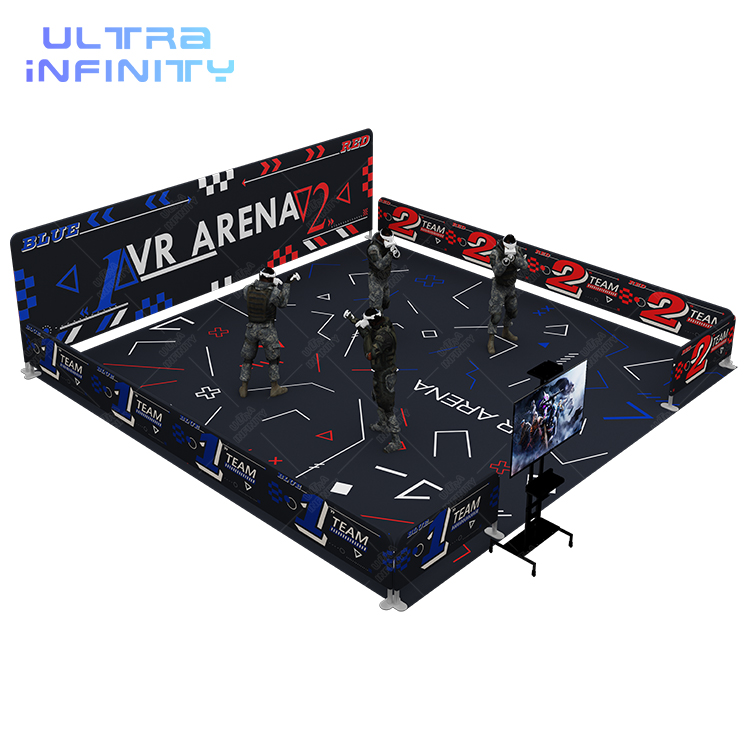
| Our Infinity VR Arena 2.0 (own sheet) | L8 x W8 m (4 players) | 4 per round | 10 x 10 m for 6 players, 10 x 15 m for 8-10 players |
| Sandbox VR (franchisor) | suite approx. 4,000-5,500 sq ft (372-511 sq m) | 2-6 per session | play-area-only footprint not published |
| Virtual Discovery (free-roam vendor) | 40-100 sq m = up to 6 players | 6 | ladder to 600-1,000 sq m = up to 32 players; system ceiling 10,000 sq m |
| Synthesis VR (venue-tech vendor) | 6 x 6 m called the standard minimum | title dependent | 5 x 5 m or 4 x 4 m for compact titles |
Chart it end to end and the ladder is not subtle: 1.33 sq m, 5.4 sq m, then 12.5, 25, 64 and 98. The interesting thing is the gap between 5.4 and 12.5. Nothing in this set publishes a format between a large pod and the smallest arena strip, which is why the question 'can I put an arena in my 60 sq m bay' usually turns into a different question: how many pods, or one standing platform, plus whatever the arena-format vendor can compress into 5 x 5 m. Our own 4-player Arena 2.0 configuration is printed at 8 x 8 m, which is 64 sq m for 4 players per round - a bigger room per head than HOLOGATE's published 25 sq m for 4 players, and a legitimate thing to ask a maker about when you compare systems.
Floor is rent; throughput is the return on that rent. Here the published record is thinner than operators assume, so read the absences alongside the numbers.
What suppliers print on the pod side is a per-ride length, not a capacity. Our VR Terminator sheet prints 'Playing time: 2-5 mins', and so does our 2-person standing platform sheet. None of the six supplier listings in Table 1 prints a playing time at all, so the ride length on the pod side is our machine's number, not a category norm - and what nobody prints, on either side, is sessions per hour. Across every pod listing, operator FAQ and product page we could find, no named supplier publishes a numeric players-per-hour figure for a VR cabinet, and none publishes the clearance or queue zone you have to add around one. So the pod throughput line in your model has to be built by you, from the ride length plus your own turnaround, and it should be labelled as your assumption whenever you show it to a landlord.
The arena side is better documented, and the difference is instructive. The maker HOLOGATE prints its own throughput: '25 square meters / 269 square feet and allows up to 4 people per session. With most of our games being 5 minutes in length, this comes out be approximately 40 players an hour.' The operator Zero Latency prints 'up to 8 players every 30 minutes' and session formats of 15, 30 or 45 minutes. Our own Arena 2.0 sheet prints '4 persons/round, about 3-5 mins/round, 6 round/hour', which is up to 24 player slots in an hour by our arithmetic (4 x 6) - and that is a machine-cycle clock, not a sold-seat clock.
The gap between those two clocks is where arena capacity actually goes. Sandbox's guest FAQ requires check-in 15-30 minutes before the booking, states that a session cannot start until the whole party is present, and enforces a 5 minute grace period; that is a group-coordination overhead per session that a single-rider pod simply does not carry. A vendor framework from Synthesis VR says the same thing as methodology: 'A five-minute delay before launch and another five minutes during reset turns a 30-minute experience into a 40-minute operating block.' Treat that as the vendor's worked example, not as a measured arena. And note the sales-format difference reported by the trade press: a free-roam operator can sell arena time in 30, 45 and 60 minute increments, whereas a cabinet sells a fixed ride length.
Two conclusions fall out of that chart, and they run against the usual assumptions. First, arena density is a policy of the vendor, not a law of the format: 6.3 sq m per player and 16.3 sq m per player are both published arena numbers, one from a system maker and one from an operator, at similar party sizes. Second, bigger does not mean more efficient per head. Virtual Discovery publishes a ladder that starts at 40-100 sq m for up to 6 players and ends at 600-1,000 sq m for up to 32, so its own curve loosens as venues grow (about 6.7 sq m per player at the bottom, 18.8 at the top by our arithmetic). If the argument for an arena were efficiency per square meter, that ladder would argue against it.
For the small-space operator the practical read is this. A pod converts floor into rides at a rate you set yourself, with no published benchmark to check it against - our cluster page on how many VR chairs fit in 50 square meters works that layout question through for chairs, and the mixed-venue space comparison covers VR alongside bowling, golf and darts. An arena converts floor into group sessions at a rate its maker publishes, but it buys that rate with a room, a supervising game master and a whole-party clock. Below the 12.5 sq m of HOLOGATE's smallest published 2-player strip there is no arena format in the record at all, so the choice stops being a comparison and becomes a default.
| Constraint | What a pod page prints | What an arena page prints |
|---|---|---|
| Ceiling | Machine heights 1.70-2.70 m; one vendor guide asks for a 2.5 m / 8 ft room | HOLOGATE: 2.80 m / 9.5 ft vertical clearance; no operator publishes one |
| Circuit | 600 W and 2,500 W on our two sheets at 110-240 V; supplier pods 0.4-3.2 kW, one catalog sells its largest racing cabinet at 380 V | HOLOGATE: 2x 16A fused lines, grounded, plus internet (1x 16A for the 2-player system) |
| Floor load | Small plate, two cases that clear the load opposite (200 kg on 1.33 sq m, 400 kg on 2.70 sq m, about 31 psf each by our arithmetic) and one that does not: EPARK at 260 kg on 0.39 sq m is about 136 psf. Ask for the load path, not just the mass. | No arena publishes an equipment load; IBC design load for assembly space is 100 psf |
| Network | No supplier prints a network requirement for a single cabinet | Cisco Meraki: a location is high density above 30 clients on one AP; PoE+ recommended |
| Tracking hardware | AIO headsets with inside-out tracking: no external sensors or base stations to field | Positioning infrastructure, servers and the arena Wi-Fi are part of the delivered system, on our reading of the delivered-package wording |
| Turnover parts | Playing time 2-5 mins printed; no head-swap logistics printed | Charging racks, spare interfaces and per-session cleaning of headsets, lenses, vests and props, on our reading of the cleaning and fitting pages that operator publishes |
The circuit line is the most underrated door-close in a mall fit-out. A 600 W single-rider pod at 110-240 V is, in practice, a plug into the circuits a landlord already has. A 2,500 W platform on a 5.4 sq m plate starts to be a dedicated circuit conversation. And when a supplier titles its largest motion rigs as 380 V machines (three phase by the standard reading of that voltage), that is the difference between dropping a machine into a bay and paying an electrical contractor to bring three phase to that bay. Ask for the nameplate, not the marketing wattage, and ask which of the printed figures is the idle draw and which is the working draw - two of the pods in Table 1 print a band (0.4-1.1 kW and 1-2.2 kW) precisely because the machine does not draw one number.
One more electrical print worth having in your inbox: Sega Amusements International's VR Agent, a two-player attendant-free cabinet, lists its power requirements on its own spec table as 220 V at 6 A or 110 V at 12 A for 1,350 W. Set that against 600 W on our one-person sheet and you get the honest spread inside the word pod: two to three times the connected load between machines that a mall landlord will treat as the same kind of tenant, which is why the nameplate belongs in the lease negotiation rather than in the brochure.
Money is where these two models are least comparable, so the table below keeps three different bases apart instead of building a single cost-of-VR number. A marketplace list price for a machine is not a system licence, and neither is an aggregator's summary of a franchise disclosure document. Merging them is the most common error in this topic, and it is why a lot of published VR-is-cheap and VR-is-expensive articles are both wrong at once.
| Object | Published figure | Basis | Recurring line the same source prints |
|---|---|---|---|
| 7DCinema two-capsule 9D pod (Made-in-China listing) | US$10,200.00, MOQ 1 set | asking price per set, excludes freight and tax | 1-year parts and labour warranty as printed |
| Guangzhou Yinghua 10-12 passenger flying theater (Made-in-China listing) | US$28,888 for 1-4 pieces, US$15,888 at 5+ pieces | asking price, tiered by quantity | 1 year on key components, lifetime software maintenance |
| Free-roam arena licence (licensor FAQ) | starts at 165,000 USD for a 6-player system | vendor starting-at price per system, fit-out separate | 16% of ticket sales, or pay-per-play, or a fixed monthly fee |
| Arena fit-out (same licensor page) | from around 50,000 USD, not paid to the licensor | vendor's from-around figure, per venue | launch in 6 to 9 months |
| Sandbox VR arena franchise (Franzy, FranchisePayback, FranchiseFactbook readings) | US$50,000 franchise fee, 5% royalty plus about 7% brand fund | aggregator readings of a disclosure document | total investment reported between about US$1.4M and US$2.9M depending on source |
| Synthesis VR venue content platform (vendor price list) | 30 USD per station per month, billed annually | published list price per station | tiers from 0 USD entry to 40 USD per station monthly |
Two structural points survive all that basis-keeping. First, the arena licence converts part of your cost into a variable: Zero Latency's published ongoing options are '16% revenue share of ticket sales', pay-per-play, or a fixed monthly fee, with the percentage the only one priced on the page and expressed elsewhere on it as roughly 4 USD per person per play. Every extra player therefore carries a fee, which is exactly how a percentage licence behaves and exactly why a busy arena can absorb it and a quiet one resents it. A per-station content fee of 30 USD a month, by contrast, is a cost that scales with how many headsets you own, not with how many tickets you sell. Those two recur differently, and a small venue's utilisation pattern decides which one hurts less.
Second, the cheapest-looking capital line usually has the thinnest service story. The pod listings print 1-year hardware warranty terms, and one of them is explicit that the lifetime commitment is on software, since software problems are resolved by remote control by the supplier's technician. Our own sheets print the same shape of term - the 9D VR slide page carries '1 year warranty and lifetime maintanance' (typo on the page). At headset level, HTC's Business Warranty and Services raises coverage to 24 months on eligible devices where the service was purchased, with repair logistics described as two-way UPS and, in the vendor's own wording, usually next-business-day movement and a three-month post-repair warranty floor. The honest summary: an arena licence bundles a support line for the life of the agreement (Zero Latency prints 24/7 ticket-based support), whereas an imported cabinet bundles a warranty period and a remote software fix, and hardware turnaround becomes your problem.
There is one procurement risk that applies to both formats and gets missed because it sits in a headset channel rather than an equipment quote. Trade reporting on Meta's notice says the Quest for Business program is being wound down, with commercial SKU sales ceasing from 20 February 2026 and existing subscriptions reduced toward zero, ending 2030, which removes Meta's commercial licensing, commercial warranty, priority support and Shared Mode / MDM route for venues buying that way. Two practical consequences for a small operator: the enterprise headset channel is part of the quote, so a VIVE Business Edition or equivalent term should be priced at the same time as the machine - our page on choosing a commercial VR headset covers what to compare - and any quote you accept should be checked line by line against our VR arcade equipment quote checklist, because freight, duties and on-site works are where a low unit price disappears.
Rent is the last line, and it is the one that quietly settles the small-space question. Cushman and Wakefield report US national shopping centre asking rents of $25.65 per sq ft per year for Q2 2026, up 2.2% year over year, on 6.0% vacancy; JLL's Q1 2026 report prints a national 'market rent (per s.f.)' of $25.88 and credits CoStar. Two brokers, two labels, about 1% apart - so name the publisher and the label rather than blending them, and remember asking is not effective once tenant improvement allowances enter the deal. Now the arithmetic nobody publishes for you: at the Cushman and Wakefield asking level, the Sega VR Agent's assembled footprint of 2.60 x 3.28 m, about 91 sq ft, is roughly $2,330 a year of rent for its own plate, while Zero Latency's 1,055 sq ft 6-player arena is about $4,510 per served player per year at the same rent. Both are our arithmetic on two printed numbers each, they are rent for floor rather than total occupancy cost, and they say why a 98 sq m room is a very different bet in a secondary Midwest market than in a New York metro centre. Our market-by-market breakdown is in the US cost guide and the equipment lines around it are in how to budget commercial VR equipment.
And the negative anchor, because it changes how you should read every vendor claim in this genre: Dave and Buster's FY2025 Form 10-K folds VR into the arcade (its stores carry roughly 125 and 112 games at Dave and Buster's and Main Event respectively, with VR named among the non-redemption games that 'can be played by multiple customers simultaneously'), reports average store size of 37,000 sq ft ranging from 16,000 to 70,000 sq ft, and discloses no VR throughput, footprint or per-attraction revenue at all. The largest public US operator of this kind of venue does not break VR out. Any per-bay revenue number you are shown is a marketing figure, not a filing.
Small spaces are usually unattended spaces, and that is where the pod's advantage gets complicated. Consider the cleaning instructions: the one operating procedure both formats must run and neither can buy back with square meters.
Meta's official device-care page is unambiguous about materials: 'Use a dry microfiber cloth after each use.', 'Do not use chemical cleansers.' and, printed twice, 'Do not use alcohol.' The facial interface, straps, headpads and silicone covers can be removed and hand washed 'with cool water and a mild liquid detergent', but the page then requires you to 'Allow to air dry fully before reinstalling.' HTC's guidance as relayed by resellers lands in the same place on optics: a dry microfiber cloth on lenses, a water-damp cloth on a foam cushion, full drying at room temperature. Now put that next to an arena maker's published between-users SOP: HOLOGATE instructs staff to 'Use a sanitizing wet wipe over any area that touches hands, face, or body' and then to 'Allow the component to sit and air dry for at least 30 seconds, or until fully dry', drying lenses with a soft single-use tissue. Both are manufacturer documents. They are not reconciled by anything either page says, because neither names a wipe chemistry - so a venue writes its own SOP and has to keep both constraints inside it.
The face-contact component is the one with a regulator record. In recall 21-768 the US Consumer Product Safety Commission states that the affected removable foam facial interfaces 'can cause facial skin irritation and reactions including rashes, swelling, burning, itching, hives, and bumps', that the firm received 'approximately 5,716 reports of incidents of skin irritation and approximately 45 reports of consumers that required medical attention', and that the remedy was a free silicone cover on about 4 million units. That is a regulator finding about a consumable a shared-headset venue puts on dozens of faces a day, and it cuts both ways in this comparison: by our reading of the format an unattended pod turns over more faces per interface per shift than a staffed arena does, and has nobody standing there to inspect it.
The drying step is the cost. A peer-reviewed study of UV-C cabinets (JMIR Formative Research 2025, a Yale-group team) recorded published cycle times of '1 minute for the Cleanbox ... 3 minutes for the LiViliti ... and 10-20 minutes for the Philips', found a minimum of 10^3 killing for the two bacteria it tested, and reported that 'In no experiment was there a mean of zero CFUs recovered when UV-C devices were run according to their MIFU times'. It also classified VR headsets as noncritical devices that should be cleaned and disinfected with low- or intermediate-level disinfectants, and found a device retained full functionality after approximately 1,860 minutes of UV-C exposure and 176 applications of chemical wipes. Read that as the honest version of a cabinet claim: a chemical-free cycle you can sell to a guest is real, and it is a between-users aid rather than sterilisation. Cabinet hardware is published too: the Uvisan pages print 'Disinfect your equipment and devices in 2 minutes' with 9, 12 or 18 headset capacities and a footprint of 750-900 mm wide against 400-600 mm deep, i.e. about 0.3 to 0.54 sq m of your small space spent on hygiene by our arithmetic, plus a barrier-cover line worth quoting - HOLOGATE says its disposable mask covers 'does not replace the Standard or Advanced cleaning methods'. Those covers are also cheap enough to be a consumable line rather than a policy debate: a listed 100-pack of single-use hygiene masks is priced at $14.99, which is about $0.15 per use by our arithmetic.
Staffing turns out not to be the differentiator, which surprises most operators. The arena makers claim one attendant: Zero Latency answers 'One staff member can run a session' with two staff at peak, and HOLOGATE says 'a single attendant' can fully operate its system and still attend to other attractions. So an arena is not heavier to staff per session than a pod is - a pod just lets you put that attendant somewhere else entirely, and Sega sells its VR Agent cabinet as 'attendant free, coin-operated', with an arcade maker describing a whole category of 'unattended, coin- and card-operated VR'. Trade reporting goes further on the arena side, quoting an FEC vendor's claim that one well-trained attendant can manage two or more arenas. What none of those publishers supplies is the enforcement mechanism: no SOP, no audit and no age-screen protocol appears behind either attendant-free claim, which is exactly the gap the next paragraph falls into.
What does bite on the pod side is supervision of minors, because it is not a floor requirement, it is a policy requirement written by the headset maker. Meta states that 'Parents cannot create an account for a child under 10 and children under 10 cannot use Meta Quest 2 and 3', with parent-managed accounts covering children between 10 and 12, and HTC's Focus 3 safety guide states 'The product was not designed to be used by children' and that adults should monitor older children closely. Sandbox's FAQ adds the venue rule: for guests under 18 a parent or guardian must be physically present in the store during the session to sign a minor waiver, and American Academy of Pediatrics guidance from the same sourcing round notes that brief VR exposure has not been shown to cause harm in children 'especially when VR is used with parental supervision', adding that 'adult guidance on when and why breaks are needed is important'. In a child-heavy FEC, an unattended self-serve cabinet with an age gate nobody verifies and a waiver nobody checks is the format's weakest point, and that is an operations answer, not a hardware one. Our comparison of the seated formats - VR simulator chair versus stationary VR and which compact simulator fits your venue - is where that decision is worked out machine by machine, and the arena equipment list covers what a room build carries.
Then the small technical fact that makes the whole pod category workable rather than a compromise: Meta publishes Roomscale as needing 'a safe and unobstructed space measuring at least 6.5 feet by 6.5 feet (2 meters by 2 meters)' and adds that 'If you have a smaller space than that, you can use your headset in Stationary Mode, which lets you play while sitting or standing in one place.' The manufacturer itself sanctions the seated station. Combined with all-in-one headsets carrying inside-out tracking - no external sensors to install or recalibrate, in the words of one maker's component page - that is what allows a 1.33 sq m plate to be a functioning VR attraction at all, and what removes the rig, backpack PC and base-station furniture a room-scale format has to field. Note the direction of the caveat, though: Meta prints a minimum for Roomscale and no maximum anywhere on that page, so do not let anyone quote you a headset limit as an arena specification.
Take the numbers above in the order a landlord and an electrician will ask for them. Each question below has a published figure behind it, and the last one is the only one about capital.
Put those answers together and the pattern is stable. A pod wins a small space on floor, ceiling, voltage, walk-up traffic and capital structure, and loses on experience scale, group revenue and the fact that the throughput benchmark you need has to be built by you. An arena wins when you have a genuinely clear 25 sq m or more, a 2.8 m ceiling, 16 A circuits you can dedicate, a staffed desk to run the cleaning, age-screen and supervision cycle, and a group-booking culture - birthdays and corporate bookings, not a mall corridor. If you are mixing VR into an existing multi-attraction floor, note that the arena vendors themselves now sell into that scenario: Zero Latency's Compact system is offered 'exclusively for FEC and multi-attraction operators' at roughly 100 sq m, and HOLOGATE lists family entertainment centers, bowling alleys and shopping malls directly in its install targets. That is the honest version of the small-space promise: not an arena in a cupboard, but an arena maker compressing its entry SKU toward the size of bay you own.
Send us your bay - dimensions, slab height, the supply you have, and whether your traffic is walk-up or booked - and we will tell you honestly whether it is a pod layout, a standing platform, or a room you should not be trying to fill with an arena. Our VR park solution page and the free 3D layout design service both work from the same sheet of constraints, and the format family behind these choices is mapped in the free roaming VR arena multiplayer guide.
On the published numbers, yes, and the margin is large. Our own one-person pod sheet prints a plate of 1.33 x 1.00 m at 600 W and 110-240 V, supplier listings for seated cabinets run from 0.39 sq m - EPARK's egg cinema, whose page prints a passenger cap under 5, not a seat count - to 2.7 sq m of plate, and Meta states that anything under a 2 x 2 m space can run in Stationary Mode while seated or standing in one place. Three things still have to be checked before you buy: machine height (1.70 m to 2.70 m across the sheets we read, against one vendor guide asking for a 2.5 m room ceiling), the supply at the bay, and the fact that no supplier publishes the queue and service clearance a pod needs around it - that part of your layout is your own assumption.
The published floors are rooms, not bays. Zero Latency prints 98 sq m (1,055 sq ft) for a 6-player arena and 128 sq m for 8 players, plus ancillary zones including a server room of about 2.5 to 3.5 sq m, and its FEC-facing Compact system is still roughly 100 sq m of clear game space. HOLOGATE, which sells smaller, prints 25 sq m / 269 sq ft for its 4-player ARENA and a 5 x 2.5 m strip for its 2-player system, both with 2.80 m of vertical clearance. Sandbox VR publishes a suite of about 4,000 to 5,500 sq ft and does not publish its play area separately. Our own Arena 2.0 sheet prints 8 x 8 m for four players.
That is not a question this article can answer honestly, and you should be suspicious of anyone who does. No filing breaks it out: Dave and Buster's FY2025 Form 10-K folds virtual reality into the arcade and discloses no VR throughput, footprint or per-attraction revenue, and the vendor figures that do circulate - a licensor's projected annual ticket revenue per arena, a maker's average players per month - are marketing numbers for unnamed clients. What can be compared is the cost shape: an arena licence priced at 'starts at 165,000 USD' plus about 50,000 USD of fit-out with 16% of ticket sales ongoing, versus a cabinet at a published list price with a 1-year hardware warranty. For our own modelled revenue per square meter, read the dedicated revenue page rather than a comparison article.
Per session, roughly the same. Zero Latency states that one staff member can run a session, with two at peak; HOLOGATE states that a single attendant can fully operate its system and attend to other attractions, and trade reporting quotes an FEC vendor saying one well-trained attendant can run two or more arenas. The pod category is marketed the other way - Sega's VR Agent cabinet is sold as 'attendant free, coin-operated' and an arcade maker describes 'unattended, coin- and card-operated VR' as its own category. The real difference is what the staff member is there for: between-users cleaning to a manufacturer's protocol, headset fitting, and the age screen the makers write - Meta prohibits use by children under 10 and puts 10 to 12 behind a parent-managed account - plus, for minors, the supervision and waiver handling an operator like Sandbox requires by having a guardian physically present in the store.
Three numbers. Ceiling: pods print 1.70-2.70 m of machine height and one vendor guide asks for a minimum 2.5 m / 8 ft room, while HOLOGATE's arena requirement is 2.80 m / 9.5 ft of vertical clearance; model IBC separately requires 7 ft 6 in of headroom on the means of egress and a barrier wherever clearance above a circulation path is under 80 in. Supply: 600 W and 2,500 W at 110-240 V on our two sheets and 0.4-3.2 kW across named supplier pods, with the Zhuoyuan catalog titling its largest motion rigs at 380 V three phase, against HOLOGATE's 2x 16A fused, grounded lines for a 4-player arena. And the headset channel: commercial licensing and warranty terms belong on the quote, not just the machine price.
Send us the room: dimensions, slab height, the supply at the bay and whether your traffic is walk-up or booked. We will tell you whether it is a single-rider pod like our VR Terminator Shooting Simulator, a 2-person standing platform like our HTC VIVE VR Standing Platform, or the arena end of our own range - our Free Roaming VR Arena 2.0, whose smallest printed configuration is 8 x 8 m - through the VR park solution page or the free 3D layout design service.