Somebody in this argument is always selling you something, and in this article it is us. NextPlay builds and ships indoor golf bays for venues, so every word below about the merits of a driving range should be read as coming from the party with the most to lose by saying it. That is the disclosure, and it comes first because the research record gives us no better way to settle the question. There is no study that puts a golf simulator and a driving range head to head and measures who gets better.
We ran the search for this article on 2026-09-23. In Europe PMC, a title search for golf simulator returns zero records. Not one trial that takes two groups of golfers, sends one to a bay with a launch monitor and one to a range with a bucket, and then compares what each of them carries to a golf course. The pages that tell you otherwise are quoting something adjacent, and the adjacency is the whole problem: a putting lab in a university, a virtual reality transfer study with headsets, an instrument reliability paper on a specific device in one indoor room, or a vendor explaining why its vendor is good.
What does exist is worth more than a winner, once you read it carefully. There are peer-reviewed reliability studies of launch monitors used indoors, which tell you exactly which of your numbers are stable and which are noise. There is a body of golf motor-learning research on feedback, practice schedules and attention focus, most of it on novice putting rather than on your driver. There is one 2025 trial that compared practice in virtual reality with practice in the real world and found the transfer ran in one direction. And there are venues that publish their own rate cards, which is the only honest way to answer the money half of the question.
So this is how the article is built and how to read it. Instrument claims come from manufacturer pages and are quoted as what the manufacturer lists, not as what it achieves. Learning claims come with the study design attached, because a finding from 60 putts by university students is not a finding about your Tuesday evening. Money claims name the venue, the currency and the unit. And where a sentence would help us sell a bay and we could not source it, the sentence is not here. There is no measurement tolerance anywhere in this article, for any machine, ours included, because not one manufacturer page in the set we captured publishes one. One convention to read the quotes by: text inside quotation marks reproduces the wording of the record it came from, its dollar signs and percent signs included, nested quotations inside them are set as single quotes, and where a record uses a character this ASCII-only page cannot print, a greater-than-or-equal-to sign, a less-than-or-equal-to sign, an approximation sign, a degree symbol, a pound sign or an en dash, that character stays out of the quotation and we say what it stood for in words beside it rather than altering the quote from the inside.
Start with the cheapest version of the question: after you hit one golf ball, what do you actually know about it? On a traditional range the answer is ball flight plus whatever you can read against a yardage marker, and that is it. You watched it. You will remember roughly where it went and you will absolutely not remember the face position, the path, the angle of attack or the spin rate. The range gives you an outcome and no mechanism, which is exactly why it can feel productive for months and change nothing.
The tech-enabled range sits in between and is often described as if it were the bay. It is not. A Toptracer-style range is, in the words of one Florida venue that publishes its own specification, "a camera-based tracking system installed on the driving range", where "sensors track the flight of each golf ball and display a shot trace and real-time stats on an in-bay monitor or your mobile device". The same page lists what you get, "carry, total distance, ball speed, height", and what you are meant to do with it, "Dial in yardages for each club" and "Track dispersion patterns and tendencies". That is genuinely useful and it is still ball data only. The system watches the ball, so it cannot tell you anything about the club.
A launch monitor in an indoor bay prints more, and the honest way to describe the category is to name what each well-known device lists on its own page. Foresight GCQuad lists six ball parameters, launch angle, side angle, ball speed, total spin, carry and side spin or spin axis, plus eight club parameters including club path, angle of attack, loft and lie, face angle, impact location and closure rate, and states that this needs "no extra hardware necessary". Trackman 4 lists thirteen ball parameters and seventeen full-swing club parameters, including dynamic lie, low point and swing plane. SkyTrak lists nine ball parameters and five club parameters, and the club list has no attack angle and no dynamic loft. Uneekor EYE XO2 claims 24 club and ball data points from three infrared cameras, and answers its own FAQ about clubface stickers with "Yes. The EYE XO2 requires reflective clubface stickers to capture full club data.", while the specification table on the same page softens that to "Stickers Recommended for accurate Club Data". Trackman iO is the clearest illustration of how much of this is a license rather than a sensor: its Home tier lists club speed alone, and the club speed, face angle, path, attack angle and impact block appears under the Home Complete and Commercial wording.
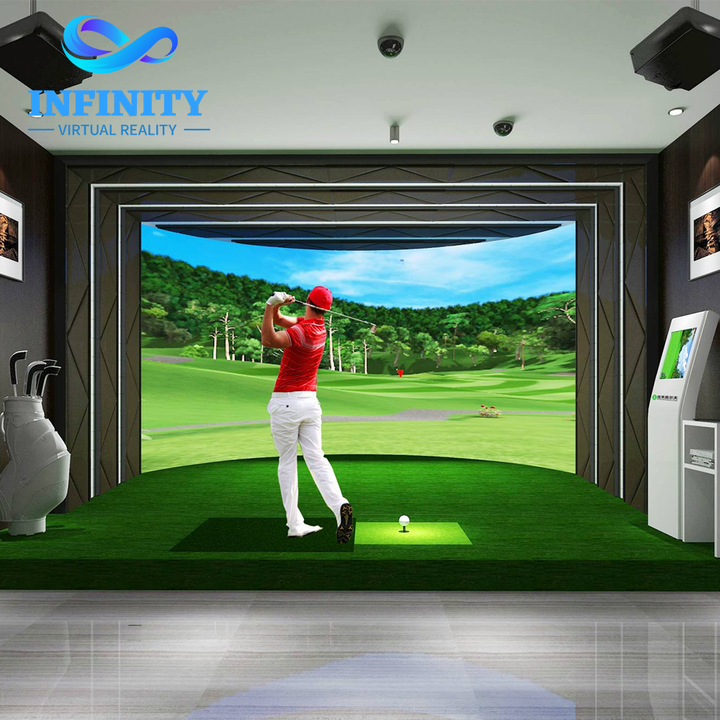
Our own machine is deliberately smaller than all of that, and since it is the one we sell it is worth stating precisely. The product page for our commercial AR golf simulator describes dual high-speed camera detectors running at 3,000 or more frames per second capturing three quantities, "ball spin, launch velocity, and face angles". That is the whole published measurement list on our sheet. The same page prints no price, no power figure and no accuracy figure, and it prints "Product size: Welcome customized", meaning the enclosure follows your room. If a competitor page promises you more numbers, that is a real difference, and more numbers is not automatically better practice, which is the subject of the next two sections.
One more piece of vocabulary, because these words get used loosely in golf content and the definitions decide what a number is worth. From Trackman's own guide to its data: face angle "is the most important number when determining the starting direction of the golf ball"; club path is "the direction the club head is moving (right or left) at impact" measured against the target line; attack angle is "the up or down movement of the club head at the time of maximum compression", and shots off the ground "should have a negative Attack Angle"; dynamic loft is "the amount of loft on the club face at impact" measured relative to the horizon. Read together, that is the mechanism side of the scorecard. The result side is carry and dispersion, which is what a range gives you, and the two do not measure the same thing.
| What you know after one shot | Traditional range | Tracked range bay | Indoor simulator bay | A good instructor |
|---|---|---|---|---|
| Where the ball finished | Yes, by eye and marker | Yes, measured per shot | Yes, measured per shot | No, that is not the point |
| Why it finished there | No | No, the system tracks the ball | Partly, if the device lists club data | Yes, and it prioritizes which cause matters |
| What the club did | No | No | Depends entirely on the device and license tier | Yes, on video, and it is the lesson |
| Your number from last month | No | Some venues save sessions in an app | Yes, this is the bay's real advantage | Only if the pro keeps notes |
| A different lie, slope or wind | Yes | Yes | No, and our own sheet prints no surface specification | Yes, a playing lesson is the point |
Here the research is unusually clear, and it is not clear in the direction the industry talks. When launch monitors are tested indoors with real golfers, a small group of metrics is rock solid and a specific set of the interesting ones is not. The most useful study for anybody practicing inside is a reliability paper on Trackman 4 with high-level golfers, two sessions in an indoor setting, published in the Journal of Sports Sciences in 2023. Its numbers, quoted as the abstract prints them: club head speed "ICC = 0.99; SEM = 1.64-1.67 mph", ball speed "ICC = 0.97-0.99", carry distance "ICC = 0.91-0.97", and then the line that should be taped above every bay in the world, "In contrast, spin rate showed the worst reliability", which that abstract reports as ICC = 0.02-0.60 with an SEM of 240.93-454.62 in degrees per second. The authors' own conclusion names three metrics as "the most consistently reliable" and recommends them "for practitioners working with golfers".
The same three came out on top in a second study with a different device and a different design. Brennan et al. in the Journal of Strength and Conditioning Research in 2024 put a FlightScope Mevo+ against a TrackMan 4 indoors with 29 junior golfers, ten shots with a 6 iron and a driver, and found "the strongest relationships evident for clubhead speed (CHS) and ball speed", with coefficients the paper gives as 0.92 and above. Agreement was near perfect for smash factor and "the poorest levels of agreement was for spin rate", with a Bland-Altman mean bias the authors report at "1,238" or better. Their sentence to the coach is the one worth keeping: variables such as "spin rate, launch angle, attack angle, and spin axis exhibit substantially greater variation compared with the TrackMan 4, suggesting that practitioners may wish to be cautious when providing golfers with feedback relating to these metrics".
The third paper is the one that should change how you use the screen. Bliss and Langdown compared the Mevo+ and the Trackman 4 indoors across driver, 7 iron and pitching wedge, and reported that every parameter showed moderate to excellent consistency except one: "except angle of attack which was poor for both 7-iron and pitching wedge (ICC = 0.06 & 0.03, respectively)". Angle of attack and dynamic loft also sat at the bottom for absolute agreement between the two devices. They recorded 60 pitching wedge swings where the Trackman 4 captured no club data at all, and five of eighty 7-iron shots where the Doppler radar appeared to double the spin, reporting "between 11,000 and 13,500 rpm, around 6000 rpm higher than was reported on the Trackman 4" because of a seam error. And they are explicit that the reference device is not a reference: Trackman 4 "is not technically a 'gold-standard'", with motion capture and high-speed video holding that role.
Translate that into practice and the advice is simple, and it is not the advice the screen is designed to give you. Track club speed, ball speed and carry, because those are the readings a study found repeatable within and between sessions, and a baseline you cannot trust twice is not a baseline at all. Use smash factor and dispersion as your working log. Then treat spin rate, attack angle and face-to-path as directional information about a pattern over many shots, not as the reason you changed something after shot four. If your entire practice session is built around a number whose reliability one peer-reviewed paper put at 0.02 to 0.60, you are not training, you are reacting.
Two honest caveats on the research itself. The 2023 reliability paper is high-level golfers on one device indoors, so it says something about that instrument rather than about every bay, and the Bliss and Langdown comparison is two devices against each other, not against a laboratory standard. The Bliss and Langdown methods section also describes the physical conditions of indoor capture in a way most marketing skips: its Trackman 4 sat 2.5 meters from the ball with 6 meters to the screen and its Mevo+ 2.4 meters from the ball with 5.9 meters to the screen. That paper is also where the indoor ball comes from, and it is not a neutral accessory: in collaboration with Titleist, Trackman has developed the "RCT golf ball designed to enhance the data capture of launch conditions in an indoor environment", and its normalization exists precisely so that "data from different sessions or different environments (such as indoor versus outdoor settings) can be accurately compared". A bay is a measured environment with its own rules. Knowing that is the difference between using the data and being used by it.
This is where a bay seller has to say the uncomfortable thing. The device is built to give you feedback on every single shot, and the motor-learning literature has spent several decades on the question of how often feedback should arrive. The starting distinction is between knowledge of results, which is the outcome, where the ball finished, and knowledge of performance, which is a parameter of the movement itself, defined in the 2024 systematic review of golf motor learning quoted at the end of this section as feedback "about the quality of the movement execution itself (e.g., the extent of hip extension or the extent of shoulder rotation)". A screen showing carry and dispersion is a KR machine. The club data comes closer to KP. They are not the same kind of information and they do not produce the same kind of learner.
The classic warning is called the guidance hypothesis, and it was tested on a golf putting task. "The guidance hypothesis suggests too much knowledge of results during skill acquisition can be detrimental to long-term performance", and in Butki and Hoffman's 2003 experiment the group receiving continuous feedback on all 96 putts "performed better during acquisition, but the KR-deprived groups performed better on delayed retention trials, especially when KR was absent". Ishikura reported the same shape in 2008 with 34 golfers hitting 60 putts at reduced frequency: "in the retention test conducted the following day, the constant error of the 33% KR group was less than that of the 100% KR group". Practice with less feedback looked worse and was remembered better.
We are not going to pretend that literature is settled, because it is not, and a page that cites only the convenient half is what we are objecting to elsewhere. McKay and Ste-Marie tested exactly this in golf putting in 2020, with 56 participants crossing real choice over feedback against a yoked control and continuous against faded knowledge of results, and reported that "the effects were not statistically significant and trivially small" and that the results "were inconsistent with the guidance hypothesis". So the defensible position is not that reduced feedback is proven to make you better. It is that constant feedback has a documented cost in retention studies and no documented benefit beyond the session itself, which is a strange thing to want from a practice product. Three more golf-specific results sit in the same corner of the literature, each with a catch. Sixty novices and moderately expert putters practicing under blocked, serial-blocked and serial feedback schedules learned at the same rate, because "learning was not affected by the feedback schedule". Schmidt and colleagues, with 42 students in four groups over eight putting sessions spread across four weeks, found "a stable retention performance for the variable training groups in contrast to the control group" and at the same time reported that "differences in the amount of task variation between groups with variable training schedules did not affect skill acquisition", which is a null between amounts of variation, not a null between variation and none. And a 1997 lesson in a natural setting, teaching four foundational golf skills under low versus high contextual interference to 36 novice undergraduates, reported "no significant differences between groups".
The bay has one honest advantage on this point, and it is not the screen, it is the switch. You cannot delete ball flight on a range. You can stop looking at the monitor. A practice structure as simple as "play five shots, check the numbers on the sixth" is easy to hold to in a room with a screen and hard to hold to outdoors, where every ball answers you whether you asked or not, and that option, the ability to control the dose, is the honest case for the machine. It is also the reason a bay with no self-discipline is worse than a range, because the screen will sit there answering every shot if you let it.
Then there is the result that nobody selling an instant-feedback product wants to lead with. Guadagnoli, Holcomb and Davis ran 30 golfers through four 90-minute practice sessions with a 7 iron, split into video-assisted instruction, verbal-only instruction and self-guided practice, and measured performance immediately after and again two weeks later. On the first post-test, "the two instruction groups performed worse than the self-guided group". On the second, "the two instruction groups performed better than the self-guided group, with the video group performing best". Their own reading: "video analysis is an effective means of practice, but that the positive effects may take some time to develop". Instruction that measures itself by whether today felt productive is measuring the wrong thing, and a data-rich session is exactly that trap in a nicer chair.
What the research does support without much argument is where to point your attention. A 2021 Psychological Bulletin meta-analysis across 73 studies on performance and 40 on learning found an external focus of attention, on the effect of the movement or the target, better than an internal focus on body parts: "The EF condition was more effective than the IF condition for performance, Hedges' g value = 0.264 (95% CI [0.217, 0.310]), retention learning, Hedges' g value = 0.583 (95% CI [0.425, 0.741]), and transfer learning, Hedges' g value = 0.584 (95% CI [0.325, 0.842])." The same paper adds that "neither age group, health status, or skill level, nor their two-way interactions, moderated the ES differences". That matters here because numbers pull attention inward. A range telling you the ball went left is, whatever else it is, an unambiguously external instruction. A bay showing you your wrist hinge at impact invites you to think about your wrists, which is the one habit the strongest evidence in this literature says to train out of.
Boundaries, because a systematic review of 52 randomized golf motor-learning studies published in 2024 drew them for us. Its overall verdict on augmented feedback specifically: "For 'cognitive training' and 'augmented feedback', no single method can be considered the most favorable." Its verdict on the field: "The overall biggest limitations were the lack of statistical power for more than half of the RCTs, and the fact that most studies of the present review investigated simple putting tasks in novices only", concluding that "it is currently not possible to derive specific training and learning recommendations for golfers and golf coaches". That is narrower than it sounds: the same review does name an external focus of attention, increasing contextual interference and errorless learning as the methods that came out ahead, so the field has directions, it just does not have a prescription.
Practice is worth nothing if it does not move the game, and moving the game is called transfer. This is the part of the evidence that is inconvenient for the product we sell, so it goes in its own section rather than in a footnote. The closest thing to a head-to-head that exists in golf is a 2025 study in Human Movement Science by Bennett, Neumann and Stainer, and it is not about launch monitors, it is about virtual reality putting. Forty-six novice golfers were split across quiet eye training or no training, and across practicing in VR or in the real world, then tested at baseline, after training and again a week later. The training helped either way. The environment did not.
The direction of that asymmetry is the finding. "When putting in VR, participants who practiced their putting in the real-world (independent of training), improved in their radial error baseline-to-post and baseline-to-retention, while there was no improvement for participants who practiced in VR." The authors' conclusion is the sentence to keep if you keep one from this article: "real-world skills may transfer to VR environments, but that skills practiced in VR may need additional training to facilitate real-world performance improvement". The same group's second 2025 paper, across 44 novices, 14 national- or international-level athletes and 5 experts putting 30 times in each environment, found "More putts were holed in the real-world than VR across expertise groups", and suggested that "Visuomotor co-ordination in VR may be disrupted". Pataky and Lamb, in the Journal of Sports Sciences in 2018, trained 32 novice putters against deliberately random physics inside a virtual environment over five training days and reported that subjects "quickly adapt to physical randomness in virtual training", while adding that "this learning may weakly transfer to real golf putting kinematics".
Those are headset studies on a putting mat, and a bay where you strike a real ball into a screen is a different animal, so we will not smuggle the result across. The honest statement is that the transfer evidence available for indoor and virtual golf practice is thin and points the wrong way, and that nobody has run the study that would settle it for a launch monitor bay. That is a hole in the literature, not a conviction, and it deserves to be reported as one.
The range has an equivalent problem and its own critics, and the criticism is of practice design rather than of technology. A Mallorca golf school states it plainly about why range sessions do not survive the first tee: "on the range we train in a repeated and artificial setting", and then the other half of the same sentence, "on the course every single shot is different", followed by the line that a straight ball is its own diagnosis, "If your ball flies straight on the driving range, it's because you're not aiming at anything." A coaching platform lists the same failure as behavior rather than philosophy: same club for the entire session, same target for multiple shots, no pre-shot routine, "Rapid-fire ball hitting without thought", "Perfect lies on every shot", "No pressure or consequences", "Unlimited balls to 'find your swing'". Note what that list is not. It is not a list of things only a bay fixes, because a bay with the same structure, one club, one target, no consequences, is the same bad practice with a nicer readout.
The strongest critique of range economics we found comes from somebody who sells practice equipment and says so on the page, which is more disclosure than most of this industry manages. His list starts with "a 40-minute round trip" and a ten pound basket, priced in his own currency on his own page, that "punishes 'wasting' balls on experiments, bays that encourage one club at one target, and a social incentive to look good rather than learn", and his conclusion is the sentence worth stealing: "The economics of the range push you towards exactly the practice structure the evidence rates worst." Same currency discipline as everywhere else in this article, that basket is a British pound figure from a UK seller, not a US price.
What a bay does not do is easier to state from what our own sheet publishes than from any competitor, because our own page is the one we can quote. Our simulator listing prints no surface specification and no short-game mode, and the measured quantities it does print come off a fixed hitting area into a screen, and our sheet prints no surface specification for that area. What it does not list is an uneven lie, wind, a downhill stance, a ball above your feet, the slope you read before a chip or the pressure of a shot that counts. The simulator comparison this site publishes for venues covers the room and revenue side of that; what matters to a golfer is narrower, which is that the bay measures a repeatable shot and golf is played as an unrepeated one.
One more ceiling worth knowing, because it prevents the whole conversation from becoming a faith statement about practice. A 2014 meta-analysis in Psychological Science found that "deliberate practice explained 26% of the variance in performance for games, 21% for music, 18% for sports, 4% for education, and less than 1% for professions", and the authors' conclusion is the sentence to hold against anyone selling a program: "deliberate practice is important, but not as important as has been argued". Structured practice in a good room is not a handicap machine, and the sports figure in that quote is the honest ceiling on what a practice history buys. What the bay reliably buys is measurement and repetition, and that 18% is variance explained across a whole literature, not a scorecard for your handicap.
Where a bay helps on learning grounds is narrower than the schedule argument it usually gets sold with, and it is not data, it is the ease of manufacturing consequence. The evidence for it is one putting experiment rather than a full-swing literature, and it runs like this. Cabral and colleagues, with 84 participants completing 300 putts across two days, gave one group a mild-anxiety training protocol and gave the other the same putts without it, then tested both under pressure, and found that "the AT group maintained their performance across posttests, whereas the control group performed worse under pressure". Practice under a consequence and the consequence stops costing you. A bay makes that easier to engineer than an open lot does: set the number you have to beat, make the next putt count for a nine, repeat it. Outdoors the same drill costs more planning and more walking, and that is a difference in expense rather than a difference in possibility. Two boundaries travel with that sentence, and they are the same boundaries as everywhere else here. It is putting, it is novices in a laboratory, and carrying it across to your driver swing is an assumption we are making, not a result anyone has published.
The money question looks easy and is mostly unit error. A bucket of range balls is a count. A simulator bay is a clock. Once you divide a bucket price by fifty balls and compare it with an indoor bay that prints an hourly rate and no ball count at all, you have built a number that measures nothing, because the two pages are not selling the same unit. So this section compares hours with hours and sessions with sessions, and every price below is a price a named venue prints on its own page, in the currency it prints it in, as of 2026-09-23. One currency note the pages themselves do not cover: no US venue below prints the word dollars, only a dollar sign, so those figures are read as US dollars from the site address, and the Scottish page is the one place a pound sign is printed.
| What you are buying | What venues publish | Named source | Currency and unit |
|---|---|---|---|
| Range balls | Small 5 dollars for roughly 25 balls, medium 10 for about 50 and large 15 for about 75; or small 8, medium 14 and large 18 dollars, each printed plus tax, for 35 to 40, 60 to 70 and 100 to 110 balls; or a public 10 dollars for 50 balls and 15 for 100, with member rates of 8 and 13 | Bobby Jones Golf Club, Florida; Highland Park, Alabama; Van Buren Golf Center, California | US dollars, per bucket, taxes where the page prints them |
| Tracked range bay | Bay rental "start at $30 and can range up to $60 per hour", with the page adding "Bay pricing is per bay, per hour, not per person. Up to 4 guests can share a bay", plus 6.5 percent sales tax and demand pricing | Orange Lake Golf, Toptracer range at The Legends, Florida | US dollars, per bay hour |
| Indoor simulator bay | A flat "rate of $50 per hour" across eight TrackMan bays, with 5, 10 and 20 hour passes at 225, 400 and 700, or "summer rates are live: $80 an hour peak and $50 an hour off-peak" charged to the whole bay rather than per head | Swing Fit Golf Club, Ohio; Clubhouse Golf, New York City | US dollars, per bay hour; the New York venue labels its figures as live summer rates and charges the bay, not the head |
| Instructor time | 60 minutes at 45 and 60 pounds and 30 minutes at 35 and 40 across three professionals, or "$60 / 30 Minutes" and "$120 / 60 Minutes" at a Vermont club with video analysis included in the hour, or supervised practice at 38, a program the listing says is "designed for an hour" but "If there is only one player, it is 30 minutes", with "Range balls not included" | Hayston Golf Club, Scotland; Sugarbush, Vermont; a PGA professional listing on pga.com | Pounds for the Scottish page, US dollars for the two American ones, never merged |
Three readings come out of that table and none of them is a winner. The first is that the hourly prices above are separately published rate cards, not a market range: a tracked outdoor bay at 30 dollars an hour rising to 60, one Ohio indoor venue at a flat 50 across eight TrackMan bays, and a New York indoor venue at 80 in peak and 50 off-peak, which that venue labels as its live summer rates. There is no average bay rate to quote from three rate cards, and a bay hour cannot honestly be divided against an instructor hour across venues either. What can be compared is one venue's own card against itself. The Vermont club that prints 120 dollars for 60 minutes of private work with video analysis prints 60 for 30 minutes. The pga.com listing here prints 38 dollars for a supervised practice program that runs 30 minutes if you are the only player and excludes range balls. The Scottish club prints instructor time at 45 to 60 pounds for 60 minutes against 10 pounds for 60 minutes of self-hire, which is the only machine-versus-lesson ratio in this article and sits entirely inside one price list in one currency. So the machine is not a substitute for the lesson, it is what you use between lessons. The second is that the cheapest real ball striking on the table is a bucket at 5 to 15 dollars, and no measurement you can buy changes that. A bay hour is not better practice than a bucket, it is a different purchase, one that buys you a clock, a screen, a consistent surface and an environment.
One number this comparison cannot give you is the one golf content reaches for fastest, which is repetitions per hour. Nobody in the rate cards above publishes one. A bucket prints a count of balls, not a count of repetitions you can actually complete before dark, and a bay prints a clock and no ball count at all, so any article that hands you a shots-per-hour figure is estimating from walking speed and wait time rather than citing a venue. Here is the unit we would use instead, offered as our editorial judgment and not as a finding: a repetition is a shot with a target, a club, a commitment and a read of what came back, and the only count worth caring about is how many of those fit inside the hour you paid for. On that unit an indoor hour tends to hold more aimed shots than an outdoor one, because the clock is not spent walking to the rack or waiting for the bay in front of you to clear, and that is a real argument for the bay that has nothing to do with data. It is also the argument you should time yourself on, since we sell the room.
The environment is the half of this nobody can fake outdoors, and the evidence for it is bureaucratic rather than scientific, which makes it more reliable. The City of Saskatoon publishes that "Hours of operation are weather dependent. Weather conditions may require early closure, delayed opening or temporary pauses in service" for its driving ranges, and lists a seasonal opening date for them. The City of Calgary maintains a page titled "Golf course and range seasonal schedule" in which the driving range is a facility that is separately opened. A Florida municipal club prints "open daily from Sunrise to 45 Minutes before Sunset". An Alabama one prints hours that end at dusk. Meanwhile the industry body that counts rounds, the National Golf Foundation, quantifies the same thing from the demand side, of a metric that covers rounds at US golf facilities rather than range attendance: "a 1-inch change in rain results in an average monthly decline of 2.2%", with July 2026 rounds down 3.6 percent nationally.
The counterweight is fair and it is not a small point, because "outdoors" is not a synonym for "unavailable" the way a bay seller likes to imply. Topgolf states that "Unless it's an extreme weather event, nothing can stop a good time at Topgolf, not even rain or snow. Our venues are all-weather facilities with covered hitting bays that are fitted with fans for the summer and heaters for the winter", and a California range that publishes public and member bucket rates runs a lighted range with covered stalls until 11 at night in summer with the last bucket at 10. Covered and lighted outdoor hitting bays are the strongest answer the range side has to the schedule argument. What they do not come with is a published hourly rate to compare: the entertainment-range chain states only that "our pricing is by the bay per hour, not per person" and that "Prices depend on your venue", so on this point it competes on availability rather than on a number we can put in the table above.
Zoom out to who actually plays and the practice picture shifts again. The National Golf Foundation reports that "A total of 48.1 million Americans age 6+ played golf" and, in its own capitals, "BOTH on-course and off-course", a 2025 record that "includes 29.1 million people who played on a golf course and another 19 million who participated exclusively in off-course golf activities at places like traditional and tech-enabled driving ranges, indoor golf simulators, or golf entertainment venues like Topgolf". The same body counts "at least 1,500 simulator businesses nationwide" as of November 2025, says "This total has nearly tripled since 2022", and notes they "average between three and four hitting bays", while stating plainly that "Our count isn't exhaustive".
So here is the decision, stated as a decision rather than a preference. A home bay or a commercial bay is the right purchase when your constraint is schedule, when you need a measured baseline in the three metrics that are actually repeatable, and when you have the self-control to look at the screen every sixth ball rather than every ball. A range is the right choice when your constraint is money, when the shots you need to practice have a lie and a consequence attached, and when you are honest that a small bucket at 8 dollars plus tax is real ball striking and a bay hour is a room. A lesson is the right choice whenever you do not know which of the two you need, because that is the diagnosis the machine cannot make for you. If you are the operator deciding what goes on a floor rather than the golfer deciding where to hit balls, the arithmetic is on what a simulator costs, the room requirements on how much space a bay needs, and our layout team will look at your drawings before anything is quoted at the free 3D layout page.
The questions people actually type, answered with the evidence located in this article and nothing else.
Neither, and that is not a dodge, it is the state of the research. There is no peer-reviewed study comparing practice in a simulator with practice at a driving range, a title search for golf simulator in Europe PMC returned zero records when this article was written. What exists is narrower and more useful: indoor reliability studies showing that club speed, ball speed and carry are repeatable readings while spin rate is not, one 2025 transfer study in which real-world practice carried into virtual reality and virtual reality practice did not carry anywhere, and published rate cards. A bay is better at measurement, repetition and weather. A range is better at consequences, variety of lie and price per bucket, which is the unit it actually sells in.
The evidence supports using one as a measurement and repetition tool and does not support the stronger claim. Get better with a simulator well enough and you are relying on three things the literature does back: keeping a baseline in the metrics that are reliable, controlling how often you look at feedback rather than absorbing it on every shot, and rehearsing under manufactured pressure, which a 2024 study with 84 participants completing 300 putts across two days found protected performance while an unstressed control group performed worse under pressure. The claim that simulator practice lowers your handicap has no trial behind it, and the one transfer result available in virtual golf points the other way and is put in writing by its own authors as needing "additional training to facilitate real-world performance improvement".
Club head speed, ball speed and carry distance. A 2023 indoor reliability study of Trackman 4 with high-level golfers reported club head speed at ICC 0.99, ball speed at 0.97 to 0.99 and carry at 0.91 to 0.97, and named those three as the most consistently reliable metrics for practitioners. The same study put spin rate at ICC 0.02 to 0.60, the worst in the set, a 2024 comparison of Mevo+ against TrackMan 4 found the poorest agreement on spin rate and told coaches to be cautious giving feedback on spin, launch angle, attack angle and spin axis, and a third indoor study found angle of attack inconsistent between two devices at ICC 0.06 and 0.03. Trust the speed and distance numbers, treat the rest as a pattern over many shots.
Because the two are asking different things of you. Blocked repetition of the same club at the same target with no consequence produces excellent performance inside the session, which is why the range version of the same complaint is so common; one coaching list names "Perfect lies on every shot", "No pressure or consequences" and "Unlimited balls to 'find your swing'". Motor-learning research adds the uncomfortable half: practice that looks smooth while it is happening is not evidence of learning, retention tests are, and a 2002 golf study found that instructional groups performed worse than self-guided golfers immediately and better two weeks later. Also, a bay shot is measured and a course shot is committed to, and those feel completely different to hit.
Priced by the hour from venues that publish rates, and not by the ball, since a bay prints a clock and a bucket prints a count and the two denominators do not meet. In the US listings gathered for this article: range buckets at 5, 10 and 15 dollars for roughly 25, 50 and 75 balls at a Florida club that prints no tax line, and 8, 14 and 18 dollars each plus tax for 35 to 40, 60 to 70 and 100 to 110 balls at an Alabama municipal one, tracked range bays starting at 30 dollars and reaching 60 dollars an hour with up to four people sharing, indoor simulator bays at a flat 50 dollars an hour at one Ohio venue or 50 to 80 dollars at a New York one that labels those as its summer rates, and instructor time from 38 dollars for a supervised practice program that runs 30 minutes if you are the only player and excludes range balls, up to 120 dollars for an hour of private work with video. A plausible working month is one lesson plus bay hours between it plus bucket practice, and the mix depends entirely on whether your constraint is schedule, money or diagnosis. What we are not going to do is multiply four unrelated published rate cards into a monthly total that no venue sells; take the rates above and multiply them by the sessions you can actually keep.
Only sometimes, and section 6 carries both halves of it with the named sources: two city operators publish weather-dependent hours and seasonal openings, the National Golf Foundation puts a one-inch change in rain at "an average monthly decline of 2.2%" in rounds at US facilities, and covered, lighted venues keep selling straight through the weather. Weather is a reason a bay is more consistent, not a reason a range is unusable.
They do different jobs on different days of the month, and the two rate cards stay on their own pages: a PGA professional listing reviewed for this article sells supervised practice at 38 dollars, 30 minutes if you are the only player and with range balls not included; a different venue, in Ohio, rents a TrackMan bay at 50 dollars an hour with no instructor in it. We are not putting those two in one comparison sentence, because one buys a diagnosis and the other buys a clock. The lesson is the diagnosis and the bay is the log. What no launch monitor replaces is the judgment about which of the many things it can print is worth changing, which is the same judgment a bay screen invites you to skip, and the 2024 systematic review of 52 golf motor-learning studies is blunt that the research cannot make it for you either.
If you are building this for a venue, an academy or a coach, the practice question turns into a floor question fast: clear height, depth to the screen, and what else the rest of the room can carry. Send us the drawings, the ceiling and the dayparts you want to fill and our team will mark what fits before anything is quoted, starting from the commercial AR golf simulator full set, the Gate Challenge Golf Hole and the Cyclone Spin Hole or the free venue layout service. We sell the bay and we publish no measurement tolerance for it, so read our answer to that question the way you should read everyone else's.