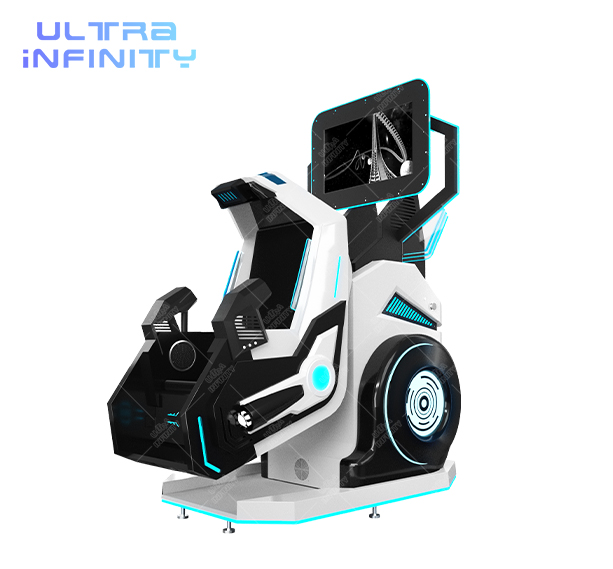
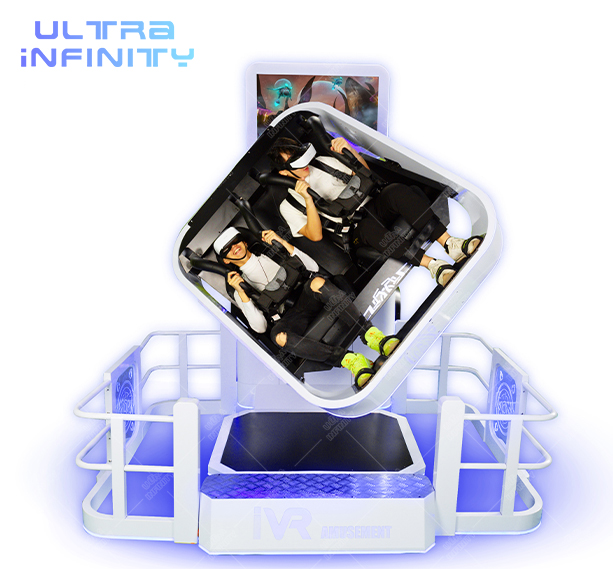
A VR roller coaster simulator is not one machine, and the fastest way to buy the wrong one is to treat it as one. On our own shelf the category holds six different machines: a single-seat 360 degree chair, a two-seat 360/720 chair, a two-seat drop tower, a single-seat 3 DOF slide machine, a single-seat 360 degree coaster/flight/racing simulator, and a five-seat 720 degree cinema ride. They all sell the same promise - a coaster you can put indoors - and they behave nothing alike on a floor plan, on a power schedule or in a queue.
The second most expensive mistake is comparing them on price. Price is an output, not an input. What actually sets the quote is the geometry of the ride: how many riders come off it per cycle, how much floor and clearance the machine claims, how many kilowatts it draws, and how the ride is loaded and unloaded. Change any one of those and the same category lands in a completely different price band, a different staffing model and a different part of the venue.
This guide works through the category the way a buyer actually decides. First the six formats side by side with real footprints and power figures. Then the selection rule we use on layout projects, which we call Ride Geometry. Then the throughput maths that separates a busy machine from a busy floor, the content question, and the seven lines to settle before you sign a quote. Every specification below is from our own product pages and was re-verified in September 2026.
This is the table we open with on every layout call, because operators rarely realise how far apart the extremes sit. The slide machine occupies about 1.4 square metres of floor and runs on a single-phase supply at 1.2 kW. The five-seat 720 degree cinema occupies 12 square metres, weighs 950 kg and draws 3.8 kW. One of those fits in a hotel corridor lounge; the other is an anchor attraction that needs a hall, a floor-load review and its own electrical circuit.
| Format | Riders per Cycle | Footprint | Power | Motion Platform | Content Included |
|---|---|---|---|---|---|
| VR 360 chair, single seat | 1 | Single-seat frame plus clearance | Single-phase | 360 degree rotation plus 45 degree pitch | Coaster, scenic, underwater and action title families |
| VR 360 chair, 2 seats (IN720-01) | 2 | Two-seat frame plus clearance | 110-240 V, 2,000 W | 360/720 degree rotating chair | 2 x DPVR E3 (2K) headsets, 9 movies, 2-5 minute rides |
| VR Drop Tower, 2 seats | 2 | L2250 x W1600 x H2710 mm | AC 220 V, 2.1 kW | Vertical drop and jump tower | 8+ titles |
| VR Slide Machine | 1 | L1200 x W1200 x H800 mm (about 1.4 sq m) | 110-240 V, 1.2 kW | 3 DOF dynamic platform | 19 inch screen plus DPVR headset, water and sky slide titles |
| VR Thunder Fighter | 1 | L2660 x W1460 x H2330 mm, 380 kg | AC 220 V, 2.5 kW | 360 degree rotation, flight joystick and racing wheel | 40+ titles |
| VR UFO, 5 players, 720 degree | 5 | L4080 x W3300 x H2600 mm (12 sq m) | 220 V, 3.8 kW | 180/360/720 degree cinema motion | Cinema-style multiplayer coaster content |
Two numbers in that table deserve a warning. First, footprint is not the product dimensions - it is the product dimensions plus the safety envelope, the boarding clearway and the queue lane. Our long-standing guidance for rotating chairs is a 3.5 metre clear radius around the machine, and the same discipline applies to a drop tower and to a five-seat cinema whose whole gimmick is that the cabin moves. A machine advertised at 12 square metres will want closer to 20 square metres of sellable floor once people are standing next to it.
Second, rated power is not the circuit you need. A 2 kW chair and a 9.5 to 15 kW circuit allocation are both correct statements about the same machine - one is what the machine consumes, the other is what the room has to reserve so that the ride, the lights and the queue screens do not brown out together. We keep those two numbers separate on purpose, and so should your electrician. The full breakdown of ceiling height, floor load and three-phase allocation is in our ceiling, floor load and power guide for 360 VR chairs.
We call the selection rule Ride Geometry because on real projects the floor decides more often than the wishlist does. Four axes, in this order: thrill axis (what the guest came for), footprint and clearance (what the room can give), riders per cycle (how the queue behaves), and group mode (whether people arrive in twos or sixes). Answer them in that order and the shortlist is usually down to two machines before anyone mentions a price.
| Venue Archetype | First Pick | Second Pick | Skip |
|---|---|---|---|
| Bar, hotel or boutique lounge with 80-150 sq m of play space | VR Slide Machine: about 1.4 sq m, 1.2 kW, runs off a standard supply | Single-seat 360 chair as the premium step-up | Five-seat 720 cinema: 12 sq m and 950 kg of concentrated load |
| Mall zone or mid-size family venue, 150-400 sq m | VR 360 chair, 2 seats: two riders per cycle, the best throughput per square metre | VR Drop Tower 2 Seats for the vertical thrill axis | Slide machine as the anchor - it is a garnish, not a draw |
| Large venue or cinema hall, 400 sq m and above | VR UFO 5 Players: the group anchor that fills a hall | A 360 chair for solo and repeat riders | Nothing here - this is the archetype the category was designed for |
The first row is the one operators argue with, and it is the one that pays. A bar does not need the biggest machine in the category, it needs the machine that runs while people are already sitting at the table. The slide machine is 1.4 square metres, 1.2 kW and about 80 kg, which means it goes into a corner that was previously holding a plant pot, on a supply that already exists, without a floor survey. The single-seat chair is the natural upgrade once the corner proves it earns; the five-seat cinema is the machine that turns a renovation into a construction project.
The middle row is where most venues actually live. Two riders per cycle on a chair is the single biggest throughput decision in the category, because couples are the default arrival unit in a mall or an evening venue. Pair it with a drop tower and you have two thrill axes - rotational and vertical - which is what stops a queue from feeling like one long wait for one ride.
The third row is the only place the five-seat 720 degree cinema makes sense: a venue whose business model is groups. If families, parties and corporate teams are the calendar, five riders per cycle with a shared story is worth the 12 square metres and the 950 kg. If your calendar is couples on a Friday night, that same machine is an expensive way to sell one ride to one person at a time. The payback maths for that specific machine, and for the drop tower and the slide machine, are already worked through in our five-seat VR UFO cinema, two-seat drop tower and slide simulator revenue guides - this article deliberately does not repeat them.
A five-seat ride looks five times better than a one-seat ride on a specification sheet, and it almost never is. Riders per hour is riders per cycle multiplied by cycles per hour multiplied by how well the queue is managed, and the second term is where big machines lose ground. A single-seat chair that turns every three minutes can complete more cycles than a five-seat cabin that takes six minutes to board, harness and clear.
Our planning model uses a 2 to 5 minute ride time plus boarding and clearance, which is why the chair-format machines sit at 12 to 16 cycles per hour and a five-seat cinema sits slightly lower, at 10 to 12, because five people have to be seated, checked and unloaded as a group rather than one at a time.
| Format | Riders per Cycle | Cycles per Hour (Model) | Riders per Hour |
|---|---|---|---|
| VR 360 chair, single seat | 1 | 12-16 | 12-16 |
| VR 360 chair, 2 seats | 2 | 12-16 | 24-32 |
| VR Drop Tower, 2 seats | 2 | 12-16 | 24-32 |
| VR Slide Machine | 1 | 12-16 | 12-16 |
| VR Thunder Fighter | 1 | 12-16 | 12-16 |
| VR UFO, 5 players, 720 degree | 5 | 10-12 | 50-60 |
Read that with your own arrival pattern next to it. A bar selling to couples turns a two-seat chair 12 to 16 times an hour and moves 24 to 32 people; the same bar with a five-seat cinema moves people in bursts of five and pays for 12 square metres of floor to do it. A mall venue on a Saturday needs the opposite: the cinema soaks up family groups whose alternative is walking out, while the chair serves the couples who would never buy five seats.
The operational lever that moves this number more than any purchase decision is queue design, not machine choice. Pre-booking, a visible countdown, a two-person boarding script and a photo or score moment all shorten the gap between rides. We have written separately about how often to refresh a 9D game library, and the same discipline applies here: a machine that is fun for two minutes and awkward for three wastes 60 percent of its capacity.
Every machine in this category is sold with a content library, and the library is where repeat business is won or lost. The numbers vary more than buyers expect: the two-seat chair ships with nine movies and 2 to 5 minute rides, the drop tower with 8+ titles, and the Thunder Fighter with more than 40 titles spread across coaster, flight and racing modes. That difference matters less than the shape of the library.
A well-built library gives you four distinct moods, and the successful venues we work with programme them deliberately. A scenic or slow glide for nervous first-timers and younger riders. A classic coaster for the default walk-up. An inversion or launch title for the thrill seeker who will otherwise ride once and leave. And an action or underwater family title that works for a group where one person is motion sensitive. The single-seat chair, for example, ships with coaster titles alongside underwater and free-roaming families precisely so the machine can serve four different guests in one hour.
Three practical consequences. First, a nine-title library is roughly half an hour of unique content at 2 to 5 minutes per ride, so repeat play has to come from competition and progression rather than from novelty - scores, leaderboards, personal bests, seasonal ladders. Second, ask what happens at renewal: whether the included titles are perpetual, whether new releases are paid, and whether the machine accepts your own content. Third, treat ride length as a marketing variable, not a fixed property. A two-minute ride is the right product for a queue you want to move; a five-minute ride is the right product for a premium ticket in a quiet venue.
Wind, motion and sound effects belong in this section too, because guests experience them as content rather than as hardware. The single-seat chair ships with a wind effect and head-motion control; those small cues are why a 2 minute ride reads as a full experience instead of a headset demo. If you are choosing between two machines at a similar price, the one with the richer sensory layer usually wins the repeat visit.
A VR roller coaster simulator quote is usually written as one number, and one number is exactly what you cannot compare across suppliers. Ask for the quote line by line, and ask for these seven lines specifically. In our experience, four of them are where a cheap quote stops being cheap.
Two of those lines are where we most often see buyers surprised. Circuit allocation, because a machine rated at 2 kW can still need a reserved circuit several times larger once the room is loaded. And spare headsets, because a headset is the only part of the ride that a guest puts on their face, which makes it the part that fails first and the part you cannot improvise.
If you are still at the stage of choosing between one seat and two on a rotating chair, our chair roller coaster buying guide works through exactly that decision, including the ten-line quote checklist we use on rotating-chair projects. For budget anchoring, the published range for commercial chair-class machines on this site is 6,000 to 12,000 US dollars and above per machine, with multi-seat cinema systems quoted per project because the floor, power and civil work dominate the cost.
One operational caveat belongs in the quote conversation, because it changes how you sell the ride. Virtual roller coaster content can induce visually induced motion sickness in sensitive guests, which is a well documented effect of visual and vestibular mismatch rather than a fault in any particular machine. Design the session length, the seat choice and the content ladder around that, brief your staff on the stop signal, and put the honest line on the signage - guests forgive a ride that warns them far more readily than one that surprises them.
The questions buyers actually ask when they compare roller coaster simulators, answered with the specification rather than the sales line.
A 360 VR chair is one format inside the roller coaster simulator category. The category also includes two-seat 360/720 chairs, two-seat drop towers, 3 DOF slide machines, 360 degree coaster and flight simulators, and five-seat 720 degree cinema rides. They share a promise - an indoor coaster - and differ in riders per cycle, footprint and power.
Based on our planning model, a single-seat machine at 12 to 16 cycles per hour moves 12 to 16 riders, a two-seat machine 24 to 32, and a five-seat 720 degree cinema 50 to 60 at a slightly lower 10 to 12 cycles per hour because the group boards and clears together. Queue design moves this number more than machine choice does.
The machines themselves range from about 1.4 square metres for the slide machine to 12 square metres for the five-seat 720 degree cinema, whose frame measures L4080 x W3300 x H2600 mm. Add the safety radius, boarding clearway and queue lane: for rotating chairs we plan a 3.5 metre clear radius, so a 12 square metre machine realistically wants around 20 square metres of selling floor.
Rated power runs from 1.2 kW for the slide machine and 2.1 kW for the two-seat drop tower up to 3.8 kW for the five-seat 720 degree cinema, with chair-class machines at 110-240 V and 2,000 W. Rated power is not the circuit you need: reserve the circuit for the machine plus lighting and screens, and confirm single-phase or three-phase with your electrician.
It depends on your arrival unit, not on the specification. Five seats per cycle wins if families, parties and corporate groups are your calendar, because they buy the shared story. Two chairs usually win if couples and walk-ups dominate, because you can run two independent queues and two content moods and never hold up four people for one nervous rider.
Chair-class commercial machines on this site have been published in the 6,000 to 12,000 US dollar range and above per machine, and multimedia rotating machines sit above that band. Five-seat cinema systems are quoted per project because the floor load, the electrical work and the rigging usually outweigh the machine itself. Ask for a line-by-line quote rather than a lump sum.
Yes on both counts for the larger formats. Rotating chairs need a minimum clear height of about 3.8 metres and a floor that handles 350 to 500 kg per square metre of dynamic load, and the five-seat cinema concentrates 950 kg of machine weight into 12 square metres. The 1.4 square metre slide machine at about 80 kg is the exception that fits an existing room without a survey. See our ceiling, floor load and power guide for the full breakdown.
Rides run 2 to 5 minutes depending on the title and the machine. Included libraries differ: nine movies with the two-seat 360 chair, 8+ titles with the drop tower, and more than 40 titles with the Thunder Fighter across coaster, flight and racing modes. A nine-title library is roughly half an hour of unique content, so repeat play comes from scores and progression.
Start with the slide machine. About 1.4 square metres of floor, 1.2 kW on a standard supply and around 80 kg means it installs into a corner of an existing room without a floor survey, and it keeps running while guests are already at the table. Upgrade to a single-seat 360 chair once the corner proves it earns.
Programme the content in moods rather than titles, run a leaderboard or seasonal ladder, keep the session short enough that the queue moves, and use the sensory layer - motion, wind, sound - to make a two-minute ride feel complete. If your ladder goes stale, refresh the library: our guide on how often to refresh a 9D game library covers the cadence and the licensing cost.
The right format is the one your floor and your guest pattern can actually support. NextPlay builds all six: the single-seat 360 VR motion chair, the two-seat 360/720 chair, the five-seat 720 degree UFO cinema, the 3 DOF slide machine, the two-seat drop tower and the 360 degree Thunder Fighter. Browse the VR roller coaster simulator range to compare them, or send us your floor plan and guest pattern and we will model riders per hour, circuit allocation and the machine mix on your real numbers - starting with the free 3D layout service.