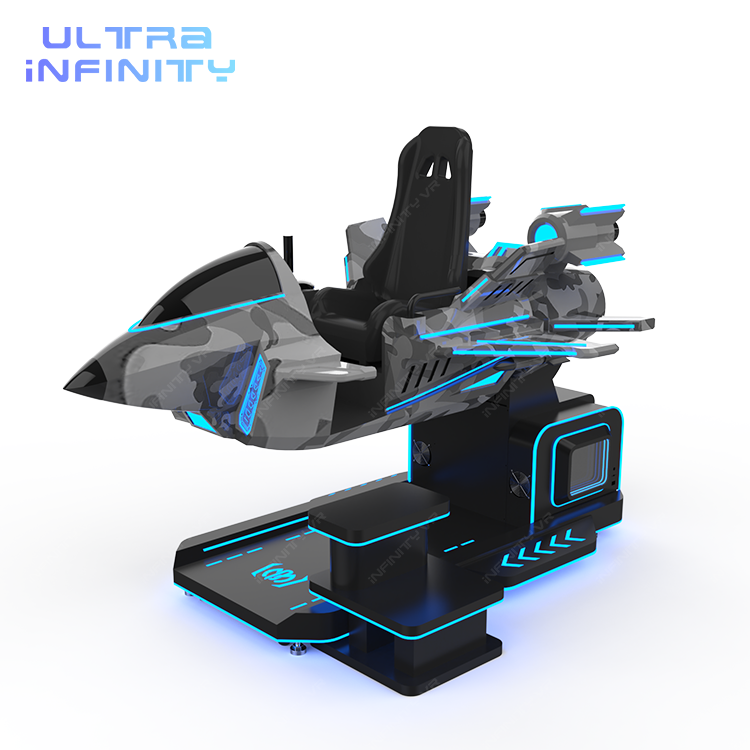
The following commercial simulation units form the primary revenue generators of the high-turnover ride program.
The VR slide simulator is engineered to monetize a compact corridor footprint with a ride silhouette that stops foot traffic. The complete installation occupies an operating footprint of approximately 6.5 square meters, including the slide track envelope, entry platform, operator station, and queue aisle, while requiring a clear ceiling height of 3.0 to 3.5 meters. Unlike fixed-base simulators, the slide machine presents a moving carriage profile that is visible from the main circulation aisle, converting passive passersby into ride purchases. In a typical mall FEC layout, the slide acts as the high-energy signature attraction between standard arcade cabinets and premium VR arenas, capturing both thrill-seeking teenagers and family groups of two to three riders. Placement guidance positions the slide near the food court boundary or the party corridor where group traffic concentrates, and orients the carriage track perpendicular to the pedestrian flow to maximize sight lines. Operators report that a well-positioned slide machine generates $34,000 to $40,000 of revenue per square meter annually, roughly 3.5 times the yield of standard redemption arcade floor space, and the moving carriage creates a landmark that anchors the surrounding game zone.
Key Spatial Yield Parameters: Operating Footprint: 6.5 m2 Including Track Envelope; Required Clear Height: 3.0-3.5 m; Recommended Placement: Food Court Boundary / Party Corridor; Annual Yield Benchmark: $34,000-$40,000/m2; Ride Cycle Target: 2.5-3.5 Minutes.
The commercial case for the slide simulator rests on a motion-drive architecture built for continuous high-throughput operation. The carriage runs on a precision rail system driven by a pneumatic or servo-linear actuator pack, delivering smooth longitudinal slide, lateral sway, and vertical bounce synchronized to the on-screen surf and coaster content. Each seat carries an independent restraint assembly with lap-and-shoulder harnesses, and the ride software refuses to start until all locks report closed. The visual subsystem renders at 120Hz with a low-latency pipeline on a high-brightness display positioned at the carriage front, and the audio array is integrated into the carriage shell to create an immersive sound field that follows the rider. The chassis uses Q235B galvanized steel with a powder-coated finish, and the entry platform incorporates an anti-slip safety deck with handrails. The complete assembly is rated for duty cycles above 12 hours per day with service intervals aligned to 2,000 operating hours for the carriage drive system.
Subsystem Certifications & Tolerances: Carriage Drive: Pneumatic / Servo-Linear Actuator Pack; Restraint: Redundant Electromagnetic Lap & Shoulder Harnesses; Display: 120Hz High-Brightness Pipeline; Chassis: Q235B Galvanized Steel; Service Interval: 2,000 Operating Hours; Ride Cycle: 2.5-3.5 Minutes.
The slide simulator monetizes rapid session turnover, and that throughput profile produces strong cash flow per staff hour. Complete capital expenditure for a single installation, including freight, site preparation, electrical work, and factory commissioning, ranges from $42,000 to $58,000 by destination market. Direct operating costs are modest because one operator manages the entire ride cycle, the carriage drive draws a peak of 4.5 kW, and content runs from a service-free media server updated over the network. At a blended session price of $9 to $14 and 80 to 110 sessions per operating day across a 310-day year, gross revenue lands between $223,000 and $310,000 in year one at stabilized utilization. Monthly direct OPEX of $2,400 to $3,400 covers operator labor allocation, power, maintenance reserves, and software licensing, leaving a monthly net cash contribution of $13,000 to $18,000. Cumulative net cash flow therefore crosses the capital line within 5 to 7 months of stabilized operation, and even the conservative 50% utilization scenario pays back inside 9 months.
CAPEX Distribution: Slide Unit (58%), Freight & Customs (12%), Site Preparation & Electrical (19%), Content & Media Kit (4%), Contingency Reserve (7%). Target Payback: 5-7 Months. Peak Power Draw: 4.5 kW. Staffing: 1 Operator per Shift.
A high-throughput motion attraction introduces specific facility requirements that must be resolved during the design review. The carriage drive and media server require a dedicated 220V supply on a 32-amp breaker with independent grounding, isolated from lighting and audio circuits to avoid ground-loop noise in the show system. The track runs on precision rails that must be mounted to a floor verified flat to FF 50 commercial flatness, with perimeter shielding protecting the rail zone from dust and liquid ingress. Structural engineers must validate the floor slab against the dynamic load of the moving carriage, which combines riders, carriage mass, and acceleration forces, with a dynamic load multiplier of 1.6 applied during acceleration and braking phases. Heat output is moderate, so standard HVAC with 6 to 8 air exchanges per hour is sufficient, but the media server room should hold ambient temperature below 28 degrees Celsius. Emergency egress requires the carriage to return to the entry position and unlock all restraints within 10 seconds of the e-stop command.
MEP Engineering Standard: Dedicated Supply: 220V 32A; Floor Flatness: FF 50; Dynamic Load Multiplier: 1.6x; Media Server Room: <28C Ambient; E-Stop Recovery: Carriage Returns & Unlocks in <10 Seconds.
High-turnover attractions benefit disproportionately from cashless integration because session queues move at speed and staff must never handle change. The slide controller integrates with the venue management platform through REST API, supporting RFID wristbands, card readers, and QR mobile wallets, with a ride queue that holds prepaid sessions for 5 minutes before releasing to walk-in riders. Session telemetry, including ride count, revenue, content title, and fault flags, streams to the venue dashboard at one-second intervals. The media server supports remote content updates, so operators can schedule new ride titles from any connected device without a site visit. Dynamic pricing rules can apply off-peak discounts automatically, and the system can issue split-session tickets for shared rides. Remote diagnostics expose carriage motor current, restraint lock health, and rail sensor status, enabling the regional team to identify wear trends before failures occur and reduce mean repair time to under 30 minutes for module swaps.
Software Interoperability: API/REST, MQTT and TCP/IP Protocols; Card Reader Compatibility: Nayax, Intercard, Embed and Custom Webhooks; Telemetry Polling Rate: 1.0 Second; Content Update: Remote Scheduled Deployment; MTTR: <30 Minutes for Modular Replacement.
Continuous rider turnover elevates the safety engineering burden, and the slide platform is designed to satisfy both machinery directives and amusement ride principles. Restraint is provided by lap-and-shoulder harnesses with redundant electromagnetic locks, and the ride software refuses to start until all locks report closed. An e-stop at the operator console stops carriage motion within 300 milliseconds, followed by automatic return to the entry position and restraint unlock. The platform follows CE machinery directive documentation and the operational safety principles of EN 13814 amusement ride standards, shipping with a full technical file for municipal inspection. Fire compliance follows building level requirements: the carriage shell is Class B1 flame-retardant, all power cabling is low-smoke halogen-free, and the track envelope is kept free of stored materials. Daily pre-opening checks verify restraint lock status, rail cleanliness, and media server readiness, and these records are retained in the operator logbook for inspector review.
Compliance Checklist: Restraint System: Redundant Electromagnetic Harnesses; E-Stop Response: <300 ms Carriage; Platform Standard: CE Machinery Directive + EN 13814 Principles; Shell Material: Class B1 Flame-Retardant Composite; Cabling: LSZH Low-Smoke Halogen-Free.
Consistent high-throughput operations depend on a disciplined daily routine that balances guest experience with mechanical care. The 8-step opening sequence starts with a visual inspection of the track rail, carriage shell, and restraint assemblies. Step 2 verifies the carriage drive engages smoothly and completes a slow no-passenger run with no audible fault. Step 3 runs the e-stop test, confirming the carriage returns to the entry position and all restraints unlock within 10 seconds. Step 4 checks the media server boots to the correct ride menu and the audio array passes a level test. Step 5 validates card reader and queue connectivity with a test transaction. Step 6 confirms display brightness matches the current promotional setting. Step 7 reviews the previous day's ride telemetry for anomalies in carriage current or restraint lock cycles. Step 8 clears the platform deck, checks anti-slip surfacing, and verifies queue signage. The cycle repeats at midday and at closing, with sanitization of all seat surfaces and harness grips between sessions.
SOP Execution Schedule: Pre-Opening Audit (08:30-09:30); Midday Operational Check (14:00); Post-Closing Sanitization & Maintenance Audit (22:30-23:30). Carriage Service Interval: 2,000 Operating Hours. Annual Third-Party Inspection: 1x per Year.
The slide machine is an effective private-event asset because a single ride accommodates a complete group wave in minutes, keeping event queues short. Birthday party packages bundle two slide rides with the party room rental, generating $25 to $45 per group above standard admission. Corporate team-building programs run leaderboard challenges where teams post the fastest lap scores, driving package rates of $350 to $800 per two-hour block for groups of 20 to 60 people. School group programs offer discounted matinee sessions on weekday mornings, converting idle capacity into contracted revenue. Because the operator simply starts and stops rides, event staff requirements remain minimal, protecting margins. Operators actively marketing the slide as the signature party attraction report that 34% of party bookings include at least one premium ride, and loyalty members who redeem ride credits for the slide show a 20% higher average monthly spend than members who do not.
Corporate Event Economics: Party Bundle Upsell: $25-$45 per Group; Corporate Block Rate: $350-$800 per 2 Hours; School Matinee Contracts: Discounted Weekday Mornings; Party Ride Inclusion Rate: 34% of Bookings; Loyalty Spend Lift: +20% Monthly Average.
High-turnover attractions are inherently visual, and the slide machine converts that energy into measurable marketing reach. A synchronized camera rig captures every rider during the surf sequence, and an exit kiosk offers immediate download or share of the clip, branded with the venue logo and ride title. Because the carriage is a moving landmark, the attraction generates organic reach simply by operating, drawing spectators who become riders. Venues report that 48% of slide riders download or share their clip, and each shared clip produces an average of 1,300 impressions. Monthly high-score challenges across the library of ride titles encourage repeat visits, and the display cycles through seasonal themes that refresh the attraction's visual identity without new hardware. A digital stamp program rewarding five rides with a free session increases monthly retention by 25% for the teenage segment, the highest rate among all attraction types in the venue portfolio.
Virality Metrics: Clip Share Rate: 48% of Sessions; Reach per Shared Clip: 1,300+ Impressions; Retention Program Lift: +25% Monthly Teen Retention; Seasonal Display Themes: Refreshed Quarterly Without Hardware Change.
The slide's carriage drive and ride audio require deliberate acoustic integration within multi-tenant buildings. The pneumatic or servo-linear drive generates low-frequency structure-borne vibration that must be isolated at the mounting interface using a double-layer elastomer pad assembly rated for continuous motion duty. The ride audio system is calibrated to project toward the rider, with the carriage shell acting as a natural acoustic barrier, and operators should maintain the session volume below 85dB at one meter from the shell exterior. The entry platform and queue zone can be treated with acoustic paneling where the slide sits near quiet retail or restaurant seating. These measures typically keep noise complaints below one per quarter, provided the mounting audit, shell calibration, and volume policy are enforced. For upper-floor installations, the track mounts should be reviewed by a structural engineer to confirm floor deflection stays within the 1/360 span ratio recommended for motion equipment.
Acoustic Engineering Parameters: Vibration Isolation: Double-Layer Elastomer Pad Assembly; Ride Audio Calibration: <85dB at 1m Exterior; Shell Acoustic Barrier: Carriage Composite Shell; Floor Deflection Limit: 1/360 Span Ratio; Adjacent Tenant Noise Complaints: <1 per Quarter.
The slide machine ships as a modular kit sized for efficient ocean freight. The complete system packs into a single 20-foot container with shock-absorbing steel crates, with the carriage drive, media server, and electrical harnesses all pre-wired into plug-and-play connections. Factory testing completes a full ride cycle and a complete show sequence before shipment, so the unit arrives fully commissioned. On-site installation by the factory-trained team, including rail alignment, floor anchoring, electrical connection, audio calibration, and staff training, completes in 5 to 8 working days. The media library ships with 20 licensed ride titles and supports scheduled remote additions, giving operators a content roadmap for the first year. Spare parts kits covering carriage bearings, actuator cartridges, sensors, and restraint components ship with the unit, and critical spares are staged at regional hubs for 48-hour dispatch.
Logistics & Assembly Milestones: Packaging: 1x 20FT Container; Factory Pre-Assembly: 100% Commissioned Full Cycle Before Shipment; On-Site Assembly Timeline: 5-8 Working Days; Content Library: 20 Licensed Titles + Remote Updates; Critical Spare Dispatch: Within 48 Hours.
The twelve-month pro forma for a VR slide machine shows how rapid session turnover smooths seasonal revenue volatility. Months 1-2 cover installation, soft launch, and free-preview rides for loyalty members and local influencer groups to seed word-of-mouth. Months 3-6 deliver the growth inflection as birthday party programs and corporate packages activate, with weekend session counts peaking during school holidays. Months 7-12 stabilize around the weekday-teen and weekend-family pattern, supported by school matinee contracts. The base case at 60% utilization projects year-one gross revenue of $266,000 with a 64% EBITDA margin, crossing full payback in month 6. The conservative case at 45% utilization still reaches $199,000 gross revenue with payback in month 9, while the premium case with party bundles and media capture at 75% utilization exceeds $310,000 gross revenue and pays back in month 5.
12-Month Projected Performance Summary: Base Case Gross Revenue: $266,000; Base Case EBITDA Margin: 64%; Conservative Utilization: 45% (Payback Month 9); Premium Case Gross Revenue: $310,000+ (Payback Month 5); Breakeven Occupancy Threshold: 22%.
Frequently asked questions from mall operators, FEC owners, and entertainment investors cover installation, ride operations, certification, and revenue parameters.
Q1: What is the minimum ceiling height for a VR slide simulator? A1: A clear ceiling height of 3.0 to 3.5 meters is recommended for the carriage envelope, track clearance, and rigging. Standard mall single-height zones and FEC halls are compatible. Q2: How is a ride session priced and how many people can ride at once? A2: Each carriage seats 2 riders per session, priced at $9 to $14 per ride, with premium party bundles reaching $25 to $45 per group when media capture is included. Q3: What safety certifications apply to the moving carriage? A3: The platform follows CE machinery directives and EN 13814 amusement ride principles, with redundant electromagnetic harnesses, sub-300ms emergency stops, and a complete technical file for inspection. Q4: How is maintenance scheduled for the carriage drive? A4: The carriage drive follows a 2,000 operating hour service interval, with remote diagnostics flagging wear trends early, and complete spare kits available from regional hubs within 48 hours. Q5: How long does installation take and what is included in training? A5: Factory-commissioned modules install in 5 to 8 working days, followed by 3 days of on-site staff training covering operations, safety checks, media updates, and maintenance routines.
A weekly disaggregation of ride revenue and operating cost illustrates the cash flow rhythm of a single slide machine operating 11 hours per day. Weekdays average 78 rides at an $10 blended session value, weekends climb to 120 rides with premium pricing, and party bundle upsells and media capture add incremental revenue on top. Corporate and school group blocks contribute contracted weekday-morning revenue. Direct operating costs are limited to shared operator labor, carriage drive electricity, maintenance reserves, and content licensing. The weekly model below reflects stabilized operations in month 6.
Weekly Cash Flow Metrics: - Weekday Ride Revenue (Mon-Thu): $3,120 - Weekend Ride Revenue (Fri-Sun): $4,200 - Party Bundle & Media Capture Upsell: $980 - Corporate & School Group Blocks: $1,120 - Total Weekly Gross Revenue: $9,420 - Weekly Direct OPEX (Labor, Power, Maintenance, Content Licensing): $2,700 - Weekly Net Operating Margin: $6,720 (71.3% Direct Operating Margin).
The VR slide simulator gives venue operators a high-turnover signature attraction that monetizes thrill demand at a revenue density flat attractions cannot match. It sells rapid repeat sessions per operator interaction, anchors the party program, feeds social virality through shareable ride clips, and delivers a 5-7 month target payback at stabilized utilization. By partnering with NextPlay, operators receive the complete execution chain: 3D spatial layout and structural review, factory manufacturing with full-cycle commissioning, global logistics, on-site installation, and ongoing operational support with scheduled content updates. Contact the NextPlay commercial engineering team to receive a site-specific placement plan, ride-pricing model, and a complete financial projection built around your venue's traffic profile.
End-to-End Commercial Implementation Steps: Site Survey & Structural Review -> Carriage Placement & 3D Layout -> Factory Manufacturing & Full-Cycle Testing -> Global Shipping & Customs Handling -> On-Site Installation & Staff Training -> Grand Opening Marketing & Content Roadmap Support.
Contact NextPlay commercial engineers today to receive a site-specific placement plan, ride pricing model, and complete ROI projection for your VR slide simulator installation.