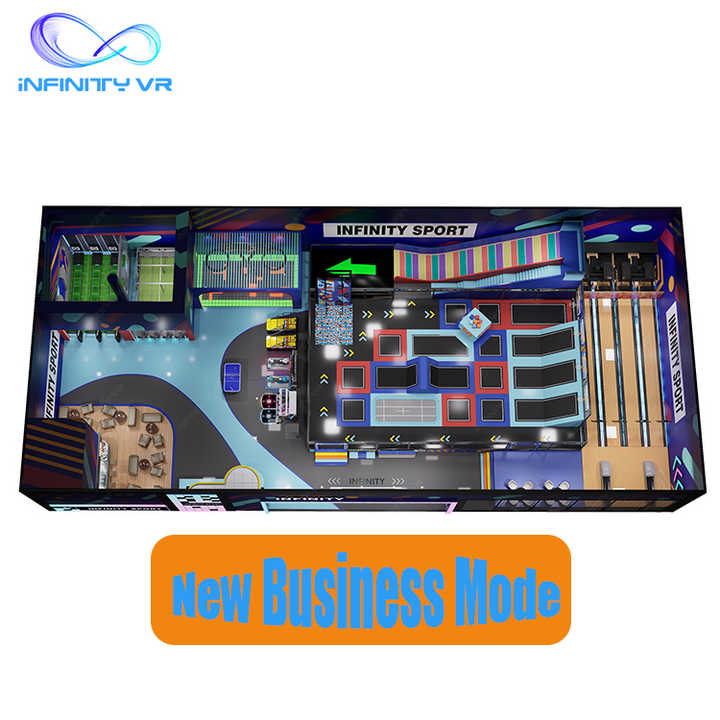
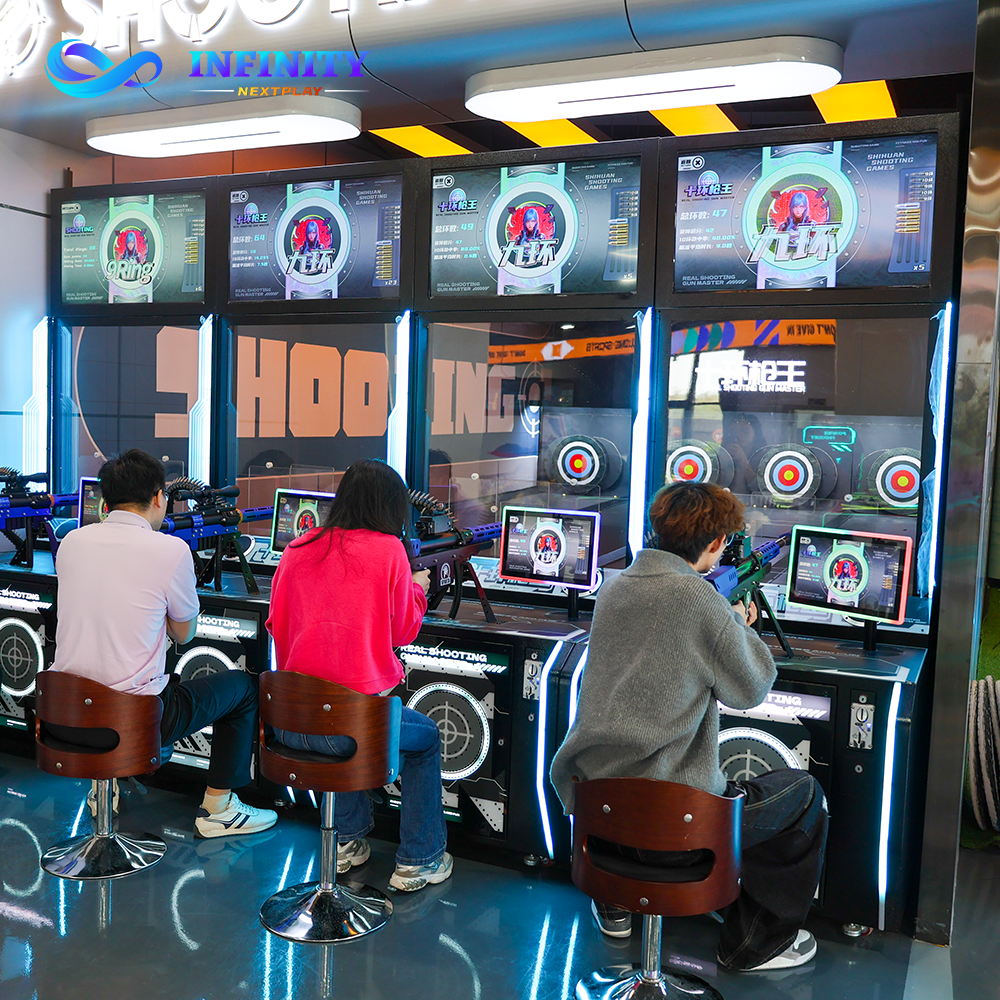
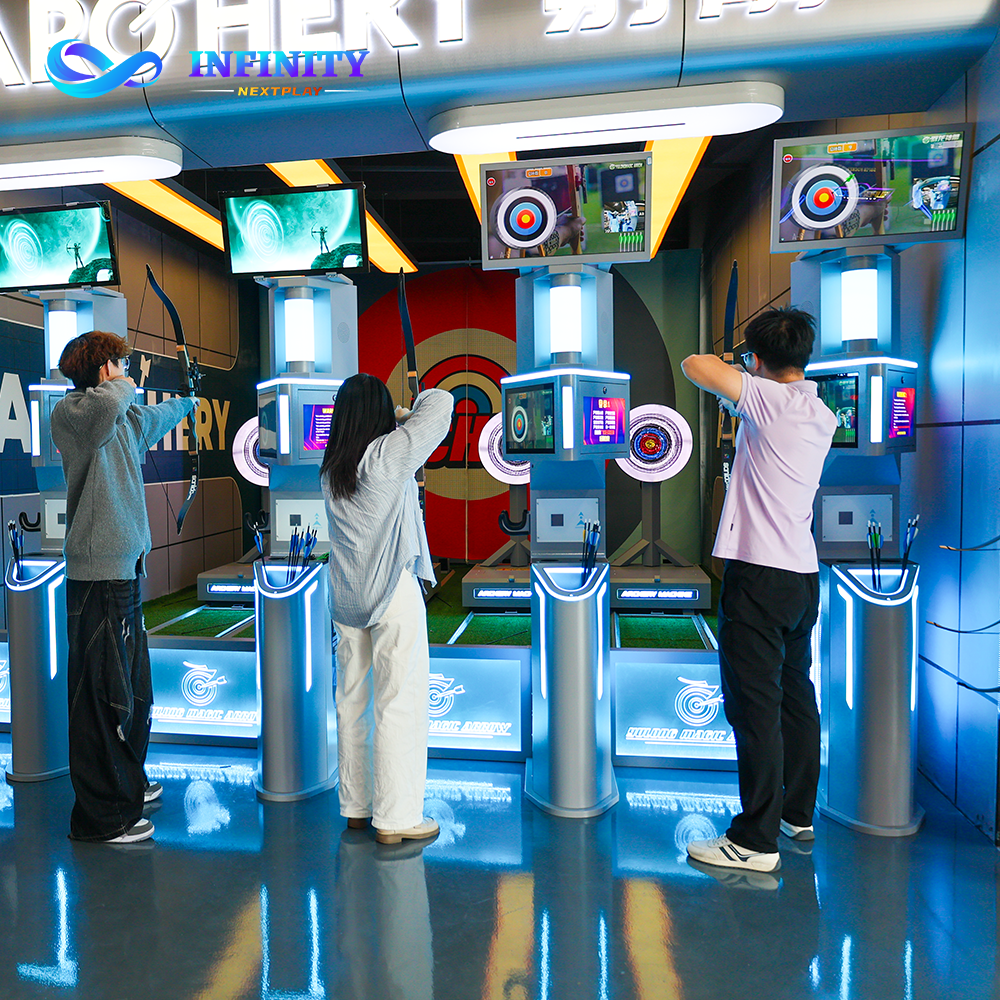
The following commercial sports simulation units form the primary revenue generators within this end-to-end commercial installation.
Commercial laser tag and active shooting arenas rank among the highest-yield attractions in modern family entertainment centers. Operators report equipment utilization rates above 82% during weekend peaks, driven by highly repeatable rounds that last 12 to 15 minutes each. A standard 220m2 to 380m2 fusion arena can rotate up to 24 concurrent players per round while maintaining structured throughput scheduling. Revenue per active square meter consistently outperforms traditional arcade cabinets because laser weapon systems require zero consumable projectiles, eliminating recurring material cost entirely.
Market Yield Benchmarks: Equipment Utilization: 82% Peak Weekend; Round Duration: 12-15 Minutes; Concurrent Players: 24 Per Round; Zero Consumable Projectile Cost; Monthly Yield Potential: $105-$160/m2.
Industrial-grade laser tag weaponry deploys IR (infrared) emitter arrays and vest-mounted receptor sensors operating at 38.4kbps data modulation. Each weapon terminal integrates a rechargeable lithium battery pack rated for 8+ hours of continuous operation on a single charge. Central arena management consoles track individual shot accuracy, score aggregation, and team balance in real time via 2.4GHz wireless mesh networking. Sensor response latency stays below 20ms, ensuring precise hit registration during high-paced firefights.
Hardware Specifications: IR Data Modulation: 38.4kbps; Battery Runtime: 8+ Hours Continuous; Wireless Protocol: 2.4GHz Mesh; Sensor Response Latency: <20ms; Frame Count Supported: 20 Units.
Total capital expenditure for a full fusion arena scales linearly with floor area and weapon count. A base 220m2 arena configuration carries a CAPEX of approximately $86,000 to $118,000, including weapon systems, arena infrastructure, LED lighting, and themed wall padding. With an average ticket price of $11 per round and throughput of 24 players every 15 minutes, operators recover initial investment within an industry-leading 7.3 to 8.9 months under standard weekend load.
ROI Projection: Base Arena CAPEX: $86,000-$118,000; Average Ticket: $11/Round; Throughput: 24 Players/15min; Monthly Gross Revenue: $21,000-$38,000; Break-Even Target: 7.3-8.9 Months.
Unlike projectile-based attractions, laser arenas impose minimal special mechanical load on building infrastructure. Total electrical allocation for a 380m2 arena averages 18kW to 32kW across lighting, weapon charging, and server racks. HVAC must sustain 12 air exchanges per hour to manage body-heat load from high-activity players while maintaining relative humidity below 55% to protect IR sensor optics. Dedicated uninterruptible power supply (UPS) units protect scoring servers from transient grid disturbances.
MEP Parameters: Power Allocation: 18kW-32kW Single Phase; HVAC Air Exchanges: 12/hr; Relative Humidity Limit: <55%; UPS Protection: 3kVA Scoring Servers; Floor Flatness: FF 50 Standard.
To eliminate queue friction and maximize round throughput, integration with contactless RFID wristbands and QR-code payment gateways is mandatory. Arena management software automates session scheduling, individual score tracking, and real-time leaderboards displayed on overhead screens. A proactive maintenance telemetry module pushes Webhook alerts to operations staff when weapon battery levels fall below 30%, ensuring peak operational readiness.
Software Integration: Wristband Protocol: RFID/NFC; Payment Gateways: Nayax, Intercard, Embed; Leaderboard Refresh: Real-Time; Future Booking Capability: REST API; Battery Low Alarm Threshold: 30%.
All laser weapon housings and arena infrastructure comply with CE, RoHS, and FCC Part 15 emission standards. Padded wall and bunker panels utilize flame-retardant Class B1/M2 polyurethane foam covered by industrial vinyl rated for low-smoke-zero-halogen (LSZH) performance. Emergency lighting and exit signage are installed at intervals not exceeding national fire-code requirements, and E-Stop disconnects are provided at each arena entrance for immediate operator intervention.
Compliance Checklist: Emission Standard: FCC Part 15 / CE; Foam Rating: Class B1/M2 Flame-Retardant; Vinyl: Low-Smoke Zero-Halogen; Emergency Egress: Code-Compliant Signage; E-Stop: Hardwired at Arena Entrances.
An effective daily operational standard procedure sustains peak game quality and asset lifespan. Pre-opening staff verify weapon battery state, IR calibration, arena sealing, and scoring-server connectivity. Midday maintenance conducts sanitization of headsets, vests, and touch panels using UV-C disinfection towers. Post-closing, operators run a full diagnostic suite, recharge weapon fleet, and log any sensor anomalies into the maintenance system for next-day resolution.
SOP Schedule: Pre-Opening Verification (09:00-10:00); Midday UV-C Sanitization (15:00); Post-Closing Diagnostics & Recharge (22:30-23:30); Mean Time To Repair (MTTR): <20 Minutes.
Laser tag arenas rank among the strongest corporate event drivers, capturing weekday off-peak bookings from team-building organizational clients. Operators bundle arena sessions with food and beverage service and private lounge hire, lifting corporate package margins above 64%. Same-floor integration with Q4 scoring shooting and A6 arcade archery lets event managers rotate groups across multiple attractions, extending average dwell time and per-head spend.
Corporate Economics: Average Group Size: 15-40 Staff; Hourly Package: $380-$900; F&B Margin Contribution: 66%; Corporate Repeat Rate: 38% Annually; Multi-Attraction Cross-Sell: +45% Per-Head.
Integrated ceiling-mounted 4K cameras capture squad firefights, final-score reveals, and victory celebrations, auto-generating short-form highlight clips. Players scan a QR code on the exit display to download branded gameplay footage, converting each visitor into an organic social media ambassador. Global leaderboards across the Infinity network foster recurring rivalry that pulls casual customers into repeat paid sessions.
Virality Metrics: Video Download Rate: 52% of Players; Organic Reach per Player: 1,600+ Impressions; Leaderboard Rivalry Retention: +31% Rebook; Social Share Conversion: 26% Share-to-Play.
Laser arenas operate within highly recognizable soundscapes of digital hits, crowd cheers, and pulsed weapon audio. To protect adjacent retail or hotel functionality, airborne attenuation systems with STC 55-rated wall assemblies keep sound inside the arena footprint. Flexible audio zoning directs crowd effects overhead while dampening low-frequency impulse through floating floor isolation mounts.
Acoustic Parameters: Airborne Reduction: STC 55 Rating; Impact Isolation: IIC 58 Floating Floor; Zone Audio Routing: 4 Independent Zones; Peak Impulse Attenuation: -28dB; Noise Diverter: Overhead Ducted Sound.
International project rollouts benefit from modular arena kits precision-engineered to pack inside standard 40ft high-cube containers. Pre-wired bunker modules, quick-connect weapon consoles, and tool-free wall paneling allow factory-trained engineers to complete full arena assembly, commissioning, and staff training within a compressed 9 to 14-day on-site window.
Logistics Milestones: Container Requirement: 1x 40HQ / 220m2; Factory Pre-Test: 100% Verified; On-Site Build: 9-14 Days; Staff Training: 3 Days On-Site; Spares Kit: Delivered with System.
A rolling 12-month pro forma projects phased revenue growth from a soft-launch baseline to mature weekend peaks. Months 1-2 deliver commissioning and marketing ramp; months 3-6 accelerate via viral short-form content; months 7-12 stabilize with recurring corporate bookings. Conservative occupancy modeling confirms sustained positive cash flow even at a 42% arena utilization floor.
12-Month Summary: Year-1 Gross Revenue: $310,000-$520,000; Net EBITDA Margin: 39.6%; Net Cash Flow After Debt: $118,000; Breakeven Utilization: 27% Capacity.
Comprehensive answers to the questions venue developers and operators most frequently raise during feasibility review.
Q1: What is the minimum space needed for a profitable arena? A1: A functional 220m2 layout supports 20 players and delivers 7.3-month payback; scaling to 380m2 lifts capacity to 24+ concurrent players and improves per-m2 yield. Q2: How much ongoing cost do weapon batteries incur? A2: Lithium packs rated for 8+ hours per charge deliver over 1,200 full cycles, with replacement cost per pack under 6% of annual revenue. Q3: Can equipment merge with our existing POS and loyalty systems? A3: Yes, arena software exposes open REST APIs and standard TCP/IP allowing drop-in integration with the majority of commercial POS and loyalty platforms. Q4: What warranty is offered? A4: Arena consoles and weapon electronics carry a 12-month direct-replacement warranty; structural bunkers and padding are covered for 3 years. Q5: How quickly can the arena open? A5: With fully modular kit build, most arenas open to public within 9 to 14 days from the moment on-site installation begins.
A weekly view of revenue streams and operating costs shows the cash-cycle rhythm of a high-performing laser tag fusion arena.
Weekly Metrics: Weekend Peak Arena Revenue: $8,400; Weekday Retail Sessions: $3,900; Corporate Private Bookings: $5,700; F&B & Locker Add-ons: $2,200; Total Weekly Gross: $20,200; Weekly OpEx (Labor, Power, Software, Sanitization): $5,900; Weekly Net Operating Margin: $14,300 (70.8%).
Delivering a profitable, high-repeat laser tag fusion arena is a matter of precise engineering, dynamic programming, and streamlined deployment. By partnering with NextPlay, owners receive a complete end-to-end solution—from spatial and MEP layout to factory manufacture, global logistics, on-site commissioning, and continuous operations support. Contact our commercial engineering team for a tailored 3D arena layout and full ROI model calibrated to your site.
Execution Steps: Site Survey -> Engineering & Layout -> Factory Assembly -> Shipping & Customs -> On-Site Installation & Training -> Grand Opening & Growth Support.
Contact NextPlay commercial engineers today to receive a custom 3D spatial layout, MEP installation guide, and comprehensive ROI financial projections for your commercial site.