VR arcade pricing is not one number, it is four numbers stacked on top of each other: what one person pays for one turn, how many people have to pay for that turn to happen, what a minute of it is really worth, and what the sheet does not print. Ask how much does a VR session cost and you have named only the first of the four. This page answers all four from price lists that were open on 2026-09-20, so you can budget a visit and an operator can see how their own rate card reads from the queue.
The short version, in US dollars per person. A free-roam arena match at a specialist venue runs about USD 39 to USD 49 at a large chain and about USD 50 at a locally owned Florida franchise. A room-scale booth session at an arcade-style VR venue runs from about USD 15 for fifteen minutes to about USD 55 for two hours. A single short ride on a motion chair or a 9D motorcycle in a mall or an entertainment floor sits lower, in the USD 6 to USD 15 band that this site publishes as its own planning rate. Per person, per turn, the arena is the most expensive thing you can do in VR and the chair is the cheapest, and the difference is not the headset.
| What you buy | What the public sheets say (2026-09-20) | Per person, US dollars |
|---|---|---|
| Free-roam arena match, specialist venue | A US chain prints 39 per person on weekdays and 49 at weekends; a Florida franchise prints 50 per person, Monday to Sunday, with a 35 per person escape-room format beside it | USD 39 to USD 50 |
| Room-scale booth, timed ladder | A US booth-and-free-roam operator prints one per-minute ladder applying to both its room-scale and its free-roam play: 15 for fifteen minutes, 25 for thirty, 35 for an hour, 45 for ninety and 55 for two hours, all per person | USD 15 to USD 55 |
| Headset arcade time | A Sydney operator prints 25 for thirty minutes and 40 for an hour on weekdays, 30 and 50 at weekends (Australian dollars) | About USD 16 to USD 33, converted by us at AUD 1 = USD 0.65 on 2026-09-20 |
| Motion chair or 9D ride | We found no chain publishing a mall kiosk price, so we quote our own planning band instead: 6 to 8 for a short motion ride and 10 to 15 for a chair session | USD 6 to USD 15 |
| Birthday or group party | Per person 49 to 99 in Australian dollars at one arena, from 100 per group of four at a US booth, from 175 per group of six to twelve at a UK free-roam venue (pounds) | Wide, and usually per group |
Three things explain almost all of the spread, and none of them is the quality of the headset. The first is staffing: an arena match has a host fitting gear, briefing the group and running the clock, while a chair ride can be started by the guest. The second is capacity per cycle: an arena sells one group at a time in a room nobody else can use, a booth sells the same half hour to whoever is standing there, and a chair sells two to five minutes to a single rider. The third is the eligibility gate - age floors on the sheets we read run from seven to thirteen, the three sheets that print a height floor print 121 cm, 130 cm and 1.40 m, and a child who fails the gate is a ticket you cannot sell.
Where the deeper mechanics live: this site publishes the operator side of the same numbers in how to price a VR arena, why VR arenas can charge 12 dollars a head and how to price VR sessions and game credits by the minute. This article is the mirror image of those: the customer-side read, one price sheet at a time.
Put the sheets in order and a pattern appears that no single venue page spells out. The formats sort themselves into a ladder, and the price rises with how much of the venue one session occupies: a machine, a booth, a chair, a platform, a room, or a building block of floor with a host standing in it.
The bottom rung is the coin-op and static cabinet. Our own published planning band puts a static VR cabinet at USD 3 to USD 4 for eight to fifteen minutes of play and a coin-op cabinet at USD 2 to USD 3 per play (why VR motorcycles outprice static cabinets and why venues upgrade from static arcades to motion simulators). No specialist venue we read sells that format at a headline price any more, because in our own published numbers the same three to four square metres earn about three times what a coin-op cabinet zone earns once they run as a motion row, and the ticket roughly doubles one rung up.
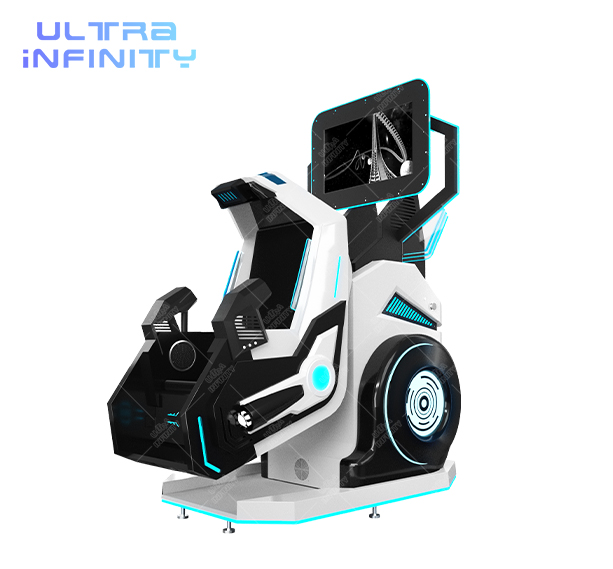
The next rung is the motion ride: a 9D motorcycle, a racing cockpit, a motion chair. Our published band is USD 6 to USD 8 for a three to five minute motion ride and USD 10 to USD 15 for a 360 chair session, with a two-seat shared ride at USD 20 to USD 25 per game. The reason this small format reaches an arena-scale price for a fraction of the time is that it sells a physical event rather than a screen: the published reasoning is on whether a VR chair is profitable for an arcade and how much a VR chair costs to buy.
Then come the headsets-by-the-hour venues, and here the real sheets are unusually clear. A US booth-and-free-roam operator prints one straight ladder per person, which its own sheet applies to room-scale and free-roam alike: 15 dollars for fifteen minutes, 25 for thirty, 35 for sixty, 45 for ninety and 55 for two hours, and includes an hour of gamepad arcade time with any purchase of thirty minutes or more. A Sydney operator sells headset time as its own product at 25 Australian dollars for thirty minutes and 40 for an hour on weekdays, 30 and 50 at weekends. A Canadian arcade with six VR stations sells time by the station rather than by the person at 33 Canadian dollars an hour, publishes a fifteen-minute entry at 13 and a two-hour block at 59, takes 15 percent off Monday to Thursday, and is one of the only sheets we found that states outright that prices do not include tax.
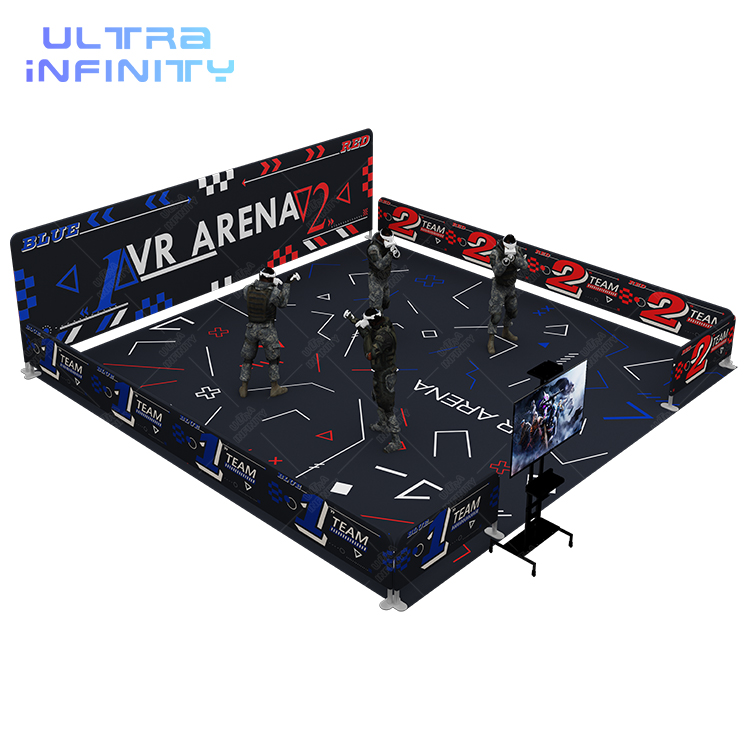
At the top sits the free-roam arena, and the two US examples are worth reading side by side. A large US chain prices per person per experience at 39 dollars on weekdays and 49 at weekends, with mixed-reality video included in the ticket. A locally owned Florida franchise of a free-roam brand prices its arena games at 50 dollars per person every day of the week and its smaller escape and adventure format at 35 dollars per person, with group discounts only starting at sixteen or more players. Same format, similar market, and the second one is the more expensive of the two; the first reads like a chain rate card and the second like one building running on its own numbers, though neither sheet discloses its cost structure.
Read that chart twice, because it is the single most useful thing on this page. One sheet discounts time: buying two hours instead of fifteen minutes cuts its per-minute price by more than half. The Florida arena sheet does not. It prints one flat 50 dollars per person with no duration tier anywhere on the sheet, which we read as pricing the match rather than the minute: one 50 dollar ticket per person whatever the round actually runs, because the room cannot hold another booking while you are in it and the host cannot run two groups at once. The arena is not expensive per minute because it is premium; it is expensive because it sells a room, and rooms do not go on sale.
Our published operator-side target for a paid VR minute is USD 0.80 to USD 1.20 (the price-per-minute math for VR sessions and game credits), which is why the arena sheets sit above the target and the long booth sessions sit below it: the rate card in the VR arena pricing guide tiering walk-ins at 11 to 15 dollars for a fifteen to twenty minute round is the compact version of the same trade-off.
The most expensive mistake on a VR price list is not a high number, it is a number whose unit you have misread. Three units turn up on real sheets - per person, per group and per station - and they are not interchangeable. One US booth operator prices a birthday party per group (from 100 dollars for four players, 130 for six, 180 for eight, 220 for ten on the thirty-minute package, and a sixty-minute package that runs from 130 to 320), while the same page prices general admission per person. A UK free-roam venue quotes a party from 175 pounds for a group of six to twelve and a quick-play session from 25 pounds per person, and also lists a shared thirty-minute slot from 15 pounds per person for smaller parties joining a game that is already running. And that Canadian arcade states in two places that its 33 dollar an hour rate is per station, one player at a time, with friends taking turns.
| Unit on the sheet | What it means at the counter | Real example read 2026-09-20 | The trap |
|---|---|---|---|
| Per person | The VR arcade price per person: everyone who plays pays the printed number | Arena tickets at 39 to 50 dollars; booth time at 15 to 55 dollars | A group of eight pays eight times the headline |
| Per group | One VR party package price per group covers a booked block, usually with a minimum | Parties from 100 dollars for four players at one booth; from 175 pounds for six to twelve at a UK arena | Bring two more friends and the per-head cost falls; bring one fewer and you still pay the floor |
| Per station | You buy a machine for a period, one player at a time | 33 Canadian dollars an hour on one station, with a 15-minute entry at 13 | Two people do not halve it; they take turns |
| Per experience | One ticket, one session, length set by the venue | The US chain prices per experience, not per minute | You cannot buy time back or shorten your way to a discount |
Per-head arithmetic is where groups lose the most money and win the most back. The Sydney arena sheet is the cleanest public demonstration of both discount axes at once, because it prints them in one table: six or more players pay 45 Australian dollars on a weekday and 55 at the weekend, eight or more pay 42.50 and 52.50, twelve or more pay 40 and 50, and beyond twelve the sheet says contact us for further discounts and that you must call to book to redeem any discounted rate. Read as a customer, that is a simple instruction: two more friends is worth more than any coupon, and the phone call is part of the price list.
The same logic appears on our own operator bands from the other direction. The published arena rate card recommends 11 to 15 dollars a head for a fifteen to twenty minute walk-in round, an immediate rematch at 9 to 11 rather than full price, a private buyout at USD 350 to USD 600 an hour, and a monthly pass at USD 89 to USD 129 for eight rounds plus a priority lane (tiering VR arena walk-ins, buyouts and season passes). Those are the same three levers a guest can pull: come at the quiet end, come back immediately at the discount, or come in enough numbers that the venue would rather sell you the room than leave it empty.
For a family of four comparing three options on a Tuesday, using the sheets above in US dollars: four arena tickets at the weekday chain rate is about USD 156 for one shared experience; four fifteen-minute booth sessions at the US ladder rate is about USD 60 for four short turns; four short rides on a motion chair at our published band is about USD 40 to USD 60, with nobody booked and no minimum. Same afternoon, three very different things bought.
Underneath all of this is a cost floor that customers never see and operators argue about: NextPlay's published cost model for a four-player arena puts the hardware depreciation, space, staffing and power of one ten-minute-per-player round at USD 1.80 to USD 2.60 per player before any margin (the 4-player VR arena session cost model). The headset itself is a consumable inside that number, rated at 300 to 500 sessions, wearing out at about USD 0.15 to USD 0.35 per session on a twelve to eighteen month cycle (how often commercial VR headsets need replacing), and cleaned between every single one of those sessions (the between-session headset sanitizing routine). That is what a per-head ticket is quietly carrying.
Every VR price on a sheet is a unit of something, and the unit is rarely the thing you actually get. Three clocks run during a visit and customers are quoted on only one of them: the clock on the ticket, the clock of the venue, and the clock inside the headset. The gap between them is what customers ask about most, and the two numbers sit side by side on the sheets that print both.
Start with the clock of the venue. The US chain quoted above states that guests must check in with the host fifteen to thirty minutes before the booking time and that a session cannot start until the whole party is present. The Florida franchise asks for ten to fifteen minutes early for check-in, host introduction and the mission briefing. So a ticket for a match of roughly thirty active minutes occupies forty-five to sixty minutes of your afternoon, before anyone talks about the score afterwards. Our own arena model prices the same overhead from the other side, on a shorter round than the franchise sells: a fifteen-minute group match, six rounds and twenty-four players an hour, which is exactly why the slot you bought cannot stretch (why VR arenas can charge 12 dollars a head).
Now the clock inside the headset, which some sheets print honestly and most do not. A UK arena operator publishes both numbers on every listing: a thirty-minute time slot at 13.50 pounds with about fifteen minutes in headset, a forty-five-minute slot at 22.50 pounds with about thirty minutes in headset, a sixty-minute slot at 27.50 pounds with about forty-five in headset, and a ninety-minute slot at 42.50 pounds with about seventy-five in headset; the two cheaper rungs carry a weekdays-only availability note. That is the most useful price transparency on any sheet we read, and it changes the arithmetic completely.
The third clock is the one that costs people real money: the cancellation and lateness ladder. On the US chain sheet, cancelling between twenty-four and seventy-two hours before a booking costs 39 dollars with the balance returned as a voucher; inside twenty-four hours there is no refund; a no-show cancels the booking and forfeits the payment; arriving up to five minutes late shortens the experience and arriving more than five minutes late cancels it with a 50 dollar fee. A separate franchise of a free-roam brand refunds in full for cancellations at least a week out and issues game credit inside a week. Neither of those is hidden, and almost nobody reads them before booking a school-holiday slot for twelve children.
Minimum group sizes and discount mechanics belong on this clock too. The Sydney arena prints its best rates only for six, eight or twelve players and adds that rates beyond twelve players require a phone call, that you must call to book to redeem a discounted price, and that its weekday rates apply Tuesday to Thursday only. The Florida franchise starts group discounts at sixteen players. The US booth operator sells gamepad arcade time at 7 dollars an hour and a day pass at 15 dollars on weekdays or 20 at weekends alongside the VR ladder, and throws in an hour of gamepad time with any VR purchase of thirty minutes or more - which is a venue adding perceived value without cutting the headline rate, the same move our own rate-card guidance recommends with a rematch discount instead of a price cut (tiering VR arena walk-ins, buyouts and season passes).
A VR ticket is the entertainment ticket on an arcade floor whose price most visibly depends on who is asking, because the eligibility gate is enforced at the machine. On the sheets read for this article, the minimum age runs from seven at a Canadian station arcade to thirteen at one Texas franchise of a free-roam brand, with eight at a UK arena and at the Florida franchise, and nine at a UK free-roam venue and at an Australian arena. The Sydney sheet that prints a six prints it about players per booking, not years of age. Height floors read 121 cm at the Canadian arcade, 130 cm at the Australian arena and 1.40 m at a Spanish venue. And these are not brand-wide rules: franchises of the same free-roam brand publish age floors of eight, nine and thirteen across two countries, and that brand's Spanish outlet prints a 1.40 m height minimum but no age floor at all. The gate you must satisfy is the one on your local page, and it is worth checking before you organise a group.
Content gates sit inside the venue gate. At the Florida franchise, non-zombie arena titles take players from eight and zombie titles take players from twelve, so the same room sells two different eligibility lines on the same Saturday. That mirrors what our own zoning work recommends: rules written per attraction zone rather than one blanket number for the whole floor, because a seated cinema ride and a free-roam combat match are not the same risk (what age and height rules each VR attraction should enforce). That guide publishes our working minimums: eight years and 120 cm for a free-roam arena with one trained staff member on every session and fifteen minutes as the session ceiling; ten years and 130 cm for a motion seat, with a health screen for pregnancy, heart conditions, neck or back injuries and severe motion sickness; four years and 100 cm for a seated 9D cinema, with children under eight riding beside an adult.
The headset makers add a layer under all of it, and operators write it into their gates: Meta publishes a minimum user age of ten for its Quest headsets, with parental management for the ten to twelve band, and Sony documents its PlayStation VR2 as not for use by children under twelve. Those are hardware guidance, not law, but they are the reason a venue cannot simply invent a lower age floor for a booth built around those units.
| Gate | What real sheets publish (2026-09-20) | What our published guidance says | Ask before you book |
|---|---|---|---|
| Minimum age | 7 to 13 depending on venue and format; one franchise splits 8 and 12 by title | 8 and 120 cm for free-roam, 10 and 130 cm for motion seats, 4 and 100 cm for seated cinema | Is the floor for the ride you want, or for the scariest title in the room |
| Minimum height | 121 cm at a Canadian station arcade, 130 cm at an Australian arena, 1.40 m at a Spanish venue | Matched to harness fit and headset fit, not to the ticket | Bring the shortest child to measure first, not to queue |
| Glasses | Contacts recommended at the Florida franchise; small frames only at one Australian venue; no glasses at one Spanish venue | A fit and hygiene rule, not a health rule | Whether the venue stocks disposable lens inserts or asks you to remove frames |
| Paperwork | A waiver for every participant at one franchise; a parent or guardian physically present on site to sign for any guest under 18 at the US chain | Health screen at the motion zone, posted content ratings at the cinema zone | Who in your group has to be present, and until what age |
| Supervision | A host briefs and accompanies arena groups on every sheet that describes it | One trained staff member inside or at the arena boundary for every session | Whether the host is included in your price or a private host costs extra |
Two exclusions recur and both are worth pre-empting in a group booking. Motion-sickness sensitivity and pregnancy or heart conditions appear as exclusions or as strong cautions on most arena sheets - the US chain phrases its own as not recommending the experience to pregnant guests or people with heart conditions, which is a caution rather than a rule, and the two arena pages behind it list overlapping but not identical exclusions: the Australian one adds a broken limb to epilepsy, deafness or severe hearing loss and wheelchair use, while the Spanish one covers epilepsy, hearing loss, wheelchair use, heart condition and late pregnancy and prints no injury clause at all. Compact motion formats set the same kind of line elsewhere: our comparison of egg chairs against 9D cinema formats records an operating attraction requiring riders of about 90 cm with under-14s accompanied (VR egg chair versus 9D cinema formats).
The honest part of a VR price sheet is the part that is missing. Of every venue page read for this article on 2026-09-20, exactly one says outright that its ticket prices exclude tax: the Canadian station arcade prints that line under its rate table. The US chain adds a footnote asterisk to its weekday rate and states its membership prices as plus applicable taxes, which is a different disclosure on a different product. The UK and Australian sheets are silent on VAT and GST. Nobody we read publishes a fee for a glasses-friendly headset insert, a rematch at a discount, or an extra charge for a private host - and silence is not the same as free, so ask the three questions below before you assume.
The second silence is structural. The US mall-based immersive chains we read price per person per experience and change the number by location and date, with no flat published rate anywhere on their own pages; the big-box arcade groups we found that sell VR time inside a card or credit system publish no per-play VR price on those pages either; and we found no chain publishing a price for a mall kiosk ride, which is why the short-motion rows on this page quote our own planning bands and say so. A quoted price that appears only inside a booking flow is not a price list, so treat those formats as call-to-price, and treat any article that gives you a neat average for them as unverifiable.
For the operator reading this as a mirror: the gap between your rate card and the customer experience is almost entirely in these three questions, and the fix is not a lower price. It is printing the unit on the board, stating the in-session minutes beside the slot length, publishing the age and height gate at the zone, and putting the arrival window on the confirmation. The published mechanics for setting the numbers themselves are in how to price VR sessions and game credits by the minute, the cost lines behind them in how to budget commercial VR equipment and how often commercial VR headsets need replacing, and what a well-priced zone is meant to earn in how much a VR arcade earns in year 1.
If you are choosing a format to run rather than a ticket to buy, price the floor area, the staffing and the eligibility gate before the ticket number, because all three decide what you can charge: the free-roam arena sells the room, the motion chair sells a short physical event without a host at every turn, and the four-seat cinema chair sells a group in one paid cycle. Seen from that side of the counter, a VR price list is one attraction's rate card inside a wider sportainment floor, where the ticket for the headset competes for the same wallet and the same hour as the bowling line and the mini-golf lane next door (what sportainment means and why venues are grouped under it). Our equipment quote guide covers what each one costs to land and energise (what a VR arcade equipment quote should include), and the guide to what to play on them is written for the customer side (the ultimate VR experience guide with ten games to try).
Looking for a commercial VR arcade setup? The models below match the setups above.
The six questions the price sheets themselves raise, answered with what the venues publish and what we recommend.
On the public sheets read on 2026-09-20, a free-roam arena match costs USD 39 to USD 50 per person at US venues, an arena-format ticket in Sydney runs 40 to 55 Australian dollars per person depending on group size and day, and room-scale booth time runs from 15 dollars for fifteen minutes to 55 for two hours. Short motion formats sit lower: our published planning band is USD 6 to USD 8 for a three to five minute motion ride and USD 10 to USD 15 for a 360 chair session, and we found no chain publishing a mall kiosk price.
Both units appear on real sheets, sometimes on the same page, and mixing them is the most common budgeting error. A free roam VR ticket price is quoted per person on the arena and booth sheets we read; party packages on those same pages are priced per group with a minimum of four, six or twelve players; and one Canadian venue prices by the station, stating that one station serves one player at a time while friends take turns. Before you book for a group, confirm the unit, the minimum headcount and whether the discount needs a phone call to redeem.
Because it sells a room and a person, not a machine. An arena holds four to eight players in a space nobody else can use, with a host fitting gear, briefing the group and supervising the match. Our own arena model has it earning about six rounds an hour, against the twelve to sixteen rides an hour our published chair planning model puts a single-seat chair at, which that guide labels a planning reference rather than a promise, and that gap is the whole reason the arena ticket has to be bigger. Our published cost model puts the depreciation, space, staffing and power of one arena round at USD 1.80 to USD 2.60 per player before margin, and the headset inside that ticket is a consumable rated at 300 to 500 sessions.
It varies by venue and often by title within the venue. The sheets read for this article print minimum ages of 7, 8, 9, 12 and 13 in different places - one franchise sets 8 for its standard arena games and 12 for zombie titles - with height floors of 121 cm, 130 cm and 1.40 m on the three sheets that print one. Our published zoning guidance works from the mechanism instead: 8 years and 120 cm for a free-roam arena, 10 years and 130 cm plus a health screen for a motion seat, and 4 years and 100 cm for a seated 9D cinema with an adult beside children under eight.
The recurring ones are timing and paperwork rather than extras: check-in fifteen to thirty minutes before a booking, a session that will not start until the whole party is present, a slot length that is not the same as your time inside the headset, and cancellation ladders that charge 39 dollars to cancel inside seventy-two hours or 50 dollars for arriving more than five minutes late at one US venue. On tax, one sheet states prices exclude tax and the rest are silent, so ask. Video and photos are included at one chain and sold as a two dollar add-on in the model our own motion-ride pricing guide uses.
Use the three levers the sheets themselves advertise: bring numbers, because one Sydney arena drops its per-head rate in tiers at six, eight and twelve players; come at the quiet end, because weekday rates are 10 to 20 percent below weekend on the same sheet and one Canadian arcade takes 15 percent off Monday to Thursday; and take the rematch or bundle rate instead of a discount, because an immediate second round at 9 to 11 dollars holds the headline price while filling your hour. Buy time in longer blocks only where the sheet tiers by the minute - a flat per-match arena rate does not discount length, because the room cannot be sold twice.
Five lines that work on any VR sheet, in any currency.
NextPlay builds the formats behind these tickets - the free roaming VR arena, the single-seat VR 360 motion chair and the four-seat 9D cinema chair - and our team works out what a given room can hold and price before anyone quotes hardware, starting from the free 3D layout design service. For the operator side of this same subject, read how to price a VR arena and the price-per-minute math for VR sessions and game credits.
Tell us your floor area, your footfall and the session length you want to sell, and our team will model which of these formats your room can hold and what the ticket has to cover - starting from the free 3D layout design service, and reading the price-per-minute math for VR sessions and game credits for the rate mechanics behind every number above.