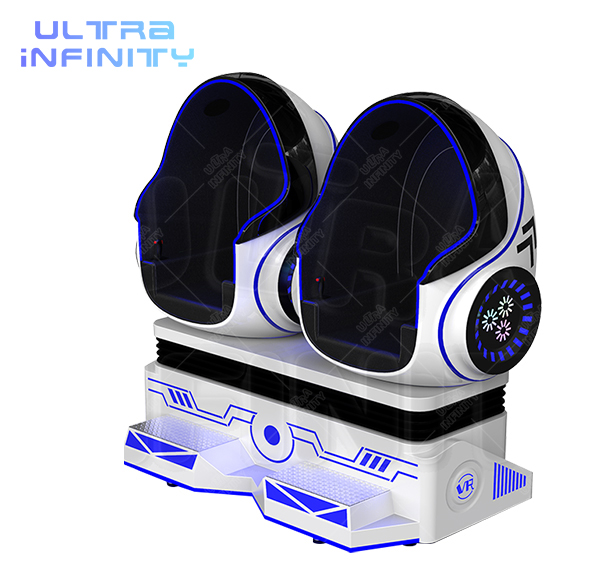
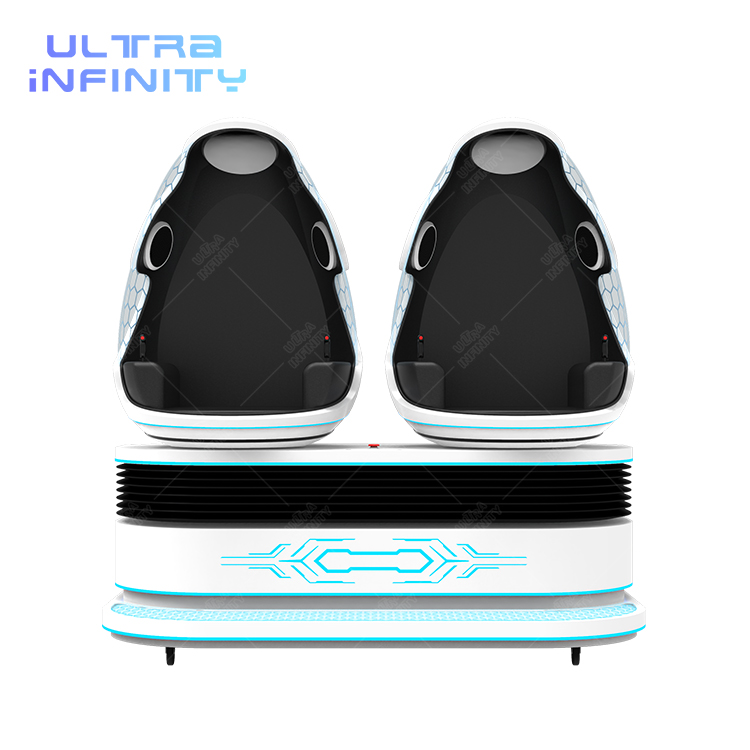
If your venue has a space the size of a small room left over, and you want an attraction that fills it with paying riders rather than furniture, the closed-capsule 9D family is usually the first place an operator lands. Within that family, the machine most people call a VR egg chair is the simplest to explain: a sealed seat shell with a headset inside, a motion platform underneath, and a touch panel that turns a guest into a two-to-ten-minute ride.
The question this article answers is the one operators ask before they buy: of the egg chair, the single and dual seat versions, the 360 rotating chair, the four-to-five-seat UFO cabin and the rideship, which one fits this venue first? The answer is never the brochure-favorite model. It is the machine whose footprint, players-per-hour and ticket yield match the floor you actually have. We call that the First-Machine Fit, and the steps below are the order we would run them in.
Throughout this guide, third-party specs from two manufacturers are used as planning references and are labelled as reported by the vendor - treat them as directional, not industry-wide guarantees. NextPlay egg chair units are referenced at the point where their real spec sheet matters. If you are comparing this family against open rotary coaster simulators, the six-format coaster comparison is the companion piece; the density math for a 50 square meter room lives in how many VR chairs fit in 50 square meters.
Walk through a supplier catalog and the families blur, but for planning purposes the closed-capsule 9D category is five stations. They share the same DNA - a motion platform, a headset, a seat and an effect rack - and differ mainly in how many riders board per cycle and how much floor each one asks for.
| Machine | What It Is | Riders per Cycle | Typical Footprint (reported) | Best First Role |
|---|---|---|---|---|
| Single-seat egg chair | Closed seat shell, one rider, headset and motion platform; up/down, left/right, forward/back motion | 1 | 110 x 110 cm (VART single egg) | A quick solo thrill that cycles fast; ideal foot-traffic catch |
| Dual-seat egg chair | Two riders side by side in one shell; parent-child and couple friendly | 2 | 210 x 110 cm (VART dual egg) | Families and pairs; better UP vs a single in party traffic |
| 360 rotating chair | A seat that rotates a full circle with headset and wind; open or half-cabin | 1-2 | 190 x 160 cm (VART 360 single) | A visual anchor that pulls a crowd; more of a spectacle than an egg |
| UFO 4-5 seat cabin | Enclosed cabin for a small group with a motion platform | 4-5 | ~2.5 to ~4.5 m2 by build (reported) | Group rides and parties; higher riders-per-floor at peak |
| Rideship / motion cinema | Larger multi-seat dynamic platform with themed envelope | 6-12 | 11-35 m2 by model (vendor range) | Flagship draw when the venue is already busy |
Two planning notes before the numbers. First, "footprint" usually means the cabinet outline only - the reserved circle around the machine for a wheelchair turn, a queue queue-off and staff access adds real meters, and operators routinely underestimate it. We come back to that in the next section. Second, riders-per-cycle is not revenue: a single-seat egg that cycles in three minutes can out-earn a four-seat cabin that takes eight minutes to board, if the queue and the price are right. The trade-off is the heart of the whole decision.
Suppliers say a compact 9D machine "needs only 2-9 square meters" to place the whole unit - the figure is quoted by a VR manufacturer for its 9D cinema line and is best read as the bare cabinet area, not the full operating cell. Before you trust a single footprint number, measure these four things on the real floor.
When you add those, a single-seat egg that measures 110 x 110 cm at the base typically wants about 2.5-4 square meters of operating cell, and a dual-seat 210 cm shell wants roughly 4-6. That discipline is why the First-Machine Fit question is never "which is smaller" but "which fits completely, with its loading lane, in the space I am willing to give it." The full density play for a bigger room is covered in 50 square meter VR chair layout.
A 9D ride cycle is short on purpose: two to ten minutes per title, and a manufacturer quotes an average of about eight riders per hour on a 9D egg chair. Your real number depends on boarding speed, title length and whether you run one guest after another or add padding for changeover. The math below is a planning model, not a promise.
| Scenario | Riders per Hour (model) | Ticket (assumed) | Hourly Take (model) |
|---|---|---|---|
| Single-seat egg, 3-min rides, smooth changeover | 8 | $5 | ~$40 |
| Single-seat egg, 4-min rides, busy changeover | 6 | $5 | ~$30 |
| Dual-seat egg, 3-min rides, pairs boarding | 12 (6 pairs x 2) | $5 per rider | ~$60 |
| 4-seat UFO cabin, 6-min rides, full cabins | 16 (2.7 cycles x 4 x 1.5) | $5 | ~$80 |
The point of the table is not the money but the shape of the decision. The single-seat egg makes less per hour but needs almost no queue management and its line moves visibly, which itself attracts the next customer. The dual seat lifts the same footprint to a higher ceiling when pairs and families are your traffic. The cabin only wins once you can fill several seats repeatedly - an empty cabin is the most expensive thing on your floor. For the full profitability picture including costs, see is a VR chair profitable for an arcade.
Within the egg chair itself, the single-biggest buying decision is seat count. A single-seat egg keeps the smallest footprint and the fastest solo queue. A dual-seat shell about twice the width lets a parent and child, a couple or two friends ride together - and in family-heavy traffic that pairing is often the difference between a machine that cycles with single riders and one that is never empty because the next two guests can board as one party.
The honest trade-off is throughput versus admission. With a dual seat you can charge a small per-rider premium over the solo price because the experience is shared, but you also take up more floor for the same number of seats as two singles would give you. In venues whose traffic is mostly single shoppers and quick bursts, two single-seat eggs deliver more riders per meter of wall. In family and party venues, one dual-seat shell outperforms two singles on social value.
Height and age matter here too: seated motion rides in an operating venue typically set a minimum height around 90 cm (about 35 inches) with younger riders accompanied by an adult - a dual seat becomes the natural home for that parent-and-child pair. NextPlay builds both the single-seat VR egg chair and the dual-seat Dino VR egg chair so the seat-count choice is a config decision rather than a product trade-off.
The other common path is not a first machine at all - it is a venue with a busy floor adding one compact 9D cabinet as round two. The logic is different from a fresh build, and it is worth stating because operators often apply new-build math to an add-on decision.
The add-on question has two honest failure modes. One is undervaluing the reserved space around a machine that looked compact in a photo. The other is buying group capacity you cannot fill: a cabin that waits for a fourth rider is costing you money every minute it is half-empty. If the venue already has a profitable seat-based attraction, the full argument for the category is in the VR chair profitability breakdown.
When the choice is specifically between an egg chair, a 360 rotating chair and a small UFO cabin, the deciding factors can be laid side by side. Use the table as a tie-breaker after the floor and traffic math, not before it.
| Factor | Egg (single/dual) | 360 Rotating Chair | UFO 4-5 Seat Cabin |
|---|---|---|---|
| Cabinet footprint | Smallest - a 2-4 m2 operating cell fits most corners | Mid - wider and taller base for the rotation swing | Largest per rider ratio; needs a small room |
| Motion character | Tilt, drop, heave and effect rack inside a closed shell | Full 360 rotation, more of a spectacle | Group motion in an enclosed cabin |
| Queue / spectacle | Low spectacle, high cycle speed, constant small line | High spectacle, draws a crowd to watch | Group spectacle, slower cycle |
| Best traffic match | Single shoppers, short bursts, waiting-room fill | Passers-by and window spots | Families and parties in a busy hall |
| Power and service (typical building load) | 1.2-3.5 kW, smaller service footprint | 2-3.5 kW, more cabling | Higher power, more moving parts to service |
Notice that the 360 rotating chair occupies the middle on footprint but wins on spectacle - which is why a venue with a window position may rightly choose it over the egg even when the egg has the better surface return. The egg wins on flexibility and downtime, the 360 on pull, the UFO cabin wins on group revenue at peak. There is no universal winner; there is only the machine that matches this floor, this queue and this price point. For the open-rotary family in full detail, how a motion platform fakes a coaster explains the mechanism from the rider side.
For a planning reference rather than a promise, one suppliers 2026 arcade guide brackets an entry-level setup of 30-60 square meters with 2-3 machines at roughly 20-40 thousand US dollars including basic decor and simple ticketing. That is a vendor-reported band for a small venue, not a price list and not an industry figure - treat it as a sanity check on the size of the financial decision, then price the actual cabinets you shortlist.
The honest frame works in the other direction too. If a first machine of one compact 9D egg sits at roughly the low end of a small-venue build, it is not a tiny spend - it is a paying floor attraction with real power draw, a service plan and a headset that must be wiped between every rider. Budget software and game updates as a recurring line, and put money aside for the motion platform itself, since the short, violent cycles are what wear the mechanics.
Before you sign, run this checklist on whichever machine makes it to your shortlist. Most of it is physical, because the physics of a 9D cabinet is where operators get burned.
When the cabinet checks out, the next step is geometry, not PDF: send the floor plan with the actual operating cell marked, and let the layout be drawn rather than assumed. Every machine in this family is a physical object inside a room that has doors, columns and a queue - the free 3D layout service is the fastest way to see whether the fit survives contact with the real floor.
The questions operators ask before they buy their first closed-capsule 9D machine.
A closed seat shell with a VR headset, a motion platform and an effect rack (vibration, wind, leg and back cues). A guest sits inside, picks a title on the touch panel, and gets a two-to-ten-minute immersive ride. It is the compact member of the 9D cinema family.
The cabinet outline is small - a single-seat build measures around 110 x 110 cm and a dual around 210 x 110 cm as reported by one manufacturer - but plan a full operating cell of roughly 2.5-6 square meters once you add the loading lane, exit gap and safety bubble.
It depends on the site. The egg wins on footprint, cycle speed and service simplicity; the 360 rotating chair wins on spectacle and crowd pull, which suits window or high-pass-traffic spots. Match to the location, not the brochure.
Operator math depends on riders per hour times ticket minus operating cost. One manufacturer quotes about eight riders per hour on a 9D egg; at a modest ticket that is a small but real hourly yield before costs. The full profitability picture for VR seats is covered in our dedicated guide - it is category specific, not a single number.
Single seat: smallest footprint, fastest solo queue, best for single-shopper traffic. Dual seat: about twice the width, lets a parent and child or a couple ride together, and earns a per-rider premium - which usually wins in family and party venues.
Typical cabinet draws are roughly 1.2 to 3.5 kW on single-phase 220-240V, so a larger dual-seat build may deserve a dedicated circuit on a busy floor. Confirm the quoted draw against the venue wiring before install.
Yes, with a policy. An operating ride sets a minimum height around 35 inches (about 90 cm) and requires under-14s to be accompanied by an adult; your venue should post its own height and supervision rule and follow it over any default. A dual-seat egg is the natural pairing for parent and child.
Plan for 6-8 real riders per hour per occupied seat as a working model. A single egg with 3-minute titles and smooth changeover does about 8; a dual shell with pairs does 12 or more riders; group cabins only win when you can fill several seats every cycle.
Egg: smallest, fastest cycle, lowest spectacle. 360 rotating: more spectacle and pull, mid footprint. UFO 4-5 seat cabin: group motion and higher peak revenue, but it only pays off when seats stay full - an empty cabin is the most expensive machine on the floor.
No. The First-Machine Fit rule is to run one compact cabinet to consistent occupancy before adding a second. Starting with the smallest unit that matches your traffic lets you prove the category, the price point and the floor layout without committing half a room to a format that may not suit the venue.
The right cabinet is the one whose operating cell fits your real floor. NextPlay builds the VR egg chair and the dual-seat Dino VR egg chair within the 9D VR cinema range - send us your floor plan with the actual operating cell marked, and the free 3D layout service will draw each cabinet into your space before you commit. If you want the group format too, the egg chair collection shows the full single-and-dual lineup side by side.