

In everyday use, putt putt can mean mini golf. More precisely, mini golf describes the activity, while Putt-Putt is also the name of a particular miniature-golf brand. You may be talking about the same kind of outing, but the words alone do not tell you the course layout, difficulty or rules. For those details, check the venue you plan to visit.
Why both names can describe a mini golf outing
If a friend suggests playing putt putt, they may simply mean a trip to a miniature-golf course. Collins' American English entry includes a golf-related meaning covering miniature golf and the course used for it. That explains why the phrase can work as an everyday description of the activity.
There is also a specific business behind the name. Putt-Putt's own history describes a branded miniature-golf game and a franchise business. A conversation about playing putt putt therefore does not, by itself, identify a particular operator or location.
When making plans, exchange the venue name or booking link rather than relying on the phrase alone. That small step settles which business you mean and lets everyone check the same course, address and ticket.
Mini golf: the activity
Use this to describe a miniature putting game. The venue's course and instructions tell you how that particular visit works.
Putt-Putt: also a brand name
Use the actual location when referring to the brand. Informal use of putt putt in a conversation does not identify the venue.
What the name does not tell you
The name is a starting point, not a complete description of the experience. Avoid deciding that putt putt must be easy and geometric, while mini golf must have elaborate scenery. Look at the actual route, playing tasks and current visitor information before choosing between venues.
| Your question | What to check at the venue |
|---|---|
| Is this a Putt-Putt brand location? | The operator's official location information and the business named on the booking. |
| Is the course indoors or outdoors? | The selected course description and current photographs, including any separate indoor and outdoor areas. |
| How is the game scored? | The scorecard, game instructions or staff briefing for the course you will play. |
| Will the group find it difficult? | The actual shot routes, obstacles and available instructions; discuss any assistance needs with the team. |
| What does our ticket include? | The course or round included, arrival instructions, any other activities and the booking terms. |
A visitor checklist, not a set of rules shared by every course. Confirm details with your chosen location.
Neither label supplies a reliable finishing time or a price. If you have a meal, party or journey afterwards, check the location's estimate and allow for the other parts of the visit. Our round and visit-time guide explains why time on the course and total time at the venue are different.
Learn the course rules before the first shot
For a stroke-counting round, the familiar objective is to get the ball from the starting area into the target with as few strokes as possible. The German Minigolf Federation's competition-rule summary describes that objective. Its competition procedures should not be assumed to be the house rules at every leisure venue.
Before beginning, ask how your group takes turns, when a hole is finished and what happens if the ball leaves the lane. If there is an attempt limit, ask both when to stop and which result to enter. A limit on attempts does not, by itself, explain the scorecard entry.
Group movement is another reason to check local instructions. For example, the Putt-Putt Memphis play page tells groups not to play through a slower group. That is a policy at the named location, rather than a rule to copy to every mini golf venue. If your group is delayed, ask the team how to proceed.
At an interactive hole, read the stated objective and scoring instructions before assuming that every task uses the same stroke-counting method. A screen, themed target or unusual obstacle does not explain the rules on its own.
Choose the visit your group actually wants
Imagine two listings: one says putt putt and another says indoor mini golf. The useful comparison is what each booking offers. Open the course information, look at the playing area and check whether everyone in your group can take part under that venue's current conditions.
For first-time players, find out how the start and scoring are explained. If anyone needs a step-free route, a place to pause or another adjustment, discuss the actual arrangement with the venue. A photograph of a level-looking hole is not enough to answer questions about the whole route.
For a group booking, confirm whether people play together or are divided into smaller groups, and whether the ticket includes another attraction. Share the confirmed address, arrival time and booking details with everyone. Those details will shape your outing more than which of the two names a friend uses.
Planning a course of your own? Describe the playing task
If you are choosing equipment for a venue, turn the naming question into a practical brief. State whether guests will putt towards a cup, aim at targets with point values or follow a route around obstacles. Ask the supplier to demonstrate the selected game and explain how the result is recorded. Do not use either name as a substitute for a product specification.
NextPlay's equipment examples below show different playing tasks for that discussion. They are NextPlay products, not Putt-Putt brand locations. For the wider operator comparison, see our guide to Putt-Putt, mini golf and indoor course planning.
Three NextPlay holes for different playing tasks
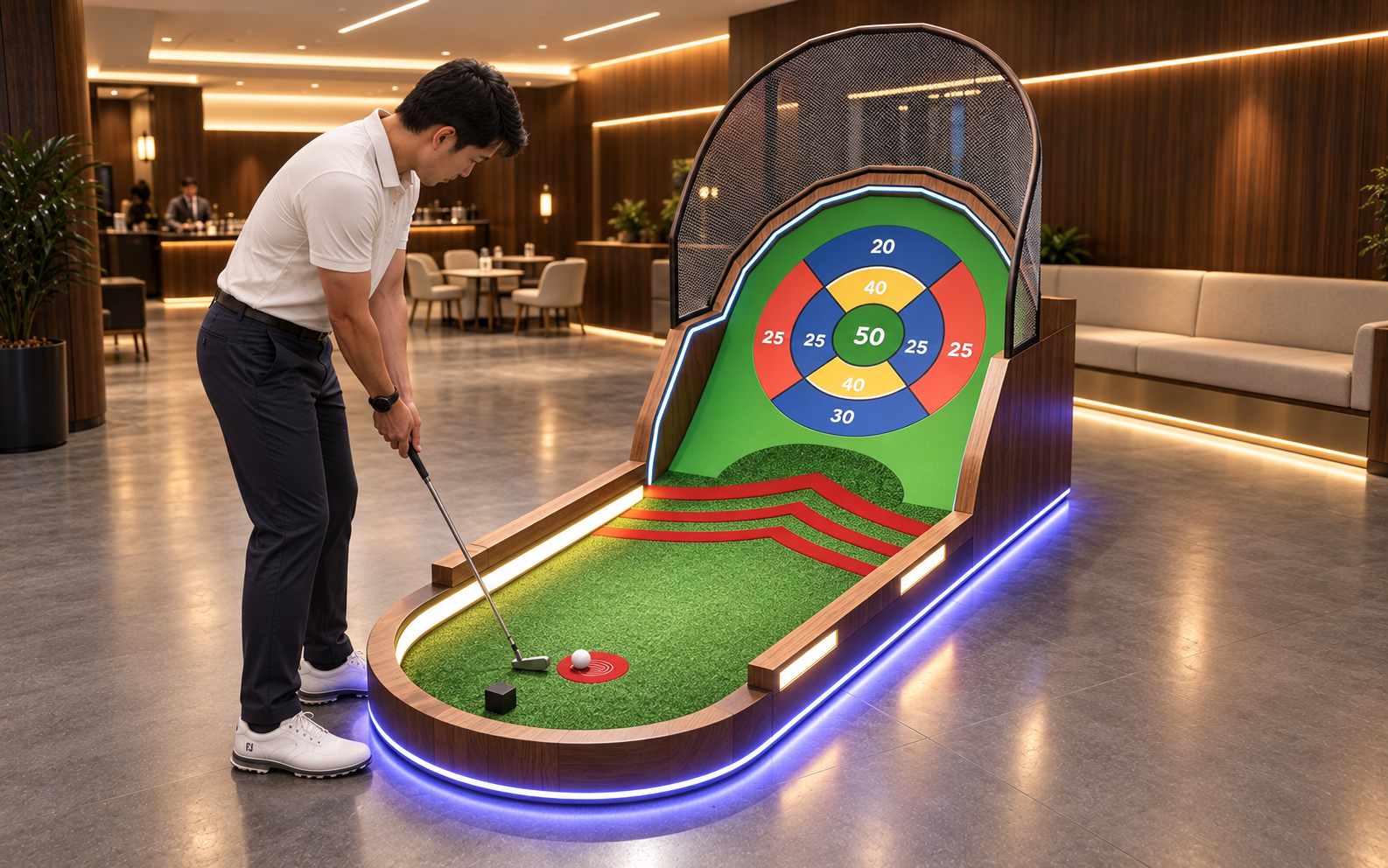
Golf Target Shooting Hole
NextPlay describes target zones with different point values. Use this example when discussing a points-based task and the instructions guests need before a turn.
View Details ›
Bowling Golf Hole
Players putt along a lane towards pin targets. Ask for the complete playing sequence and explain that objective clearly in the guest briefing.
View Details ›
Curve Block Golf Hole
Curved lanes and blocking obstacles shape the ball's route. Review the intended path and the playing instructions for the version you are considering.
View Details ›Describe the game you want guests to play
Planning your own mini golf venue? Share your room plan, intended audience and preferred playing tasks to discuss an equipment proposal with NextPlay.