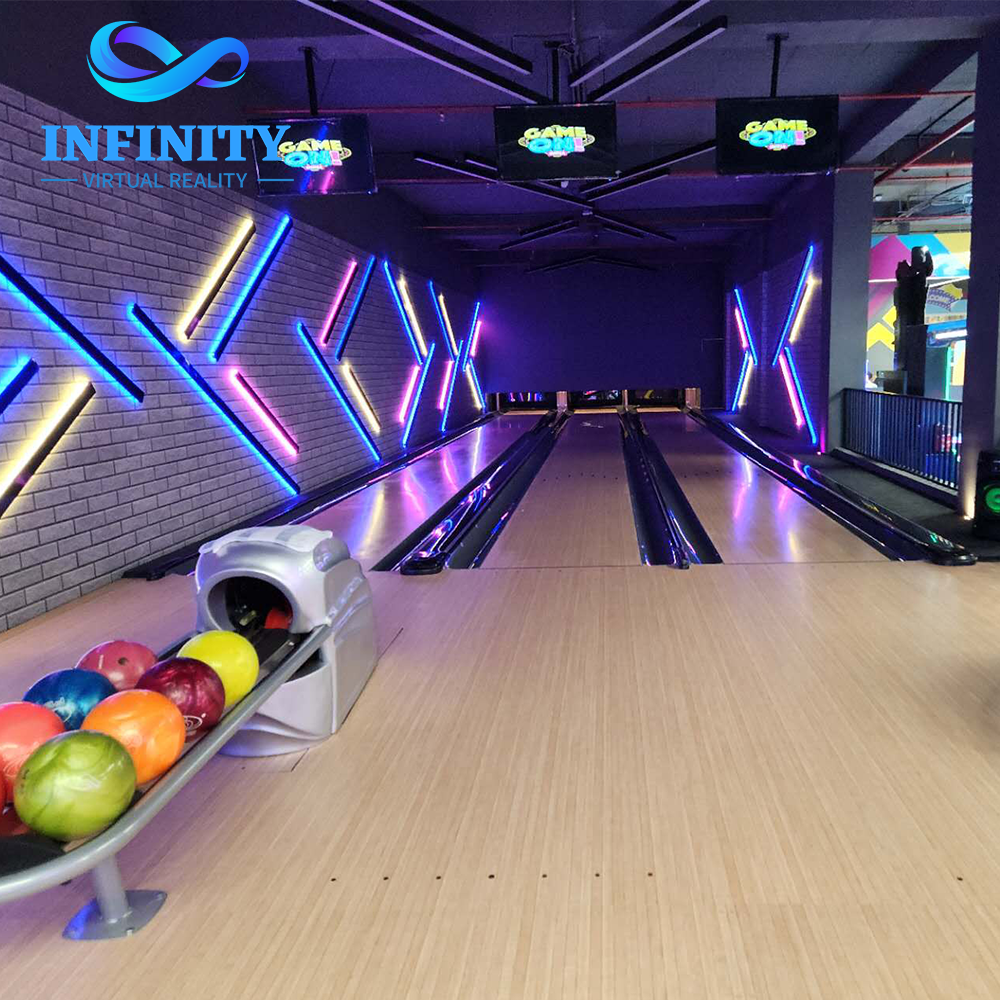
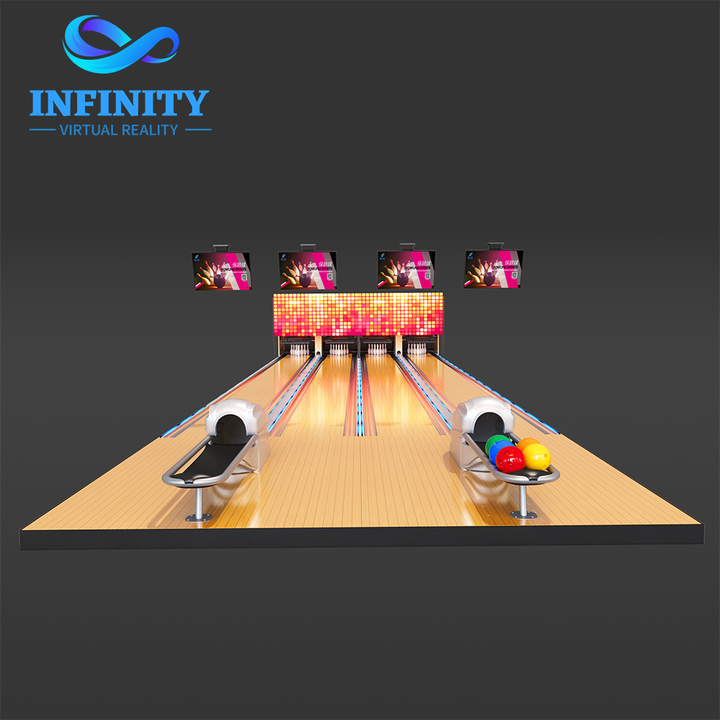
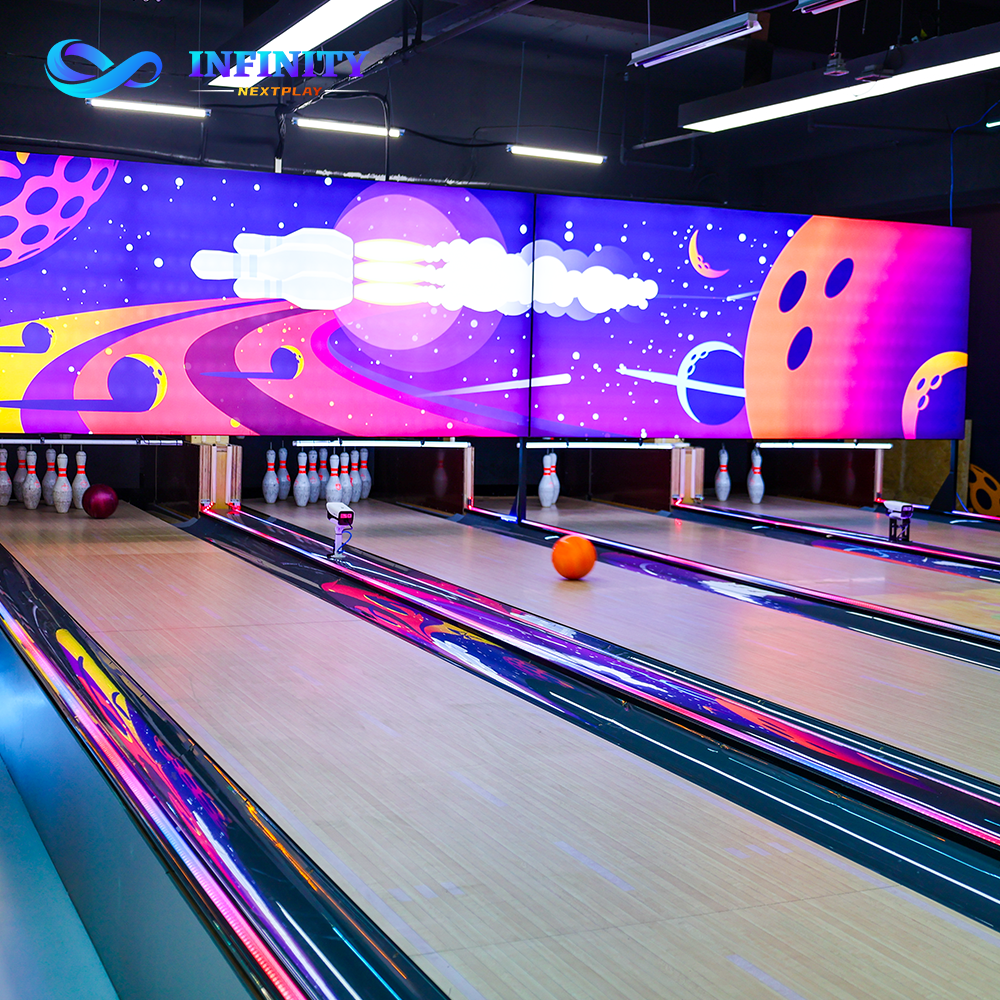
Mini bowling equipment priced on the published bands: the $9,800-$6,400 per-lane ladder, the $28,500 four-lane duckpin package and the $33,000 two-lane string set, the hidden lines that turn $28,500 of equipment into a $39,000-44,000 ready-to-open project, the two-phase growth model and the five levers that move the budget.
Mini bowling equipment costs $9,800 per lane ordered alone, $7,100 per lane inside a four-lane package, and $6,400 per lane at six lanes - the published ladder for the compact duckpin format, and the single most useful set of numbers a project buyer can carry into a budget conversation. Mini bowling, in this catalogue, is the compact-format category: the 12-to-14-meter duckpin lane with its 1.5 kg no-finger-hole ball, the string-format lane, and the integrated pinsetters that remove the machine room. The price bands below are package prices for that category, quoted the way turnkey projects actually buy - by configuration, not by machine.
The ladder exists because the package, not the lane, is the ordering unit. A single-lane order carries the full package overhead - the matched pinsetter, the scoring line, the engineering and the commissioning - on one lane, which is why the first lane carries a 38 percent penalty against the four-lane rate. The lane-count analysis (which lane count is the most cost-effective) measures the steps exactly: the biggest drop sits between one lane and four, the per-lane price flattens toward six, and the staff line holds at one attendant until the sixth lane forces the second shift.
One reading rule keeps the rest of this page honest: a per-lane price without a lane count is a teaser. Every number below is anchored to a configuration and a published source, and the budget stack at the end carries the lines - freight, installation, site preparation - that turn an equipment price into a project price.
The published ladder deserves its own table, because each step has a budget consequence.
| Lane count | Per-lane price | Published reference | What drives the step |
|---|---|---|---|
| 1 lane | $9,800 | Single-lane duckpin order with pinsetters and scoring | Full package overhead on one lane |
| 4 lanes | $7,100 | $28,500 four-lane duckpin package | Overhead spread; matched machine set |
| 6 lanes | $6,400 | Six-lane order at the bulk rate | Deepest discount; second staffing shift opens |
The split-delivery rule is the ladder's practical payoff. The venue that plans to open with two lanes and add two later should order the four-lane package and split the delivery, because two single-lane orders cost about $7,000 more than the package - the published comparison is blunt about it, and the same logic scales up: the six-lane order with a split delivery locks the $6,400 bulk rate while the lanes arrive on the phase-two date. The delivery schedule is part of the scope the supplier commits to, which makes the split delivery a pricing tool, not a favor.
The format frames the ladder too. The duckpin numbers above are the density leader; the commercial 2-lane string bowling equipment prices the entry band at $24,000 to $32,000 for the pair in the 2026 alley-cost benchmarks, and the standard 10-pin bowling alley plays a different sport entirely - the full-size anchor that starts where the compact ladder ends.
Per-lane prices only make sense against the package totals they add up to, and the published lane-cost breakdown (the per-lane cost breakdown) prices all three formats the project buyer is choosing between. The four-lane duckpin package totals about $28,500 for the equipment - $7,100 per lane with the overhead spread - and carries the scoring line inside it at about $4,800 across the four lanes, a line that does not exist in a refurbishment quotation at all. The two-lane string package with scoring prices at about $33,000, or $16,500 per lane, the middle band for compact centers. The premium ten-pin lane runs $58,000 to $75,000 before scoring, and the ten-pin wings that anchor large centers start from about $235,000 for four lanes.
| Format package | Published total | Per lane | Note |
|---|---|---|---|
| Duckpin 4-lane package | About $28,500 equipment | $7,100 | Scoring line about $4,800 included; 12 m lanes |
| String 2-lane package | About $33,000 with scoring ($24K-32K entry band) | $16,500 | 18-26 m lanes; field-serviceable string units |
| Ten-pin 4-lane wing | From about $235,000 | $58K-75K premium lane | 26 m lanes; machine room; 4-6 week install |
The alley-cost benchmarks (the 2026 alley-cost guide) carry the same story in annual-market form: $6,500 to $8,000 per duckpin lane, the string two-lane set at $24,000 to $32,000, $38,000 to $48,000 per ten-pin lane, and a full venue starting above $50,000 - with the light-conversion projects at $15,000 to $25,000 and the ten-pin campus builds from $120,000 upward. The format choice is the biggest single line in the budget: the profit-format analysis (the most-profitable-format comparison) shows the duckpin wing winning below 500 square meters on density while the ten-pin anchor wins above it on absolute revenue per lane, and the payback comparison (the duckpin vs 10-pin payback analysis) prices the same trade as $25,000 to $35,000 all-in per duckpin lane against $50,000 to $70,000 for ten-pin.
For the buyer mapping equipment to floor plan, the format guide (the duckpin format guide) and the equipment explainer (the duckpin bowling equipment guide) document the $45-per-lane-hour rate and the 55-to-70-square-meter pair footprint that the four-lane package prices are built to monetize - the revenue side of the price bands this page owns.
The single most expensive misunderstanding in a mini bowling budget is reading the equipment price as the project price. The published lane-cost breakdown prices the gap explicitly: installation and commissioning at about $950 per lane for the duckpin and string formats, ocean freight at $1,500 to $3,500 depending on the port and the pallet count, and a last-mile delivery line of $600 to $1,500 when the door is narrow or the route is obstructed. Site preparation sits outside the supplier quote entirely - the owner pays a local contractor - and the training and commissioning day that closes the install is part of the package scope the checklist article grades line by line (the turnkey package checklist).
The published ready-to-open number proves the arithmetic. The four-lane duckpin project that opens with $28,500 of equipment lands at about $39,000 to $44,000 all-in once installation, freight and site preparation join the line - and the EXAMPLE budget stack below shows exactly how the bands add up.
| EXAMPLE budget stack: four-lane duckpin project | Published figure | Source line |
|---|---|---|
| Equipment package (lanes, pinsetters, returns, scoring) | $28,500 | The four-lane duckpin package |
| Install + commissioning | About $3,800 ($950 x 4 lanes) | Per-lane project line |
| Ocean freight | $1,500-3,500 | Port and pallet count |
| Last-mile delivery | $600-1,500 | Door and route constraints |
| Site preparation | Owner-paid, local contractor | Outside the supplier quote |
| Ready-to-open total | About $39,000-44,000 | The published all-in project price |
The hidden lines reward early pricing twice over. Priced early, they are budget lines a landlord and a lender can underwrite; discovered late, they are the schedule slips that move the opening date - which is why the supplier math matters as much as the equipment math. The package breakdown (the full-venue package breakdown) puts the single-supplier quote against the multi-vendor assembly at the same scope: about $150,000 against $180,000, on the compact projects where the sourcing savings matter most.
Not every project buyer can fund the full ladder on day one, and the published two-phase model exists for exactly that buyer. Phase one: four lanes on the package price - the $28,500 duckpin package prices the lanes at $7,100 each, and the wing reaches its payback range at 60 percent utilization. Phase two: the two-lane extension ordered at the bulk rate - about $6,400 per lane, locked at the original order with a split delivery - with the second staffing shift opening only when the fifth-lane demand holds it. The staff line is part of the model: one attendant per shift covers four lanes, shoes, scoring and the counter, and the second shift is a demand decision, not a default.
The revenue side of the model is published too. At 70 percent utilization the duckpin lane earns about $198 per day, the four-lane wing contributes about $11,100 per month before the waiting-zone lines, and the waiting-zone games - the darts, the shooters, the redemption corner that ride the same floor - add about $1,800 per month of margin where two lanes alone hold about $800. The profit analysis (the bowling profitability model) runs the full cost line: $4,600 to $6,200 of monthly running costs against roughly $7,900 of net contribution at target utilization, which repays the $28,500 equipment line in about 5 to 7 months and the full $40,000 to $48,000 opening budget in 6 to 7.
The payback comparison (the duckpin vs 10-pin payback analysis) closes the model with the caution that protects it: the illustrative four-lane payback runs about 14 months on the all-in investment, against 18.5 months for ten-pin, and utilization is the master lever - the wing that holds 70 percent of a $45-per-lane-hour rate is the one that lands near the published lines. Budget the phases, order the package once, and let demand - not optimism - open the second shift.
Five levers move that budget, and every one of them has a published range. Format: the duckpin package is the density price, string is the entry band, ten-pin is the anchor price - the biggest single swing in the budget. Lane count: the ladder from $9,800 to $6,400 per lane, with the 38 percent penalty for going it alone. Spec: scoring is a line - about $4,800 across four lanes in the duckpin package - and the automatic-versus-string pinsetter choice trades machine cost against serviceability. Logistics: $1,500 to $3,500 of freight by port and pallets, $600 to $1,500 of last-mile by door and route. Building: the converted unit clears its 6-to-10-day site-prep clock where a new shell carries 3 to 5 weeks of it.
The EXAMPLE buyer ties the levers together. A $30,000 equipment budget: the four-lane duckpin package at $28,500 fits, the $3,800 installation line and the freight band push the project to the published $39,000-44,000 ready-to-open range, the wing monetizes at about $198 per lane-day at target utilization, and the phase-two extension prices at the locked $6,400 when demand earns it. The buyer who prices all five levers before signing is the buyer whose budget survives contact with the port, the door and the calendar.
The cost questions project buyers ask before budgeting a mini bowling project, answered with the published references.
The published ladder prices the compact duckpin format at $9,800 per lane ordered alone, $7,100 per lane inside the four-lane package, and $6,400 per lane at six lanes. The four-lane duckpin package totals about $28,500 for the equipment, and the two-lane string package with scoring prices at about $33,000 - with the string entry band at $24,000 to $32,000 in the 2026 benchmarks.
About $39,000 to $44,000 ready to open: the $28,500 equipment package plus about $3,800 of installation and commissioning at $950 per lane, $1,500 to $3,500 of ocean freight, $600 to $1,500 of last-mile delivery, and site preparation paid by the owner to a local contractor.
The first lane carries the full package overhead - the matched pinsetter set, the scoring line, the engineering and the commissioning - which is the published 38 percent single-lane penalty. Two single-lane orders also cost about $7,000 more than one four-lane package, which is why the split-delivery order is the standard move for phased projects.
The published entry points: the two-lane string package with scoring at about $33,000 ($16,500 per lane), with the string two-lane band at $24,000 to $32,000 in the alley-cost benchmarks, and the duckpin pair documented at a 55-to-70-square-meter footprint where the bar-scale builds run the $45-per-lane-hour rate.
The project lines an equipment quote leaves out: installation and commissioning at about $950 per lane, ocean freight at $1,500 to $3,500, last-mile delivery at $600 to $1,500, owner-paid site preparation, and the training and commissioning day - the lines that turn the $28,500 equipment price into the $39,000-44,000 project price.
The published model runs the four-lane wing at about $11,100 per month at 70 percent utilization against $4,600 to $6,200 of running costs, repaying the $28,500 equipment line in about 5 to 7 months and the full $40,000-48,000 opening budget in 6 to 7 - with the illustrative all-in payback at about 14 months and utilization as the master lever.
Five lines to budget by.
Price the floor before the equipment: drop the lanes onto the real plan with the free 3D layout design, compare the duckpin bowling system and commercial 2-lane string bowling equipment packages against the ladder, and hold the full buying route in the duckpin bowling equipment guide before the budget goes to the signature.
Send the room dimensions and the lane count: we will return the package quote on the published bands - equipment, freight, install and commissioning itemized - plus the footprint plan via the free 3D layout design, from the duckpin bowling system ladder to the commercial 2-lane string bowling equipment entry set.