A commercial multi-sport simulator is one tracking-powered bay that switches sports on the same footprint - this guide defines it against the three architectures, the venue pre-checks and the buy boundary with single-sport gear.
What is a multi-sport simulator, in the sense a venue operator actually buys? It is one tracking-powered bay that plays several sports on the same footprint: the screen, the mat, the sensors and the safety net stay where they are, and the sport changes in software. One machine, one floor area, a menu of sports - and every clause of that sentence is a buying decision, because the class rather than the brand on the bezel sets the price band you are quoted, the floor area you commit, and the throughput you can sell on a Saturday night.
This page defines the equipment class, which is a different job from the venue-level definitions already published on this site. The what is sportainment page and the multi-activity indoor entertainment center definition describe rooms, categories and zone plans; a multi-sport simulator is one machine that occupies a single bay inside one of those rooms. Operators get into trouble when they price the machine and plan the room in the same sentence - the two decisions share a floor plate, not a budget line.
Three near-neighbours are not this class. An arcade cabinet is not a multi-sport simulator, because the input is the cabinet controls: a basketball or boxing cabinet stays an arcade game whatever the marquee says. A single-sport machine with variant modes is not this class either - a golf simulator that only plays driving-range and course formats is one sport with a deep content list, a legitimate buy that simply answers a different question. And a headset-only VR attraction where the guest never handles a real ball or club belongs to the separate VR-based band, which JAMMA prices at $8,000-35,000 (according to JAMMA).
The price bands track the definition closely enough to be useful. A commercial multi-sport simulator is quoted at $18,000-60,000 for screen, mat and sensors together, at a 12-25 square meter footprint and 20-40 guests per hour of throughput (according to the JAMMA Multi-sport Simulator Buying Guide). The type bands split further - golf-focused builds at $20,000-80,000, VR-based builds at $8,000-35,000, compact batting builds at $12,000-40,000 (according to JAMMA) - so the first line to check on any quotation is which class the number belongs to. Buy the class, then the brand.
Ask three vendors for a multi-sport simulator and you will get three different machines under the same name, because the sensing layer is where the architectures diverge. Optical and depth-sensing cameras image the ball and the body and let software infer the result; radar and launch monitors measure the launch of the real ball directly; photometric camera pairs plus infrared read the scene at high frame rate and hold up when the room lights go down. The architecture decides the calibration routine, the spare-part list and how the unit behaves under your own lighting, which is why it belongs on the specification before the price does.
| Architecture | How the object is read | Vendor anchor (researched) | What it means for your room |
|---|---|---|---|
| Optical / depth-sensing cameras | Image of ball, club and body motion, mapped to a sport in software | aboutGOLF Multisport runs depth-sensing cameras across 8 game modes, with the sensor add-on from $3,500 (according to aboutGOLF) | Calibration and lighting sensitive - ask for the calibration routine and the lighting limits |
| Radar / launch monitor | Direct measurement of the real ball launch: speed, angle and spin | Foresight Sports sells multi-sport launch monitors, including a GCHawk soccer skill drill listed at $1,000 (according to Foresight Sports) | Reads the ball rather than the room - needs a repeatable hitting or kicking position |
| Photometric cameras + infrared | High-frame-rate photometric pair, with infrared filling fast and dark play | Sports Simulator covers 100+ sports from dual 90-degree photometric cameras plus infrared (according to Sports Simulator) | Sensor count and infrared coverage drive the hardware line - check camera positions on your layout |
Content depth is sold alongside the architecture, and the two are priced separately. TruGolf MultiSport ARCADE carries 14 games at $4,500-5,000 as an add-on (according to TruGolf); the aboutGOLF Multisport entry sits at $3,500 on the sensor side (according to aboutGOLF); the Sports Simulator Elite Edition lists at $29,950 for 60+ sports across three cameras (according to the Simulator Showroom price list). A quotation that names a sport count without naming the sensor that reads it is only halfway to a specification - the sport count is software, the sensor is the part that has to survive your room.
The same discipline applies to any technology-led attraction definition you put on this floor: the published interactive mini golf definition is written the way a specification should be read - what the hardware measures, what the software adds, and where the two stop. For a multi-sport simulator the equivalent questions are short: which architecture, how many sensors, what does a replacement sensor cost, what lighting does the calibration allow, and which sports sit inside the licence rather than sold as add-ons. Ask all five before you ask about the sport count.
One more thing the architecture changes: what happens when a mode is discontinued or a sensor fails mid-season. Photometric and camera systems depend on firmware and calibration files, radar systems depend on the launch unit itself, and the add-on prices above are the researched floor for what a replacement part costs when it is sold as an accessory rather than covered as a warranty item. Put the spare-part price in the contract, not in the brochure, and ask which sports survive a software refresh that the vendor stops maintaining.
The operator meaning of the class is arithmetic: one floor plate, several content lines. A bay that hosts golf on a weekday evening, baseball batting on a weekend afternoon and a kicking game for a school group earns from three calendars without a second build-out - which is the whole commercial argument for buying breadth in one machine instead of depth in three. The published NextPlay benchmarks price what a square meter earns when an attraction owns it outright, and those numbers are the yardstick a shared bay has to clear.
| Attraction (published benchmark) | Published monthly efficiency | Read for a multi-sport bay |
|---|---|---|
| Archery lane | ~$960 per m2 per month at 68% utilization | Precision ticket on a tight footprint - the top of the ladder |
| Shooting lane | ~$460 per m2 per month at 62% utilization | Session-paced mid-band - the read any bay has to answer to |
| Baseball batting bay | ~$160 per m2 per month including netting | Netting and safety zones inflate the footprint, so measure net area |
| VR arena | $320 per m2 per month | Group play on a larger footprint per session |
| Eight-zone 1,000 m2 floor | ~$143 per m2 per month | The whole-floor blend that a mixed room actually books |
Three of the published anchors are quoted in other units because that is how the attraction sells: a darts corner at about $1,400 a month, a duckpin lane at $45 per lane-hour and a golf bay at $38 per bay-hour. Read together they say one thing - the ticket and the hour are the levers, and a multi-sport bay gives you more tickets to price on the same hour. The zone-by-zone catalogue in the sportainment examples for indoor venues guide and the mode list in the what you play at a sportainment venue page are where those tickets get named; the bay is where they get booked.
(EXAMPLE) One bay, one assumption set: six booked bay-hours a day at the published $38 per bay-hour golf-bay anchor is $228 a day, and twenty-six open days a month is $5,928. Assumptions stated - a single bay, flat rate, no food and beverage, no free play, no seasonal dip. The point of the figure is the shape of the calculation rather than the number itself, and your own rate card and calendar replace both inputs.
The other side of the ledger is what the footprint costs to fill. A commercial multi-sport unit lands at $18,000-60,000 all-in (according to JAMMA), the researched comparison puts single-sport systems at $15,000-150,000 and above (according to JAMMA), and the published NextPlay cost anchor for a single all-in installed station is $25,000-60,000 (verified). One multi-sport bay replacing three single-sport builds is the same argument the definition opened with, now with a price attached: breadth in one footprint, one install, one service contract, one calibration schedule - and one bay that can be re-priced by changing the mode rather than the lease.
Three questions decide whether the machine can live in your room at all: how high is the ceiling, how many square meters you can hand over, and how many guests an hour the bay has to move. Answer them before the quotation, because all three are cheaper to fix in a floor plan than in a purchase order - and every one of them has a researched number behind it.
Ceiling first: motion and impact simulators want at least 3 meters of clear height (according to the vartarcade venue checklist), and that figure is taken before projector throw and screen height are subtracted. A hall with a mezzanine, a soffit or a sprinkler run under 3 meters either moves the bay or changes the format, and both are decisions you make in the plan rather than on delivery day.
Net footprint second: a single bay runs 10-20 square meters including safety clearance (according to JAMMA), while commercial multi-sport units are quoted at 12-25 square meters of footprint (according to the JAMMA buying guide) and a VR corner wants 30-50 square meters to open small (according to vartarcade). Then give the room its non-play share: an industry layout guide puts 25-35% of total area to reception, circulation, queue and back-of-house (according to Victor Activate Games), while a vendor rule of thumb splits the floor 60% play, 20% circulation, 15% support and 5% queue (according to Blee Game). Two rules, one job - choose which one your lease arithmetic uses and write it on the plan.
Throughput third: the buying guide puts a system at 20-40 guests per hour with a typical dwell of 45-90 minutes (according to JAMMA), which makes the bay revenue line a scheduling problem as much as a hardware one. Placement is part of it - machines within 10-15 meters of the entrance draw 30-50% more plays than the same machines deeper in the room (according to Yulong Sports) - and so is the mix: rotating three or more machine types lifts guest dwell by 40-60% (according to Yulong Sports). A multi-sport bay is the cheapest way to supply that rotation, because the second and third sports are already inside the licence you paid for.
Take those three answers into the layout stage rather than the checkout: the free 3D layout design places the bay, the clearance and the queue share on your actual floor plate, and the published sportainment venue zone plan shows how that bay sits beside the rest of the floor. A pre-check done on paper costs an afternoon; the same three questions answered after delivery cost a refit.
The boundary between multi-sport and single-sport is not a quality line, it is a proposition line. Buy multi when the floor plate has to serve several audiences and the calendar has to change by season; buy single when one sport is the reason a guest makes the trip. Everything else in the comparison follows from that one sentence, which is why it is worth settling before any quotation arrives.
| Your situation | Buy | The vendor comparison (according to JAMMA) | Why it holds |
|---|---|---|---|
| Testing a new category on a shared floor plate | Multi-sport | $10,000-70,000 band; 30-60 minute dwell; 6-24 month payback band | One footprint serves several calendars |
| Selling one sport as the reason to visit | Single-sport | $15,000-150,000 and above; 60-120 minute dwell; 9-36 month payback band | Depth, real gear and a training proposition |
| Adding a second category beside an anchor attraction | Decide on net m2 and booked hours | The same two bands - the deciding input is the floor plate you already have | The bay must fill the hours your anchor leaves empty |
The comparison behind those three rows is JAMMA research on multi-sport versus single-sport systems (according to JAMMA): price at $10,000-70,000 against $15,000-150,000 and above, dwell at 30-60 minutes against 60-120 minutes, and payback at 6-24 months against 9-36 months. Shorter dwell means more turnovers, so throughput-led rooms lean multi; longer dwell means deeper sessions, so training, league and coaching formats lean single. The bands are vendor comparisons rather than measurements of your room, and your own booked hours decide which band you can actually live in.
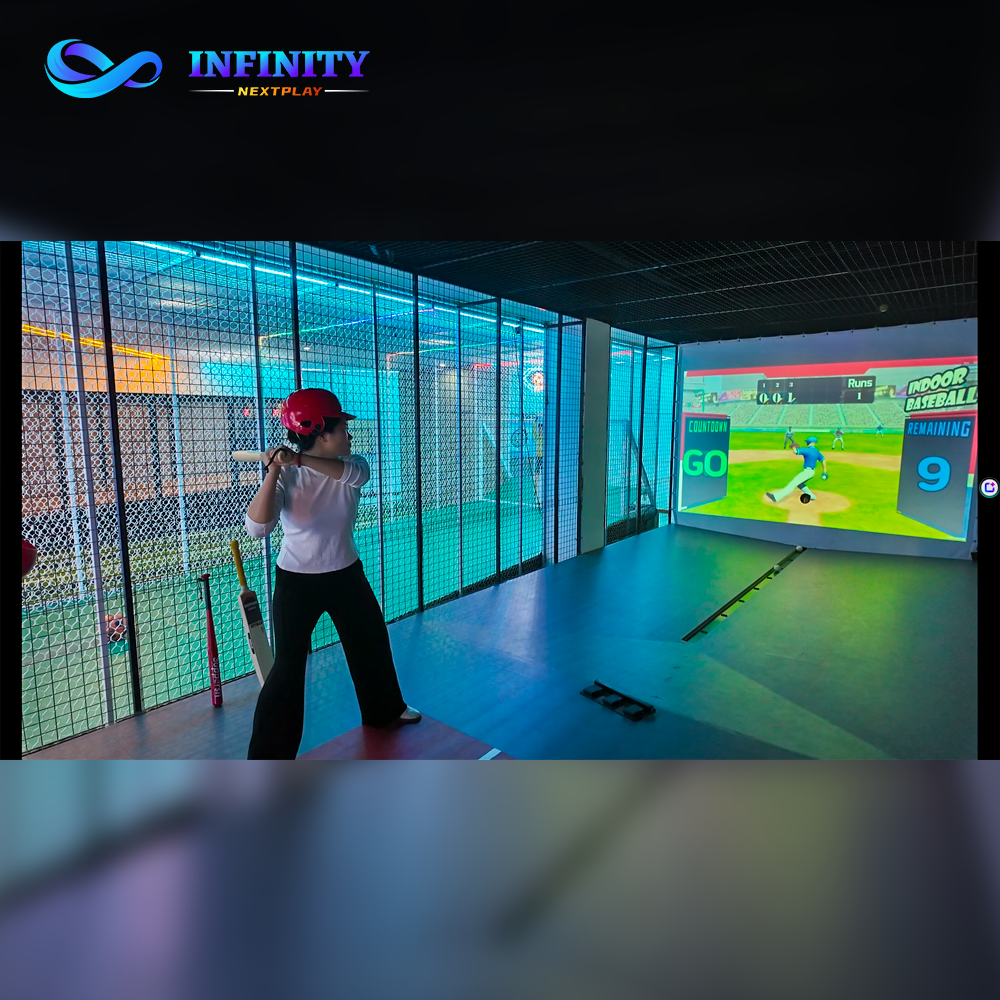
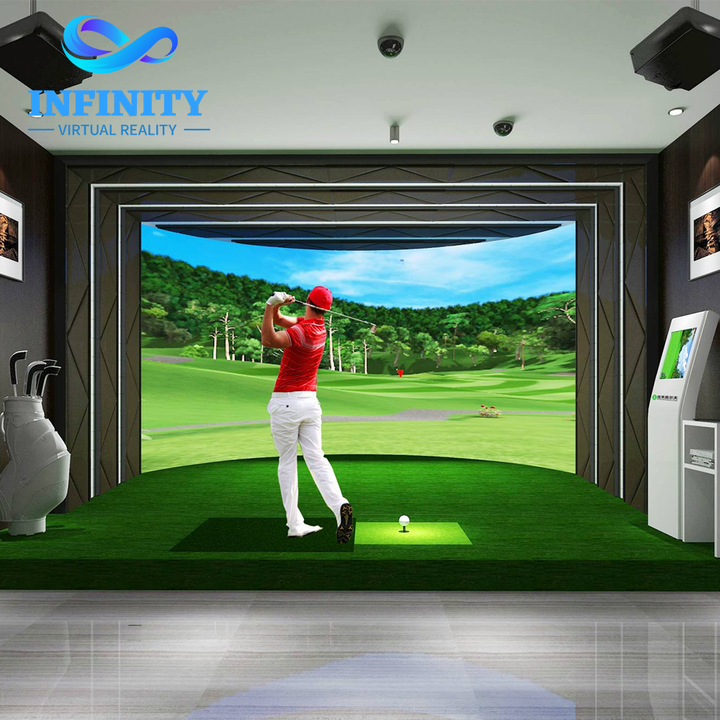
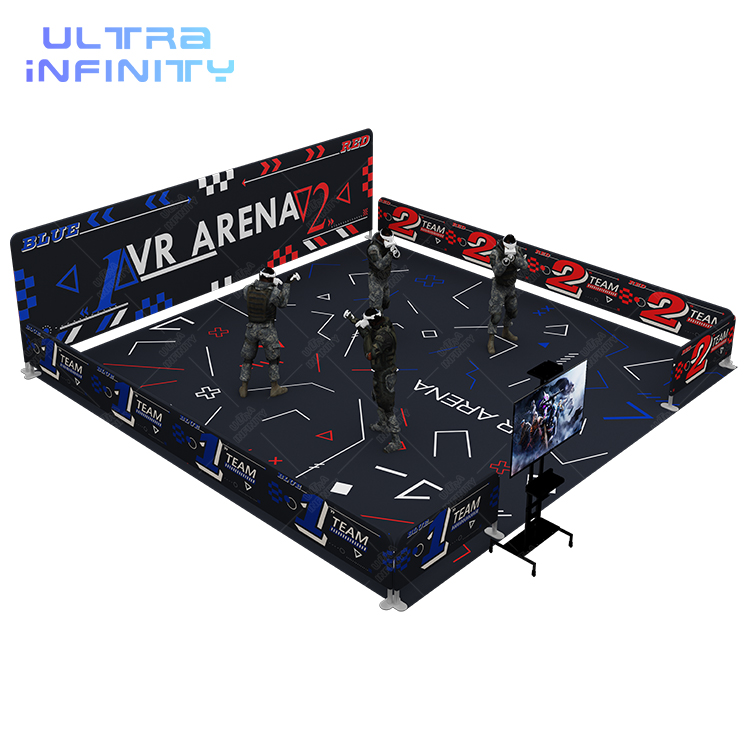
There is a third answer, which is the one most published venues land on: run one multi-sport bay for breadth and one deep single-sport bay for the audience that will travel for it. In this catalog that reads as the Immersive Indoor Baseball Batting Simulator for single-sport depth, the Indoor AR Golf Simulator for camera-tracked sessions on the training calendar, and the Free Roaming VR Arena 2.0 for group throughput between bookings - three propositions, one floor plate, one pre-check.
A specification sheet is a list of the things you refuse to take on trust. Ten lines cover almost everything that kills a multi-sport purchase after the crates arrive, and every one of them can be answered before a deposit moves.
(EXAMPLE) The illustration buyers quote back most often is the JAMMA single-bay model: $30,000 up front at $8 per 15-minute session, 24 sessions a day over 30 days is 720 sessions, $5,760 gross and $4,032 net a month, paying back in about 7.4 months (JAMMA illustration). Assumptions stated - full-price occupancy at the listed session rate, no free play, no seasonality, and operating cost already folded into the stated net. Treat it as the shape of a model rather than a forecast: third-party steady-state data puts a golf bay at $95,000-115,000 a year at 36% utilization and $55 per hour (supported, Tabski), and X-Golf franchise disclosure shows a median of $94,970 across 114 stores inside a $58,785-247,991 range (platform and FDD data).
Two more lines belong in the model before you sign. Food and beverage: an NGF survey of 354 operators found roughly $0.73 of F&B spend for every $1 of bay revenue, a $55 session against about $40 of F&B per visit (according to NGF data via Tabski), so the bay yield is larger than the rate card suggests. And utilization: the researched life-line says an annual utilization under 25% leaves a staffed four-bay room unable to cover fixed costs, with a first-year average near 33% (platform data). Every quotation that promises payback owes you the utilization figure it assumed - ask for it in writing.
Run the checklist against a real floor plate before you run it against a price: the free 3D layout design places the bay, the clearance and the queue share on your plan, and the three configurations below are the ones this catalog pairs with that plan.
A multi-sport simulator is one tracking-powered bay that plays several sports on the same footprint: the screen, mat, sensors and safety net stay where they are, the sport changes in software, and a real ball, club, dart or kick is what the system scores. It is an equipment class rather than a venue category - the room-side definitions live in the published sportainment guides, while this is the machine that fills one bay of that room.
The researched catalogue spans golf, baseball, football, soccer and hockey, with vendor sport counts running from 8 game modes (according to aboutGOLF) and 14 games (according to TruGolf) to 60+ sports on three cameras (according to the Simulator Showroom price list) and 100+ sports on photometric plus infrared hardware (according to Sports Simulator). The question that matters in a quotation is not how many modes exist, but which of them your licence includes and which arrive as paid add-ons.
Three architectures do the work. Optical or depth-sensing cameras image the ball, club and body and let software infer what happened; radar and launch monitors measure the launch of the real ball directly; photometric camera pairs plus infrared read the scene at high frame rate and keep working when the lights drop. Which one a vendor uses decides the calibration routine, the spare-sensor price and how the unit behaves under your own lighting.
Plan 10-20 square meters per bay including safety clearance (according to JAMMA), 12-25 square meters of footprint for a commercial multi-sport unit (according to the JAMMA buying guide), at least 3 meters of clear height (according to the vartarcade venue checklist) and a 25-35% non-play share for reception, circulation, queue and back-of-house (according to Victor Activate Games). The throughput to plan against is 20-40 guests per hour at 45-90 minutes of dwell (according to JAMMA).
The researched comparison puts multi-sport at $10,000-70,000 with 30-60 minute dwell and a 6-24 month payback band, and single-sport at $15,000-150,000 and above with 60-120 minute dwell and 9-36 months (according to JAMMA). Buy multi when one floor plate has to serve several calendars; buy single when one sport is the reason a guest makes the trip. Most published venues end up running one of each beside an anchor attraction.
Send your floor plate and ceiling height: we will return the bay count, the clearance and the throughput frame through the free 3D layout design - anchored with the baseball batting simulator, the Indoor AR Golf Simulator and the Free Roaming VR Arena 2.0.