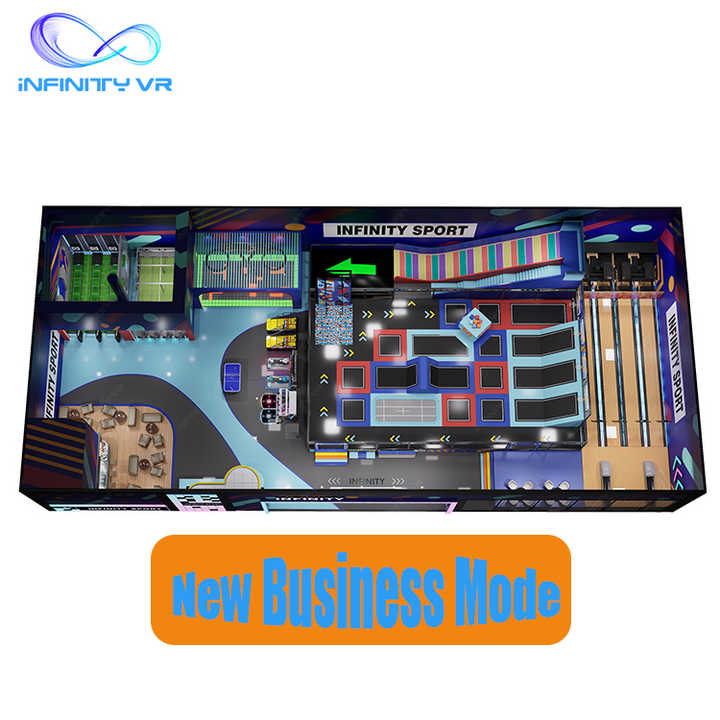
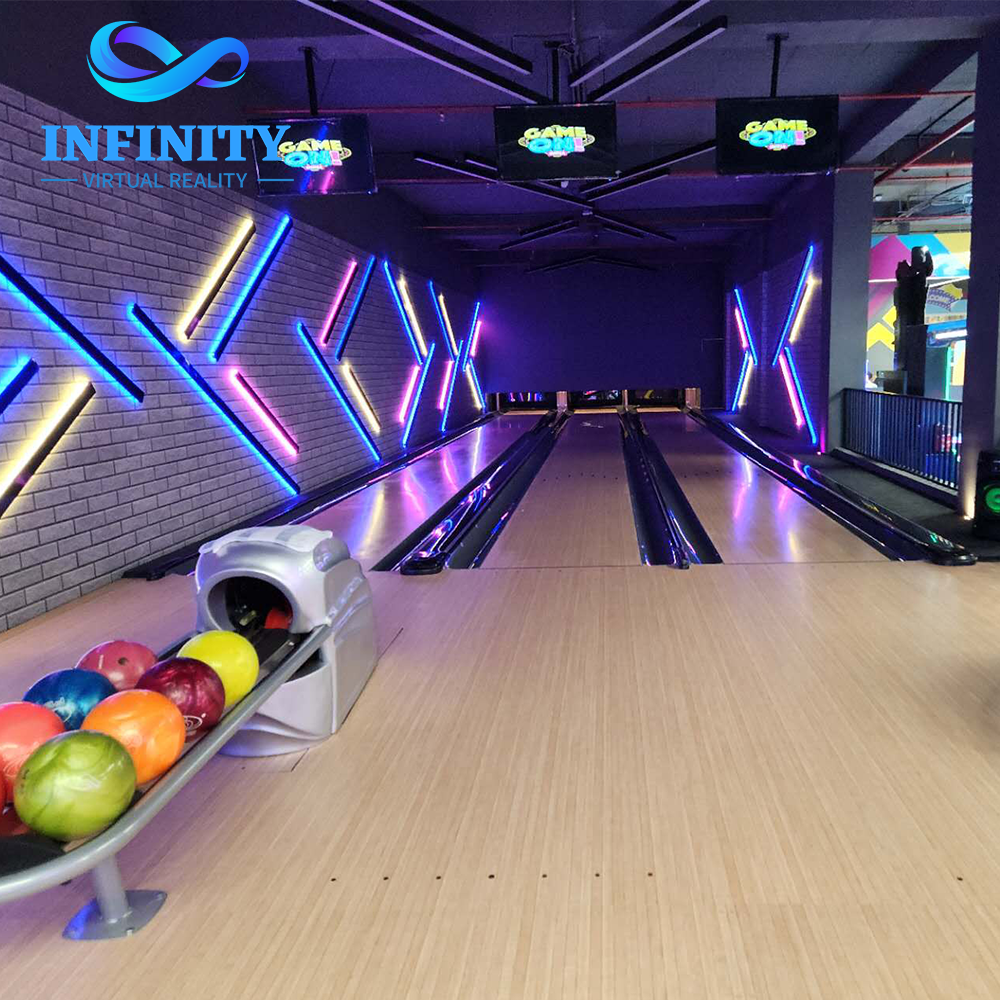
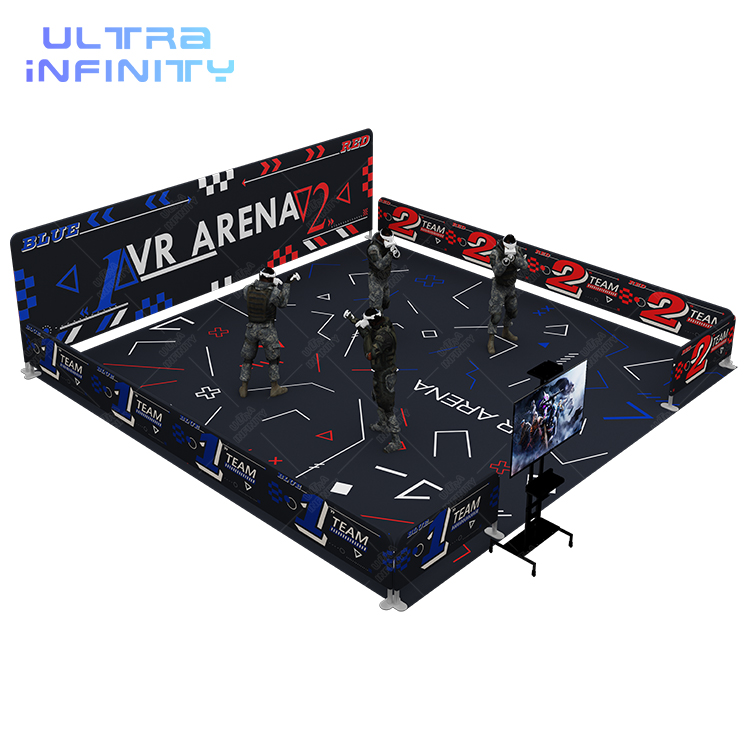
The following equipment units form the primary revenue-generating hardware for the commercial venue described in this guide.
Explore the equipment referenced throughout this guide: Custom Interactive Sportainment Equipment Duckpin Bowling System for Full Venue Solution Free Roaming VR Arena 2.0. Each unit is engineered for commercial-grade reliability and backed by full factory support.
Single-attraction venues face a brutal math problem: one product, one revenue stream, and a hard ceiling on how many visitors you can serve per hour. Multi-activity venues solve this by spreading risk across several attractions and letting each customer spend longer and pay more per visit. A Custom Interactive Sportainment Equipment system anchors the floor while bowling and VR fill out the experience, giving families a full afternoon instead of a thirty-minute stop.
Why Multi-Activity Wins: Multi-activity venues report 30-50% higher spend per visit and 20-35% longer dwell time than single-attraction venues, because each zone is a fresh reason to stay and spend.
Indoor multi-activity venues range from roughly $200,000 for a compact 2,000-3,000 sq ft build to $800,000 or more for a flagship 8,000 sq ft operation. The wide spread comes down to three variables: the number and type of attractions, the quality of fit-out and interior design, and the structural work your space requires before a single machine is installed. Understanding where your concept sits on this range is the first step to a realistic budget.
Attraction equipment is the largest single line item, typically 45-55% of your total budget. The cost per zone depends heavily on the type of hardware you choose. A Free Roaming VR Arena 2.0 commands a premium price because it delivers a multiplayer experience no arcade cabinet can match, while a duckpin bowling package offers a cost-efficient anchor that fills space without filling your entire budget. Spreading the mix keeps your average cost per square foot healthy.
Equipment Share: Equipment typically runs 45-55% of total budget. VR arena: $80K-$150K. Sportainment: $60K-$120K. Duckpin 2-4 lanes: $45K-$90K. Darts/shooting/arcade: $40K-$80K.
Beyond equipment, you must budget for the physical space: demolition, electrical work, flooring, lighting, acoustic treatment, restrooms, and the interior design that makes a venue feel premium rather than generic. Fit-out typically runs $60-$150 per square foot depending on your region and finish level. Electrical and HVAC upgrades are the most common source of budget overruns, especially in older buildings, so include a structural contingency before you commit to equipment purchases.
First-time owners consistently underestimate six costs: licenses and permits, insurance, security deposits and rent guarantee, point-of-sale and management software, initial marketing, and three months of working capital. Insurance for a venue with multiple active attractions can cost $15,000-$40,000 per year, and permit fees vary wildly by municipality. Building these into your budget before opening prevents the classic scenario of a beautiful venue that cannot afford its own launch.
Hidden Cost Checklist: Licenses & permits: $5K-$25K. Insurance: $15K-$40K/year. POS & software: $3K-$8K. Launch marketing: $10K-$25K. Working capital (3 months): $40K-$100K.
Ongoing costs for a mid-size multi-activity venue typically land between $30,000 and $70,000 per month, with rent and staff wages as the two dominant lines. Staffing is the biggest controllable cost: a 3,000-5,000 sq ft venue needs 6-12 staff members at peak, and labor efficiency determines whether you break even quickly or bleed cash. Knowing your fixed monthly burn lets you calculate the daily revenue target you must hit before opening day.
A well-run multi-activity venue generates revenue through entry fees, per-attraction pricing, food and beverage, parties and private events, and membership or loyalty programs. Realistic monthly revenue for a mid-size venue is $40,000-$90,000, with food and beverage contributing 25-35% of the total. The key metric is revenue per square foot: healthy multi-activity venues hit $80-$150 per square foot annually, versus $40-$70 for many single-use concepts.
Revenue per sq ft: Healthy multi-activity venues: $80-$150/sq ft annually. Single-use concepts: $40-$70/sq ft. F&B typically 25-35% of total revenue.
For a typical mid-size venue, you can expect to reach break-even on your total investment within 12-24 months of steady operation. Compact boutique venues with aggressive marketing can approach the 12-month mark, while flagship builds with heavy fit-out tend toward 24 months or slightly beyond. Because a Duckpin Bowling System and a VR arena serve different audiences and peak at different times, the multi-activity mix smooths weekly revenue and shortens your payback window compared with a single attraction.
Most owners fund an indoor entertainment venue through a combination of SBA or commercial bank loans, equipment financing, and personal capital. Equipment financing is attractive because attraction hardware is the collateral and terms often stretch 3-7 years. Some suppliers offer lease-to-own programs that lower your initial cash requirement. Before approaching lenders, prepare a realistic pro-forma showing your break-even point, monthly debt service, and a 15-20% operating contingency.
Funding Mix: Bank/SBA loan: 50-70%. Equipment financing: 20-30%. Owner equity: 10-30%. Keep monthly debt service under 30% of projected gross revenue.
The most expensive mistakes are under-budgeting structural work, over-investing in one attraction at the expense of a balanced mix, and forgetting ongoing costs like maintenance, spare parts, and software subscriptions. Another frequent error is buying cheap equipment to save money, then paying more in downtime and repairs. Work with suppliers who provide full documentation, warranty, and after-sales support, and always build a 15-20% contingency into your total budget.
A compact multi-activity venue costs $200K-$350K, a mid-size venue $350K-$550K, and a flagship build $550K-$800K or more, depending on attractions, size, and fit-out quality.
Most successful venues run 4-6 attraction zones that serve different audiences and peak at different times, which smooths revenue and increases spend per visit.
Typical ROI timelines range from 12-24 months for compact and mid-size venues, with flagship builds extending to 24-36 months.
Food and beverage plus group attractions like VR arenas and duckpin bowling drive the highest margins, but the winning mix depends on your space and target demographic.
Structural work, especially electrical and HVAC upgrades in older buildings, is the most common budget overrun. Insurance and three months of working capital are also frequently underestimated.
Yes. Many owners open with 3-4 zones and add attractions as revenue grows. Choose a modular layout and scalable equipment so expansion is straightforward.
Ready to build your multi-activity venue? Start by mapping your available space, defining your target demographic, and setting a realistic budget range. Then request a professional space plan and equipment quotation from a supplier who can show you a 3D layout, itemized costs, and projected revenue for your specific location. A free design consultation is the fastest way to validate your concept, avoid expensive mistakes, and turn a rough idea into a bankable project.
| Venue Type | Size | Attractions | Total Investment |
|---|---|---|---|
| Compact / Boutique | 2,000-3,000 sq ft | 3-4 | $200K-$350K |
| Mid-Size Neighborhood | 3,000-5,000 sq ft | 4-6 | $350K-$550K |
| Flagship / Destination | 6,000-8,000 sq ft | 6-8 | $550K-$800K+ |
Get a free equipment quote and 3D layout tailored to your space, budget, and target market.