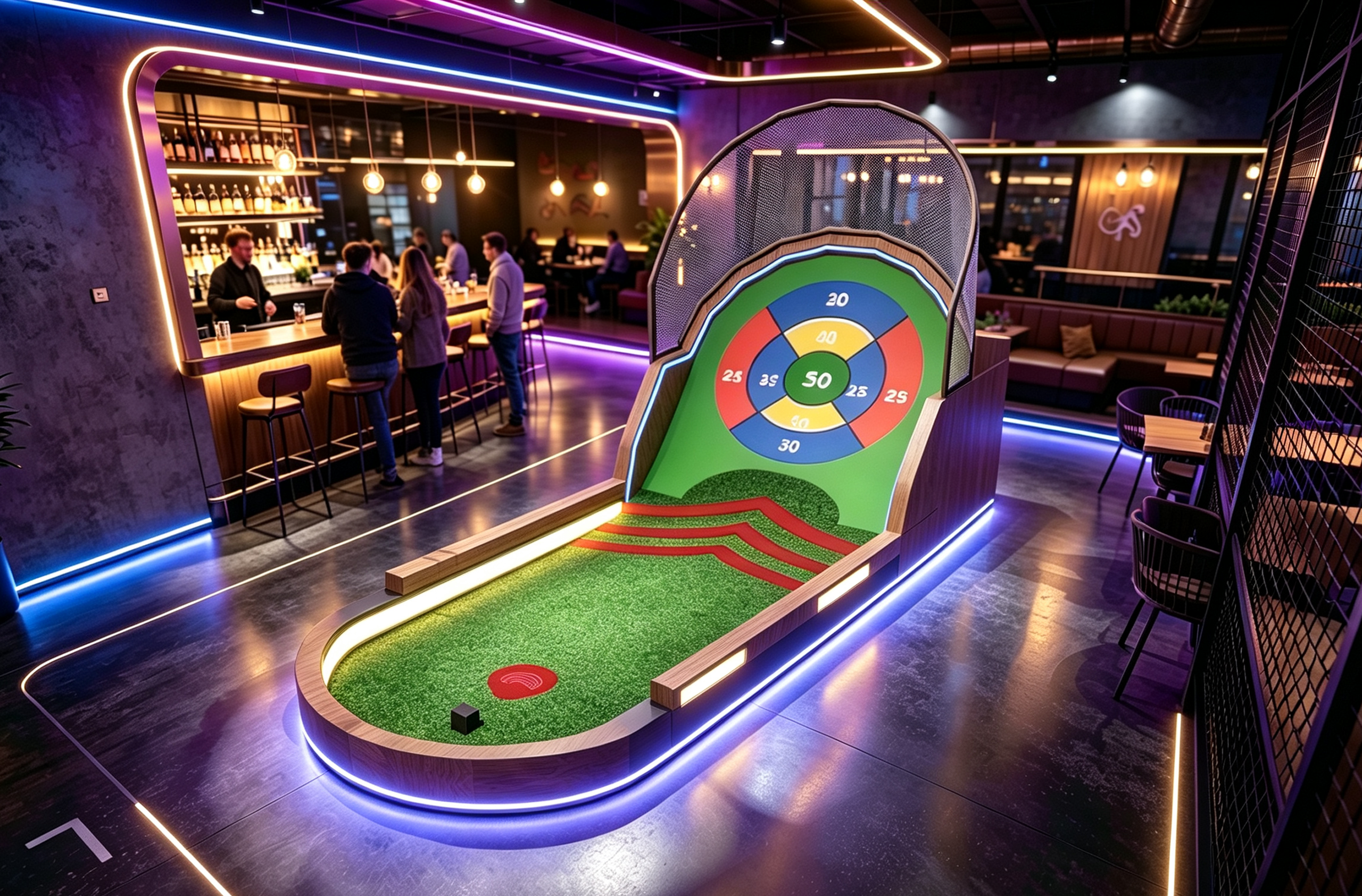
Interactive mini golf is the traditional game, played on a traditional lane, with the ball, the cup and the scoreboard wired. A shot is detected by a sensor rather than seen by a person. The score appears on a screen at the hole rather than on a card. The hole itself can change what it asks of you, rotating themes, difficulty and game modes across the same surface you already walk. Everything a guest actually does, aim, strike, walk, retrieve, is the same as it has been since the first concrete lanes, and that is the point. The format wins not by inventing a new game but by removing the two things that made the old one hard to run and hard to sell twice.
The two things are scoring and staleness. Paper scorecards are the quiet tax on every family group, four kids, one pencil, disputed marks, a first hole lost to finding a pen. And a themed lane is a photograph once: whatever mountain or castle you built in year one is the same mountain in year five, and the repeat visitor walks it with the tiredness of someone who has already seen it. The technology layer in an interactive course attacks exactly those two. Automatic stroke detection keeps the line moving without staff watching every cup, and a digital or re-programmable hole can be a different attraction on a different month without a contractor on site.
This guide is the definition page for that category, and it has to do one chore before anything else, because the phrase is used for at least three genuinely different products. When a search for interactive mini golf, high tech mini golf, immersive mini golf or electronic mini golf lands here, the useful answer is not one product description but a classification: which of three things a supplier means, what each one costs you in floor, staff and cash-flow terms, and which of them your venue can actually operate. Those three classes are set out in section three, and every later section names the class it is talking about.
What this page deliberately does not carry is the money arithmetic. Cost per hole, payback period, revenue per square meter and capacity math already have owner pages in this cluster, each with its assumptions printed, and a hub that restated them would only give the same number two homes and a drift risk. Where a figure belongs to an owner page, this page links to it at the point you would want it. The only dollar figures printed anywhere below are third-party vendor price lines, attributed to the vendor that publishes them, with what they exclude stated in the same breath.
Strip the marketing and an interactive hole is four layers of hardware and software sitting on an ordinary lane. None of it is exotic, and each layer solves a specific operating problem, which is why they can be bought and specified separately. The layer map below is assembled from what the serious vendors publish about their own systems, from the brochure pages of the retrofit specialists down to our own module sheets, and it is worth reading as a shopping checklist rather than as trivia.
| Layer | What is installed | What problem it removes | How vendors describe it |
|---|---|---|---|
| Detection | Sensors at the cup, in props or in the ball path; some systems read a tagged or tracked ball, one published system scans the player putter instead of the ball | The stroke does not need a human witness, so no one has to watch eighteen holes to keep scores honest | Putt Mania describes LED balls that track strokes with up to three electronic scoring cups per hole; Lucky Putt, as published by its builder Creative Works, describes putter scanning and ball tracking with completely automated scoring |
| Display | A screen or LED marker at every hole, plus larger leaderboards on the course | The group does not need to remember where they stand, and competition becomes visible to people who are not playing | Putt Mania publishes 42 inch leaderboards at every hole on its package sheet; our own full-course specification describes live scoreboards and team versus solo boards as software modes on the same eighteen holes |
| Atmosphere | Perimeter LEDs, projection onto the lane, sound, and in some builds fog, wind and moving props on DMX control | The hole can change theme without construction, which is what makes a five year old course feel new | Putt Mania lists hole perimeter LED runs, a projector prop and DMX-controlled fog, lighting and wind; our LED hole theme rotation guide covers the same job from the operator side |
| Management | Course-wide software: player counts, hole-level dwell time, theme and difficulty scheduling, ads on the leaderboards | The operator can see the queue instead of guessing at it, and can price and program the attraction remotely | Putt Mania publishes a multi-course management view showing how many players are on a course, at which hole and for how long; our own game-mode list is scheduling at the software layer, not the contractor layer |
Two notes on that table, because both have caught buyers out. First, the detection layer is where the products genuinely differ, and there is no single best method. Ball-side tracking, cup sensors and putter scanning each have failure modes: a tracked ball is a consumable you lose and recharge, a cup sensor is a mechanism in the path of a five year old with a putter, a putter scan ties play to a tagged grip. The vendors publishing each approach are publishing it as the right one, and the honest reading is that all three work and all three add a maintenance line that a concrete lane does not have. Second, the atmosphere layer is the one most likely to be quoted at you as free or included by somebody. It never is. Projectors, DMX relays and LED runs are boxes, mounts, cabling and a service schedule, and they should appear in a bill of materials the same as a cup does.
If you want the scoring layer argued properly, with the queue arithmetic behind it, that case is made on its own page, manual scorecards or sensor leaderboards, and the hourly consequence of whichever you pick is carried on mini golf course capacity. This section exists so that when you read those pages you know which of the four layers is doing the work.
The phrase interactive mini golf is used commercially for three products that differ in what you buy, where it goes, and what it does to your floor plan. Mixing them up is the single most common research error we see in inquiries, usually because a buyer watched one video of each and their brains filed them together under screens plus putting. They are not the same purchase, and the difference is not branding.
| Class | What it is | Who sells it | What it replaces or adds |
|---|---|---|---|
| Retrofit technology layer | Sensors, scoring, leaderboards, lighting and show control installed onto lanes that already exist, playable or not already irrelevant | Putt Mania is the clearest public example, its brochure states the package retrofits an existing indoor course, and the association coverage repeats the retrofit claim; our own full-course specification builds the same layer in from new | Adds to an existing course, no new construction, the lanes themselves keep their shape |
| Modular electronic holes | Individual self-contained game units, a putt-through challenge with its own scoring, lighting and adaptive difficulty, delivered as a piece of furniture | This is our product line, described further down, published standalone challenge holes from a parkour-style traverse to a multi-zone target hole | Adds playable challenge points into a floor that has no lanes at all, or dots an arcade, a bar or a lobby |
| Arcade putting cabinet | A seated or standing screen game where you putt a ball into scoring holes on a machine; nothing walkable | Sega ships one, a twin-cabinet putting game with seven scoring holes that links up to three pairs, covered by arcade trade press in mid-2026; several distributors pitch similar machines | Replaces nothing; it is a floor-standing impulse machine that is not a mini golf course and should never be priced against one |
The reason the classification matters commercially is that each class answers a different question. The retrofit class answers my course is old and my repeat rate is dying. The modular class answers I have no lanes at all but I have floor, footfall and a wall to feed. The cabinet class answers I have a wall to stand a machine against and a queue of children. A venue that buys class three while researching class one has bought a toy, and a venue that quotes class two pricing for a class one project is comparing a piece of furniture to a construction contract.
The other three keyword phrasings map across these classes without difficulty. High tech mini golf and electronic mini golf are searches for the detection and display layers, which means classes one and two, and almost never three. Immersive mini golf is a search about the atmosphere layer, projection and lighting and theme, which in practice means the show-heavy end of class one or a newly designed course built around re-themable holes. If you are searching those phrases and deciding a budget, anchor first on which of the three tables above describes what a supplier is pointing at.
The comparison table is the heart of this page, so it is worth stating the standard of evidence used in every cell. Where a line is published by a vendor about its own product, the cell says so. Where a line is our own specification or our own planning model, the cell says that too. Where no credible number exists in public at all, the cell says none, rather than filling in a plausible one. Traditional mini golf is not a strawman in this table. It is cheaper per hole, it fails less often, and for a destination outdoor venue with a strong theme it may well be the better product. The technology earns its place under specific conditions, and the table is where you can see them.
| Dimension | Traditional lane | Tech layer over the same lane | Evidence and honest caveats |
|---|---|---|---|
| Scoring | Paper cards, turn-by-turn play, an adult watching children mark boxes | Automatic stroke detection at the cup or in the ball; scores posted at every hole | Reported by Putt Mania and by Lucky Putt builder Creative Works for their own systems; the queue consequence on our side is on the scoring-technology page |
| Group flow | One group per hole at a time, pace set by the slowest card | Up to six players on the same hole simultaneously, per Putt Mania; our modular holes publish one to three or one to four players depending on the module, per two to three minute round | The vendor figures describe their systems and game modes; our round clock is a machine specification, not an observed park average |
| Theme life | A fixed physical theme from opening day; refresh means a contractor | Lighting, projection and software modes rotate on the same surface | Our theme-block design is first-party; the rotation economics are argued on the LED hole theme page |
| Staffing | Attendants, card collection, score disputes, party desk | One attendant supervising an auto-scoring eighteen is a claim published on the retrofit vendor site and on our own solution page | Both claims are self-interested, one from a retrofit vendor and one from us; treat as a planning assumption to test against your own layout |
| Maintenance | Concrete, carpet, a rail, the occasional repaint | The lane list plus sensors, cups with mechanisms, balls as consumables, screens, projectors, lamps | Unavoidable and under-discussed; our weekly maintenance checklist covers the pin, rail and sensor version |
| Footprint | A full course is multiples of nine holes, Wikipedia notes the usual hole is under ten meters long | Retrofit adds zero floor to an existing course; modular units are furniture; a challenge-style build is quoted at roughly 400 square feet per hole by one builder | The retrofit and modular numbers belong to different product classes, and the third-party 400 square foot line belongs to a third measurement scale again, nearer full-course per-hole areas than to furniture; none of them may be averaged into one planning figure |
| Round time | Commonly estimated at 45 to 60 minutes for eighteen holes in public guidance | No independent timing for tech courses; vendor materials avoid stating a round clock | The traditional figure is low-grade consensus, not a standard; the absence of a tech figure is itself a finding |
| Ticket | A family rate with local dispersion, priced on this site in the rate-card guide | Putt Mania states the tech layer supports two to four dollars more per game | Vendor-reported uplift, from the company selling the layer; verify against your own willingness-to-ask before believing it |
Read down the evidence column and one pattern shows. The technology layers are real and multiply published, scoring, leaderboards, simultaneous play, rotation, because those are hardware facts a brochure can state. The performance claims are thin and self-sourced, staffing savings, ticket uplift, repeat visits, because those are economics and nobody outside the venues themselves has published them. That is not a reason to disbelieve them. It is a reason to model them in your own plan, with your own numbers, and the cost and payback pages linked in the next section are built for exactly that.
There are four cost questions a buyer of interactive mini golf actually has, and this page routes each of them to the page that owns the arithmetic, because repeating the figures here would give every number two homes and no owner. What does a full indoor course cost, with and without the technology layer, is on the indoor mini golf course cost breakdown and its hub, cost, space and profit potential. How long the investment takes to return, is argued hole-count by hole-count on the payback timeline, computed per square meter on the ROI earnings model, and framed as a calculation you can run yourself on the ROI calculation guide. What the equipment itself buys, hole by hole, is listed on the mini golf equipment buying guide. And how a course earns, the ticket structures that service the cost, is on the time-tier rate card and inside the business plan.
The one external price line worth printing here, because it calibrates the retrofit question and no page of ours carries it, is the published package list from a retrofit vendor. Putt Mania prints 61,400 US dollars for a nine-hole package and 106,400 for an eighteen, in its own brochure, and the same brochure is explicit that exact pricing varies with course materials, hole count and options. Two caveats travel with those figures and neither is optional. They are a technology package over lanes you already own, not a course, and they sit alongside, not inside, the construction cost of the lanes themselves, which is why they cannot be compared with the build figures quoted for full courses. And they are the list prices of one company, reported as what that company charges, not an industry rate.
Why the link-only discipline on this page specifically: interactive mini golf is the one corner of the category where vendor price lists, per-hole construction ranges and the planning bands this site publishes are all circulating publicly and measure genuinely different scopes. A builder-published US range for a traditional course, a retrofit electronics package and our own course planning bands are three different measurements of three different things, and any table that averages them is a lie with decimals. The pages named above each print its own assumptions; take the one that matches the scope you are quoting, and take its working, not its headline.
Space is where the three product classes stop being a taxonomy lesson and start being a lease negotiation. A full course, a modular hole and a cabinet are three different questions about floor, and the published answers are not interchangeable, so they are set out here separately, each with its source named.
| Question | The number | What it actually measures |
|---|---|---|
| How much floor does an eighteen-hole indoor course need? | Our solution page plans an eighteen from 12 to 48 square meters per hole by difficulty band, bundled into compact, standard and premium venue tiers whose exact bands are published on how much space an indoor mini golf course really needs | Our own planning bands for new full-course builds, holes plus circulation; the traffic-flow logic behind the per-hole range is on the 100 square meter nine-hole corridor and the mistakes version is on seven layout errors |
| How much floor does a tech layer need over lanes that exist? | Zero added, by definition; the retrofit class replaces hardware inside the existing geometry | A retrofit vendor footprint claim restated honestly: what it adds is service access, screen mounts and cable routes, not play area |
| How much floor does a single modular electronic hole need? | Our published module sheets, read again today, give a 3.5 by 1 by 0.85 meter chute game, a 4.1 by 1.7 meter quiz unit, a 3.7 by 1.8 meter moving-target unit and a 4 by 1.6 meter desktop maze unit; the chute, quiz and timing sheets also publish 100 watts on a wide-range input | Furniture footprints for point installations in arcades, lobbies and bars; the bar-format economics of dots in a 100 square meter room are on compact lane formats for bars |
| How much floor does a third-party modular hole need? | Lucky Putt publishes an average of about 400 square feet per challenge, roughly 37 square meters | A third-party figure in a different unit system describing a different product; 37 square meters lands inside our full-course per-hole band, nowhere near the 3.5 to 7 square meter module footprints above, and the two must never be merged into one planning number |
The practical read is simple. If your floor question is eighteen holes, the technology layer barely moves the footprint answer, and the honest space work is the course layout arithmetic the linked pages carry. If your floor question is I have a dead corner, a lobby, a back bar or an arcade slot, then the modular class is the product, the numbers are the module dimensions above, and the five-step exercise of fitting a hole into an existing arcade is written up on adding a mini golf hole to an existing arcade. What you should refuse to do, by anyone, is add the two answers together.
Every venue that adds a technology layer is told it will raise throughput, and the claim is real but it lives in a specific mechanism, not in the electronics as such. The mechanism on the traditional side is the paper card and the search for the nine hole, which is dwell time that produces no revenue. The mechanism on the tech side is that scoring happens while the group walks, so the next group starts when the putt is away rather than when the card is tallied. How many players per hour that produces, given your hole count and your session design, is exactly the model published on mini golf course capacity, and this page will not restate it. What this page will do is keep two clocks apart, because the vendor figures and our own figures run on different ones.
| Clock | What it counts | Whose numbers | Where it applies |
|---|---|---|---|
| The play clock | How long one group is physically at one hole, and how many of them can be there at once | Up to six players on the same hole simultaneously is reported by Putt Mania; our modular sheets publish one to three or one to four players per round depending on the module, at two to three minutes per round | Design of the hole itself, and whether a party can play together instead of being split |
| The course clock | How long eighteen holes take a family, which on the traditional side is commonly estimated at 45 to 60 minutes in public guidance | No independent course-clock figure exists for tech courses in what we could verify; vendors of both classes decline to publish one | Ticket pricing, party scheduling, real-estate efficiency per visit; the reason its absence matters is that this is the clock your landlord reads |
That second row is a finding, not an omission. Not one of the retrofit or modular vendors we could verify publishes a round-time figure for its own tech course, which is consistent with the mechanism working and the marketing department being careful, or consistent with the sensors slowing play down when a kid studies the projector instead of putting. The only defensible planning move is to treat any promised time saving as unproven until it is proven on your floor, with your layout, during your Saturday. The play clock you can buy. The course clock you measure.
Immersive mini golf is the phrase buyers use for the atmosphere layer, and commercially it is the most interesting of the four keywords in this page family, because it maps onto the genuine structural weakness of the traditional format. A conventional course is a capital sculpture. The money is spent once, the theme is frozen the day it is poured, and every year after is a depreciation schedule against a guest experience that cannot respond to anything. A birthday market that wants jungle this year and space next year cannot be served by concrete. A Halloween event cannot exist on a course whose holes are fixed props.
The technology answer is to move the theme from the structure to the light and the screen. Our own full-course design uses this shape: eighteen holes organized as three six-hole theme blocks, a retro block, a cyber block and a mechanical block, with the difficulty laddering across them, beginner through advanced, and the whole thing playable as software game modes, relay, competition, achievement and holiday-egg events, on the same surfaces. That is a first-party design system, and its operating logic, the rotation calendar and what each swap costs in staff time, is carried on the LED hole theme rotation guide. Other publishers describe the same idea in their own hardware vocabulary, a retrofit vendor lists per-hole LED runs, a projector prop and DMX fog, lighting and wind as package options, which is the atmosphere layer sold as show control rather than as game design.
Two failure checks before buying immersion. The first is that an immersive claim is only worth what its rotation schedule is worth: a course that can change themes but has no calendar, no owner and no pattern for changing them is a normal course with a lighting bill. The second is that projection and fog are not childproof and not lamp-proof, and every atmosphere device in the guest path is a maintenance line and a service contract, which is why the atmosphere layer belongs in this guide right next to the weekly sensor, pin and rail maintenance checklist rather than in a brochure.
For raw idea fuel in this direction, the guest-facing side of the question, what holes should actually ask of a player, the twenty formats collected on indoor mini golf ideas and the play design behind what indoor mini golf is are the sibling pages.
Once the class question and the money routes are settled, the purchase is one of two paths, and they are genuinely different projects with different risk shapes. The good news is that the path question has a clean decision test.
| Path one: layer over existing lanes | Path two: build new with the layer in | |
|---|---|---|
| What you buy | Detection, display, atmosphere and management hardware installed into a course that already exists; Putt Mania publishes a current lead time of around twelve weeks on its homepage | A full course designed around the technology from the floor plan up, our solution page builds the scoring, scoreboard and theme-block layer into the design as the default |
| The risk shape | The lanes were designed by someone else, for paper cards, in a geometry you cannot move; sensors inherit every layout sin, and the trade-association coverage of retrofit systems (BPAA BCM, July 2024) says the quiet part, that fit to any indoor course is the pitch | Construction plus electronics in one critical path; a late software change is cheap, a late cup relocation is concrete |
| The honest test | Your course is structurally sound, meaning it survives the seven-error checklist on the layout errors page as a good draw, and the problem is staleness and disputes, buy the layer | You are starting from floor, or your lanes are genuinely wrong, and then the layer is not the fix, the layout is |
| Who it fits | An established family venue whose course is fine and whose repeat rate is not; a bowling or arcade operator adding the attraction sideways via the five-step arcade route | A new venue, a conversion, or anyone whose layout needs fail the honest test in the row above |
There is a third, pragmatic hybrid that most of our inquiries turn out to want, which is a conventional new course with two or three genuinely electronic holes placed where the floor already leans, a quiz hole by the party room, a moving-target hole where a dead corner needs pulling power, the rest ordinary lanes. It caps the consumable count, keeps most of the maintenance surface mechanical, and buys the visible technology, the scoreboards, for the price of three holes rather than eighteen. The fit-and-flow version of that decision is the arcade five-step page linked above; the revenue-design version of where to put a pulling hole is on designing a course for maximum revenue.
The technology layer does not fail like a lane fails. A lane fails slowly and visibly, carpet matting, a rail dent, a painted line fading. A tech hole fails fast, electrically, and sometimes invisibly, a cup sensor that counts double, a leaderboard that froze at the third hole, a tracked ball in the planter with the charger. The table below is the honest inventory, assembled from what vendors themselves publish as package contents, which is also the list of things that can leave the package.
| Failure | How it shows up on a Saturday | Mitigation that actually works |
|---|---|---|
| Consumable loss | Tracked or LED balls walk out of the game; the Putt Mania package sheet ships two hundred and fifty balls for a course | Ball inventory is a float, like arcade tokens; count it weekly and cost the shrink into the ticket before the tech, not after |
| Sensor miscount | A disputed score at the last hole with a screen as the only witness, which is worse than a paper dispute because the parent cannot see the mechanism | Keep manual override visible to staff, log every override, and put the override count into the weekly maintenance review on the sensor checklist |
| Display downtime | One hole dark, the group reads the whole course as broken; perceived failure outruns actual failure | Every hole needs an identity as a lane that can be played unplugged; if it cannot, the design is a video game with a putter attached and should be priced like one |
| Atmosphere hardware | Projector lamps, DMX relays and fog fluid are consumables with lead times; nothing looks more dead than a frozen shark | Lamp and fluid spares on site, a service contract with a stated response window, and a rotation calendar that tolerates one dark hole |
| Software staleness | The game modes nobody re-scheduled go unseen by the fifth visit; the technology was bought to fix repeat rate and the fix is left in the box | Someone owns the calendar; relay night, league night and the seasonal mode are programming decisions, and the tournament bracket page shows what booked competition does to a weekday |
| Power and network reality | The chute, quiz and timing sheets each publish 100 watts on wide input, but eighteen holes plus leaderboards plus projection is a circuits conversation, not an extension cord | Put the electrical and network schedule in the same drawing as the course layout, before the concrete; our layout service covers this as a matter of course |
None of this is an argument against the layer. It is the argument for buying it as an operations decision rather than a decoration decision. A traditional lane is a low-maintenance asset with a short event radius. A tech hole is a higher-maintenance asset with a programming radius. The venues that get the value are the ones that staff the programming and respect the maintenance, and the ones that treat it as install-and-forget are the ones who will read every row in that table personally, in sequence, on a busy Saturday.
The classification, the clocks and the failure inventory all cash out in one question, which version of the category fits which venue. The rows below are the conversations we actually have, and each one ends at the owner page for the number that decides it rather than at a number.
| Your situation | The version that fits | Read first |
|---|---|---|
| Established indoor course, structurally sound, stale repeat business | The retrofit layer, scored and boarded, atmosphere only on the worst three holes | The theme rotation economics on the LED guide, and the honest-test row in the purchase paths table |
| New venue from bare floor, family market | A full course with the layer designed in, theme blocks and live boards as the default rather than the upsell | The space tiers above, then the cost hub and the business plan before anyone quotes |
| Arcade, bar or lobby with no lanes and a dead corner to feed | Two to four modular electronic holes, the furniture class, chosen for the party sizes that walk past | The arcade five-step fit guide and the compact bar formats; the versus-bowling space math is on revenue per square meter if the corner is contested |
| Bowling or entertainment center adding a second revenue layer to slow nights | League-shaped competition: tournament brackets, corporate buyouts, the tech layer for the scoring honesty that leagues demand | The tournament night format and the corporate buyout package, which are the two bookings an auto-scoring course wins that a paper course cannot host cleanly |
| Anyone shown an arcade cabinet as mini golf for a venue | Nothing; the cabinet is class three, a floor-standing impulse machine, fine as a machine and dishonest as a course | The three-class table above, and ask the supplier which row you are being quoted against |
If your situation needs a drawing rather than a table, that is what the free 3D layout design service is for. Send the plan, say which of the three classes you are leaning toward, and we will mark where the sensors, the boards, the power and the dark-hole fallback go, on the mini golf course solution basis we build for ourselves.
The deliberate omissions, so nothing here is mistaken for the page that owns it. No cost, payback, per-square-meter or ticket figures from our own models appear in this article; those live on the cost hub, the cost breakdown, the two ROI pages, the payback timeline, the rate card, the business plan and the versus-bowling comparison, all linked above, each with assumptions printed. The only third-party dollar lines are a retrofit vendor package price and a per-game uplift claim, both attributed and both caveated as to scope.
No performance number is presented as industry data. Every staffing saving, throughput lift and repeat-visit effect in this category is published by a party selling the layer, including us, and this page has consistently named the seller instead of laundering the claim. Where nobody publishes anything, the article says nobody publishes it; the absent course-clock figure for tech courses is flagged as a finding rather than filled with a guess.
Two areas sit outside this site entirely. What your local authority requires to permit electrical play equipment and public occupancy is jurisdiction-specific and belongs to a licensed professional in your market. And the consumer-side experience, how a visit actually feels, which hole to design for which age, is the guest-facing sibling on what indoor mini golf is. Start at the class table, take the link that matches your situation, and let the owner pages do the arithmetic.
The questions that decide the purchase, answered with named vendors, our own published sheets and the models marked as models.
The traditional putting game with a technology layer over it: sensors detect strokes so scoring is automatic, every hole carries a display, lighting and projection let the theme rotate without construction, and course software lets the operator watch players hole by hole. The swing, the putter and the walk are unchanged. The retrofit class installs the layer over lanes you already have, and the modular class delivers single self-contained electronic holes as furniture, which is how our own one to three or one to four player modules, at two to three minutes a round depending on the module, are specified on their sheets.
Interactive mini golf, high tech mini golf, electronic mini golf and immersive mini golf are four search phrases over one category, with different emphasis. High tech and electronic point at the detection and display layers, sensors, auto scoring, leaderboards. Immersive points at the atmosphere layer, projection, per-hole lighting, sound and show effects; Putt Mania sells this as DMX fog, lighting and wind plus projector props, and our own full-course design sells it as three six-hole theme blocks that rotate in software. All four phrases should make you ask the three-class question first, retrofit layer, modular holes, or an arcade cabinet, because the budgets are a construction contract, a piece of furniture and a vending machine apart.
Three methods are published by their vendors. One tracks the ball, LED and tagged balls read strokes against cup and midpoint sensors, with up to three electronic scoring cups per hole on the published package sheet. One scans the player putter instead of the ball, the method Lucky Putt describes on its builder page, which converts the grip into the key. One is operator-side ball tracking without saying how, Puttshack markets automatic scoring under a trademarked ball name without publishing the mechanism. Each trades a consumable, a tagged grip or an unexplained black box; none is neutral marketing, all three are named as vendor descriptions on this page.
That is the retrofit product class, and yes is the vendor line: Putt Mania states its package retrofits existing indoor courses, with no added floor, and trade-association coverage repeats the fit-any-course claim. Our honest-test rule for the decision: if the existing layout is sound and the problem is staleness and score disputes, the layer is the right purchase; if the layout itself is the problem, the layer will faithfully automate a bad floor plan, and the fixes belong on the layout-errors and corridor pages first. The same vendor publishes a roughly twelve week lead time, which is a scheduling fact worth more than any feature list.
On the published sheets: up to six players on the same hole simultaneously is the figure Putt Mania states for its retrofitted holes, and our modular units publish one to three or one to four players per round depending on the module, at two to three minutes a round. Those are machine and system figures, not your Saturday. The players-per-hour consequence for a whole course, which is the number your staffing model needs, is modeled on the capacity page rather than repeated here.
The retrofit class adds no play floor, it reuses the lanes. The modular class is furniture, our published modules run from roughly 3.5 by 1 meters to 4.1 by 1.7 meters per unit. One third-party builder quotes an average of about 400 square feet per challenge for its own modular holes, roughly 37 square meters, which lands inside our full-course per-hole band rather than beside our module footprints, and it is a different product measured in a different unit system. A full new course, with or without the layer, is planned from 12 to 48 square meters per hole in our tiers, and the space tiers page carries the venue-size bands. Each of the numbers above answers a different question and none of them may be added together or averaged.
The published third-party anchor is a retrofit package list from Putt Mania, 61,400 US dollars for nine holes and 106,400 for eighteen, which is electronics and show hardware over lanes you already own, excludes construction, and is the list pricing of one company rather than a market rate. Our own full-course cost bands, with and without the technology layer, are carried on the indoor course cost breakdown and the cost hub, and the payback arithmetic is on the timeline and ROI pages, all linked in the cost section. Do not let anyone average the vendor package price against a builder cost per hole; they measure different scopes.
The adult case is a scoring and scheduling case more than a theme case. Automatic stroke tracking and visible leaderboards are what make leagues, brackets and corporate nights run without an argument at the desk, which is why the tournament format page and the corporate buyout package page are sibling pages to this one. One retrofit vendor states its system supports a two to four dollar per-game ticket premium, which is vendor-reported and belongs in your own rate-card test rather than in a business plan as fact. The traditional turn-based family stroll stays a family product either way, and the tech layer does not change that, it changes who else you can serve after six in the evening.
Buying the demo and staffing it like a lane. The layer moves maintenance from a carpet and a rail to sensors, cups with mechanisms, ball floats, screens and lamps, and it moves operations from open-and-run to programming, theme calendars, mode rotation and override logs. The venues that struggle treat it as a decoration that scores itself. The venues that profit treat it as an attraction with a software product inside, run the weekly checklist, schedule the calendar, and count overrides. That is the whole difference, and the failure table in this guide is the inventory of what you are agreeing to own.
Send us the plan and say which of the three classes you are leaning toward, the retrofit layer, the modular holes or a hybrid, and our team will mark where the sensors, the leaderboards, the power circuits and the dark-hole fallback go, starting from the Golf Parkour Hole, the Golf Target Shooting Hole and the Cube Maze Golf Hole modules or the full mini golf course solution, with the free 3D layout design done before any hardware is quoted.