Sportainment is a word that did one thing well: it fused two categories that venues used to run separately. The published definition hub (the what-is-sportainment guide) reduces the term to two connected elements: the sport side, where guests compete and get scored, and the entertainment side, where the venue produces the experience around the game. The term origin (the origin of the word) keeps the meaning intact for a reader who only wants the dictionary entry; this article does not restate it. Instead it reads the definition through one concrete sample, the indoor mini golf venue, because that sample carries every element of the word at once and it is the one a building owner can actually price, lay out and order.
The working test follows from the two parts. An attraction is sportainment when a guest plays a scored game inside a produced environment: there is participation with a result, and there is production around the game, the theming, the dwell, the events. Strip one element and the category moves. Remove the scoring and the game and you have a lounge with games on the wall, entertainment. Remove the production and the themed environment and you have a municipal course, sport. A venue that wants to quote sportainment in its own plan has to be able to show both elements on a floor plan, which is exactly what the next three pillars do.
Why this matters commercially is that the two elements are the two revenue lines. The sport element sells the ticket, the round, the game. The entertainment element sells everything around it, the food and drink on the dwell, the party room, the corporate night, the event calendar. The published venue-earnings reference (the mini golf earnings reality check) splits the stack that way: a reference ticket case of about USD 37,440 a month on the published utilization tiers, where utilization is the players served as a share of the course hourly capacity, with the layers above the ticket priced against it. A definition that cannot be priced is a slogan, and a building owner does not fund a slogan.
The examples catalog (the zone-by-zone examples catalog) lists the attraction families a venue can pick from, from lane and target sports to simulator bays and active-play grids. Indoor mini golf sits at the middle of that list for the definition question, because it is the family where every element of the two-part model is visible on a single floor: a scored round (the sport element) running through a themed route of six-hole blocks (the entertainment element), with the counter, the drink line and the event space attached to the loop. The format primer (the indoor mini golf format guide) is the reading for that: the holes, the theme blocks, and what a round costs to play.
The entry threshold is the other reason the sample works. A mini golf round has no skill gate, a guest of any age plays the same route, and each hole takes 3 to 5 minutes, which is the fastest cycle in the scored-game families the examples catalog lists. The throughput consequence is published: with lapping groups on the route, the 18-hole course cycles roughly 16 to 24 players per course-hour, as the ROI reference (the indoor mini golf ROI guide) publishes. Fast cycle plus open entry plus scored result is the sportainment definition in operating form.
| Definition element | What it means | Where mini golf shows it | Anchor |
|---|---|---|---|
| Sport: scored participation | A game with a result the guest keeps | Auto-scoring smart cups write the score on every hole | Format primer |
| Entertainment: produced environment | Theming, production and dwell around the game | Six-hole theme blocks and a 60-90 minute dwell | Format primer + Earnings reference |
| Event capacity | The floor books corporate and league nights | Buyout nights from USD 4,500; bracket tournaments | Corporate night + Tournament night |
| Turnover | The session cycles fast enough to fill a floor | 3-5 minutes per hole, 16-24 players per course-hour | ROI guide |
The first pillar of the definition is the one a plan has to answer: what does this zone earn. The published venue-earnings reference (the mini golf earnings reality check) runs the honest range: on the published compact course ladder, ticket revenue from about USD 17,000 a month at a conservative 15 percent utilization base to USD 53,000 and up at a peak weekend venue, all on the USD 12 reference ticket; the 500 m2 course-scale calculator scales the same ticket from USD 37,440 up to USD 140,400 and above. The five layers above the ticket, food and drink on the dwell, parties at a published 20 to 40 percent lift, the corporate buyout that runs about four times a slow walk-up evening, the tournament weekend that doubles, and repeat play targeted at 40 to 60 percent of revenue, form the second block.
The ROI formula underneath is the three-number model the ROI guide (the indoor mini golf ROI guide) publishes: capex on one side, gross revenue on the other, and the operating margin between them, with payback as the quotient. The worked example is a USD 250,000 build that nets about USD 25,000 a month, paying back in roughly ten months before financing and rent. The definition of a sportainment business, then, is not the game; it is the ratio, and the zone that clears its hardware fastest is the one where the entertainment element is engineered, not decorated.
The venue-level cross-check comes from the published earnings model for the wider category: the sportainment center revenue article (the per-square-meter earnings model) runs a per-square-meter benchmark across the four attraction categories, which is the number an investor uses to place a mini golf lane next to bowling, darts and simulator bays on the same floor. Read the pillar together: mini golf carries a defensible ticket line, a published add-on stack, and a per-square-meter benchmark family, which is the business half of the definition.
The second pillar prices the definition. The cost guide (the indoor mini golf cost guide) prices the build in three commercial tiers: a small course of 300 to 500 m2 runs USD 50,000 to 150,000, usually a compact 9-hole setup with a simple theme; a standard course of 500 to 1,000 m2 runs USD 150,000 to 350,000, the tier most operators build because the extra holes raise throughput without doubling the fixed cost; a large premium attraction of 1,000 m2 and up runs USD 350,000 to 800,000 or more, with interactive technology and the party rooms and food counter folded into the course. The same guide publishes the annual revenue band against which the tiers are checked: a typical course earns between USD 350 and USD 600 per square meter per year.
The design-side planning number stays separate, because it is a different scope. The design guide (the design-for-revenue guide) prices the course itself: a compact 9-hole indoor course typically runs USD 60,000 to 120,000, while an 18-hole course with signature holes and premium theming reaches USD 150,000 to 250,000, and a 10 to 15 percent contingency belongs on top. The equipment-only line for an 18-hole modular course is commonly USD 150,000 to 200,000 before site work and theming, as the published business-plan reference prices it. The discipline the cost pillar enforces on the definition is the split between the hardware quote and the total project cost: the hardware line is a component, never the number a plan is approved on.
Where the cost reading meets the definition: a venue that quotes sportainment has to quote two elements, and the two elements have two cost lines. The sport line is the course, the holes, the scoring and the route. The entertainment line is the theming, the dwell space, the event capacity and the production surface. The tiers above are the published way to keep them from blurring into one number, and the 10 to 15 percent contingency is the published way to keep the plan honest when the two lines land.
The third pillar is the one a definition has to survive: the entertainment element is a physical system, not a paint scheme. The space guide (the indoor mini golf space guide) sets the planning numbers: holes are sized at roughly 20 to 40 m2 including the putting surface, the walking path for the next group and the queue between holes, so an 18-hole course lands near 400 to 800 m2 at the standard build, with a 4 to 6 m ceiling for the themed obstacles and the elevated routes. The design pillar of the definition, read from the floor, is that number: the zone is the room that carries the loop.
The design guide (the design-for-revenue guide) is the throughput reading of the same pillar. A 12-hole course is priced to cycle a group every 30 to 40 minutes so a single route carries 12 to 20 rounds per hour; the round design is sequenced so that the signature hole lands where the group is most visible, the queue runs past the counter, and the finish sits near the food point. The upsell path is engineered into the same loop: a well-designed path lifts the average spend per visitor from USD 12 to USD 20 or more, at zero capex, because the spend is added at the counter between holes. That is the entertainment element in operating form: production that the route itself schedules.
The labor consequence is the line the definition usually hides. Auto-scoring runs the whole course with roughly one operator on site, because the smart cups write the score on every hole and no staff resets pins or foots scorecards, as the ROI reference (the indoor mini golf ROI guide) publishes. Staffing is the largest recurring line in most attractions, so the one-operator model is what lets the two-part definition hold economically: the sport element runs itself, and the operator sells the entertainment element, the drink, the party room, the event night.
The definition closes where the build starts. The reference document for the sample is the published solution page (the indoor mini golf course solution), which carries the 18-hole reference build: three six-hole theme blocks, the footprint tiers, the auto-scoring labor model and the revenue calculator that the earnings pillar quoted. When a plan reads sportainment, that page is the one the floor has to match, because it is the published reference the numbers above are measured against.
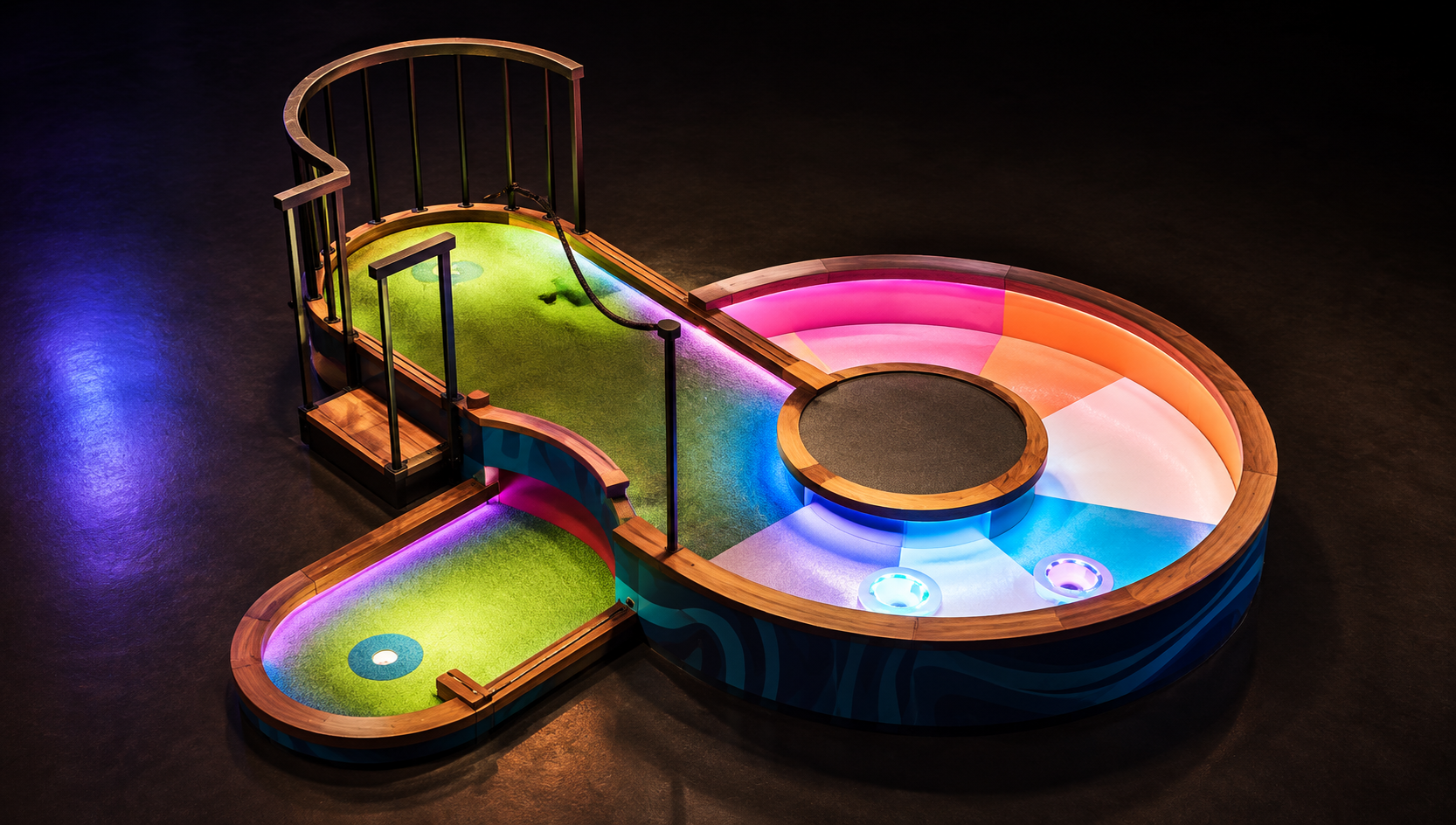
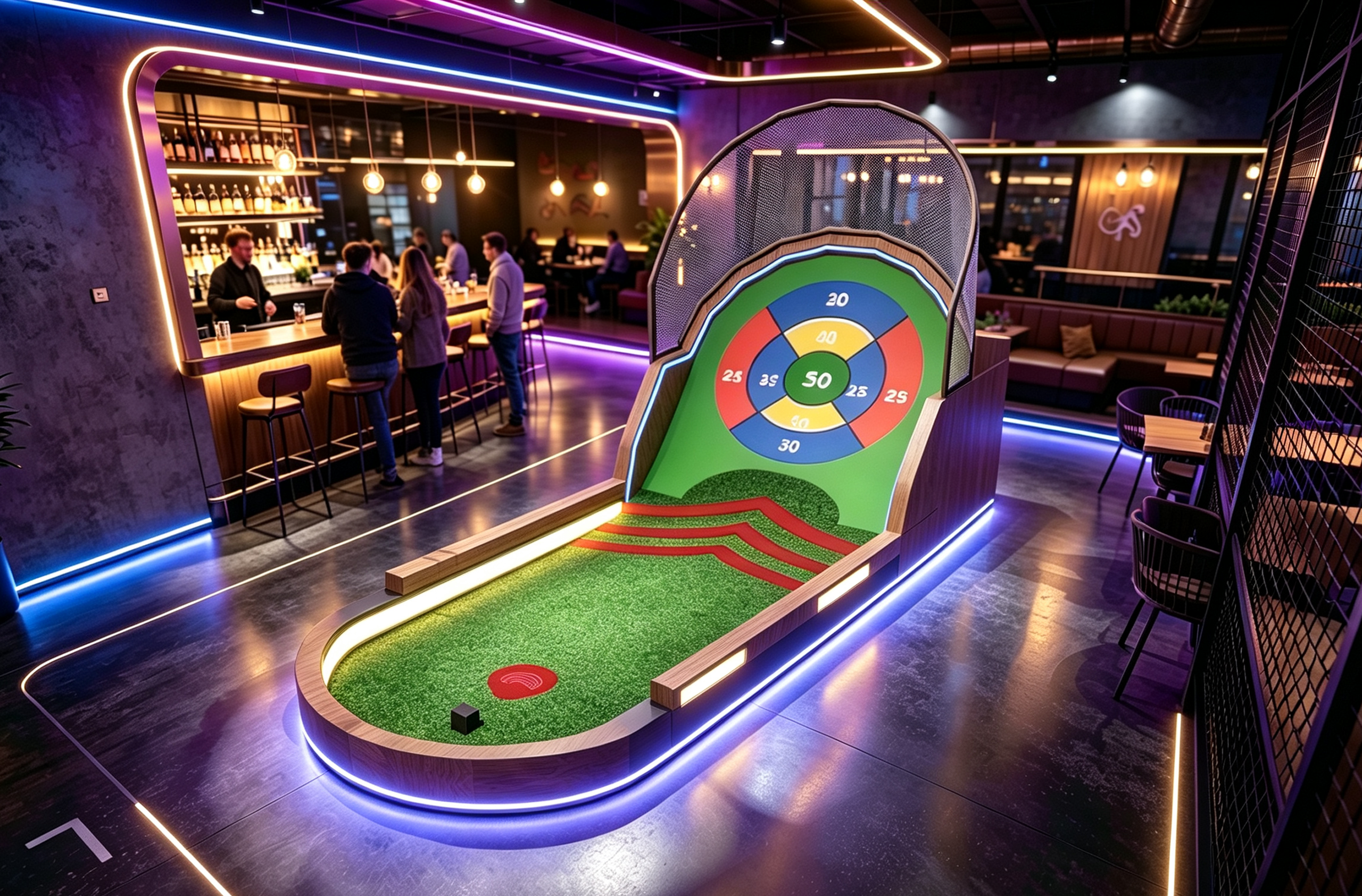
The purchase route runs from the collection to the unit. The full product line is listed on the product collection (the indoor mini golf product collection), and the three units a course is built from are the single-hole decision. The Cyclone Spin Hole is the loop-ramp signature: the published unit runs a 360 degree loop track with a central target zone in a 4.0 by 1.6 by 1.8 m footprint for 1 to 3 players at a time, which is the photo moment on the route, the shareable production piece that markets the course and stretches the dwell. The Golf Target Shooting Hole is the scoring finale: multi-zone target work is what a tournament night needs at the last hole, the competition climax that fixes the premium tier and drives the repeat target. The Golf Parkour Hole is the entry obstacle block: an obstacle line reads as approachable to a family group and sets the tone before the two demanding holes, which is where the round has to start.
The definition therefore runs in both directions, and that is the point. Read from the word: sport plus entertainment, scored participation inside a produced environment. Read from the floor: a reference build with three pillars, an earning stack, a cost tier and an engineered route, with three anchor holes that make the loop. When a venue can name both readings for its own project, it is not describing sportainment; it is running one. Start with the room: the free 3D layout design (the free 3D layout design) places the hole list on the actual floor plan, and the three anchors above are the units that turn the definition into an order.
The questions operators ask when they meet the word, answered with the published references.
The two-element model published in the definition hub: the sport side, where guests compete and get scored, plus the entertainment side, where the venue produces the experience around the game. The working test is that a guest plays a scored game inside a produced environment; both elements have to appear on the floor plan. The term origin is covered separately in the origin article.
It carries every element at once: a scored round running through themed six-hole blocks, a 60 to 90 minute dwell, event capacity in the form of buyout nights and tournaments, and a fast 3 to 5 minute hole cycle. The examples catalog places it in the middle of the attraction families, which is the position a definition sample wants.
On the published venue-earnings reference: ticket revenue from about USD 17,000 a month at a conservative 15 percent utilization base to USD 53,000 and up at peak, on the compact ladder; USD 37,440 to USD 140,400 plus on the 500 m2 course-scale calculator; with the food, party, corporate and repeat layers on top.
Three published tiers for the whole build: USD 50,000-150,000 for a small 300-500 m2 course, USD 150,000-350,000 for a standard 500-1,000 m2 course, and USD 350,000-800,000 plus for the large premium build. The design scope runs USD 60-120K for 9 holes and USD 150-250K for 18 holes, with a 10 to 15 percent contingency.
Holes are sized at roughly 20 to 40 m2 each including the walking path and the queue, so a standard 18-hole course lands near 400 to 800 m2 with a 4 to 6 m ceiling, as published in the space guide.
The route is the solution page, the free 3D layout design on your actual floor plan, the product collection for the hardware line, and the three anchor holes that make the loop: the loop-ramp signature, the scoring finale and the obstacle entry block.
Five lines to carry into the definition conversation.
Read it both ways: from the word, sport plus entertainment; from the floor, the indoor mini golf course solution with its three pillars and three anchor holes, the Cyclone Spin Hole signature, the Golf Target Shooting Hole finale and the Golf Parkour Hole entry, laid onto your room with the free 3D layout design.
Send us the floor area and the target player flow: we will return the hole configuration, the footprint plan, the installed cost model and the payback range that matches your market, laid out with the free 3D layout design - line up the Cyclone Spin Hole signature, the Golf Target Shooting Hole finale and the Golf Parkour Hole entry, then read the mini golf earnings reference to close the plan.