Twenty indoor mini golf ideas across layouts, themes, mechanics and tech: what makes a hole fun, what fits a home hallway, and what turns a course into a family repeat destination.
NEXTPLAY ACTIVE ENTERTAINMENT
20 Indoor Mini Golf Ideas for Family Entertainment
Twenty ideas that actually work indoors, organized so you can steal the ones that fit your space: layout ideas, theme ideas, mechanics, small-space tricks and the tech layer.
5 LAYOUTS 7 THEMES 4 MECHANICS SMALL SPACE THE TECH LAYER
1. Five Layout Ideas That Shape the Whole Course
The layout decides how the course feels before any theming does. These five shapes cover most indoor spaces, from a spare room to a venue floor.
- The corridor run: holes in a line along a hallway or wall. Simplest footprint, works from 2 meters wide.
- The figure-eight: two loops sharing a center island, doubling the holes per square meter.
- The wall hugger: holes wrap the perimeter, leaving the middle free for seating and strollers.
- The split level: two small floors or platforms instead of one big one, adding variety for free.
- The sandwich: a single long floor with holes laid in a snake, easy to staff and easy to see.
The layout rule that beats all others: every hole needs a sightline from the entry or the seating. A course where parents can watch the next hole from the bench books more time than a prettier course that hides the action.
2. Seven Theme Ideas Families Remember
The theme is what the kids tell their friends about. Cheap to build, impossible to skip.
- Under the sea: blue carpets, fabric waves, fish cutouts on walls. Impossible to do badly.
- Jungle safari: fake vines, animal prints on the floor and a gorilla guarding hole nine.
- Space station: black walls, glow stars, a planet lamp over each hole.
- Colossal food: giant donut ramps, spoon bridges, the classic oversized-kitchen look.
- Dino park: volcano hole, footprint tracks on the floor, foliage around the tee.
- Race night: checkered flags and a finish-line hole, easy to run as an event.
- Glow cave: blacklight course with fluorescent balls. The all-weather crowd-pleaser, day or night.
Theme picks should come from the local calendar, not a catalog: football season, a school break or a local holiday decides which theme prints tickets. A themed hole that matches what families are already planning sells itself.
3. Four Mechanics That Make a Hole Fun
The mechanics decide whether a hole is one putt or a story. These four generate the biggest smile per square meter.
| Mechanic |
How it works |
Why kids love it |
| The bridge |
Ball crosses a gap on a narrow plank |
The risk makes the hole matter |
| The funnel |
A wide entrance squeezes to one cup |
Big mistake range, still dramatic |
| The alley |
Side rails bounce the ball corner to corner |
Loud, fast and unpredictable |
| The spinner |
A rotating gate only opens at the right moment |
Timing feels like magic |
The rule of one: give each hole a single memorable moment. Two spinners and a bridge on the same hole is not twice the fun, it is twice the frustration. One clear story per hole, and the course reads like a book instead of a jumble.
4. Three Ideas for Small Spaces and Home Hallways
Indoor mini golf does not need a venue. These three ideas fit hallways, garages and spare rooms, and they make the course travelable.
- The reversible hole: one base, two tops, so a hallway course changes every weekend without new storage.
- The corner kiss: holes cut into the corners of rooms, where the walls become automatic bumpers and the space costs almost nothing.
- The door gap: a portable one-hole challenge that fits flat under a couch and turns any doorway into hole six.
The small-space test is simple: if the course can be packed flat in under an hour, it can also be redecorated, replaced and moved. Small courses should be portable by design, not by accident.
5. The Tech Layer: Scoring, Light and Repeat Money
The twentieth idea is the layer that separates a one-time course from a repeat destination: technology on top of the holes.
- A leaderboard wall makes every round a mini-tournament and gives parents a reason to come back and beat their own score.
- Interactive holes with light feedback turn a good tap-in into a moment kids film.
- A season pass or punch card built around the leaderboard converts walk-ins into members.
The courses below are the interactive end of that scale and are live on this site.
- The Speed Wave Hole Mini Golf is an electronic hole with light-up feedback, the easiest way to add the tech layer to one slot.
- The Cyclone Spin Hole adds a visual show piece that reads as an event even before anyone puts.
- The Curve Block is a classic skill hole with modern build quality for a demanding mid-course slot.
Plan the floor around the course before the course arrives. The free 3D layout design page lays out the holes, the seating and the leaderboard wall in your real space.
6. Featured NextPlay Active Gaming Equipment
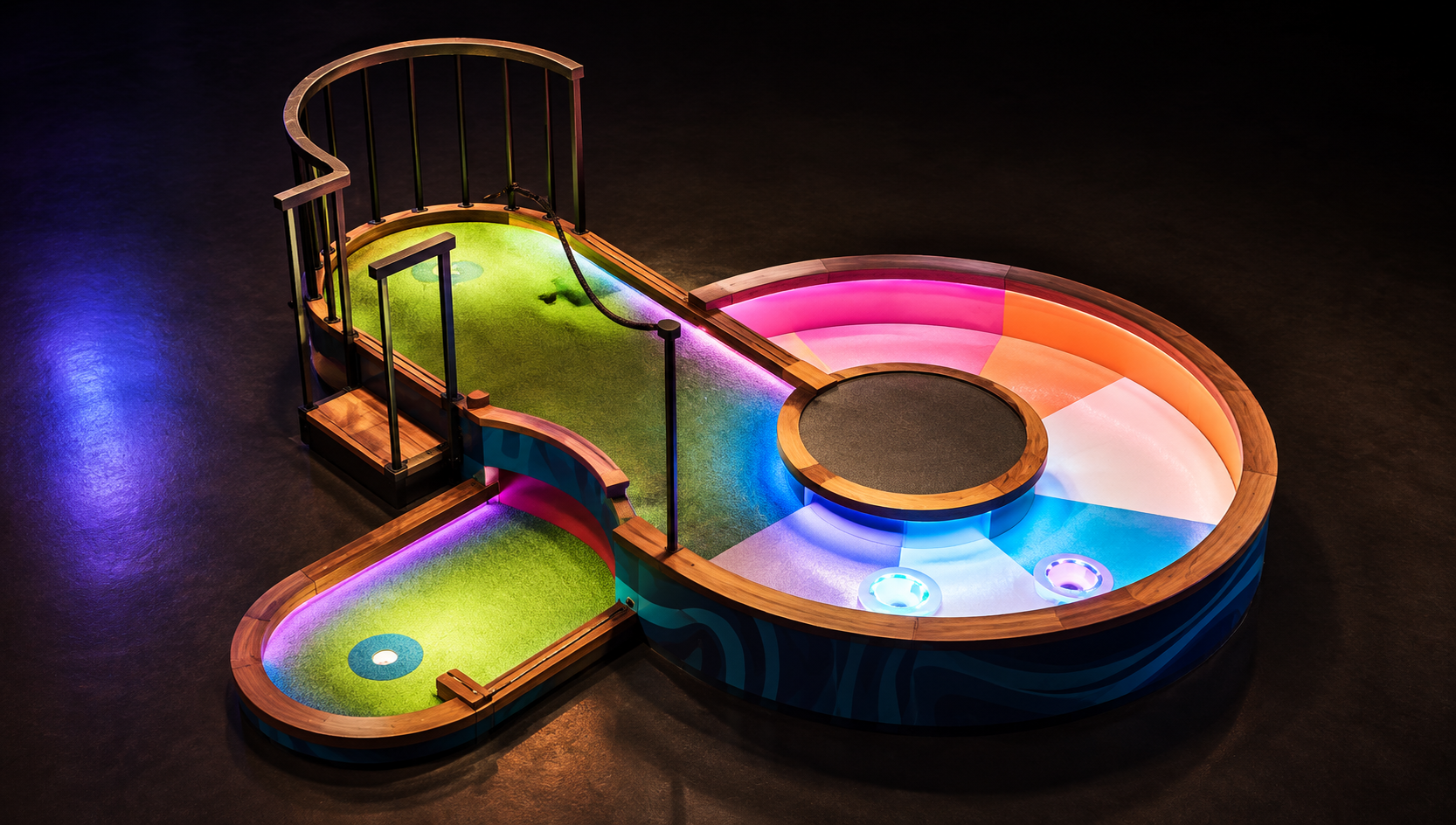
Visual Show Piece
Cyclone Spin Hole
A spinning showpiece hole that draws a crowd before the first putt.
View Details ›
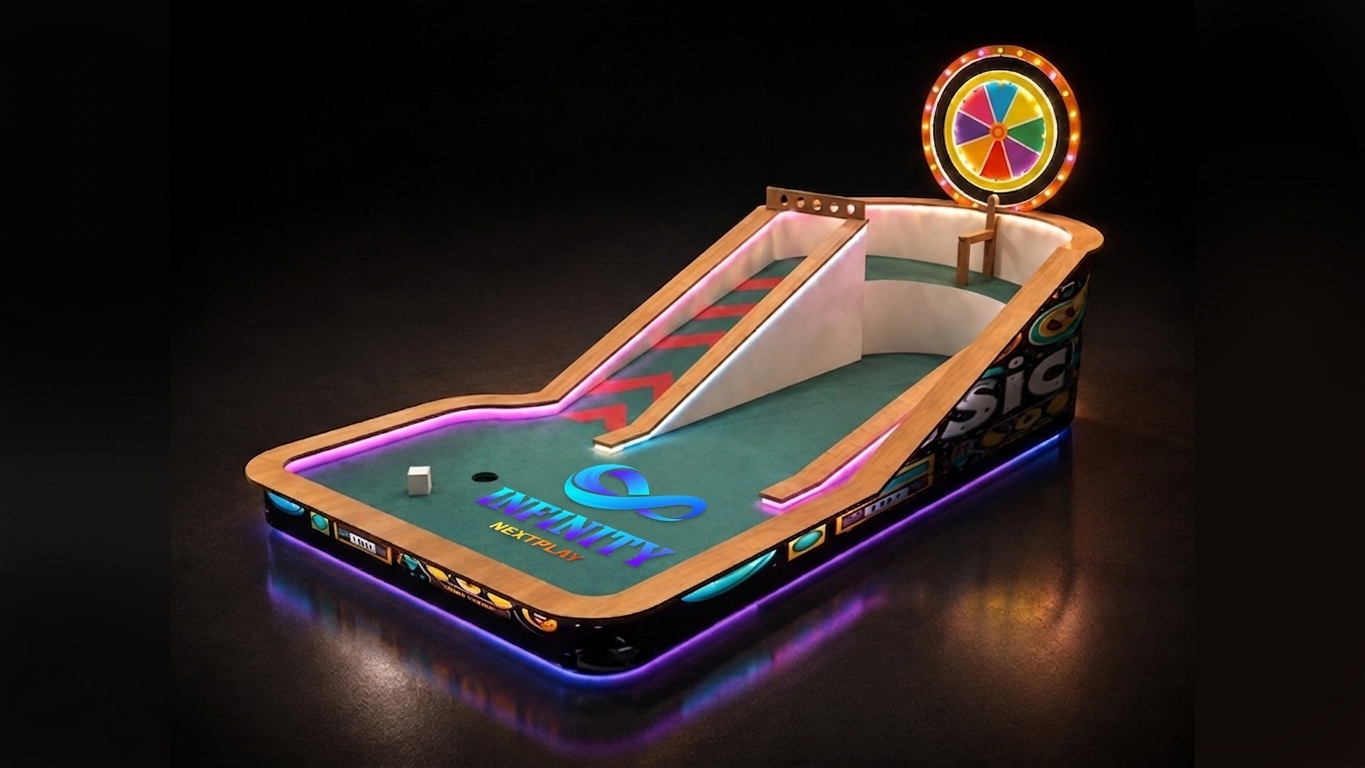
Classic Skill Hole
Curve Block
A demanding skill hole with a clean modern build for the middle of the course.
View Details ›
7. Frequently Asked Questions (FAQ)
How many holes do you need for indoor mini golf?
Nine to eighteen for a venue course, five to nine for a home setup. Venue courses above eighteen stretch playtime without adding revenue per hour.
What is the minimum space for a mini golf course?
A five-hole home course fits in about 10 x 4 meters. A compact nine-hole venue course starts around 200 square meters, and eighteen holes want 400-600 square meters.
How much does an indoor mini golf hole cost?
From a few hundred dollars for DIY obstacles to several thousand per commercial electronic hole. Plan $2,000-$8,000 per hole installed for a venue course.
How do you make mini golf fun for young kids?
Short holes, big targets and instant wins. A hole that a four-year-old can finish in three putts beats a clever hole they give up on. The light-up and moving obstacles help most here.
Can mini golf be profitable in a small venue?
Yes, if the course pulls double duty: birthday parties and events raise the per-hour value far above walk-in play. One 12 x 6 meter room running two party slots a day can outperform a much larger course on revenue per square meter.
Planning an Indoor Mini Golf Course?
Send us your floor plan and the number of holes you want. Our team lays out the course for walk-in flow and party capacity, starting with a free 3D layout design.

