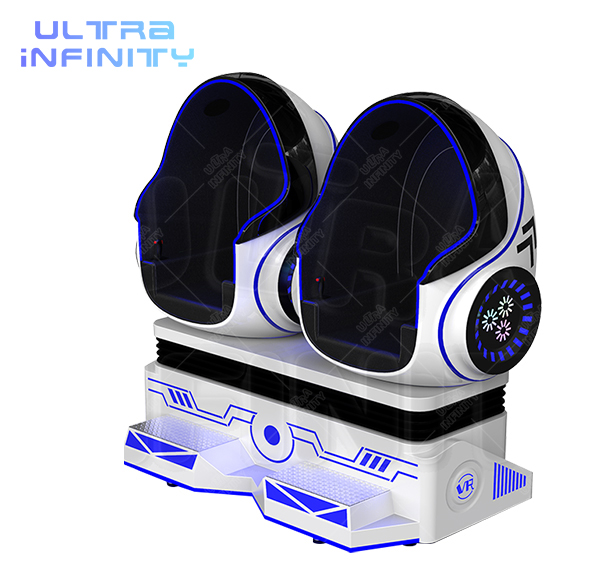
Most game rooms fail the same way: the owner buys machines first and arranges them after. The result is a VR chair nobody walks past and a racing rig parked in front of the television. The gear is fine. The route is broken.
The fix is to plan the route before the purchase order: what a guest sees at the door, what pulls them deeper into the room, and which games get the spots with the most eyes. The same equipment list makes twice the room on a good route.
Not every room needs all six. Pick the zones that match your space and the people who will use it; the table shows what each zone needs and why it earns its square meters.
| Zone | What runs there | Footprint |
|---|---|---|
| VR corner | Egg chair or motion seat plus one mat | 3 x 3 m |
| Racing row | One wheel rig or a full simulator | 2.5 x 3 m per seat |
| Interactive floor | LED tiles or projection games | 3 x 4 m |
| Target wall | Darts, archery or a shooting screen | 2 x 5 m |
| Table row | Air hockey, foosball or pool | 2 x 2 m per table |
| Lounge | Couch, screen and snack shelf | 3 x 3 m |
The zones that earn money are the ones visible from the lounge. If a guest cannot watch the action from the seat they are sitting in, the room loses half its energy and half its repeat visits.
Motion sells better than resolution. A guest remembers the tilt of the seat, not the pixels on the screen. Budget your first VR corner around the chair, and let the headset be a detail.
Start with a compact motion seat like the VR Egg Chair: one unit, no walls, no cage, and a small footprint that fits a bedroom corner or a venue wall. It runs alone, which makes it the easiest zone to test before you scale.
The rule that keeps VR corners alive: light. A VR zone in the dark is a storage shelf with a price tag. Keep the corner in the room light and the queue will form by itself.
Racing is the only game in the room where watching beats playing. That makes a racing simulator the best second purchase: it pulls people who never touch the controls, and those spectators drink the snacks and stay.
A kart-style unit like the Black VR Racing Simulator fits the same footprint as an armchair and needs no mounting, so it works in a garage as well as a venue corner.
| Setup | Footprint | Best for |
|---|---|---|
| Single seat against a wall | 2.5 x 3 m | Spare room, small venue |
| Two seats back to back | 3 x 6 m | Competitive game nights |
| Seat plus spectator bench | 3 x 7 m | Family rooms and bars |
Add a leaderboard next to the row and the room gets a repeat mechanic for free: guests come back to beat the score, and beating the score costs another ride.
The interactive zone is the part of the room that pays for birthday parties and group nights. Two ideas carry it: a floor that reacts and a wall that scores.
The party logic: interactive games are not the main event, they are the filler between cake and presents. A room with two quick interactive games books more parties than a room with one expensive machine that takes twenty minutes per round.
Prices below are planning ranges, not quotes: the final number depends on configuration, shipping and whether you buy new or used. They exist so you can plan the room in the right order.
| Zone | Entry range | What is included |
|---|---|---|
| VR corner | $3,000-$8,000 | Motion seat, headset, spectator screen |
| Racing row | $4,000-$12,000 | Simulator unit or wheel rig plus screen |
| Interactive floor | $6,000-$20,000 | LED tiles or projector, controller, safety mat |
| Target wall | $2,000-$9,000 | Dart machine or shooting screen package |
| Table row | $800-$3,000 | Air hockey or foosball, spare parts |
| Lounge | $500-$2,000 | Couch, wall screen, snack shelf |
The zone order matters more than the totals: build the lounge first, then one interactive zone that earns, then add machines as the room proves it gets used. Most rooms die of overbuying, not of a small start.
The same six zones become a business when three numbers change: price per play, session length and turnover. A home room entertains five guests for an hour. A venue zone moves twenty guests per hour through four machines.
Before you move a machine, move the floor plan. The free 3D layout design service maps your zones, your queue lines and your spectator seating onto the real room, so the route is planned before the wiring starts.
About 20 square meters: one VR corner, one racing seat and a lounge wall. Below that, pick one zone and do it well instead of squeezing three in a hallway.
Plan $5,000-$15,000 for a home setup with a VR corner and a racing seat, and $20,000-$60,000 for a venue zone with four machines, wiring and seating. These are planning ranges, not quotes.
Interactive games with short sessions (the LED floor, target games) earn fastest: high turnover and party-friendly. Simulators earn more per ride but need spectators to build a queue.
Most compact units like egg chairs and kart-style racers fit under a normal 2.4 m ceiling. Full flight platforms do not; check the unit height before you cut the floor plan.
Yes, in party mode. That is the standard trick: floor games for open hours, light show mode for parties, no hardware change required.
Send us your floor plan and the zones you want. Our team maps the route, the queue lines and the spectator seating, starting with a free 3D layout of your space.