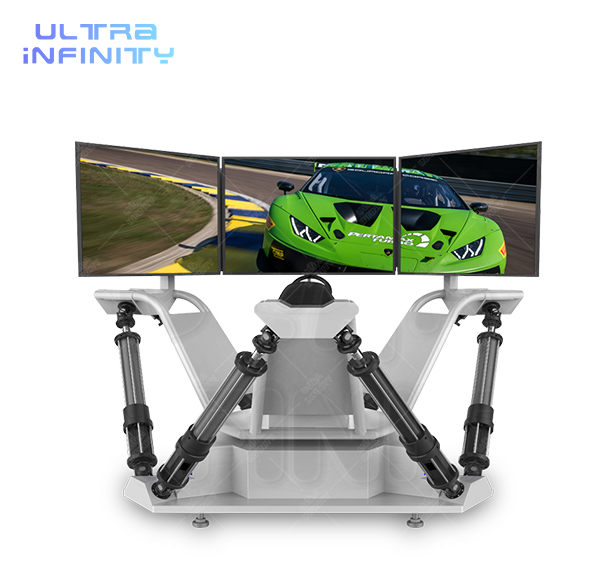
A 6DOF motion platform moves a seat, a cockpit or a whole cabin along six independent axes. Three of them translate: surge moves the platform forward and back, sway moves it left and right, and heave moves it up and down. The other three rotate: roll tilts it side to side, pitch tilts it nose up or nose down, and yaw turns it around a vertical axis. Six independent directions of movement, hence six degrees of freedom.
The number counts axes. It does not count screens, effects or game titles, and that distinction is the first thing a venue buyer should hold on to, because quotes normally arrive as a DOF figure with the axis list left out. On a racing cockpit the axes are exactly what the guest feels: roll through a corner, pitch under braking, yaw as the car rotates, and heave when a kerb passes under a wheel. The cheaper rungs of the same ladder are set out in the 2DOF versus 3DOF comparison, which makes the same point and ends on the same advice.
So a six-axis machine is the top rung of a three-step motion ladder rather than a product category of its own. The useful question is not whether more axes are better, which they are, but whether the guests on that particular floor can feel the difference and pay for it.
Six independent axes: surge, sway and heave for translation, and roll, pitch and yaw for rotation. The count describes motion axes only and says nothing about screens or content.
In VR hardware the same acronym means something completely different. There it describes headset and controller tracking in both position and rotation, which is what lets a player step through a room instead of only looking around from one fixed point. That is a tracking specification. A six-axis platform is a mechanical specification. The two phrases appear in the same sentences and have nothing to do with each other, so a supplier page is worth reading twice.
It is also not a rotation count. A 360 degree rotating chair turns the seat around a vertical axis and adds pitch on top, which is a strong effect but a smaller axis count than a full platform. When a brochure leads with rotation degrees instead of an axis list, the number being sold is spectacle rather than fidelity.
And it is not the same as the 6D label in a product name. The racing machine behind the reference build on this site is sold as a 6D racing car machine, and what sits under the seat is a 6-DOF electric motion platform with three HD screens, active speakers and wind effects, as the 6D racing simulator cost breakdown sets out. The D in that product name is a market label for the format.
VR 6DOF is headset and controller tracking. Platform 6DOF is six mechanical axes. A 360 degree rotating chair is one large rotation with limited extra axes, not a six-axis platform.
Two degrees of freedom give pitch and roll, which is enough to cover the feel of a smooth circuit and is what most home rigs settle for. Three degrees of freedom adds heave, the vertical axis, which is what makes jumps and bumps read as motion rather than as camera shake. Six degrees of freedom adds the rest: surge, sway and yaw alongside the three the cheaper tiers already provide.
Venue buyers should know what the tier below them already does, because the uncomfortable answer from the racing zone playbook is that three degrees of freedom is more than enough to deliver a convincing drive, and that the rotating spectacle is what pulls first-time guests in. See how a racing zone is planned for bars and FECs for the layout that decision produces.
That is not an argument against six axes. It is an argument about who the floor is for. A three-axis bank sells first impressions. A six-axis bank sells repeat riders, the ones who have already ridden everything else on the property and are now comparing fidelity.
2DOF: pitch and roll, enough for smooth-track lapping. 3DOF: adds heave for jumps and bumps, and remains the venue default. 6DOF: all six axes, sold to guests who notice the difference.
Racing is the clearest case. A six-axis cockpit translates brake dive, corner roll and kerb heave into the frame, and those are the cues that make a lap feel wheeled rather than animated. The reference unit pairs the platform with three HD screens, active speakers and a wind module, which is why the format reads as a small sim racing bay rather than a ride.
Flight and space formats lean on the same hardware for a different reason. A flight unit with six-axis pitch can hold a banked turn without a scripted cutscene, and multiplayer motion chairs built around a space battleship game use the same axes to sell motion to a group rather than to one rider.
The third use is the one operators underrate. The dwell time study on motion VR found that six-axis motion chairs rely on intuitive physical motion, wind feedback and 3D sound, and that external display screens are what turn the unit into a group attraction. The axes are not only a guest experience, they are a queue experience.
Racing cockpits, flight and space simulators, and multiplayer motion chairs. The common thread is a guest who has already ridden the cheaper tiers and is now comparing feel rather than novelty.
The core is the motion base: six actuators driving a platform that carries the seat, the harness and the controls. In the Thunderclap 6D racing car machine that base is electric, which matters for service intervals, noise on a shared floor and the power supply a landlord has to be told about.
Around the base sits the presentation layer. The reference build adds three HD screens, active speakers and a wind module. A single-seat formula cockpit in the same range carries a rigid bucket seat and a fixed harness, and the flagship unit is the one with the deepest pitch, roll and yaw travel in the range.
The part buyers forget is the operator layer: the control set staff use to pick a game, the motion profile they select for the rider in front of them, and the way the unit is loaded and unloaded between sessions. On a three to five minute session, that layer decides the day more than the actuator count does.
Electric six-axis platform carrying seat, harness and controls, plus three HD screens, active speakers and a wind effects module in the reference racing unit.
The published cost breakdown for this format prices the two six-axis racing units separately from the rest of the zone: the Thunderclap 6D racing car machine at $14,000 to $20,000 for two units, and the six-axis motion racing cockpit at $12,000 to $17,000 for two. That puts a pair of six-axis machines between $12,000 and $20,000 depending on which model is chosen, and the full four-cockpit equipment package for the reference zone at $34,000.
Compare per cockpit, never per zone. A zone total hides the ratio between how many machines you bought and what each one earns, and that ratio is the only number that answers whether the sixth axis was worth paying for. The same breakdown carries the rest of the room, including the screens, the effects and the layout costs that surround the motion base.
$34,000 for the four-cockpit equipment package in the reference racing build, with the six-axis units quoted at $12,000 to $20,000 per pair depending on model.
The racing zone playbook gives four numbers that decide the model: a four cockpit bank occupies roughly 12 square metres of equipment footprint, the average session runs three to five minutes, each cockpit turns five to nine times a day, and the six-axis flagship is the motion reference in that mix.
Read together with the cost breakdown, the reference four-cockpit package recovers its capital in six to nine months. The turn count is the number to defend. Sessions that stretch past five minutes cut the daily turns directly, and a queue that loads slowly does the same damage as a broken actuator.
The honest caveat is that six axes do not raise the turn count. They raise the reason to come back. Budget them as a retention line, and let the three-axis units on the same floor carry the first-time volume.
Three to five minute sessions and five to nine turns per cockpit per day in the reference racing zone, on a four-cockpit bank that pays back in six to nine months.
A motion unit is easier to sell to a mixed group than a headset is. Riders do not need to be gamers because the motion carries the experience: the study on motion VR groups describes six-axis chairs that rely on intuitive physical motion, wind feedback and 3D sound rather than on twitch reaction speed.
The second half of that finding is the commercially interesting one. External display screens let the rest of the group watch, which converts a single-rider unit into something a group stands around. On a floor that earns by dwell time, the spectator side of the machine is as valuable as the motion.
That has a layout consequence. A six-axis bank wants circulation space on the audience side, not just access on the service side.
Motion, wind feedback and 3D sound carry riders who do not play reaction games, and the external display gives the rest of the group something to watch, which is what extends dwell time.
The clearest working example of the format on a small floor is a boutique VR motorsports lounge built around six-axis motion cockpits, which the Tokyo motorsports lounge case study puts at $42,000 a month. It is a lounge rather than a circuit: fewer units, deeper units, and a room designed so the motion is the centre of the floor.
That shape suits venues that cannot win on ride count. Six axes cost more per seat and serve fewer guests per hour than a rotating chair, so they only work where the spend per guest is higher and the guest comes back. A motorsports lounge is exactly that audience.
A boutique VR motorsports lounge built around six-axis motion cockpits, reporting $42,000 a month.
Two area figures look contradictory until you separate them. The cockpits themselves occupy roughly 12 square metres in a four-cockpit bank, and the working zone around that bank runs to about 80 square metres in the reference racing layout. The difference is circulation, spectator space, queue room and the clearance a service technician needs to work around a moving platform.
Service access is the constraint venue planners underestimate. A six-axis base has actuators on more than one face, and a bank installed against a wall on three sides looks efficient on a plan and is expensive to maintain. Ask the supplier which faces need to stay clear before the layout is fixed, not after.
Finally, confirm with the supplier what the platform needs from the building: the power supply it draws, whether the floor needs any preparation, and how much vibration it puts into the slab a neighbouring tenant shares. Those three answers belong in the lease conversation, not in the installation week.
About 12 square metres of equipment footprint for a four-cockpit bank, inside a working zone of roughly 80 square metres once circulation and spectator space are counted.
First, buying a DOF figure instead of an axis list. The comparison page is explicit that buyers should ask for the exact axes a machine uses rather than accepting the headline number, because two six-axis machines are not automatically the same machine.
Second, overshooting the guest mix. If the floor is still selling novelty, the three-axis tier delivers a convincing drive for less capital, and the money saved buys screens or a second attraction.
Third, leaving out the audience side. Motion value for a group depends on the watching experience, so a bank with no spectator line wastes part of what was paid for. Fourth, letting sessions drift beyond the three to five minute band, which cuts turns directly. Fifth, treating the motion base as the whole attraction, when the reference unit only works because the screens, effects and game mix are sized to the platform.
Buying a DOF number without the axis list, overshooting the guest mix, leaving out spectator space, letting sessions drift past five minutes, and treating motion as the whole attraction.
Ask for the axis list and the travel available on each one before discussing price. Two platforms can both claim six axes and differ by a wide margin in how much roll or heave a guest actually feels, and only the travel figures settle that question.
Ask which parts are included in the quote. On the reference racing machine the six-axis base, three HD screens, active speakers and the wind module are one package, and the cost breakdown for the 6D racing format shows how the line items separate when they are quoted individually.
Then ask the operating questions: how the motion profile is calibrated for different rider ages and games, which faces of the base must stay clear for service, and what evidence the supplier can show on payback for a comparable installation. The reference for this format is a six to nine month window.
The exact axis list and travel, the actuator type, which screens and effects are included, how motion profiles are tuned for different ages and games, and the payback reference behind the quote.
Choose three axes when the floor is still introducing the format, when the guest is riding once as part of a bigger visit, and when the capital is better spread across more attractions. The three-axis tier covers pitch, roll and horizontal rotation, which is what a first ride is judged on, and the rotating three-axis cockpit is that tier in hardware.
Choose six axes when there is already a pool of repeat riders on the property, when the venue is positioned on fidelity rather than novelty, and when the floor can carry the smaller seat count a six-axis bank implies. That is the motorsports lounge model rather than the family entertainment centre model.
The two are not exclusive. Several venues run a three-axis bank for volume and one six-axis flagship for the guests who ask what else there is, which is exactly the mix the racing zone layout is built around.
3DOF when the floor is selling first impressions and volume. 6DOF when there are repeat riders comparing feel. Running one of each is a legitimate mix, not a compromise.
A six-axis bank rarely carries a floor on its own. It works as the premium end of a racing zone, with the volume attractions sitting beside it so the queue has somewhere to go, which is the structure the racing zone playbook sets out for sports bars and FECs.
It also needs the venue around it to be legible. Guests pay for depth only if they can see that the machine in front of them is a step above the last one, so signage, position on the floor and the way the bank is introduced at the counter all matter. The broader vocabulary for that kind of floor is covered in what an indoor entertainment venue is.
A six-axis bank works as the premium end of a racing zone, with volume attractions beside it so the queue has somewhere to go and the guest can see the step up.
Surge, sway and heave are the three translational axes, moving the platform forward and back, left and right, and up and down. Roll, pitch and yaw are the three rotational axes, tilting the platform side to side, nose up or down, and turning it around a vertical axis. Six independent directions, and any platform claiming the figure should be able to list them.
Not technically. Six-axis is the mechanical description of the platform, while the 6D label in product names is a market name for the racing format built around it. The reference unit sold as a 6D racing car machine carries a 6-DOF electric platform, three HD screens, active speakers and a wind module.
No, and this is the most common confusion. In VR hardware the term describes headset and controller tracking in position and rotation. In a motion platform it describes six mechanical axes. A venue can run a six-axis cockpit with a three-DOF headset, or the reverse, because the two figures measure different things.
It depends on the guest mix, not on the axis count. Three axes already cover pitch, roll and horizontal rotation, which is enough to deliver a convincing drive to a first-time rider. Six axes pay for themselves where repeat riders are comparing fidelity, which is the lounge model rather than the volume model.
In the published racing breakdown, the six-axis racing car machine runs $14,000 to $20,000 for two units and the six-axis motion cockpit $12,000 to $17,000 for two, inside a four-cockpit equipment package of about $34,000. Screens, effects and layout are quoted on top.
A four-cockpit bank occupies roughly 12 square metres of equipment footprint, sitting inside a working zone of about 80 square metres once circulation and spectator space are counted. Service access matters as much as floor area, because the actuators sit on more than one face of the base.
The reference window for this format is six to nine months on the four-cockpit package, with three to five minute sessions and five to nine turns per cockpit per day. Treat the turn count as the number to protect, because that is what the payback actually depends on.
Send us the floor area and the guest mix. We return an axis-level comparison, the cockpit count that fits, and a payback model built on sessions per day rather than on a brochure number.