Most venue operators thinking about a racing attraction picture a single expensive simulator in a corporate lobby, or a row of stationary arcade seats that nobody returns to. That mental model is exactly why racing underperforms in so many venues, and why it outperforms dramatically in the few that get the format right. A racing simulator is not one machine. It is a four-cockpit competitive system, and the difference between a cost-center pod and a revenue engine is almost entirely a planning decision.
This guide is a complete commercial engineering brief for building a racing simulator zone inside a sports bar, a family entertainment center, a mall anchor, or a corporate experience floor. It covers the four-cockpit product ladder, the motion-platform physics that separate a memorable ride from a forgettable one, the unit economics with real payback math, the floor geometry and safety envelope that determine whether your zone is insurable, the power and network specification, the esports league calendar that converts casual riders into a recurring weekly base, and the staffing model that keeps labour cost near zero.
The strategic claim is simple. A motion racing cockpit produces the highest emotional intensity per square meter of any attraction in the commercial sportainment category, and intensity is what drives both repeat play and premium price per session. Done correctly, a four-cockpit bank pays back faster than a bowling lane bank that occupies eight times the floor area.
Before going further it is worth naming the strategic point clearly. Racing is not a passive attraction and should never be positioned as a quiet side activity. Racing is a spectator sport. A cockpit in motion with a friend attacking the apex draws a crowd of six people who are all emotionally invested and all likely to take a turn next. Its value shows up in its own session revenue, in the food and beverage lift from that crowd, and in the social media content your guests generate for you for free.
Infinity supplies four racing platforms. They are not four price tiers of the same machine. They are four genuinely different commercial tools for four different operating contexts, and the most common planning mistake is buying four units of whichever looked most impressive on a showroom floor, then discovering it does not match the audience that actually walks in.
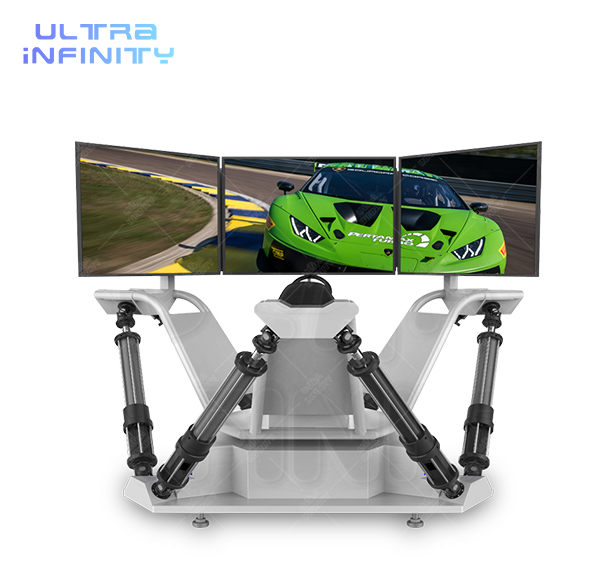
The Thunderclap is the deep-motion flagship. Its defining capability is a six-degree-of-freedom electric platform that pitches, rolls, heaves, surges, sways and yaws in synchrony with the on-screen track, so a player feels the car rotate under braking and lift under acceleration. That level of physical feedback is what separates a simulator from a video game, and it is what justifies a premium per-session price.
The commercial reason to install Thunderclap units is the same as for any flagship: it is the machine players ask for by name and the machine that anchors your league finals. A venue with one Thunderclap at the head of a four-cockpit bank creates a visible hierarchy, where the deepest-motion seat is the seat everyone wants, which naturally fills the adjacent standard seats as the waiting step up.
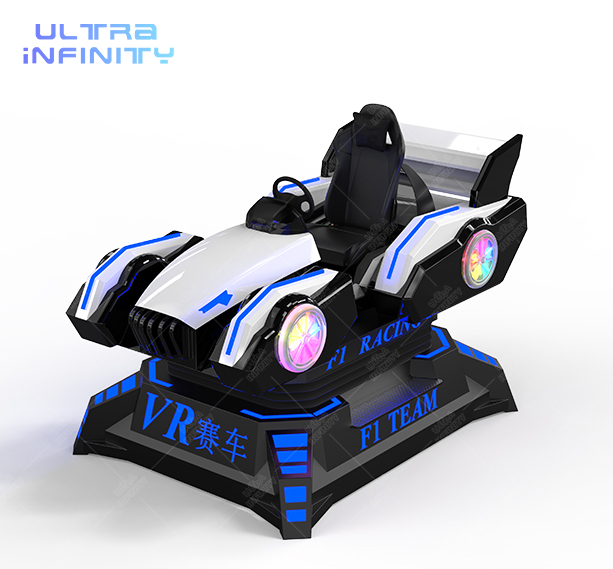
The F1 cockpit wraps the six-degree platform in a single-seat formula chassis with a rigid bucket seat, a wraparound screen and the visual language of a real grand prix car. It appeals to the enthusiast segment that cares about the authenticity of the driving position, and it photographs exceptionally well, which matters because the photograph is what sells the experience on a guest''s social feed.
In operator data the F1 cockpit tends to attract the longest single sessions and the highest attachment of return bookings among serious sim racers. Where a venue''s audience skews toward motorsport fans rather than casual families, weighting the bank toward F1 seats is usually the right call.
The rotating pod is the showpiece. Its full three-screen surround plus a 360-degree horizontal spin means the entire unit turns with the car, so a crowd sees the cockpit physically rotate through every corner. That motion is visible from across the room and acts as a living billboard for the whole zone.
Do not read the 3DOF rating as a downgrade. Three degrees of freedom is more than enough to deliver a convincing drive, and the rotating spectacle is what pulls first-time guests in. Operators frequently report that the rotating pod drives the highest footfall of the four, even if its per-session price is set lower than the 6DOF flagships.
The VR racing unit drops the cockpit entirely and puts the guest in a headset with a motion seat, which collapses the footprint to a fraction of a full cockpit and removes the screen hardware cost. The payoff is throughput: guests change over in seconds rather than minutes, so a single VR station can serve more players per evening than a seated cockpit.
This makes the VR racer the correct unit for high-traffic, price-sensitive environments such as a family entertainment center afternoon or a mall anchor where volume matters more than depth of experience. It is also the lowest-capital entry point into a racing zone, letting an operator test the category before committing to a full motion bank.
The correct ratio depends on what your venue is fundamentally selling. The table below reflects the configurations that have performed best across the operator base, expressed as a starting point rather than a rule.
The economic case for a racing zone rests on three variables that behave very differently from those of a passive attraction: a moderate capital cost per earning position, a very short session length, and a per-session price that guests accept willingly because the experience feels premium. Understanding how these interact is more useful than memorising any single payback figure.
Start with earning positions. A four-cockpit bank is four earning positions at a fraction of the capital of a single bowling lane bank, and each cockpit hosts three to five groups per evening rather than one. Even at a much lower price per session than a simulator bay, the racing bank produces more transactions per square meter per evening than almost any alternative, and it does so with a crowd-watching effect that lifts the bar.
For payback modelling, most operators find that a four-cockpit bank in a venue with reasonable evening footfall clears its capital cost within six to ten months. The variables that move that window most are your price per race or per hour, your opening hours, and critically whether you run structured league or tournament nights. A venue running organised events typically reaches payback several months ahead of an otherwise identical venue that leaves the cockpits to walk-in traffic alone.
Racing cockpit layout is governed by a safety envelope that exists because a moving platform with a seated guest can injure a bystander who wanders into the swing radius. Getting this wrong is the most common physical planning error we correct in operator drawings, and it is far cheaper to correct on paper than after the cockpits are installed.
Budget a minimum footprint of roughly three meters by three meters per cockpit including the motion swing clearance, plus a shared spectator aisle of at least one meter in front of the screen line. Unlike a dart cabinet, a racing cockpit moves, so the clearance is not optional decoration, it is the difference between an insurable installation and a liability. The practical total depth for a four-cockpit bank is therefore in the region of fourteen to eighteen meters of wall or floor run.
Lane separation deserves particular attention because it is where operators try to economise and where the consequence is a genuine safety issue. Cockpits closer than the specified clearance produce collisions between a moving platform and a passer-by. Where physical width is constrained, install a low divider rail or a planted barrier between positions rather than reducing the spacing. The barrier also improves the sense of a defined personal bay, which players consistently rate positively.
Flooring and lighting complete the specification. Use a hard, level, non-slip surface under and around each cockpit, because the motion platform transmits load to the floor and any give in the substrate reads as instability to the guest. Light the screen face directly and avoid any source behind the screen that would glare into the player''s eyes during a night track.
Racing cockpits are more demanding to install than a dart cabinet but far less demanding than a construction project, and there are three specifications worth confirming with your contractor before the fit-out is finalised.
Power is the main item. Each cockpit runs from a standard single-phase socket at a modest draw, but the motion platform draws a brief surge on actuation, so provide a dedicated circuit per cockpit rather than daisy-chaining a bank from one outlet. Specify that the socket sits concealed once the cockpit is mounted. There is no three-phase requirement, no compressed air, no water supply and no meaningful heat load for your ventilation calculation.
Networking matters for software and leaderboards. The cockpits sync scores, fixtures and rankings to a central system, and while they will operate over wireless, we strongly recommend a wired connection to each cockpit position. A dropped connection mid-qualifying is a customer service problem that costs more to resolve than the cable ever cost to install. Provide one network outlet per cockpit and treat it as part of the electrical first fix.
Mounting is the third item. Cockpits are floor-anchored and the floor must be capable of carrying the dynamic load of the motion platform with a substantial safety margin. Where a slab is uneven or lightweight, install a levelling and reinforcement pad under each position before the cockpit arrives. Retrofitting that pad after installation means lifting every cockpit in the run.
The single most misunderstood spec in a racing simulator is the degree-of-freedom rating, and misunderstanding it leads operators to overpay for fidelity they cannot feel or underpay for fidelity their guests immediately notice missing. This section is a plain-language guide.
Three degrees of freedom means the platform can pitch, roll and heave: it tilts forward and back, leans side to side, and rises and falls. That is enough to convey braking, cornering and bumps, and for most casual guests it reads as a convincing drive. Six degrees of freedom adds surge, sway and yaw: it can also accelerate and decelerate horizontally, shift laterally, and rotate around the vertical axis. That extra three is what lets the cockpit physically rotate with the car through a hairpin, which is the moment guests remember and record.
The commercial takeaway is to match the DOF to the audience. A family entertainment center afternoon crowd is happy in 3DOF and VR. A motorsport-enthusiast league finals crowd will travel specifically for 6DOF. A bank that mixes both captures the broad base and the premium top end without paying 6DOF prices for every seat.
This is the section that separates a racing bank producing acceptable returns from one producing exceptional returns. Cockpits left to walk-in traffic earn a respectable but unremarkable income. Cockpits running a structured league or tournament programme earn substantially more, and the difference comes almost entirely from operating discipline rather than additional capital.
A racing league converts discretionary attendance into scheduled attendance. A casual player might visit your venue when they happen to feel like it, perhaps once a month. A player registered in an eight-week league attends on a specific night every week for eight consecutive weeks, brings friends who also attend, and spends on food and beverage across a predictable and much longer dwell time. You have converted an unpredictable transaction into a recurring booking.
That scheduling point is worth emphasising because operators consistently get it wrong. The instinct is to run the league on Friday or Saturday when the venue feels energetic. That is precisely backwards. Friday is already full and a league simply displaces walk-in customers who would have spent anyway. Run the league on Tuesday or Wednesday and you have created genuinely new revenue in hours that previously produced very little.
The networked ranking makes league administration considerably easier because fixtures, times and results are maintained by the system rather than by a member of your team with a spreadsheet. This matters more than it sounds: administrative burden is the single most common reason venue league programmes are abandoned after one or two seasons. Remove the burden and the programme survives.
Racing has an unusual and commercially valuable property: it is one of the few attractions where a crowd gathers and stays to watch, drink and shout. That single characteristic drives an attachment rate that most other sportainment formats cannot approach, and it is the reason a racing bank belongs adjacent to the bar rather than in a remote corner of the building.
Compare the interaction patterns. A VR arena requires a customer to put on a headset and leave the bar area entirely. A bowling lane pulls a group away for an hour or more. A racing cockpit happens in short bursts with a crowd six deep behind the screen, in arm''s reach of the bar, with natural pauses between races precisely when a server can approach. The format is structurally compatible with drinks service in a way that headset-based attractions are not.
The layout implication is direct: position the racing bank within sight of the bar and on a route your service staff already walk. Operators who place racing adjacent to the bar consistently report a materially higher spend per head from racing guests than from customers using attractions in remote zones of the same venue. The mechanism is not complicated. Shorter distance to the bar means more rounds ordered.
Programming amplifies this further. Tie a drinks or food promotion to league nights specifically, and price it as a package that includes the entry fee. A driver who has prepaid for a season of qualifiers plus a food package attends reliably and spends predictably, which is the closest thing to contracted revenue that a leisure venue can construct.
The staffing model for a racing zone is light, which is a large part of why the format performs so well on a return-on-capital basis. There is no dedicated marshal required in the sense that a free-roaming VR arena or a climbing wall demands. Your existing floor and bar team absorb the zone entirely within their normal duties.
What your team does need is a short competence baseline. Any member of floor staff should be able to start a session on any cockpit, select a track on request, resolve a stuck login or a misread lap, and explain the safety envelope to a group who has not played before. That is a training session measured in tens of minutes, not days, and it should be part of standard onboarding rather than a specialist qualification.
That final item is the one worth taking seriously. A motion cockpit in a licensed venue is safe by design but not safe unconditionally. Staff should be comfortable intervening when a group leans into a swing clearance or when someone crosses an active motion zone. Make that expectation explicit during onboarding rather than assuming it will be inferred.
Racing cockpits have a moderate lifecycle cost profile, higher than a dart cabinet but far lower than a bowling pinsetter, and understanding the wear pattern lets you budget accurately rather than guessing.
The primary wear item is the motion actuator and its guidance system. Actuators degrade with cycle volume rather than elapsed time, so a heavily used cockpit in a busy bar will need service considerably sooner than a lightly used unit in a hotel lounge. Seals, bearings and calibration are the typical service items, and most are straightforward in-house or engineer visits scheduled around trading hours.
Screens and the seating shell are the second consideration. Wraparound screens are sealed units under normal indoor conditions with no scheduled maintenance, and the seat shell needs only routine cleaning as part of standard venue housekeeping. Software receives networked updates automatically with no site visit required, which keeps the content catalogue fresh without capital reinvestment.
Set against a bowling pinsetter maintenance contract or a VR headset replacement cycle, this profile is favourable. When you build a five-year model, the cumulative operating expenditure difference between a racing bank and an equivalent-capital anchor attraction frequently favours the racing bank by a wide margin.
A racing bank earns most consistently when it is programmed rather than merely available. The following annual structure has proven effective across multiple operator markets and can be adapted to local holidays without changing the underlying logic.
The underlying logic is to match commitment level to the audience actually present. League formats requiring an eight-week commitment work when your customer base is local and routine-driven. In peak holiday periods, when a meaningful share of your traffic is visiting rather than resident, switch to single-evening knockout formats that a group can enter and complete in one visit.
The corporate segment is the most underexploited revenue stream in most racing zones, and it is worth deliberate attention because it books at premium rates, fills daytime and early-evening capacity that is otherwise dead, and pays reliably against invoice rather than card.
Racing suits corporate groups better than almost any alternative for one specific structural reason: the skill floor is very low and the skill ceiling is high. A group of twenty colleagues with no prior experience can begin competing within two minutes of arriving, with no coaching, no equipment fitting, no safety briefing of any length and no physical fitness requirement. Nobody is excluded, nobody is embarrassed, and the handicap systems built into the cockpits let a novice beat an experienced player, which is exactly the outcome that makes a team event feel successful.
Package the offer explicitly rather than waiting for enquiries. A fixed price per head covering a two-hour session, a structured grand prix across your cockpit bank, a food package and a nominal prize converts easily because it removes every decision from the organiser except whether to book. Corporate buyers are purchasing simplicity as much as entertainment.
A mall-based family entertainment center of approximately 320 square meters had a familiar problem. Trade was strong on weekends and during school holidays, and very weak on weekday afternoons. The operator had considered a bowling lane bank but the footprint and capital cost made the return difficult to justify against a venue whose core business was drop-in family play.
The installed solution was a four-cockpit racing bank positioned on a previously underused perimeter: two VR stations, one F1 cockpit and one Thunderclap. The bank occupied roughly sixteen square meters of floor including clearance, which overlapped with circulation space and therefore consumed little additional usable area. The rotating 3DOF pod was added in a later phase as the visible spectacle anchor.
A Wednesday afternoon junior grand prix launched six weeks after installation, targeting the weekday family daypart with parent-and-child races. The immediate effect was a measurable lift in weekday afternoon footfall, and the secondary effect was larger: those families stayed for food and the soft-play area, extending dwell time well beyond the race itself.
The operator reported payback on the racing installation inside nine months. Notably, they attributed roughly half of the total benefit not to race revenue itself but to the incremental food and beverage and soft-play spend generated during racing sessions. That split is typical and it is why evaluating a racing bank purely on its own revenue line significantly understates the investment case.
Placing racing alongside comparable attractions on a consistent basis clarifies where it genuinely belongs in a venue plan. The comparison below is directional and intended for early-stage planning rather than precise financial modelling.
The table makes the strategic role obvious. Racing is not competing with your anchor attractions and should not be evaluated against them as an alternative. It occupies a moderate floor area at a moderate capital cost, with a throughput rate anchors cannot achieve and an emotional intensity anchors cannot match. The correct question is never whether to install racing instead of an anchor, but how many racing positions to install alongside the anchors you have already committed to.
How you launch determines whether your racing bank reaches its potential or settles into mediocre walk-in performance. The first ninety days establish the habits and the community that drive the following three years.
Price low or run free-play periods during off-peak hours deliberately. Your objective in month one is not revenue but volume of first-time drivers, because a guest who has never sat in a cockpit will not join a league. Have floor staff actively invite waiting groups to try a cockpit. Every first-time driver is a potential league registration in month three.
Introduce a weekly single-evening knockout with a small prize. This is the bridge format between casual play and league commitment: it requires no ongoing obligation but it establishes a regular night and it identifies the enthusiastic drivers who will later form the core of your league. Track who returns, and speak to them directly.
Open registration for your first eight-week season, targeting the drivers identified in month two as founding grid members. Recruiting grid regulars rather than individual drivers is the efficient path, because each regular brings a group of friends and you convert one conversation into four committed attendees. Twelve regulars produce a forty-eight-driver league.
Budget roughly three meters by three meters per cockpit including the motion swing clearance, plus a shared spectator aisle of at least one meter in front of the screen line. A four-cockpit bank therefore occupies a floor or wall run of about fourteen to eighteen meters, most of which overlaps with circulation space you already have, so the net additional area consumed is usually far smaller than the raw figure suggests.
For internal venue leagues with prizes funded from entry fees, no special licence is normally required in most jurisdictions, though local gaming and prize regulations vary and should be confirmed. Weighting prizes toward venue credit rather than cash simplifies the position considerably in most markets.
Yes, provided the safety envelope is respected. The swing clearance and spectator line keep children out of the motion zone, and the VR and 3DOF options are well suited to supervised family play, which is why family entertainment centers can position racing banks on the main floor rather than restricting them to an adults-only zone.
Three degrees of freedom pitch, roll and heave, which conveys braking, cornering and bumps convincingly for casual play. Six degrees of freedom adds surge, sway and yaw, letting the cockpit physically rotate with the car through a corner. For a league finals crowd the 6DOF fidelity is worth the premium; for a family afternoon the 3DOF and VR options are usually the right economic choice.
Six to ten months is the typical range for a four-cockpit bank in a venue with reasonable evening footfall. The single largest variable is whether you run structured leagues or tournaments. Venues operating organised events consistently reach payback months earlier than otherwise comparable venues relying on walk-in play alone.
Mix, in almost every case. The four platforms serve different dayparts and audiences: VR drives high-throughput afternoons, 3DOF pulls the spectacle crowd, F1 serves the enthusiast, and Thunderclap 6DOF anchors competitive retention. A bank of four identical cockpits covers one use case well and the other three poorly.
Moderate. Cockpits are floor-anchored and require a dedicated single-phase socket per position plus a network outlet for leaderboards and updates. There is no groundwork, no three-phase supply, no water and no ventilation requirement. A four-cockpit bank is typically installed and commissioned within two to three days, and the work can often be completed around normal trading hours.
Recalibration is a straightforward procedure your own team can complete with basic tools and a spare part held on site. There is no need for a service engineer visit in most cases. We recommend holding a small stock of common seals and fuses from commissioning so that a fault never takes a cockpit out of service for more than a few minutes.
Send us your floor plan and trading pattern. Our commercial engineers will return a cockpit mix, a safety envelope layout and a league calendar built around your venue.