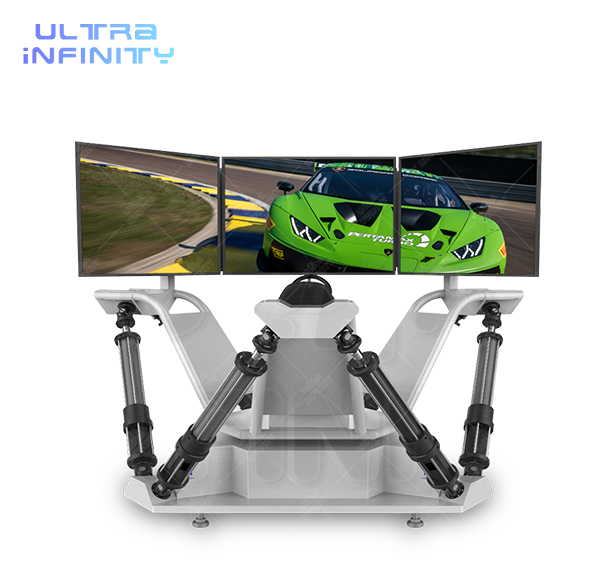
If you are looking at a VR racing simulator and wondering whether to choose 2DOF or 3DOF, the short answer is: one extra axis, a completely different sensation. A 2DOF motion system moves on two independent axes and gives you two core motion cues. A 3DOF system adds a third, and that third axis changes the way bumps, kerbs and jumps feel. For a buyer this is not an academic question. The axis count affects what the simulator can and cannot simulate, how much space and power the unit needs, and what kind of experience your visitors or your home setup will actually receive.
This article explains the three axes in plain language, shows what each one does in a racing scenario, and gives you a decision path so you know exactly when 2DOF is enough and when 3DOF is the better investment. For more detail on how motion systems work in general, see the VR racing simulator motion system guide.
| Feature | 2DOF | 3DOF |
|---|---|---|
| Axes | 2 independent axes | 3 independent axes |
| Primary axes | Pitch (forward/back tilt) and Roll (left/right tilt) | Pitch + Roll + Heave (vertical movement) |
| What it does well | Braking weight transfer, cornering lean, basic racing feel | Adds bumps, kerbs, road surface texture, jumps |
| What it misses | No true vertical movement; kerbs feel flat | Still no yaw (rear rotation) or surge (forward/back push) |
| Typical actuator count | 2 actuators | 3-4 actuators |
| Best fit | Smooth-track GT/F1, entry-level, home use, compact spaces | Rally, off-road, bumpy circuits, commercial multi-ride zones |
DOF stands for Degrees of Freedom. In a racing simulator it describes the number of independent directions the motion system can move the cockpit or the seat. The full set of possible axes in three-dimensional space is six, and they are commonly named like this:
A VR racing simulator does not have to use all six axes to deliver an immersive experience. The question is which axes matter most for the type of driving the machine is built for, and 2DOF and 3DOF represent two practical tiers that cover the majority of commercial and home use cases.
Heave is the vertical axis: the whole seat or platform moves upward and downward rather than only tilting. That sounds like a small change, but it closes a real problem in 2DOF racing simulation.
On a 2DOF system, when you brake hard the rig pitches forward. That is correct for braking weight transfer, but it also pushes your head closer to the steering wheel, which changes the distance between your hands and the controls. When you hit a kerb on a 2DOF rig, the seat tilts, but there is no upward jolt. The result is correct lean, but a missing vertical sensation. On a 3DOF system, the heave axis physically lifts and drops the platform, so a kerb strike produces a real upward jolt. The distance to the wheel stays consistent, and the vertical cue matches what a real suspension does over an uneven surface.
The practical difference shows up most on three types of content: rally racing with jumps, bumpy circuits with repeated kerbs and elevation changes, and any driving scenario where road texture is part of the immersion. On smooth modern Formula and GT tracks the difference is less dramatic; on anything with bumps or jumps, the missing heave becomes noticeable quickly.
Published testing data indicates that going from no motion to a basic 2DOF setup delivers a roughly 40 percent immersion boost compared to a static rig; adding the third axis brings that figure to roughly 60 percent. These are range estimates, not exact figures, and real-world results depend on actuator quality, travel distance, software tuning and the payload the platform carries. See the motion system guide for the engineering detail behind those numbers.
2DOF is the right entry point when the machine is primarily built for smooth-track racing. On modern GT and Formula circuits with consistent surface quality, the braking and cornering cues from pitch and roll carry most of the immersion. Vertical movement is nice to have, but it is not the axis that makes those sessions feel flat.
2DOF also makes sense when the priorities are compact footprint, lower power draw, lower entry cost and quieter operation. For a home simulator where the main use is smooth-track lapping, a well-tuned 2DOF platform covers the majority of the feel at a lower hardware commitment. The trade-off is clear: you gain a simpler setup and a lower price; you lose the vertical jolt that makes kerbs and jumps feel fully physical.
3DOF is the stronger choice when the content includes rally stages, off-road sections, bumpy circuits or any driving scenario where the road surface itself is part of the experience. The heave axis adds the vertical component that makes those moments feel real rather than approximated.
In commercial multi-ride environments, 3DOF also carries a practical advantage: it makes the experience easier to explain. A guest sitting in a 2DOF unit will feel lean and tilt; a guest in a 3DOF three-screen 2-seat racing car will also feel the bumps, the landings and the road surface. That extra axis is one of the reasons multi-seat motion rides use 3DOF as a baseline rather than treating it as a premium add-on.
3DOF is also the tier where the upgrade path opens. A machine with a 3-axis platform and the right modular architecture can potentially be expanded toward additional axes later, while a 2-axis unit is locked to the motion vocabulary of pitch and roll. For a venue that plans to grow its zone over time, starting at 3DOF avoids the cost of replacing the platform once the floor layout evolves. Higher-immersion thresholds such as the single-seat 6D F1 racing game seat or the Thunderclap 6 DOF machine show what additional axis coverage looks like in practice when the venue is ready to move up.
The jump from 2DOF to 3DOF is not only about sensation; it also affects hardware commitment. The key difference is the actuator count: 2DOF platforms typically use two actuators, while 3DOF platforms need three or four. More actuators mean more power draw, more mechanical complexity and more travel distance to manage, which in turn affects space requirements and service planning.
In practical terms, 2DOF entries target a lower entry bracket, while 3DOF sits in a higher tier because of the added actuator, the additional controller capacity and the mechanical design required to deliver reliable vertical travel. The range is wide because actuator quality, travel length, payload and software ecosystem all change the final number. A compact entry-level 3DOF rig occupies a different space from a commercial-grade 3-axis platform built for multi-shift operation.
These are range estimates only and should not be used as final budget figures. Actual pricing depends on the exact platform configuration, actuator brand, controller, software license and regional supplier terms. Always request a written quotation for the specific machine and configuration you are evaluating.
The matrix below maps typical scenarios to the motion tier that fits best. Use it as a starting point, then confirm the exact axis count and actuator spec for the machine you are comparing.
| Use Case | Primary Goal | Recommended DOF | Why |
|---|---|---|---|
| Home smooth-track lapping | Affordable entry, compact setup | 2DOF | Pitch and roll cover most of the feel on smooth circuits |
| Home rally or mixed content | Vertical immersion on jumps and bumps | 3DOF | Heave fills the gap that 2DOF leaves on uneven surfaces |
| FEC multi-seat ride zone | Clear, convincing shared experience | 3DOF | Vertical cues make bumps and jumps easy to explain to guests |
| Commercial linked racing row | Same-session head-to-head play | 2DOF or 3DOF | Match the DOF tier to the content the row runs |
| Training or comparison testing | Maximum axis coverage for variety | 3DOF or 6DOF | Wider motion vocabulary suits mixed training content |
Work through these checks in order and you will know exactly what the platform does before you commit.
Write the answers down before you compare machines side by side. A simulator is only as good as the motion architecture, actuator quality and software the supplier confirms in writing.
The questions operators and home buyers ask most often about 2DOF and 3DOF in racing simulators, answered directly.
2DOF means the platform moves on two independent axes: pitch (nose-up/nose-down tilt) and roll (left/right tilt). These two axes cover braking and cornering cues, but they do not deliver true vertical movement.
3DOF adds heave, the vertical axis. That means the seat or platform can move up and down, not only tilt. Heave is the axis responsible for bumps, kerbs and jumps feeling physical rather than approximated.
Yaw and surge add tail rotation and longitudinal G-force. They improve immersion further, but pitch, roll and heave are the three axes that cover the majority of racing-relevant cues. Yaw and surge are usually part of higher DOF tiers.
It depends on the platform architecture. Some modular designs allow a later actuator upgrade; others are fixed at the original axis count. Ask the supplier before purchase whether expansion is supported.
3DOF is generally the stronger baseline for multi-ride commercial environments because the vertical axis makes bumps and jumps easier for guests to understand and feel immediately.
Not automatically. Axis count defines the motion vocabulary, but software tuning, actuator speed, travel distance and payload all determine how natural the result feels. A well-tuned 3DOF system often outperforms a poorly calibrated higher-DOF setup.
Tell us what content you plan to run, the space available, and whether the simulator is for home use or a commercial zone. Our team can recommend the matching DOF level and lay out the floor plan with a free 3D venue layout design. The full motion lineup is in the VR racing simulator collection.