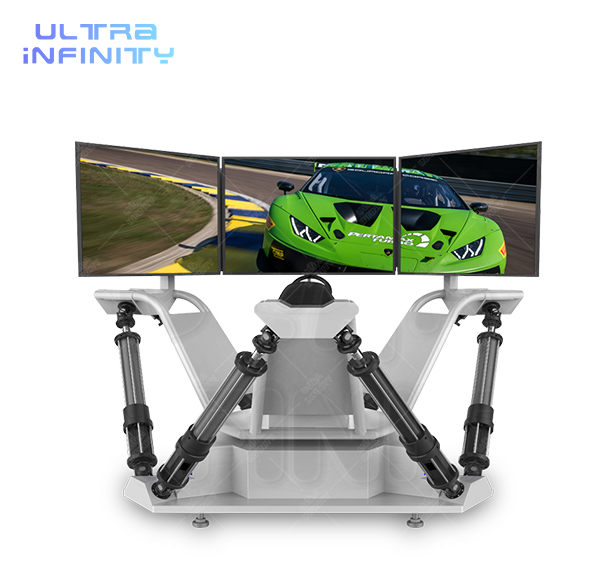
When a venue owner asks what VR racing simulator equipment comes with a complete setup, the honest answer is that the full package is not a single machine and not just a box with one headset and a chair. It is a working system made up of a servo-driven cabinet, a VR headset, software and games, controls, safety parts and the site wiring and mounts that an operator must provide. The short version is this: you get a ready-to-plug-in racing cabinet that provides the motion, the screen and the control of the ride, and you add the headset, the content, the power supply and the physical mounting that turn it into an operating attraction.
The machine at the center of this article is the INFINITY NEXTPLAY Black VR Racing Simulator, a single-player, servo-driven karting unit built for arcades, family entertainment centers and VR game rooms. Before we list its parts, it helps to fix its physical scale in your mind: the cabinet is 2300 mm long, 1530 mm wide and 1930 mm tall, it weighs 300 kg, it runs on 220 V, its drive system is a servo motor, and it carries a maximum rider load of 150 kg. Those numbers matter because every other decision about the installation, from the room size to the power outlet, starts from them.
Rather than promising a one-size-fits-all item list, this guide walks through each part of a complete setup in turn: the cabinet and motion system, the headset, the software and content, the controls and safety, and finally the items the operator must add that are not part of the machine. By the end you will be able to hand a supplier a specific set of questions and know exactly what you still need when the unit arrives on site. For the room and space side of the same machine, our VR racing simulator dimensions guide covers the floor and ceiling requirements in detail.
The rest of this article separates those five groups clearly, because the biggest buying mistake in this category is assuming that the unit in the brochure, the one that shows a player in a headset, is the whole package. In most commercial installations the machine arrives as a complete cabinet, and the operator still sources or confirms the headset, the game content, the power supply and the safety plan. Knowing which part belongs to which group is exactly what turns a confusing quote into a clear equipment list, and that is what the next sections give you.
Before diving into each component, here is the full equipment breakdown for a complete VR racing simulator setup. The table separates what arrives with the machine from what the operator adds, so you can read it as a checklist and take it straight to a quote.
| Equipment Group | Included With the Machine | You Add On Site |
|---|---|---|
| Servo cabinet & motion | Yes - the whole unit | Floor and fixing |
| VR headset | Often bundled / optional | Headset hygiene kit |
| Games & software | Bundled game selection | Content updates |
| Controls & seat | Yes - built in | Nothing |
| Power | 220 V cable | Outlet / circuit |
| Safety & barriers | Overhead mount / parts | Site barriers |
| Mounting & suspension | Suspended setup parts | Ceiling mount |
This is the high-level picture, and the next sections make each row concrete. The two rows to read carefully are the headset and the mounting. The headset is the part most commonly quoted as optional, and the overhead suspension and ceiling mount are the part most commonly forgotten that the operator must supply, which is why both are given their own section below.
Everything in the table applies to a single unit, and the same distinction carries over if you plan a multi-seat racing zone: each seat brings its own cabinet, headset, controls and safety, but the site shares power, mounting and management. That planning logic is the same logic used across the range, whether you start with a compact karting unit or a larger full-motion cockpit.
The cabinet is the machine itself, and it is the single largest and most important piece of equipment in the whole setup. It provides the structure, the seat, the motion and the electronics of the ride. In a complete package this is what you are really buying, and everything else either plugs into it or supports it.

| Specification | Black VR Racing Simulator |
|---|---|
| Length | 2300 mm |
| Width | 1530 mm |
| Height | 1930 mm |
| Area Covered | 3.6 m2 |
| Weight | 300 kg |
| Drive System | 3DOF Servo Drive |
| Voltage | 220 V |
| Maximum Load | 150 kg |
Read the specification table as an equipment statement, not just a list of numbers. The 2300 x 1530 x 1930 mm dimensions tell you the floor footprint of 3.6 m2 and the overhead space the machine needs, the 300 kg weight tells you the floor and moving-crew requirement, the 220 V tells you the power connection you must have ready, and the 3DOF servo drive tells you what kind of motion the machine produces and therefore what clear space belongs around it. Each number is a requirement for a different part of your site.
The cabinet is also what makes a VR racing simulator different from a headset-only VR game. With a headset-only system the player just stands in a clear play area. With a racing simulator the player sits inside a physical machine that tilts and responds as part of the ride, so the cabinet is both the attraction you see and the frame that carries the motion, the seat and the controls. That is why the cabinet is where most of the equipment budget goes, and why it deserves the most attention in your checklist.
The motion system is what turns a static chair into a racing experience, and in this package it is a 3DOF servo drive. Three degrees of freedom means the machine moves along and around the axes that matter most for driving feel: pitch and roll, the tilt of the cabinet as the car accelerates, brakes and corners, and a corresponding movement that makes the player feel the road. A servo motor drives this motion, which matters for service and feel: servo systems respond quickly, run smoothly and are the standard drive in modern racing simulators.
The motion envelope, the range of movement the cabinet makes, is contained within the structure of the unit. This is an important equipment fact, because it means the safety clearance around the machine is defined by the access space for the player and operator rather than by a large swinging arm. When you plan the room, you plan around a machine that moves on its own three axes inside its own footprint, which keeps the installation compact compared with larger multi-degrees-of-freedom systems.
If you want to understand exactly how this motion is created and why it feels real, our guide to how the VR racing simulator motion system works breaks the servo drive, the control and the feel into practical steps. For the decision at hand, the key point is that the motion is part of the cabinet you receive, it runs on the servo system in the spec table, and it is controlled automatically as part of the game, so the operator does not need to tune it manually for every session.
The VR headset is the screen of the attraction, the device that puts the player inside the racing world. In a complete commercial setup the headset is a critical safety and hygiene item, not just a display, because it touches the player's face, is shared between riders and must stay fixed and secure during the motion of the ride. The headset is also where cleanliness matters most in a public venue.
Whether the headset is included depends on the package you negotiate, which is exactly why it appears in the price-included column of the overview table. Some suppliers offer the cabinet with a bundled headset ready to run, and others treat the headset as an operator-supplied item. The safest buying question is explicit: ask whether the quote includes the headset, the mount and the cleaning kit, or whether you must add them, so that the final price reflects a genuinely complete setup rather than a bare cabinet.
The headset also connects to the software selection, because the available games determine what the player sees inside the headset. A complete package matches the headset to the content library, which is why the next section treats the software as part of the equipment conversation rather than leaving it out entirely.
A racing simulator without racing content is an expensive empty chair. The software and games are part of a complete setup because they are what a paying customer actually plays, and a good package includes a selection of titles that load automatically with the motion, the headset and the controls. In a commercial venue the content also drives repeat business, because variety is what brings a rider back for another session.
When you compare packages, treat the game count and the update path as equipment you are purchasing, not as afterthoughts. The software must work with the servo drive and the headset you already decided on, and it should load reliably in a public, pay-per-play setting. A new amusement needs enough built-in variety that it does not feel repetitive to a returning customer in the first weeks, and it helps to ask the supplier how new content is added after delivery.
The software is also the part of the setup most tied to the specific model of machine, so it is a reason to keep your comparison on the same basis. A compact karting unit, a familiar single-seat racing cabinet and a full-motion cockpit may share the same overall technology while offering different game libraries and session lengths, and that difference is part of the equipment decision.
The controls, the seat and the safety parts are the pieces that make the cabinet a usable and safe ride. In a complete package these arrive with the machine, which is good news for an operator, because they are built into the same structure as the seat and the motion system rather than bought separately.
The safety equipment deserves its own line because it is both a liability and a service item. The restraints are checked every session, and the removable hygiene parts of the headset are replaced or cleaned between riders. A complete setup includes these so that the machine can open for business on day one, and your operations plan should add the daily cleaning and pre-session checks that keep them effective.
Because the controls and seat are integral to the cabinet, they are also part of why the 300 kg weight and the 1930 mm height matter in practice: a seated rider plus the frame and the servo system makes a substantial unit that needs a solid floor and a careful delivery path. The room and the floor are in our space planning guide, and the day-to-day care of these parts is covered in our maintenance guide for venue operators.
This is the section that separates a smooth opening from a delayed one. Several items are needed for a VR racing simulator to run that are usually not part of the shipping crate, because they belong to your building rather than to the machine. Planning them in advance is as important as planning the unit itself.
The overhead mount and the power circuit are the two items operators overlook most often. A machine can be fully complete in its crate and still not run on opening day because the ceiling is not prepared or the circuit at the position is not big enough. Because these belong to the building, they never appear as equipment on a supplier quote, so they must live on your own site checklist.
You can also use the supplier conversation to confirm which of these are typical for the machine you chose, since different units differ on the mount and the power spec. Ask for the installation sheet early, and you will know your exact responsibility well before the machine is on site.
Here is a consolidated, order-ready equipment checklist. Run through it once as a buyer comparing quotes, and once as the operator who will receive the unit on site, because a complete setup wins on both sides of that handoff.
Use this checklist as the backbone of your request for quotation. When a supplier quotes a VR racing simulator, walk these six groups with them and ask which items sit inside the quote and which you must add. The answer to that single question is the difference between a budget that describes a machine and a budget that describes an operating attraction.
If the room size or the layout changes as you go through the checklist, the machine itself does not change, but how many you can run and where they sit does. Checking the checklist against your realistic floor plan before ordering avoids ordering equipment that cannot open, and it is the same prudence that applies when you scale from one unit to a multi-seat racing zone.
A complete VR racing setup is not an off-the-shelf single product; it is a package you match to your venue, your room and your expected crowd. The right choice depends on how much space you can give the motion, how you want the ride to feel and how the attraction fits the rest of your floor.
Looking for a commercial VR racing simulator? You can browse the full VR racing simulator collection to compare packages, and the models below represent the range, from a compact servo karting unit to a full-motion F1 cockpit, so you can match the equipment to the room you have.
The highest-value comparison in this buying decision is the one you can make with a single question: is the price for a complete setup or for a bare cabinet? The two numbers are dramatically different, and knowing which one you are being quoted changes what you must budget on top.
| What It Includes | Bare Cabinet | Complete Setup |
|---|---|---|
| Servo cabinet and motion | Yes | Yes |
| VR headset and mount | No - add it | Yes |
| Software and games | No - add it | Yes |
| Controls, seat and safety | Yes | Yes |
| Delivery and installation | No - add it | Often included |
| Ready to open on arrival | No | Yes |
The rows that separate the two columns are the headset and the software. A bare cabinet gives you the machine but none of the playable content and none of the shared-wear hygiene stack, which means you add real cost and real setup time before it can earn. A complete setup arrives aiming for day-one operation, which simplifies your plan and your budget.
The comparison also shows why the same machine can appear at very different prices from different quotes. Two suppliers can quote the same physical cabinet at a different final number simply because one assumes a bare unit and the other a complete system. Ask every supplier the same included-versus-excluded question, and compare on a complete-setup basis rather than on the headline machine price. A compact classic VR karting cabinet and a full-motion 6-DOF racing cockpit may share the same basic technology while offering very different completeness levels, so make sure you are comparing like with like before you sign. For a deeper look at how these machines feel and how they are used in practice, our VR racing for friends and families article shows the ride from the player's side.
Most buying problems with VR racing systems come from a small set of repeatable mistakes. Recognizing them before you sign is cheaper than fixing them after delivery.
Every one of these mistakes traces back to the included-versus-excluded question at the heart of the checklist. Keep the six equipment groups from this article in mind, confirm the headset, the software and the site items explicitly, and the rest of the decision is straightforward. When in doubt, put the checklist in the quote request and let the supplier answer each line.
Here are the questions buyers ask most often about what a VR racing simulator setup includes, answered directly with the equipment from this article.
A complete setup includes the servo-driven cabinet with its integrated seat, steering and pedals, the VR headset and mount, the software and game library, and the safety equipment such as restraints and hygiene parts. The operator still adds the 220 V circuit, the ceiling mount and the access space on site.
The headset is often bundled but is also frequently quoted as optional, so it must be confirmed with the supplier. Ask explicitly whether the price includes the headset, the mount and the cleaning kit, because a bare cabinet may not include the playable or shared-wear elements.
The Black VR Racing Simulator cabinet weighs about 300 kg, measures 2300 x 1530 x 1930 mm and covers about 3.6 m2 of floor space. The weight affects the floor requirement and the delivery path, and the size affects the room and ceiling planning.
The unit runs on 220 V. You must confirm a suitable outlet or circuit at the installation position, with a cable route that does not cross a walking path, and this power connection is part of the site items the operator provides.
A complete package normally includes a built-in game library and the software that links the games to the 3DOF servo motion. Confirm the game count and how content updates are delivered, because the software is part of the equipment decision.
You add the 220 V circuit, the overhead ceiling mount for the headset suspension, a solid level floor for the 300 kg unit, the clear access space around the machine, and your site safety barriers. These are building items, not part of the shipping crate.
Share the machine you are considering with INFINITY NEXTPLAY, and our team can confirm the exact equipment list, the headset and software options, and the site items you need to prepare for a smooth installation.