An 18-hole indoor walkthrough for people who have never played: the first five minutes, the alternating middle, the scoreboard gamble, and the walk out - what a course actually feels like from the putter side.
You hand over nothing but a name at the counter. In return: a putter that feels lighter than expected, a ball in a color your group will argue about, and a pencil. The staff points at the first hole, someone makes a joke about the scorecard being a formality, and before any nerves can form, the ball is on the carpet and the round has started. That is the first thing an indoor course feels like: low ceremony. No tee, no gloves, no lesson.
The first hole is deliberately kind. On the course this walkthrough follows, it was a gentle ramp route in the style of the Golf Parkour Hole - wide enough to forgive a nervous putt, shaped enough to make the first successful tap feel earned. Somewhere between the parking lot and that first hole, the sport you feared not knowing turned into a game anyone can start.
By the fourth hole, the pattern emerges: the course keeps asking a different question. A bank-shot hole - billiard-style, like the Billiard Golf Hole - teaches your group that the wall is a friend. A route hole like the Cube Maze Golf Hole slows everyone down into silent reading mode, then erupts when someone finds the clean line. The rules never change - lowest putts wins - but the texture does. That alternation is why the middle of the round does not sag: no two neighbors ask for the same skill.
Then the course asks its first timing question. A moving gate - the balance-challenge style, like the Balance Challenge Golf Hole - swings across the line, and the whole group goes quiet in the same way. Watch one full cycle, someone whispers. The player who ignores that advice donates a ball to the wall; the player who waits walks off with a two. First-timers discover that patience is a shot shape.
The signature moving hole - the cyclone-spin style, like the Cyclone Spin Hole - is where phones come out. It stalls the group for two minutes and photographs for months; a venue that places it mid-route knows exactly what it is doing. The published obstacle roundup (the indoor mini golf ideas guide collects the formats) explains the mechanics - but standing there, you only feel the countdown.
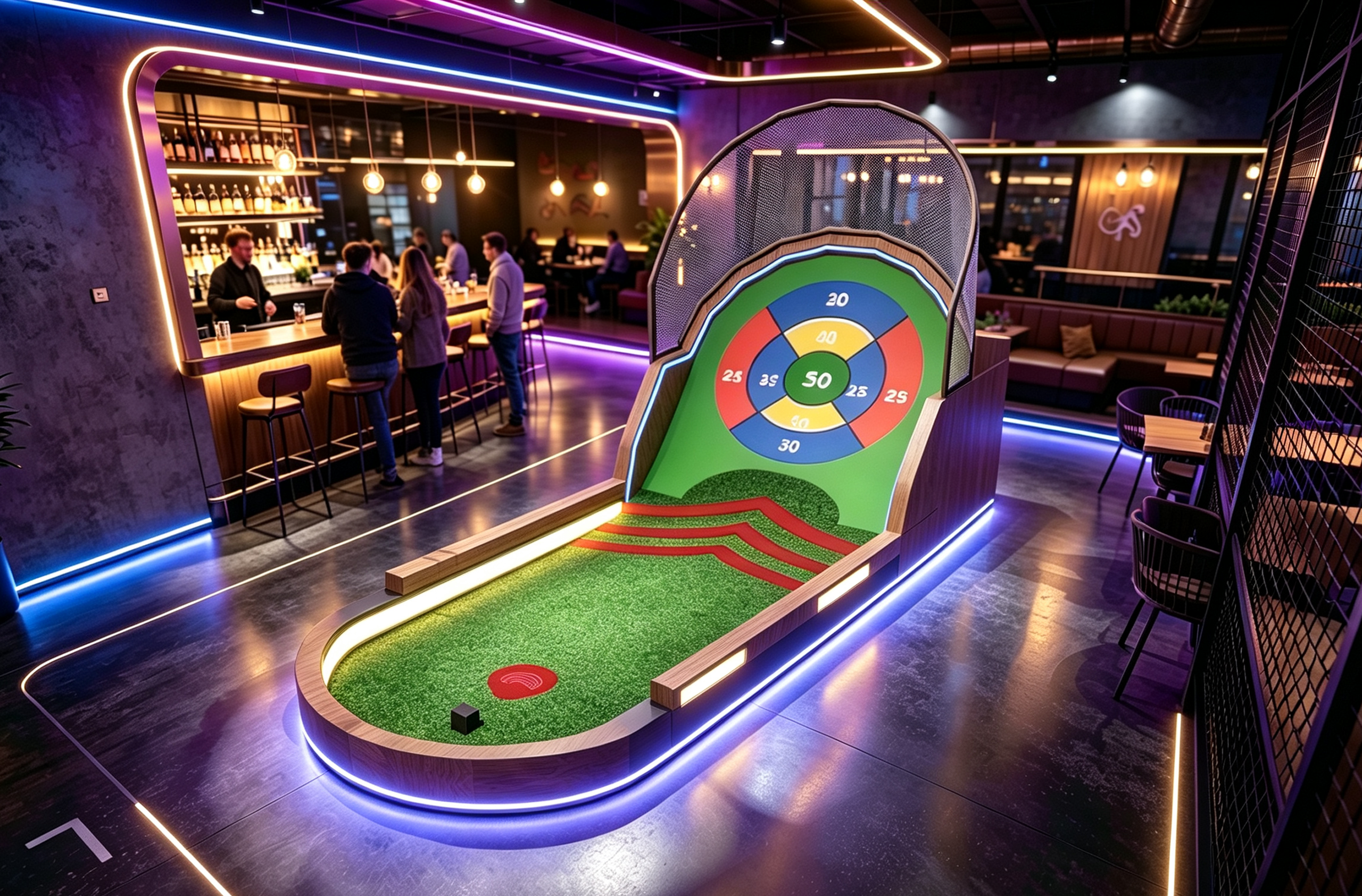
Twelve holes in, the course stops being geography and becomes arithmetic. The target hole - multi-zone, like the Golf Target Shooting Hole - replaces the cup with a points board: the safe zone scores low, the tight zone pays a bonus, and every player in the group faces the same tiny gamble. Confident putters take the risky line and pay for it; the cautious first-timer banks a steady two and quietly takes the lead. It is the most democratic hole on the course, and it is where the scorecard stops being a joke.
| Hole | The question it asked | What the first-timers remembered |
|---|---|---|
| Ramp opener | Can you roll, not hit? | The first tap that felt earned |
| Bank-shot hole | Will you use the wall? | The two-wall bounce someone banked |
| Moving gate | Can you wait one cycle? | The donated ball and the patient two |
| Target board | Safe two or risky bonus? | The cautious player who took the lead |
| Treasure finale | Ready for the photo? | The picture that outlived the scorecard |
The numbers below are the honest first-round reality this walkthrough recorded (EXAMPLE): nobody in the group hit par on the timing holes, everybody hit par on at least one confidence hole, and the winning total was closer to double digits over par than to anything you would call good golf. Nobody cared. The published rules-and-scoring guide (the how do you play mini golf walkthrough) formalizes what the scorecard was already telling the group: a hole caps at a sensible maximum, so a disaster costs pride, not the afternoon.
The finale hole is staged like a closing scene - treasure-themed in the style of the Golf Treasure Hunt Hole, lit brighter than the rest, built for the photo that will outlive the scorecard. The group photographs the hole, then plays it, then photographs the scorecard. On the walk out, the conversation has already reordered the round: the gate hole that ate three balls, the bank shot someone banked off two walls, the target gamble that handed a first-timer the win. A course that manufactures retellable moments has done its job before you reach the counter.
Safety never announced itself, which is how it should feel: soft edges, clear walkways between parallel holes, staff watching the busiest corner - the published baseline in the top 10 mini golf safety checks piece. And the exit hands you somewhere to land: most indoor venues sit the course beside food, lanes or games, so the round ends at a table instead of in a parking lot.
Reading this on the operator side? Everything the group felt was designed: the kind opener, the alternating middle, the democratic scoreboard holes, the staged finale. The indoor mini golf course solution page shows how that experience is assembled as a build plan.
Plan for about an hour and a half for a group of four, longer on a busy Saturday evening. The published walkthrough on this site breaks the round into play time, waiting time and stops - the golf is under half of it. First-timers should book an off-peak slot for the calm version of the course.
No - the first putt lands within a few minutes of walking in, the putter is light, and the holes are designed to be finished, not survived. Half the holes in a typical course are confidence holes where par is genuinely reachable on a first visit. The challenge curve rises gently toward the moving and target holes, so beginners peak where it is fun rather than frustrating.
Nothing special: shoes you can walk an hour in and a pocket for the scorecard pencil. The venue provides putter, ball and scorecard at the counter. The published dress guide for indoor attractions boils down to the same thing - dress for an hour of standing and laughing, not for sport.
Yes - junior putters sit by the door, the confidence holes are reachable for small players, and there is no rule that a group must finish all eighteen. Many families play nine and finish at the cafe; the published family guide suggests letting the youngest player set the pace and the exit time.
Weekday afternoons are the calm version: no queue, no music over your shoulder, staff free to explain a hole. Evenings bring the crowd energy - louder, faster, better for groups who feed on it. First-timers usually enjoy the calm version more and come back for the energy.
The holes that look complicated are the most fun to fail at. A moving gate (the balance-style holes) is pure timing: watch one full cycle, then putt. A target hole turns the cup into a points board: the safe zone is a two, the tight zone is a bonus - groups argue happily about which line to take. Neither needs skill; both reward a second look.
Players: book the off-peak slot and let the youngest set the pace. Operators: the indoor mini golf course solution page shows how the feel is engineered hole by hole.