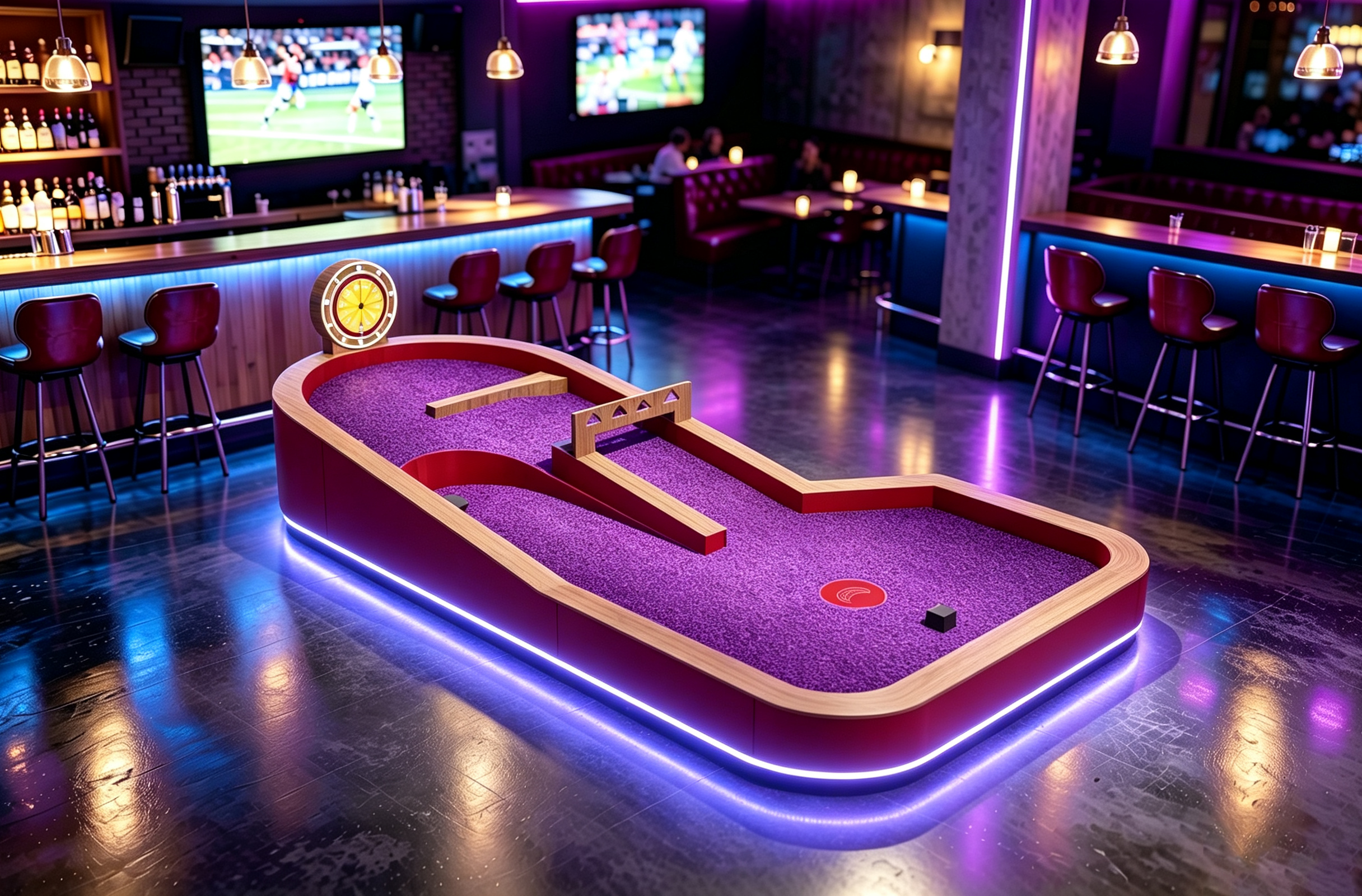
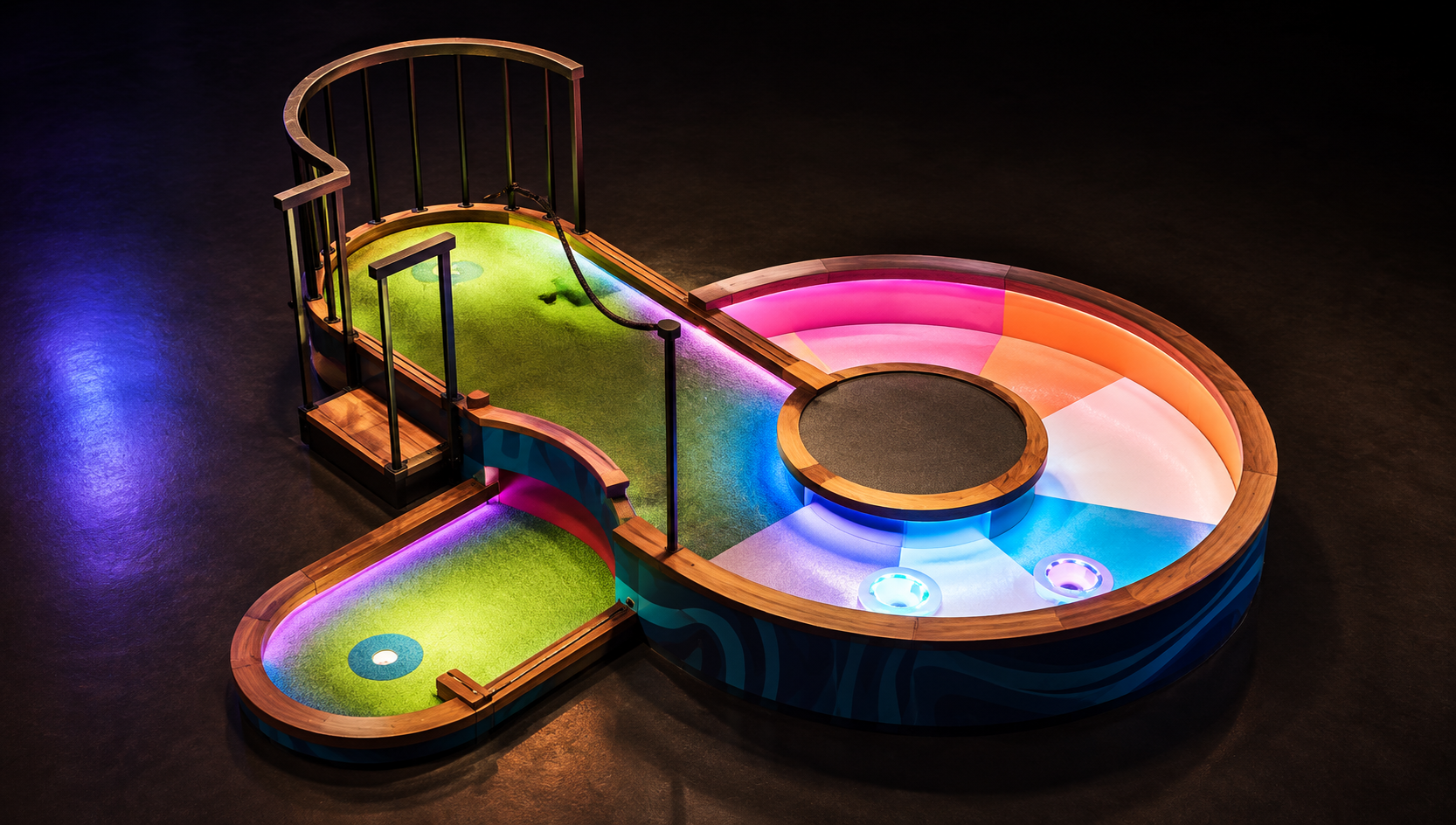
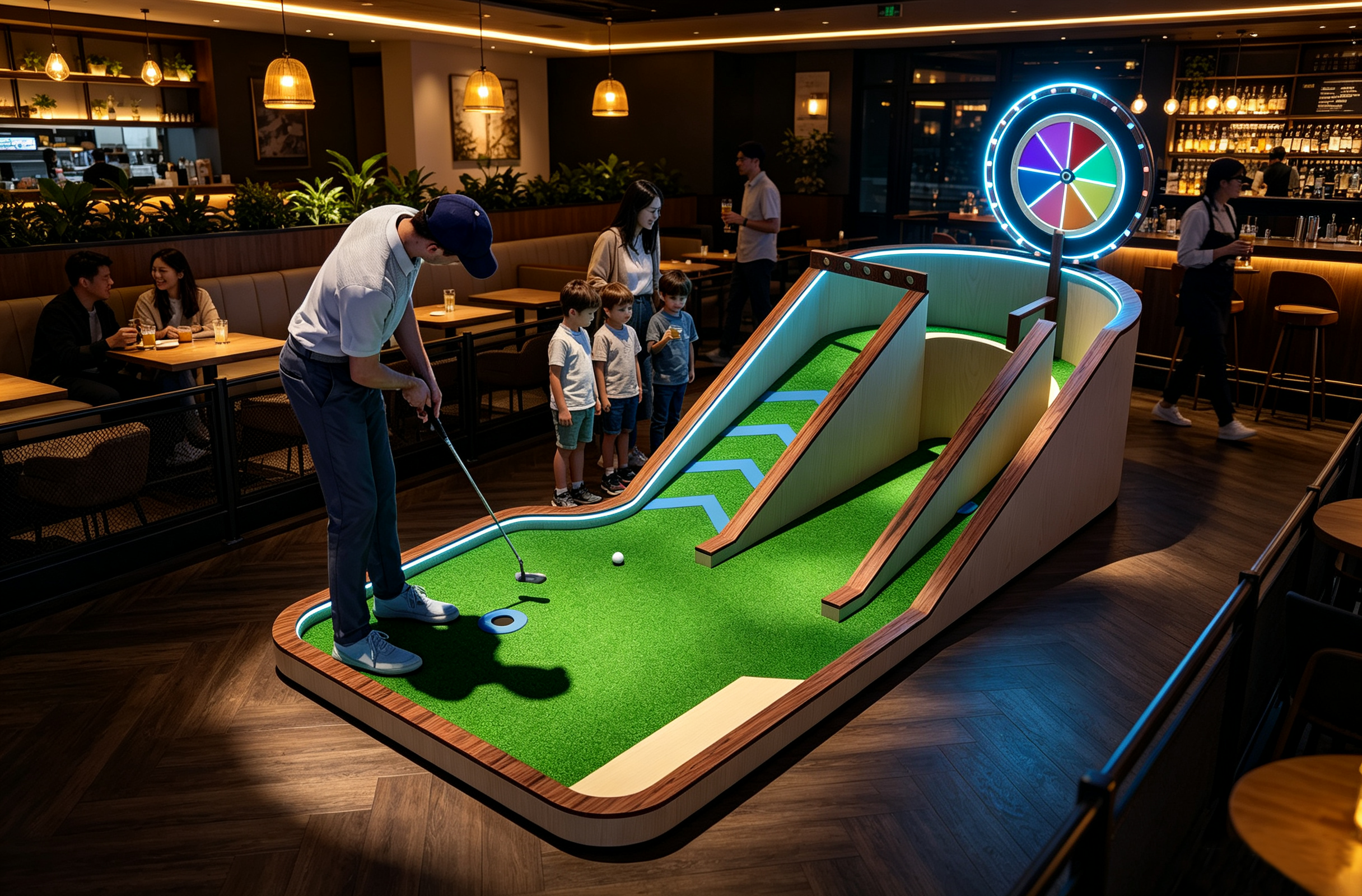
The first-round playbook: stroke play on 18 themed holes, the scorecard and the six-stroke cap, the six putting basics in order, obstacle play for gates, curves and spinners, and the pace that holds the published 45-60 minute session.
How do you play mini golf? You play stroke play on a themed 18-hole putting course: every player plays their own ball, every stroke counts, and the lowest total wins the card. The published player guide prices the round at about $12 per adult on 18 holes and times it at roughly 45 to 60 minutes, so the whole game is a one-hour, four-to-six-strokes-per-hole promise. This guide teaches the parts that promise is built on: the card, the three universal rules, the six putting basics, and the pace that keeps the group ahead of the group behind you.
The operator cluster covers the business side - hole design, rate cards and course capacity. This page is the one you hand a first-timer: what happens at the tee, what the card is asking for, and why the six-stroke cap exists. The scoring hardware question (manual card or sensor board) is the published scoring-tech comparison's subject; here the card is just paper, and the rules are the same on both.
The scorecard is one row per player and one column per hole, with each hole's par printed at the top. Write your stroke count in your column after every cup; circle it when it beats par, square it when it does not, and total the column at the end. The three rules that carry a first round: (1) play the ball as it lies, including against walls and obstacles; (2) putt from behind the tee line, never from past it; (3) take a maximum of six strokes on any hole, then pick up and move on. Groups of four is the published planning figure, and it is also the format the card layout assumes.
| Rule (EXAMPLE teaching card) | What it means on the turf | The penalty if broken |
|---|---|---|
| Play it as it lies | No nudging walls, no rerouting obstacles mid-run | Replay the stroke, +1 |
| Tee-line start | Ball behind the line for the first putt of each hole | Replay from the tee |
| Six-stroke cap | Count to six, mark six, clear the green | The cap itself is the score |
| Ball off the course | Replace at the previous stroke point | No extra stroke |
The published scoring-tech page puts the manual-card round at about 12 per course-hour and the sensor-ledger round at about 18, which is the capacity reason venues automate - and it is also the practical reason a group that keeps its own card moving is liked on every course. The published rate card ($4.50-$9.00 tiers) prices the weekday session cheaper than the weekend one; the rules stay identical across both.
Six basics cover every putt the course will ask for, and they stack in order. One, grip: both hands low and square, palms facing, so the face returns square without wrist action. Two, stance: feet inside shoulder width, eyes over the ball line. Three, ball position: center of the stance or a touch forward, never back. Four, the pendulum: shoulders move the putter, wrists stay out of it. Five, length: longer backswing for longer rolls, not a harder hit - tempo stays constant. Six, reading: on most courses the turf is fast and true, so the line into the cup matters more than the break; aim for the back of the cup on uphill putts and let gravity finish.
Bank shots sit on top of the six: on a straight lane blocked by a gate or a curve, a firm putt into the wall at a right angle returns to the center line, and the published obstacles guide (the top-10 obstacles tour) shows which holes reward the bank over the thread. The published surfaces guide rates turf, coating and tile differently - tile plays fastest, which is why tile holes punish hard hit putts twice: once off the bank and once past the cup.
| Hole type (EXAMPLE card layout) | Par | Clean-putt line | What beats par |
|---|---|---|---|
| Straight lane | 2 | Center cup, firm | One tempo putt, in |
| Curved lane | 3 | Bank off the outside wall | Threaded inside line |
| Gate or moving obstacle | 4 | Wait for the window, firm through | Timed entry, one bounce |
| Elevated or ramp cup | 3 | Back of the cup, uphill pace | Gravity drop, no second putt |
Obstacles are the holes that decide the card, and each published hole family has one correct plan. Gates: the Gate Challenge Golf Hole rewards patience - watch one full cycle of the moving gate, then putt through the gap you watched, rather than racing it. Curves: the Curve Block Golf Hole is a bank-shot hole; the wall is your fairway, and a firm right-angle bank beats a soft thread almost every time. Spinners: the Cyclone Spin Hole punishes timing; let the paddle pass, then putt into the space behind it.
The published interactive-mini-golf guide (sensor-lit holes) adds a fourth family: holes that score themselves when the ball crosses a lighted target. The rules do not change - stroke play and the six-stroke cap still govern - but the reading does: lighted targets are exact, so the tempo putt into the target is worth more than a bold second putt. When in doubt on any family, the safest par play is to reach the gate or curve in one controlled stroke and hole out with the second, instead of gambling the cap away in the first two.
The published capacity math prices the course on 45 to 60 minute rounds at 16 to 24 players per course-hour on an 18-hole walk-in route, which means your group is a moving part in someone's arithmetic. The etiquette that holds it: putt when the group ahead clears the green, keep the six-stroke cap without being told, let faster groups play through at the crossover, and mark scores at the next tee, not on the green. A group of four that follows the card keeps the published session window with minutes to spare.
Party and event rounds change the clock, not the rules: the published pricing guide shows packages and F&B anchors layered on the same per-round card. The published duckpin teaching guide closes its rules with the same line this one does: the format is easy to learn in one session, and the six basics - grip, stance, ball position, pendulum, length, reading - are the whole curriculum. Practice them in order on holes one through six, and by the back nine the card stops being a guess.
Most courses cap a hole at six strokes: count to six, pick the ball up, mark a six on the card and move to the next tee. The cap is what keeps an 18-hole round inside the published 45 to 60 minute session instead of letting one bad hole stall the whole course.
Place the ball back where it was last played, with no extra stroke charged. If the ball settles against a wall or obstacle, many courses allow a free drop one putter-head length away, never closer to the hole. House rules printed on the scorecard win when they differ.
On the first hole, the order is decided by agreement, coin flip or card order. After that, the best score on the previous hole putts first, and the worst score putts last. Away-from-the-hole is the tiebreak: the ball farther from the cup plays first.
Par is the stroke count a clean putt should take, and it is printed on the card or the hole sign. Straight lanes carry par 2, curved holes par 3, and obstacle holes with gates or moving parts par 4. An 18-hole card usually totals near par 54 (EXAMPLE card layout).
The published session plan runs 45 to 60 minutes for 18 holes with a group of three or four, and the published capacity math assumes the same round window. A four-person group that keeps the six-stroke cap holds that pace without pressure.
In casual stroke play, no: play it as it lies, and the struck ball is usually returned to its spot. Tournament formats differ, which is why the scorecard and the marshal settle disputes, not memory.
Send us your floor plan: we will return a hole-by-hole layout, a par card and the equipment list through the free 3D layout design - built around the Gate Challenge, the Cyclone Spin and the Curve Block holes.