A mini golf course lives or dies on the second visit, and the second visit is decided by what players remember - not the turf, not the price, but the hole they argue about on the way out. The published capacity analysis sets the engineering frame: a hole must play inside the 3-5 minute band or the route's 16-24 players per course-hour collapses. Every obstacle on this list earns its floor space inside that band, and the gadgets earn it by doing scoring or re-theming work the staff would otherwise do.
The ranking logic follows the published economics: throughput first (the published 9-hole plan runs 9 rounds per hour), scoring second (the published ladder runs 12 manual to 18 sensor rounds per hour), re-theme third (the published LED calendar rotates 12 times a year in 30-minute changes), and the photo moment last - because it is free marketing, but only if the hole survives the first three tests.
| Rank | Obstacle / Gadget | What It Earns |
|---|---|---|
| 1 | Sensor-scored interactive hole | 18 rounds/hr - the published sensor leaderboard ceiling |
| 2 | Rotating-blade windmill (timed) | The classic retry - shaped, not random, inside the 3-5 min band |
| 3 | Labyrinth / puzzle wall | The post-game argument that books the rematch |
| 4 | LED-re-theme hole shell | 12 rotations a year, 30-minute changes |
| 5 | Castle / themed photo hole | The goodie-bag photo - free marketing per the party playbook |
| 6 | Moving-target gate | Timing skill without a restart loop |
| 7 | Split-path decision hole | Two routes, one hole - replay value inside the same footprint |
| 8 | Raised-loop return ramp | Vertical play in a compact footprint |
| 9 | Hybrid scoring kiosk mid-route | The published 16 rounds/hr hybrid pattern |
| 10 | Ball-return / auto-reset rail | Zero-staff resets between groups |
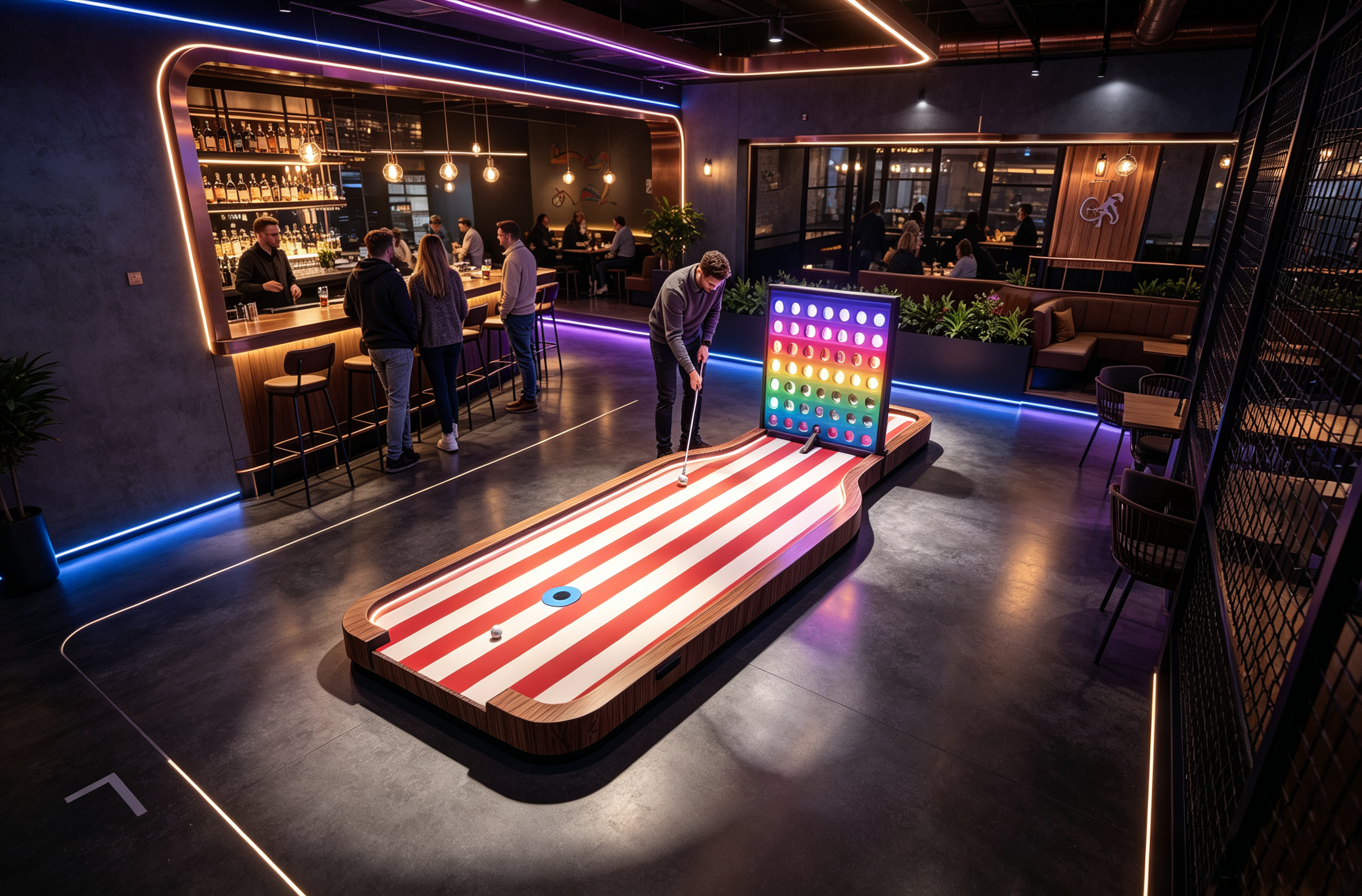
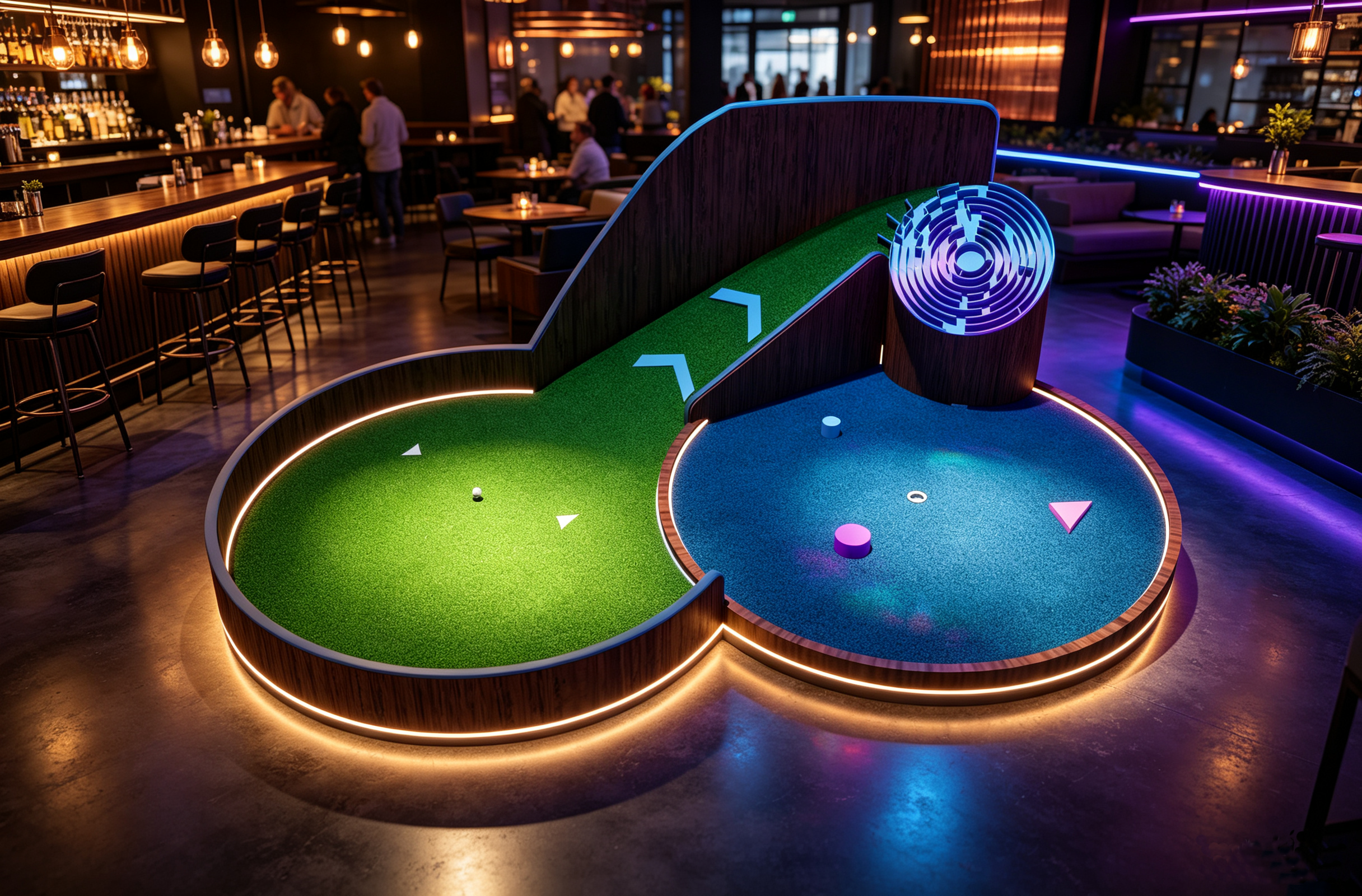
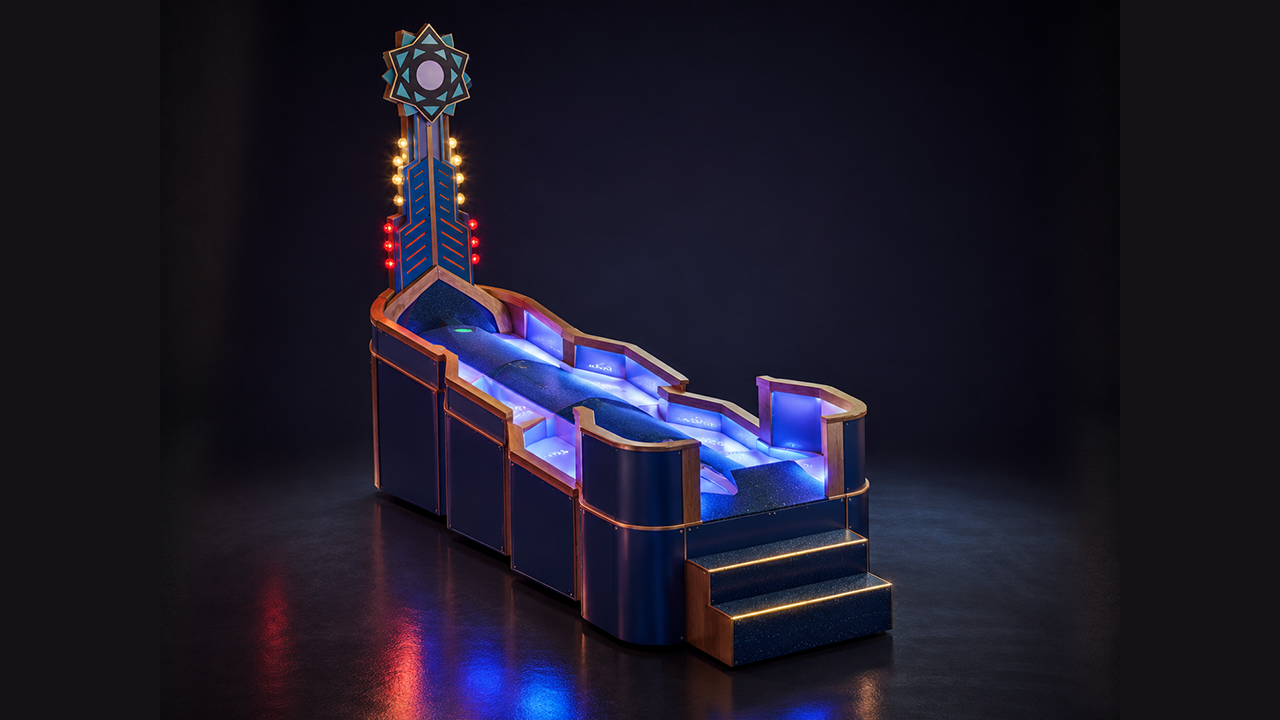
Three of the ten exist as installable products today. The Rainbow Golf Challenge is rank one built: sensor scoring runs the published 18-rounds-per-hour ceiling with zero scoring staff - the gadget that pays rent. The Labyrinth Challenge is rank three built: a puzzle route that groups argue over at the exit - the published party playbook's post-game conversation, manufactured. The Dream Castle Hole is rank five built: a themed photo hole that re-reads in every LED scheme of the published 12-rotation calendar.
Obstacles buy attention, but they spend floor area and staff time, and the published references price both. The footprint: the published payback analysis sizes a course in a 300m2 space, and obstacle-dense holes trade lane length for width and height - the split-path and raised-loop designs on this list are how variety fits the same envelope. The operating factors: each gadget adds a wear item to the published spares list and a test step to the daily walk, and the sensor-scored designs pay their own way - the published scoring ladder shows them running at 18 rounds per hour with no scoring staff, while unscored gadgets push the route toward the 10-rounds-per-hour floor.
| Operating Factor | Published Reference | What It Means for Obstacles |
|---|---|---|
| Course footprint | 300m2 payback model | Obstacle variety via width/height, not length |
| Scoring staff | 18 rds/hr sensor vs 10 none | Sensor-scored gadgets replace the staff line |
| Wear items | Published spares guide | Each gadget adds a Friday shelf item |
| Daily walkthrough | Player-order route | Gadget choke points join the pre-open walk |
Picture the published figures assembled into one 9-hole build. Holes one through eight alternate classic shapes and timed gadgets - every hole tuned to the published 3-5 minute band, the route cycling its group inside the published 30-40 minute window. Hole nine is the signature: a Labyrinth Challenge puzzle wall backed by a Dream Castle Hole photo frame - the queue stops, watches, photographs. The Rainbow Golf Challenge scoring loop runs the published sensor rate of 18 rounds per hour on the express route, and the LED shell rotates the whole course through the published 12-scheme year. When the package tier goes on sale at the published +22-35% lift, the obstacle list is the reason the photos - and the rebooking - exist.
The scenario is illustrative, but every number in it is a published reference: the per-hole band, the route capacities, the scoring ladder, the rotation calendar and the package lift.
Every figure here is a published planning reference: the 3-5 minute per-hole band and the 6-9 hole, 18-45 minute party loop come from the published party design; the 16-24 players per course-hour, the 30-40 minute 12-hole cycle and the 9-hole 9-rounds-per-hour plan come from the published capacity analysis; the 10/12/16/18 scoring ladder comes from the published scoring comparison; the 30-minute, 12-rotation LED calendar comes from the published themes guide; and the +22-35% package lift comes from the published tiered-package analysis. All are planning references, not guarantees - restate each against your own hole count and footprint before adopting them.
The questions course designers ask about obstacles and gadgets, answered with the published references.
The published capacity analysis prices the trade directly: per-hole play runs a 3-5 minute band, and every gadget that adds a retry loop pushes a hole past it. The published party design keeps 6-9 holes playing in 18-45 minutes - obstacles should shape the shot, not restart it.
The ones players argue about afterwards. The published party playbook designs themed photo holes into the loop, and the published LED rotation guide re-themes in about 30 minutes across 12 rotations a year - a familiar obstacle in a new scheme reads as a new hole.
Not if the scoring is automatic. The published scoring comparison runs 10 rounds per hour with no scoring system, 12 with manual cards, 16 hybrid and 18 with a sensor leaderboard - sensor scoring pays back the seconds an interactive feature adds.
The published capacity math runs 16-24 players per course-hour on an 18-hole walk-in route and 9 rounds per hour on a 9-hole plan - one signature hole in nine is the affordable place for the queue to stop and watch.
The published party design places themed holes as photo stops inside a 6-9 hole loop and anchors packages at a published +22-35% value lift - obstacles are the reason the goodie-bag photo exists.
Yes - vertical and interactive designs trade floor depth for height and electronics. The published capacity analysis shows the same 3-5 minute band holding across hole counts, so a compact interactive hole keeps pace with a long classic one.
Send us your footprint and hole count: we will return the obstacle mix, the scoring layout and the re-theme calendar through the free 3D layout design - anchored with the Rainbow Golf Challenge, the Labyrinth Challenge or the Dream Castle Hole.