A flat per-round price is simple to read and simple to get wrong - and for a venue owner or operator choosing how to price the attraction, the wrong choice compounds every week. The published planning math from the off-peak playbook (how to price mini golf rounds) puts it in round numbers: a flat $8 rate on a 100-round week earns $800, while a four-tier card on the same course earns $873 from 120 rounds. The flat rate does not just leave money on the table - it prices players out of the slots that cost the same to staff whether they sell or not.
The published tier card assigns a price and a reason to every slot of the week:
| Tier | When It Applies | Why the Price Is Set There | Rate |
|---|---|---|---|
| Morning | Weekdays before noon | School groups and seniors are the only demand; low price, low staffing | $4.50 per round |
| Afternoon | Weekdays noon to 5 PM | The quiet slot that needs filling; the cheapest advertised price of the day | $5.00 per round |
| Evening | Weekdays 5 PM to close | After-work and date-night demand; the standard full rate | $8.00 per round |
| Peak | Weekends and holidays | The highest demand of the week; premium rate, busiest staff hours | $9.00 per round |
The tier names do double duty as a marketing calendar: the $4.50 morning tier is the school-account price (the same logic that fills birthdays and group events), and the $9.00 peak tier protects the weekend hours every other tier is measured against.
The same course, priced two ways, produces the published comparison:
| Week Slot | Flat: Rounds | Flat: Revenue | Tiered: Rounds | Tiered: Revenue |
|---|---|---|---|---|
| Weekday mornings | 5 | $40 | 10 at $4.50 | $45 |
| Weekday afternoons | 15 | $120 | 35 at $5.00 | $175 |
| Weekday evenings | 45 | $360 | 40 at $8.00 | $320 |
| Weekend peak | 35 | $280 | 35 at $9.00 | $333 |
| Week total | 100 rounds | $800 | 120 rounds | $873 |
The evening tier earning slightly less on the tiered card ($320 vs $360) is the price of moving 20 weekday players into quiet slots - players who buy snacks and return on weekends. The F&B share follows the round: the afternoon player who adds a snack-bar item carries a higher food share than the night player who buys only the round.
The rate card sets relative prices; the reference case sizes the absolute numbers. The published ROI base case (indoor mini golf ROI) runs roughly 120 players per day at a $12 average ticket on a 26-day month - near $37,440 of monthly ticket revenue before food, beverage and party programs. That $12 blended ticket is not the walk-up rate; it is the blend the rate card and the packages produce.
Utilization is the multiplier behind the blend: the published ladder runs from about 15% as the conservative base, through about 25% and 35% at the calculator default, to 50%+ at a peak weekend venue. The rate card is the tool that pushes a quiet Tuesday afternoon from the 15% band toward the 35% band without touching the weekend price.
The card also has to survive the build cost. The published payback example assumes a $250,000 build netting $25,000 a month - a payback window of about ten months before financing costs and rent are layered on - and that example already assumes the utilization the rate card exists to create. Installation and operating factors ride on top of the card rather than inside it: the venue installs once, but it prices every week, and the tier structure is what keeps the installed course earning through the quiet slots.
Where the course sits next to a bar program, the pricing model gains a second engine. The published bars-format benchmark (mini golf for bars, compact lane formats) prices a compact 6-9 hole lane at a $45-per-hour lane rate with an +18% drink attach on the checks the lane influences, and the operating cost of the loop stays under 10% of lane revenue. The lane rate and the round rate coexist: the lane sells time and drinks to spontaneous groups, the course sells rounds to players who came for the course.
| Planning line | Value (published basis) | Where it comes from |
|---|---|---|
| Tier band | $4.50 / $5.00 / $8.00 / $9.00 per round | Published weekday rate card |
| Flat-vs-tiered week | $800 (100 rounds) vs $873 (120 rounds) | Published off-peak playbook |
| Reference ticket case | ~120 players/day at $12, ~$37,440/mo on 26 days | Published ROI base case |
| Bar-lane rate | $45 per hour, +18% drink attach | Published bars-format analysis |
| Package value lift | +22-35% over single rounds | Published birthday-package analysis |
The pricing rule that falls out of the benchmark: price the course by the round and the slot, price the bar lane by the hour, and never discount the course to fill the lane - the two audiences overlap less than they look.
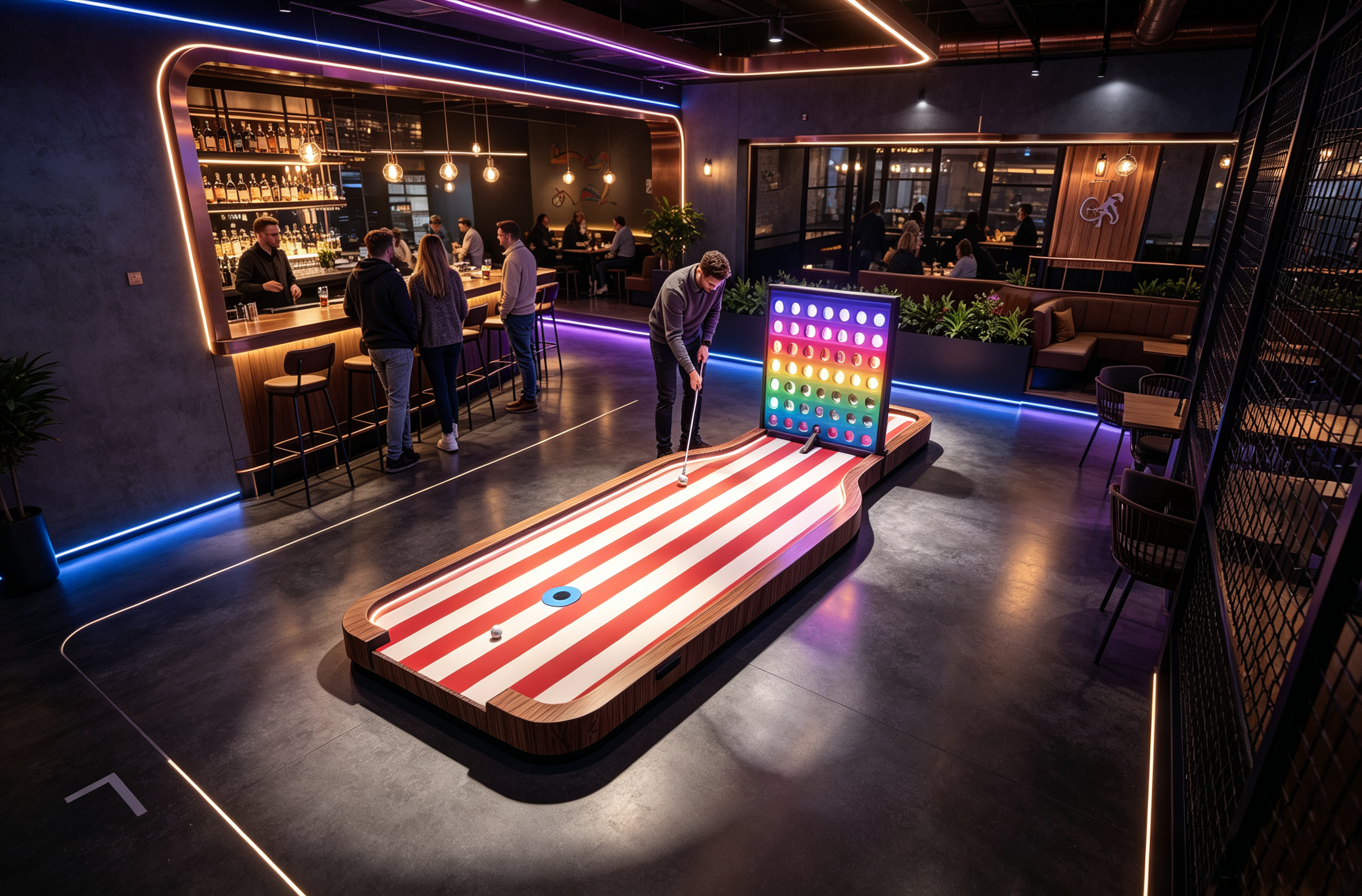
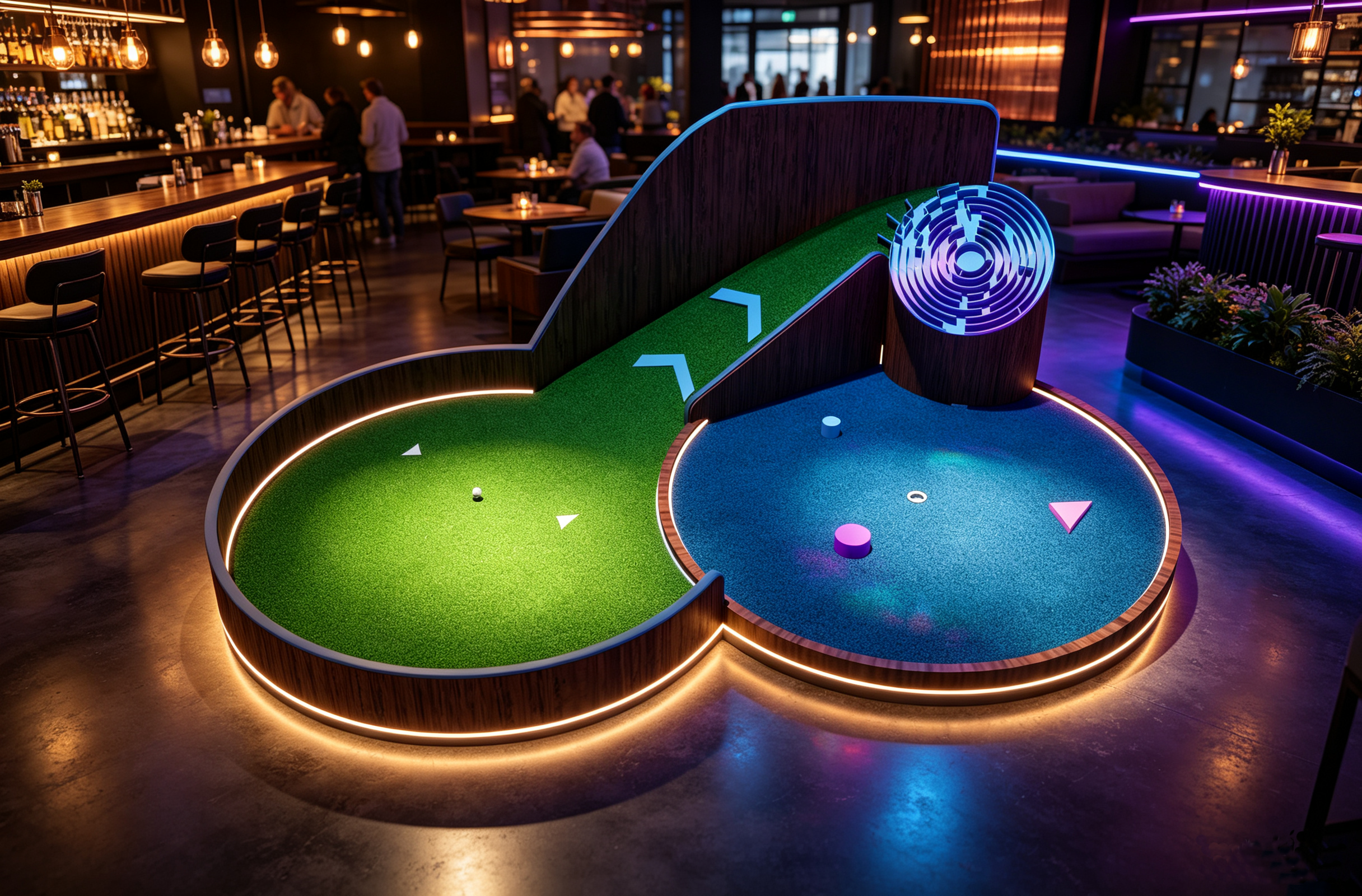
Tiered packages carry a published +22-35% value lift over single rounds. The package architecture that fits the card: bundle a peak-tier round with the F&B item the slot naturally sells (the included-drink loop captures near 100% attach), keep the walk-up tier prices intact, and let the package be the upsell rather than a hidden discount. A hole like the Cyclone Spin Hole gives the package its photo-and-story moment; a familiar-format hole like the Bowling Theme Mini Golf Challenge sells the evening tier to mixed groups who already know the bowling format; and the Beer Pong Challenge rides the bar-lane economics where the drink attach lives.
Capacity planning keeps the card honest: the published capacity analysis (mini golf players per hour) puts a course at 16-24 players per course-hour, so the tiered card should be checked against how many rounds each slot can actually sell before the prices go live.
Every figure in this guide is a published planning reference, and each one carries assumptions a venue owner should restate before adopting it. The tier band ($4.50 / $5.00 / $8.00 / $9.00) assumes a four-wave weekday-weekend demand pattern; the flat-vs-tiered week math ($800 vs $873) assumes the tiered slot fills of 10 / 35 / 40 / 35 rounds; the reference ticket case (about 120 players per day at $12) assumes a 26-day month at about 35% utilization; and the payback example (about ten months on a $250,000 build) assumes the course nets $25,000 a month before financing and rent. Restate each assumption against your own market before treating any line as a forecast.
The questions venue owners ask about mini golf pricing, answered with the published references.
No. The published planning math shows a flat $8 rate on a 100-round week earns $800, while the tiered card on a 120-round week earns $873 - the $5 afternoon tier fills a slot that has the same one-person staffing whether it is empty or full.
Four is the published working model: a $4.50 weekday morning tier for schools and seniors, a $5.00 weekday afternoon tier, an $8.00 weekday evening full rate, and a $9.00 weekend peak rate.
The published utilization ladder runs from about 15% as the conservative base to about 35% at the calculator default and 50%+ at a peak weekend venue - plan each tier against the demand band its slot actually sees.
The afternoon player who pays $5 for a round and adds a snack-bar item brings a higher food share than the evening player who buys only the round, and the bar-lane benchmark adds an +18% drink attach on top of the $45/hr lane rate.
Only where demand never varies - the flat $8 week earns less ($800 vs $873) and serves fewer players (100 vs 120 rounds) precisely because it prices the quiet slots out of the market.
Tiered packages carry a published +22-35% value lift over single rounds; the package should bundle a peak-tier round with the F&B item the slot naturally sells, leaving the walk-up tier prices intact.
Send us the floor plan and the weekly demand profile: we will return the slot-by-slot rate card and the package anchors through the free 3D layout design - anchored with the Cyclone Spin Hole, the Bowling Theme Mini Golf Challenge or the Beer Pong Challenge.