Mini golf is the safest business in active entertainment - which is exactly why its safety program gets skipped. The risks that remain are small, cumulative and perfectly preventable: a lifted turf edge at hole three, a bumper loose on the feature kids love most, a sensor lens blinded by a scaffold fingerprint. The published spare-parts guide already taught the stocking logic - the parts that fail on Saturday must be on the shelf on Friday. This Top 10 runs the same logic as a checklist: opening day once, every week after, and a deep pass riding the published 30-minute LED change windows.
The order follows the player's route - the published party design maps the loop from check-in to goodie bag, and the checklist walks the same path. The opening-day pass runs all ten once; the weekly pass runs the wear items; the quarterly pass rides a scheduled LED change from the published 12-rotation calendar, when the hole is already open for hands-on work.
| Rank | Safety Check | Cadence | What It Prevents |
|---|---|---|---|
| 1 | Walk route in player order - surfaces, trip edges, clearances | Daily pre-open | Trip incidents at the published choke points |
| 2 | Turf edges and seams | Weekly | Lifted edges - the classic ankle catch |
| 3 | Bumpers, rails and obstacle fixings | Weekly | Loose features on the most-played holes |
| 4 | Gate and moving-part springs | Weekly | Pinch points and stuck balls |
| 5 | Sensor lenses and scoring lines | Daily | Dead scoring - the 18 rds/hr ceiling fails first here |
| 6 | Ball condition and weight set | Weekly | Inconsistent play, stray-ball hazards |
| 7 | Lighting levels along the route | Monthly | Dark zones at step transitions |
| 8 | Emergency exits and clearance paths | Weekly | Blocked routes - the ~15% circulation share |
| 9 | Wear-item spares audit | Weekly | The Saturday failure with no Friday part |
| 10 | Deep inspection during LED change window | 12x/yr, 30-min slots | Everything hands-on the weekly pass cannot reach |
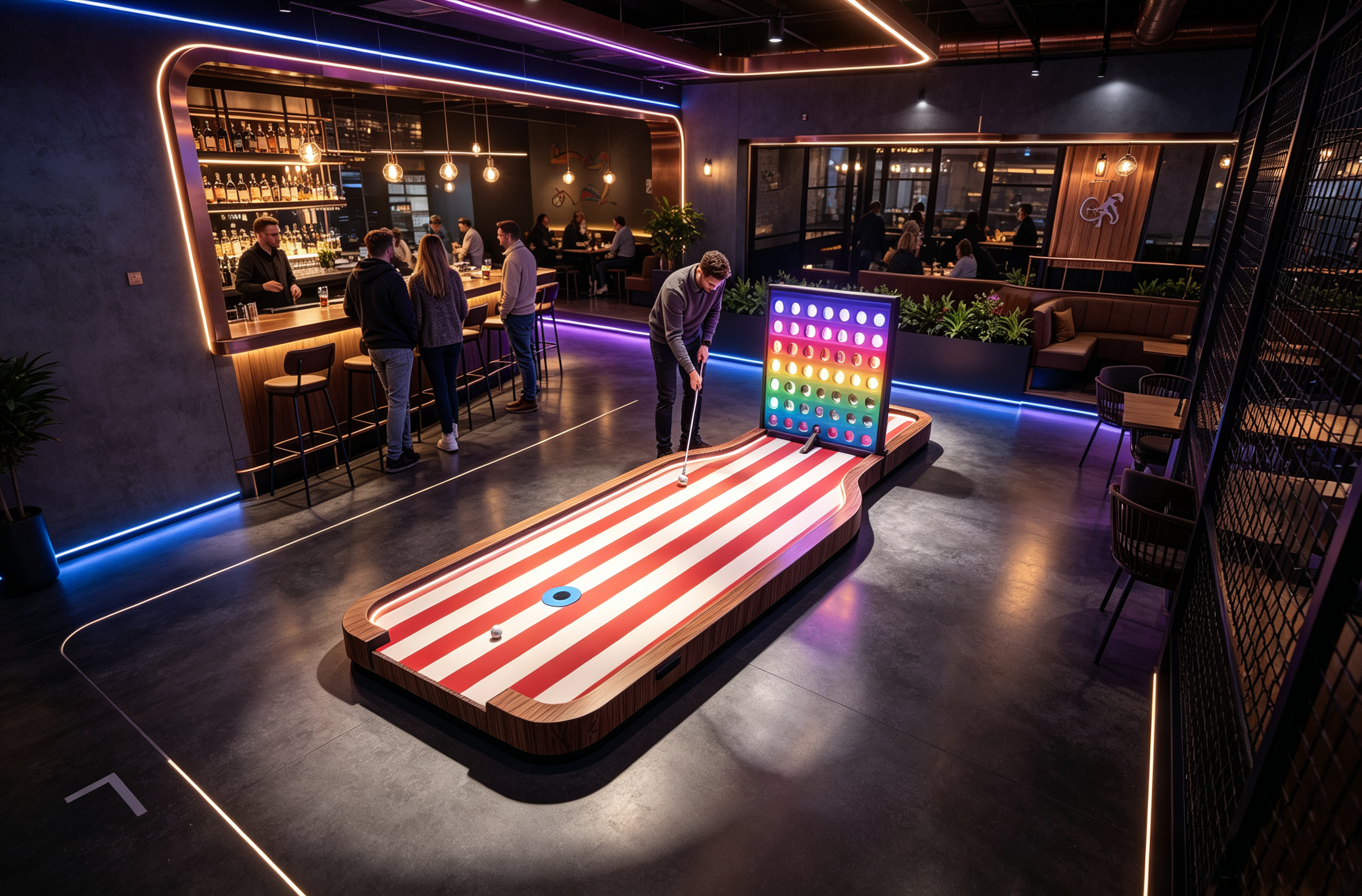
Three of the ten checks anchor to products the course already runs. The sensor line test is the Rainbow Golf Challenge - the published 18-rounds-per-hour ceiling fails first at a blinded lens, so the daily test is one putt through the scoring gate before open. The moving-part check is the Labyrinth Challenge - its puzzle route carries the route's most-handled features, so it anchors the weekly fixings pass. The deep-inspection anchor is the Dream Castle Hole - the themed frame that opens hands-on during each of the published 30-minute LED change windows.
Safety has a price list, and the published references print it. The cost lines: spare parts on the shelf before the weekend (the published spares guide), forty minutes of daily walkthrough (the player-order pass), one test putt through the scoring gate (the sensor line), and twelve 30-minute deep-check windows riding the published LED change calendar - most of which the venue already pays for in its rotation schedule. Against those lines sits the risk column: the published weekend model prices a peak three-day weekend at $18,000 for an 800sqm active park, and the checklist is the margin between 98% availability and the failures that burn it. Priced that way, prevention is the cheapest ticket item the venue sells.
| Prevention Line | Published Cadence/Cost Basis | Risk It Prices Against |
|---|---|---|
| Spares on the shelf | Weekly restock (spares guide) | Saturday failure, no Friday part |
| Daily player-order walk | ~40 minutes pre-open | Trip incidents, blocked routes |
| Sensor test putt | One putt, daily | Dead scoring at 18 rds/hr ceiling |
| LED-window deep checks | 12 x 30 min/yr (themes guide) | Cumulative wear, hidden faults |
Picture the published figures assembled into one Friday before the peak. The morning walk runs the route in player order - all ten checks, logged at the desk per the published labor-model ownership. The Rainbow Golf Challenge takes its one test putt through the scoring gate at the published 18-rounds-per-hour line. The Labyrinth Challenge fixings pass torques its puzzle gates, and the Dream Castle Hole gets flagged for hands-on during Sunday's scheduled LED change - rotation five of the published twelve. The spares audit closes the day: the published logic satisfied, nothing that fails this weekend is missing from the shelf. The $18,000-scale weekend starts with a checklist that took forty minutes.
The scenario is illustrative, but every number in it is a published reference: the stocking logic, the sensor line, the rotation calendar and the weekend-risk model.
Every figure here is a published planning reference: the spare-parts stocking logic and wear-item list come from the published spare-parts guide; the 6-9 hole loop and its choke points come from the published party design; the 18-rounds-per-hour sensor line comes from the published scoring comparison; the 12-rotation, 30-minute LED change calendar comes from the published themes guide; and the $18,000 three-day weekend risk model comes from the published weekend analysis for an 800sqm active park. All are planning references, not guarantees - restate each against your own course and staffing before adopting them.
The questions operators ask about safety and maintenance cadence, answered with the published references.
Walk the route in player order, hole by hole - the published party design maps choke points inside the 6-9 hole loop, and the walkthrough checks each one in the sequence guests will actually meet them.
The published spare-parts logic inverts into a checklist: inspect the wear items that fail first - turf edges, bumpers, gate springs, sensor lenses - because the parts that fail on Saturday must be on the shelf on Friday.
The published labor model assigns ownership by role: the roving staff member logs station faults each pass, the attendant runs the mechanical watch, and the desk tracks checklist completion before open.
Daily, before open. The published scoring comparison runs sensor leaderboards at 18 rounds per hour - a scoring line that fails mid-route stalls the throughput the whole capacity model rests on.
The published LED re-theme runs in 30-minute changes, 12 times a year - each change is a scheduled slot where the hole is already open for hands-on inspection.
The weekend peak: the published weekend-risk model prices a three-day peak weekend at $18,000 for an 800sqm active park - the same concentration logic that makes Friday's checklist the week's most important one.
Send us your hole list and staffing plan: we will return the layered safety checklist, the spare-parts audit and the inspection calendar through the free 3D layout design - anchored with the Rainbow Golf Challenge, the Labyrinth Challenge or the Dream Castle Hole.