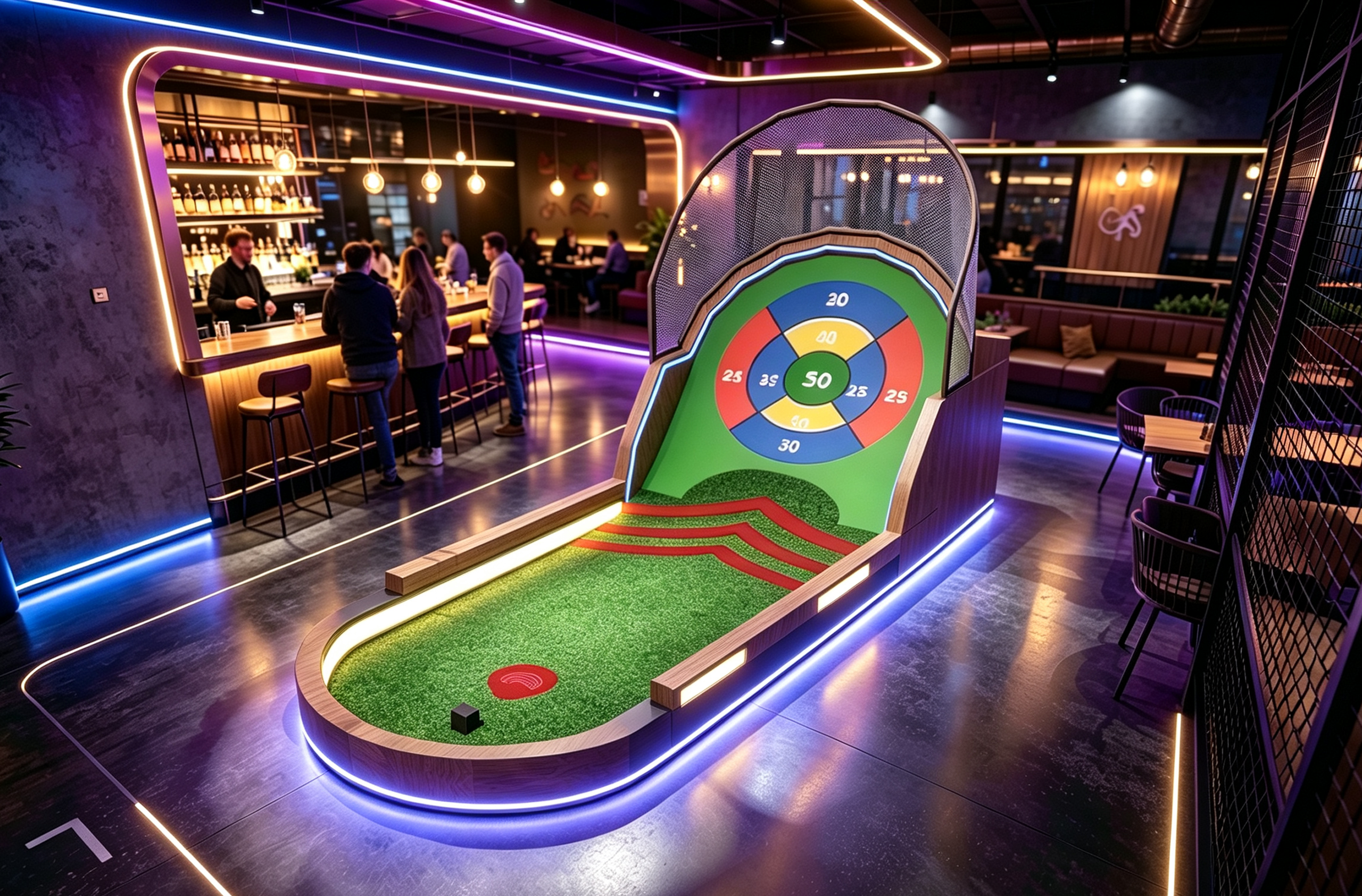
Twelve indoor mini golf formats, the player moment each one manufactures, and three proven set patterns - family nine, competitive twelve, bar six - assembled from a single fixed-footprint catalog.
A great course is not a collection of holes; it is a sentence made of them. The twelve formats NextPlay builds cover the full vocabulary - route, score, timing, confidence and finale - and the craft of course design is ordering them so the round keeps changing the question it asks. This guide walks all twelve with the player moment each one manufactures, then assembles them into three proven set patterns.
Two moments anchor every set. The opener sets the tone without punishing anyone - the ramp route of the Golf Parkour Hole is the classic choice, or the disc-twist Lucky Disc Golf Hole when juniors lead the group. The finale is the hole people photograph - the Golf Treasure Hunt Hole wears the treasure theme and closes the round with a story. What sits between them decides whether the middle sags.
Each format below carries one skill family. Read the list as a menu: pick two from one family, two from another, and never place the two same-family holes back to back.
| Hole | Skill family | The player moment it manufactures |
|---|---|---|
| Golf Parkour Hole | Route | The route story that opens a course: ramps, curved sections and rings where every shot has to be aimed and weighted to stay on the line. |
| Lucky Disc Golf Hole | Confidence | The confidence hole for juniors and first-timers - a disc twist on putting that keeps the youngest player in the group invested from hole one. |
| Golf Target Shooting Hole | Score | The score story: a multi-zone target where safer zones score less and tighter zones score more, turning each putt into a risk decision. |
| Cube Maze Golf Hole | Route | The route puzzle: cube obstacles and illuminated edges make players read the surface before they swing - and it plays differently every round. |
| King's Ultimate Golf Hole | Duel | The duel hole - a regal, head-to-head format that two players in a group always turn into a private match inside the round. |
| Billiard Golf Hole | Bank shot | The bank-shot hole: cushions rebound like a pool table, so the wall becomes part of the line - the hole that teaches angles without a word. |
| Interstellar Crossing Golf Hole | Gravity | The gravity story: a space-themed crossing where slopes and gaps decide the line before the putter does. |
| Curve Block Golf Hole | Slope read | The read-the-carpet hole: blocks placed on a breaking line punish straight putts and reward the player who test-rolls the slope first. |
| Balance Challenge Golf Hole | Timing | The patience hole (formerly Gate Challenge): moving gates set a timing window, so the second look beats the fast arm. |
| Golf Treasure Hunt Hole | Finale | The finale: a treasure-themed adventure hole built for photos and stories - the hole that closes a round and opens the group chat. |
| Cyclone Spin Hole | Signature | The signature moving-part hole: a spinning-ball challenge that stalls the queue for two minutes and sells the video for months. |
| Darts Golf Hole | Bar-side | The bar-side scorer: a darts-crossover target that pairs naturally with a drink menu and keeps late-evening groups on the course. |
The full obstacle menu behind these twelve - windmills, light triggers, moving floors and the rest - is rounded up in the top 10 mini golf obstacles and gadgets guide on this site, with the mechanics of each explained for players and buyers alike.
Pattern one - the family nine. Two confidence holes open for the youngest player, a target and a bank-shot pair carry the middle, the balance and cyclone holes give adults their duel, and the treasure finale closes. This is the birthday-calendar course: the birthday-party course design guide on this site is built around exactly this pattern.
Pattern two - the competitive twelve. Route holes lead, every target hole ships with the multi-zone scoring, and the scorecard runs a running leaderboard. Corporate groups and leagues book this course; the pace is tighter and the arguments are louder.
Pattern three - the bar six. Compact footprints only: darts, billiard, beer pong, the bowling-theme crossover, one timing hole, one confidence hole. The published bars-format analysis (the mini golf for bars, compact lane formats piece) prices this set by the hour instead of by the round, with the drink attach doing the margin work.
| Set pattern | Holes | Built for | The anchor formats |
|---|---|---|---|
| Family nine | 9 | Birthdays, weekends, mixed ages | Lucky disc, target shooting, treasure hunt |
| Competitive twelve | 12 | Leagues, corporate events, repeat players | Cube maze, multi-zone targets, cyclone |
| Bar six | 6 | Bars, lounges, short sessions | Darts golf, beer pong, bowling theme |
Selection is a table exercise; assembly is a floor exercise. Alternate the skill families down the walking order, put the signature moving hole where the queue has room to breathe (bunching at the cyclone is a feature, not a bug, when there is bypass space), and light the finale for phone cameras. The published play guide (the how do you play mini golf walkthrough) shows the round from the player side - worth reading while arranging the order, because the design is felt one hole at a time.
The published design-mistake list (the top 10 mini golf design mistakes piece) is the assembly checklist in negative: single-path flow, corridor layouts, difficulty spikes and lighting built for the room instead of for photos. Assembling the twelve formats against that list is the difference between a course that works on the plan and one that works on the floor.
Custom theming closes the gap between a catalog hole and a venue landmark: the Customized Obstacle Golf Hole takes a brand story or a local theme to spec, and themed modules such as the Bowling Theme Mini Golf Challenge and the Beer Pong Challenge show how a familiar format becomes a venue tie-in. The Labyrinth Challenge is the interactive-scoring variant for venues that want the puzzle and the tech.
One format deserves its own note: the Rainbow Golf Challenge is the color-timed challenge that works as a second opener or a mid-course palate cleanser - visually loud, mechanically simple, and consistently the hole younger players narrate to their parents. Sets that open family nines with rainbow and parkour back to back give the round its two loudest moments early, then let the middle quiet down before the finale.
The full current catalog - these twelve plus the parkour obstacle-course format (Golf Parkour) and the custom line - is one family of fixed-footprint modules: holes can be ordered, twinned, swapped and re-themed as the calendar demands. That is what makes a course a living product instead of a one-time fit-out, and it is the reason the set patterns above can all be built from the same catalog.
Operators drafting a first set can send the room to the free 3D layout design service and get the walking order, queues and photo-hole placement marked on the actual plan; the indoor mini golf course solution page carries the full course scope, and the sportainment page shows how the course sits beside lanes, sims and floors on a mixed venue.
A hole earns its footprint when it asks the player one clear question - time the gate, read the slope, take the risky line - and answers it visibly within three putts. The twelve formats in this guide each carry one skill family, which is why a course built from a balanced set feels varied without needing eighteen holes.
Start with the skill mix, then let footprint trim it: compact target and confidence holes (target shooting, lucky disc) fit the tightest rooms, moving-part and adventure holes (cyclone, treasure hunt, parkour) want more envelope and queue space. Six to nine holes that alternate skill families beat a dozen holes of the same kind - variety is the design, not the count.
Two confidence holes for juniors (lucky disc, billiard bank shots), one or two timing holes for the competitive adults (balance challenge, cyclone), and a finale that photographs (treasure hunt). That mix keeps every age in the group with something to win, which is what turns a one-visit course into a birthday-calendar regular.
The published marketing playbook runs themed rotations on the scale of seasons rather than weeks: a swap is an order line because every hole ships as a fixed-footprint module, and a theming refresh on one signature hole is enough to give the course a new story without touching the layout. Rotating one or two holes per season keeps the content calendar full at minimal cost.
Yes - the Customized Obstacle Golf Hole takes artwork, mechanics and theming to spec, so a brand story, a local landmark or a seasonal world can become a hole. Themed catalog modules (treasure hunt, bowling theme) show how finished a theme can look out of the box, and custom work extends the same language to your own story.
Compact scorer holes pair with a drink menu the way darts does: the Darts Golf Hole and the Beer Pong Challenge are built for short-session, high-repeat play beside a bar counter, and the published bars-format analysis prices the compact lane economics that carry them.
The free 3D layout design service marks the walking order, queues and photo hole on your actual floor - and the indoor mini golf course solution page carries the full scope.