Five criteria with published anchors on both sides: the 10-15 m2 lane at $12-20 a session against the 4-6 m2 shooting position and its party theatre - footprint, throughput, ticket, audience and operations, then the three buying patterns that fall out.
Archery simulator or VR shooting wall - the two precision attractions look like substitutes and behave like complements. The published anchors frame the split: archery books a $12-20 per 15-minute session at 16-24 guests per lane-hour on a 10-15 square meter lane (the published profitability model), while VR shooting runs from a single cabinet to a multi-position arena on a 4-6 square meter per position footprint (the published arena layout guide). One sells the timeless skill; the other sells the game library and the party theatre.
This guide does not hand down a verdict by taste. It runs five criteria - footprint, throughput, ticket, audience and operations - with every number anchored to the published bands, then shows the three buying patterns that fall out: the archery-first small room, the VR-shooting-first party room, and the sequenced zone that runs both. The sportainment page carries the full-venue version of that pattern.
Criterion one, footprint: a shooting position plans at 4-6 square meters and a lane at 10-15, so the VR wall is the density machine - four positions fit where one archery lane lives. Criterion two, throughput: archery's 16-24 guests per lane-hour is capped by the one-archer-at-a-time reality; the VR wall scales positions linearly and the multiplayer formats keep groups together, which is why the party formats are written around it (the published party playbook).
Criterion three, ticket: archery's $12-20 per 15-minute session is a precision-sport price - the archer pays for the skill narrative; VR shooting prices more like an arcade wall, where the session value comes from modes, rematches and group blocks. Criterion four, audience: archery converts first-timers and families with almost zero onboarding - a real bow, a familiar goal (the published how-to-play guide) - while VR shooting converts the gamer segment and the corporate team-building crowd that wants modes and leaderboards (the games list and the accuracy guide tell that story). Criterion five, operations: archery lanes are mechanically simple and staff-light; VR walls add headset hygiene, software uptime and calibration to the shift list.
| Criterion (EXAMPLE scoring frame) | Archery simulator | VR shooting wall | Edge |
|---|---|---|---|
| Footprint per unit | 10-15 m2 per lane | 4-6 m2 per position | VR shooting |
| Throughput | 16-24 guests/lane-hour (published) | Scales with positions; groups stay together | VR shooting |
| Ticket | $12-20 per 15-min session (published) | Mode- and block-based pricing | Archery |
| First-time ease | Real bow, familiar goal, one-session onboarding | Headset + calibration ask | Archery |
| Parties and events | Sequential lane blocks | Team scoring, spectator screens, per-block packages | VR shooting |
| Operations load | Lane + bow upkeep, staff-light | Headset hygiene + software uptime | Archery |
Planning assumptions, stated: the table is an EXAMPLE scoring frame - the archery numbers are the published bands, the VR shooting rows follow the published arena-layout and party guidance, and the Edge column names the criterion winner rather than scoring a total. Your own traffic mix re-weights every row.
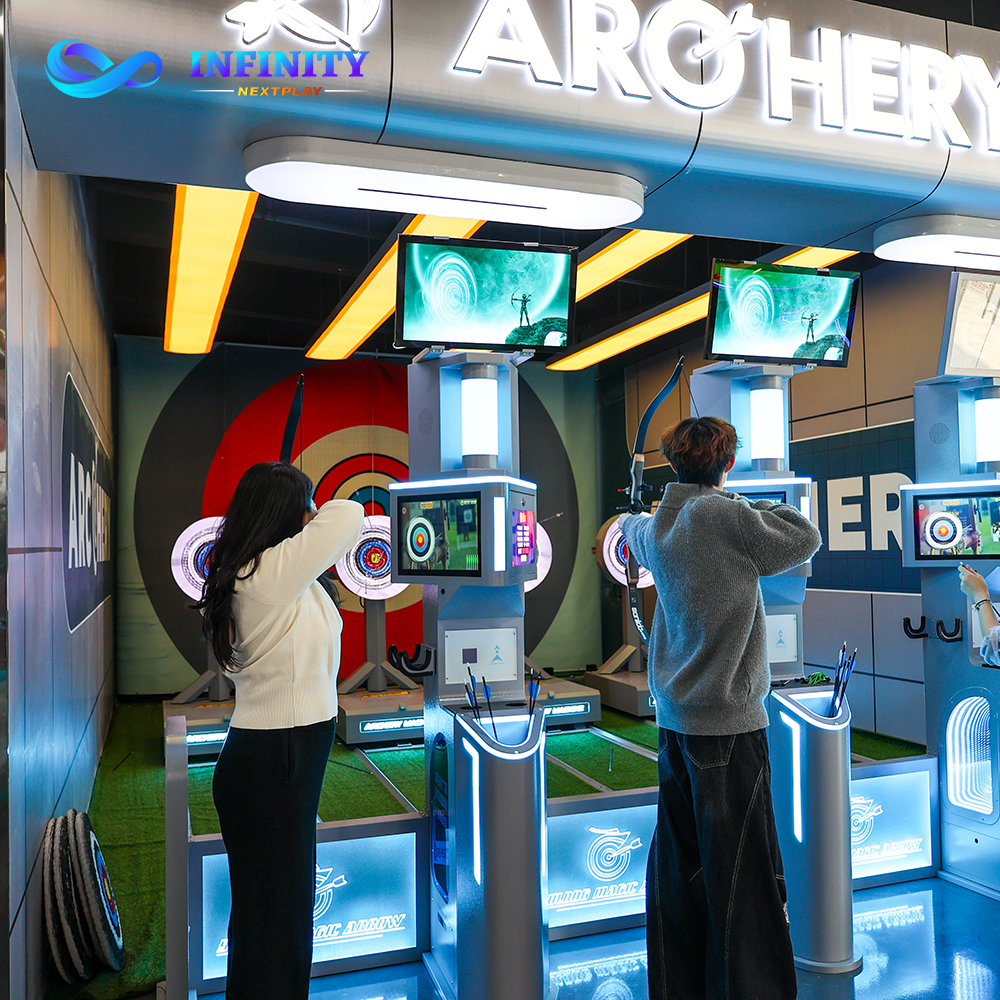
Pattern one, the small room (under 250 square meters): archery first. One lane across 15-25 square meters all-in carries a precision anchor at the $12-20 session band, staff-light and onboarding-free - and the single-station cost stack ($25K-60K published) is the whole ask. The Archery Simulator A4 is the pattern's machine: dual screens, adjustable track, corner-sized.
Pattern two, the party room: VR shooting first. Birthday and corporate demand books in blocks, and the arena formats monetize blocks with team scoring and spectator screens - the published arena build guide sizes the wall and the party playbook prices the calendar. Footprint efficiency does the rest: positions stack where lanes sprawl.
Pattern three, the sequenced zone (300+ square meters): both, in order. The archery lane anchors the precision corner; the VR wall carries throughput and parties beside it; the LED or spectator geometry feeds the queue minutes between them. The mix split below is the shape the sportainment zoning pattern lands on when the room allows it - the multiplayer VR shooting system and the Immersive Interactive LED Floor Game sit beside the archery lane as complements in this order, not rivals.
The decision path runs through your traffic, not the catalogue. Question one: what does the peak hour deliver - walk-in couples and families skew archery; booked groups and teens skew VR shooting. Question two: what does the party calendar look like - blocks on the book skew the wall. Question three: who runs the shift - headset hygiene and software uptime have a labour cost the lane never charges. Question four: what is the room - under 250 square meters the answer is usually one strong anchor, over 300 the sequenced pattern pays.
The cost frame, briefly: archery's published stack is $25K-60K all-in per station (the published cost guide itemizes it); VR shooting scales from a single cabinet to a six-position arena, so the entry ticket overlaps the archery band and the ceiling is higher. The VR chair comparator brackets the format family - a $6-12K unit with a published ~4.5-month payback on the demand model (the immersion guide covers what makes the gun feel real) - which is the density argument in its purest form. The free 3D layout design prices your own mix.
So which is better for an FEC? The criteria, not the brochure, decide: VR shooting wins footprint and parties, archery wins ticket and first-time ease, and the room size picks the order. Under 250 square meters, buy the lane. Party-driven, buy the wall. Over 300 square meters, sequence both and let the queue geometry pay for the pairing - then let the profitability model and the arena layout guide price each side of the corner you chose.
VR shooting wins the footprint math on paper - a shooting position runs 4-6 square meters against archery's 10-15 per lane - but archery's $12-20 per 15-minute session prices like a precision sport, so the per-square-meter race is closer than the footprint gap suggests. The honest answer: VR shooting wins density, archery wins ticket.
Archery. The bow is a real object, the goal is timeless, and the published how-to-play guide walks a first-timer through it in one session. VR shooting asks more of the guest - headset, tracking calibration, controller mapping - and pays it back with game variety the archery lane cannot match.
VR shooting, by design: the arena formats package birthday and corporate groups per block with spectator screens and team scoring - the published party playbook is built on it. Archery handles groups as sequential lane blocks; the value is real but the theatre is smaller.
Yes, and that is usually the answer for 300+ square meter rooms: the archery lane anchors the precision corner at the $12-20 session band, the VR shooting wall carries the throughput and the party blocks, and the queue geometry feeds both - the sportainment zoning pattern.
Archery's published single-station stack runs $25K-60K all-in; VR shooting scales from a single cabinet to a multi-position arena, so the entry ticket can be lower or the build can be larger - the cost question is really a count question. The arena layout guide prices the multiplayer build.
Run the five criteria - footprint, throughput, ticket, audience, operations - against your own traffic mix. Small rooms skew archery; party-driven rooms skew VR shooting; most 300+ square meter venues end up sequenced with both, not choosing one.
Send your floor plan and party calendar: we will return the criterion scoring and the zone split through the free 3D layout design - anchored with the Archery Simulator A4 and the Multiplayer VR Shooting System.