Mini golf theme design is usually treated as a surface decision: pick a family, paint the walls, install the props, move on. This page argues the opposite. A theme earns its keep the moment it changes how the ball plays, and it only has three places to do that: what the obstacles look like, what the scoreboard celebrates, and what the light is allowed to reveal. What follows is our connection table, our framework rather than an industry standard, with the anchor behind every row, the limits stated in plain words, and the write-down checklist that turns a chosen style into a buildable plan.
Ask an operator what the theme is for and the honest first answer is usually decoration. The walls are painted, the props are installed, the photo spot is built, and nothing about the round changes: the ramp plays the same, the score is counted the same way, and the lighting schedule is the same one the venue would have run with no theme at all. That version of a course costs money and returns a colour. The test worth applying is simpler than any mood board - does the style change how the ball plays?
Our answer is that a connected theme touches exactly three mechanisms, and the fourth thing underneath them is a consequence rather than a separate decision. First, obstacle language: the style decides what a ramp, a wall or a bumper is made to look like, and therefore what the player reads off it before they putt. Second, scoring celebration: the style decides what the room treats as an event worth lighting up and counting. Third, light reveal: the style decides which surfaces the room is willing to make visible and which it will leave in atmosphere. Under all three sits the difficulty signal, because a style that hides the slope has changed the game whether or not anyone intended it.
| Connection | What the style changes | What the play gets | Anchor and grade |
|---|---|---|---|
| Obstacle language | Prop vocabulary, materials, silhouette and colour of every ramp, wall and bumper | A read the player learns once on hole one and reuses for the rest of the round | Our framework; builder guidance reported by Harris, Designing a Themed Course |
| Scoreboard celebration | What the room treats as an event worth lighting up and counting | Scoring that rewards the behaviour the style implies rather than a bare stroke count | Our framework; mechanism reported by blooloop on Albatross and Greenspan |
| Light reveal | Which surfaces the light is allowed to make visible and which stay in atmosphere | Atmosphere that never costs the putting line | Our framework; contrast finding published in our indoor mini golf lighting guide |
| Difficulty read | How openly a hole shows its slope, its bounce and its window | Difficulty a player can see from the tee before committing to a shot | Our framework; first-party difficulty band of 12-25 square metres beginner and 30-48 square metres advanced |
| Narrative arc | Where scenic intensity rises and falls across the eighteen holes | A round that builds instead of repeating the same picture six times | Our recommendation; arc pattern reported by PeachPrime parks guide |
Beyond the rows, two published anchors are worth naming before anyone reads that table as an industry standard. The four-layer technology model we describe for sensor-equipped holes lays the layers out as Detection, Display, Atmosphere and Management (what is interactive mini golf: tech-driven holes vs traditional lanes). Theme does not sit on top of that stack as a fifth layer; it lives inside the Atmosphere layer and has to stay consistent with the Detection and Display layers below it and the Management layer above it. Our own eighteen-hole configuration then divides into three six-hole theme blocks, Retro, Cyber and Mechanical, which is the first-party structure this page uses every time it talks about a block. Neither is a rule handed down by anyone. They are the vocabulary the rest of this page writes in, and a framework you can argue with is more useful than a standard you have to trust. The last row of the table, the narrative arc, is where that framework turns into a picture, and the chart below is our recommended intensity across the three blocks.
The selection question is deliberately not answered here. Which theme family a venue should choose in the first place, and how a shortlist gets ranked against the business task in front of it, belongs to our published selection guide (best mini golf themes for indoor entertainment venues), and this page starts on the far side of that decision. Everything below assumes a style has already been chosen and asks the question nobody asks until the drawings come back: now that the room looks like something, what exactly is different about playing it?
Assumption. A venue has chosen a theme family and is now deciding how deeply that style should reach into the play itself, with the decision being made against drawings rather than against a showroom demonstration. Formula. The connection test has three inputs, obstacle language, scoreboard celebration and light reveal, plus the difficulty read that sits underneath them, and a style passes when at least two of the four change in a way a guest can describe after one round. Result. Styles that pass behave like a designed attraction rather than a decorated corridor: a player who has finished hole three can tell you what kind of world hole twelve is in, and the number on the scoreboard means something inside that world. Limitation. There is no published research quantifying what a well-connected theme returns in repeat visits, photography or revenue, and this page does not invent a figure to fill that gap - the framework is ours, every anchor is named, and the benefit claim is left open on purpose.
The rest of this page walks the three connections in order, then turns to the money question and to the artefact that survives from design to handover. Connection one is what the style does to the obstacles. Connection two is what it does to the scoreboard. Connection three is what it does to the light. After that comes the disruption arithmetic nobody quotes a number for, and finally the six-line sheet you write before a contractor asks you the first question.
The clearest version of the first connection is a single piece of geometry played twice. Take a lane with a raised ramp sitting in the middle of it. In the Retro block that ramp is a wooden bridge: planks, a low railing, a painted arch, and the player reads it as a crossing over a stream that is not there. In the Cyber block the same ramp is an energy rail: a lit strip running the length of the lane, a translucent bumper at the top, and the player reads it as a current to ride rather than a structure to cross. Nothing about the slope changed between those two readings. What changed is the vocabulary the style uses to describe the geometry, and vocabulary is the thing a first-time player actually learns early in a round.
The rule that keeps this honest is that style chooses the words and never the difficulty. A themed prop may not cover the break, the bounce or the window. That is not a taste position, it is a playability position, and our published course difficulty guidance treats read-the-line visibility as the thing that decides whether a hole plays beginner or advanced. A decorative dressing that sits over the line has silently promoted the hole without anyone signing off on it (mini golf course difficulty: how to balance a commercial course hole by hole). The same point arrives from the builder side: themed-course guidance reported by Harris argues that a strong visual has to be caught by fluent play, so props belong beside the circulation route rather than in it, and every hole should deliver a controllable challenge while it sets the atmosphere.
The other discipline worth borrowing is a question rather than a rule: which player moment is this obstacle dressing? Our design catalogue frames an indoor course as a sequence of player moments, an opener that establishes the world, a scorer that rewards, a timing test, a duel and a finale, and the useful move at design time is to name the moment before anyone chooses the prop (best indoor mini golf course designs: twelve holes, twelve player moments). An obstacle dressed for the opener is doing a different job from one dressed for the finale, and a course where every hole is dressed for the same moment reads as a corridor of unrelated pictures no matter how good each picture is on its own.
Outside corroboration for the one-job rule exists, and it is worth stating at its real strength. Theming guidance reported by David Theming argues that each hole should carry its own distinct challenge, and case coverage reported by AGS makes the structural claim alongside it: one playable themed element per hole, with terrain and barriers doing the shaping rather than scenery doing the posing. Those are builder positions rather than measurements. They agree with what the moment framing implies, which is that a themed hole has one job and the style states it out loud.
| Theme block | Obstacle vocabulary example | Difficulty read it covers or exposes | Anchor |
|---|---|---|---|
| Retro block | Wooden bridge ramps, brick side walls, painted arches, picket lane guides | Exposes the slope early: a low open wall lets the player see the break from the tee | Our framework; first-party block names from our solution page |
| Cyber block | Lit energy rails, translucent bumpers, strip light running the lane | Partly covers the read: the same break now has to be inferred from the rail instead of the wall | Our framework; first-party block names from our solution page |
| Mechanical block | Rotating gates, counterweighted flaps, metal guide fins, timed shutters | Adds a time cost to the read: the obstacle moves, so the line has to be taken while it is open | Our framework; first-party block names from our solution page |
| Crossing theme | A space-themed visual language that turns the crossing challenge into the obstacle vocabulary itself | Makes style the shot: the space concept is both the picture and the line the player has to find | Our framework; product example in our own catalogue |
| Puzzle theme | Maze walls that are the obstacle rather than a dressing placed around one | Full exposure: there is no separate prop to hide behind, the wall is the read | Our framework; product example in our own catalogue |
The band the style has to stay inside is published on our side, and it is the number a theme is not allowed to obscure. A commercial hole occupies roughly 12 to 48 square metres depending on lane length and mechanism, and our difficulty band puts beginner layouts at 12 to 25 square metres per hole and advanced layouts at 30 to 48. A Retro bridge dressed over a thirty-square-metre advanced lane is still an advanced lane. A venue that sells the room as family friendly while the props hide a steep break will find that mismatch at the review stage rather than on the floor, and the review stage is a much more expensive place to discover it.
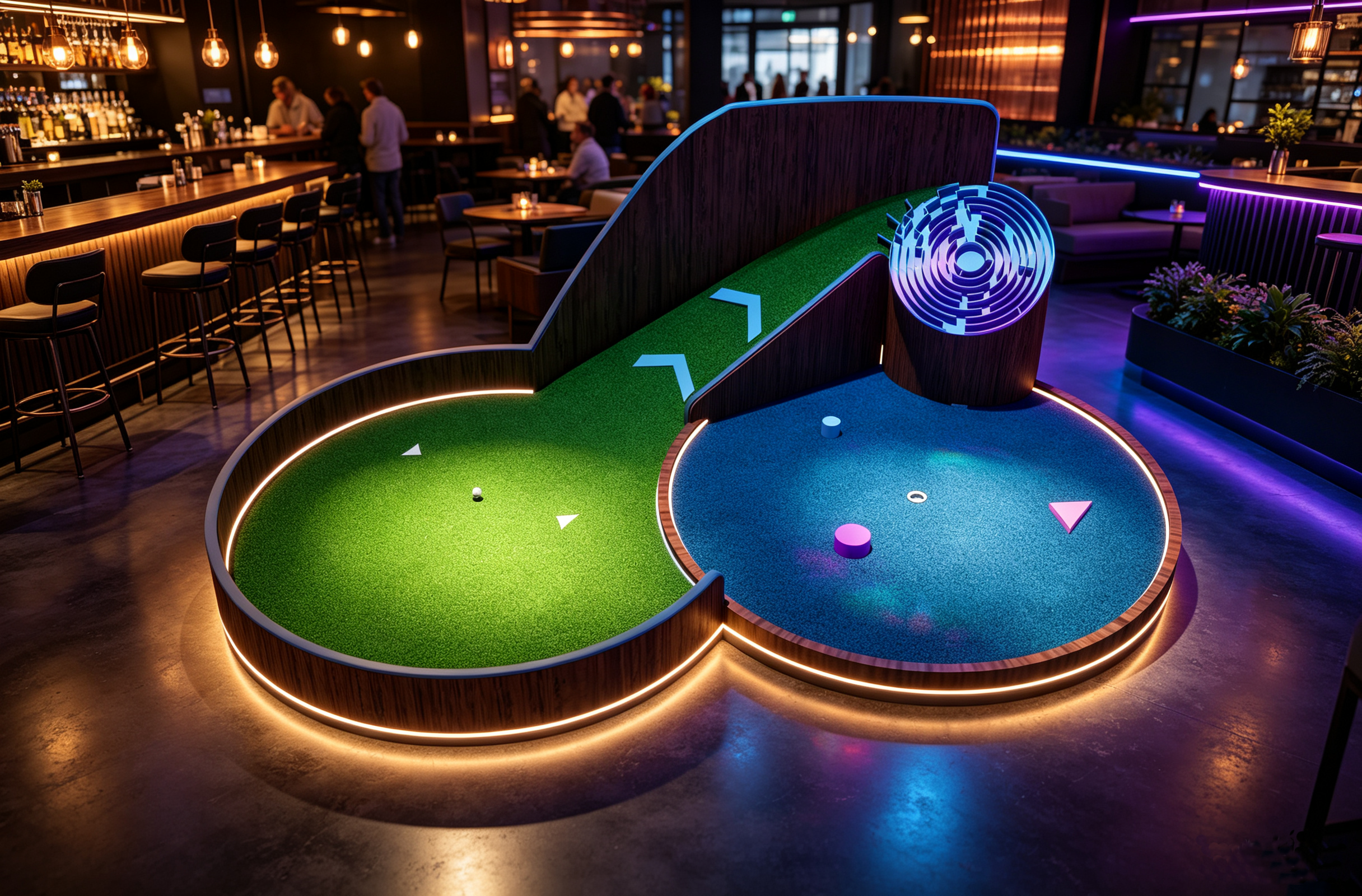
Two of our holes sit at opposite ends of this connection and both are worth seeing before you settle a vocabulary for a block. The Interstellar Crossing Golf Hole is the scenic end, a space-themed crossing challenge where the chosen visual style decides the obstacle vocabulary outright, so the picture and the shot are the same thing. The Labyrinth Challenge Indoor Mini Golf Game is the far end, where the theme is not dressing the obstacle at all because the maze wall is the obstacle. Between those two extremes every vocabulary decision on this page is a matter of degree.
An honest limit on this section: no controlled study compares a themed prop set against an unthemed one on the same hole, so nothing here predicts scores, play times or satisfaction. What it predicts is narrower and checkable on a drawing, which is whether a player standing at the tee can still see what they are supposed to hit. If the answer on the drawing is yes, the vocabulary can be as loud as the theme wants. If the answer is no, no amount of craft will fix it after installation.
Scoring is where a theme stops being a picture and starts being a rule. The score a room displays is a statement about what counted, and a style that has gone to the trouble of building a world should have an opinion about that statement. Our own configuration makes the point structurally rather than rhetorically: the same eighteen physical holes can be re-skinned with different game modes at no cost to the hardware, and we publish four of them as a first-party reference - Relay, Competition, Achievement and Holiday. The pairing question is not whether the modes exist. It is which mode belongs to which style.
The pairing we recommend follows the content of the style rather than the room it sits in. A narrative style, where the course is telling a story across its blocks, pairs with Achievement mode, because the celebration should be a named goal reached rather than a stroke count improved. A holiday or seasonal style pairs with Holiday mode and its themed eggs, because the thing worth lighting up is an object the guest found. A competitive style pairs with Competition mode, where the celebration is position. A party or league format pairs with Relay, where the celebration is a hand-off and a team total. Those are our mode names from our own registry, not an industry taxonomy, and a venue is free to argue with any of the four pairings as long as the argument is written down.
Two external mechanisms make the same argument from outside our catalogue. Routing-based scoring, as reported by blooloop in its coverage of Albatross, pays the guest for choosing a line rather than for taking the fewest strokes, which is exactly what a maze or a crossing theme is already asking them to do. Time-based scoring, in the same reporting, is described as setting pace rather than pressure. Both are reported descriptions of specific installations rather than benchmarks, and both are here for one reason: they show a scoreboard responding to what the style is about instead of ignoring it.
There is also a throughput figure worth keeping in its right place. Our published reference describes a scoring ladder at 10, 12, 16 and 18 rounds per hour, and the reason it matters to theme design is that the mode you choose sets how long a guest stands in front of a scoreboard deciding what to do next. A style built around hunting for objects wants the slower rungs, because the hunt is the content. A style built around head-to-head play wants the faster ones, because waiting is not the content. The ladder is a first-party planning reference and not a promise about any particular floor.
| Style type | Scoring mode it pairs with | What the score celebrates | Anchor |
|---|---|---|---|
| Narrative style, a story told across blocks | Achievement mode | Completion of a named goal rather than a lower stroke count | Our registry: four game modes, first-party |
| Competitive style, a leaderboard room | Competition mode | Position against the other players on the same hole | Our registry: four game modes, first-party |
| Holiday and seasonal style | Holiday mode with themed eggs | Finding and collecting the seasonal object | Our registry: four game modes, first-party |
| Party and league format | Relay mode | The hand-off and the cumulative team total | Our registry: four game modes, first-party |
| Exploration style, a world to move through | Routing bonus on the score | Choosing the line, not only counting the strokes | Mechanism reported by blooloop on Albatross and Greenspan |
| Pacing style, a round that should flow | Time-based scoring | The pace of the round without turning it into a countdown | Mechanism reported by blooloop on Albatross and Greenspan |
Scoring mode is one lever among several and it is worth saying where the others live, because a venue that pulls only one lever usually concludes nothing works. Our variety guide sets out six ways to introduce variety into a course, with theme rotation at the head of the list and game mode treated as a separate lever entirely (ways to introduce variety into a mini golf course). Keeping the two apart is what stops an operator from re-skinning the props every quarter when the actual problem was that the scoreboard had never changed.
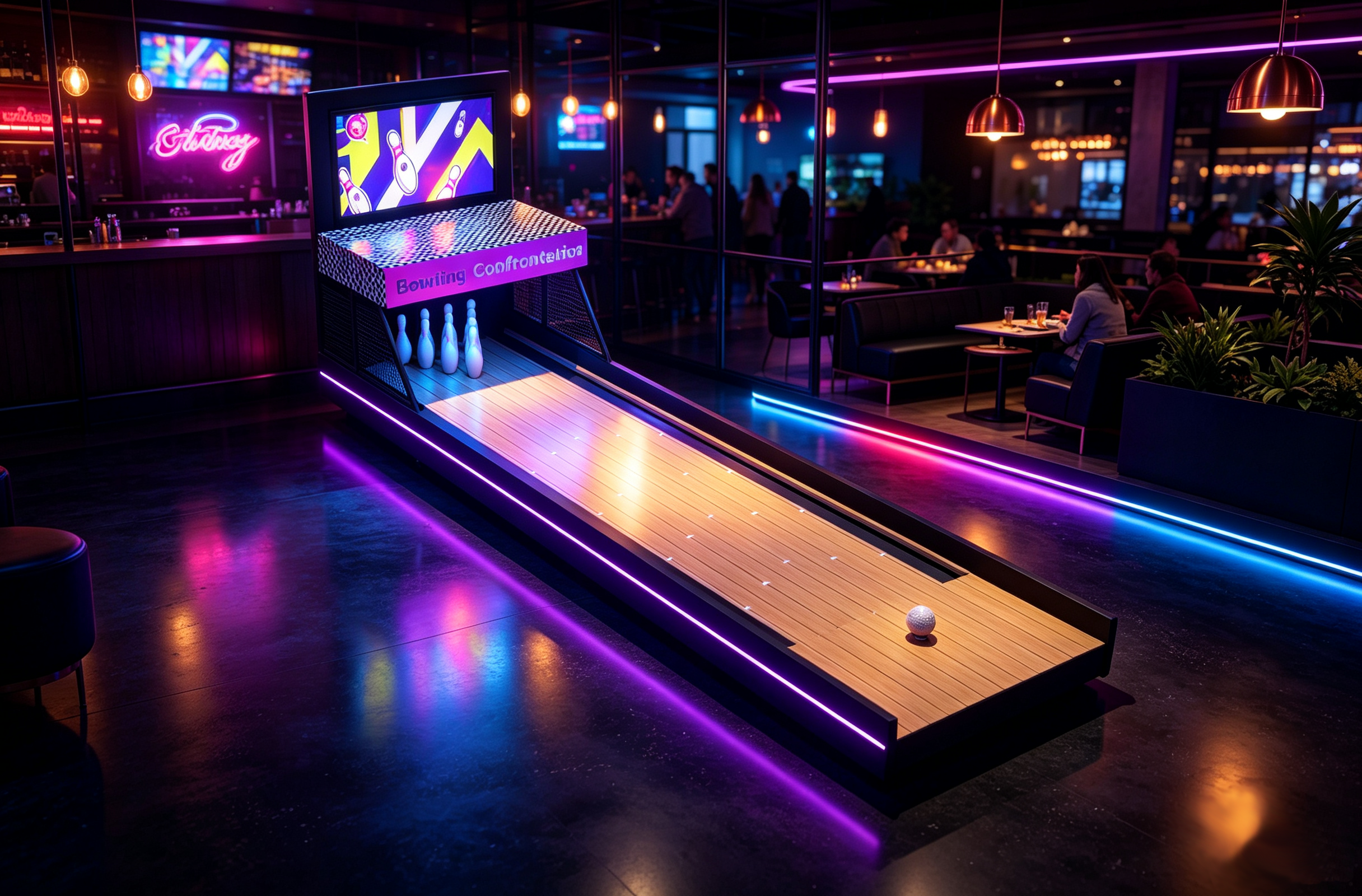
The crossover case is the easiest one to picture, which is why it is worth naming. A theme that borrows another sport brings that sport's reading habits with it, and the scoreboard then has something specific to celebrate. Our Bowling Golf Hole puts a bowling pin target on the putting lane, so the guest is reading a familiar line from a different game and the result page has a natural event to light up. That is Connection 2 in hardware: the style did not decorate the scoring, it handed the scoring a vocabulary.
One limit and it is a real one. There is no industry standard pairing a style family with a scoring mode, and no controlled study measuring what happens when the pairing is wrong. Our four modes and the pairings above are first-party, the external mechanisms are reported descriptions of named installations, and the honest claim is only that a scoreboard which responds to the style gives guests one more reason to look at it. Whether that shows up in any venue metric is not something this page can tell you.
Light is the connection that gets executed last and noticed first, and it is the one where the theme holds the most power with the least margin for error. A room can be beautifully dressed and still be unplayable if the ball disappears into atmosphere. Our lighting work resolves that with a single finding rather than a mood: contrast beats brightness. A visible ball is a ball separated from its background, not a room with more lumens poured into it, and the finding is written up with the specification numbers we put in a tender document in our lighting guide (indoor mini golf lighting: balancing atmosphere and ball visibility). This page takes the finding and leaves the numbers to that page where they belong.
Rotation is the same connection running on a calendar. When a venue changes its LED hole themes it is not redecorating, it is re-running the reveal: deciding again which surfaces light up, which colours carry the story, and what the guest is meant to notice from the tee. Our published position on that programme, the cadence, the windows and what should actually change, belongs to the rotation guide (what LED hole themes keep mini golf fresh), and this page does not restate its schedule or repeat its product examples. What it takes from that page is the observation that the calendar and the connection are the same decision made twice - once at design time and once every time the light layer turns over.
The aesthetic side is where industry guidance is most direct, and it comes with a warning attached. Indoor ultraviolet and LED glow work is described as the dominant indoor aesthetic in the PeachPrime parks guide, and the same guide insists that a glow palette has to be a matched set rather than a pile of bright colours (reported by PeachPrime). That matters for gameplay because a lane lit in three unrelated neon tones does not have contrast, it has noise. The theme should decide the palette, and the palette should decide what the ball looks like against it.
The first-party cadence behind that structure is the figure operators ask for most often: 12 LED reskins a year, each one inside a 30-minute window, published as our own reference for how often a light layer can realistically be changed without taking the course out of service. It is a planning figure from our material rather than a measured industry average, and it is exactly why the block structure above matters. A course already divided into three blocks has a natural unit to reskin, and a course that is one undivided themed space has no unit smaller than the whole floor.
Two things this section will not do. It will not publish illuminance figures for a glow aesthetic, because no public specification exists for ultraviolet and LED glow in this setting and inventing one would put a number into a specification document that nobody could defend. And it will not claim that better contrast produces better reviews or more visits. The claim is only the one our lighting page makes: atmosphere and ball visibility are in tension, contrast is how you buy both at once, and the four numbers we use belong in the tender document rather than in a marketing paragraph.
The money question behind theme design is almost never whether to theme. It is what a change of theme costs in disruption, and the honest answer is that nobody publishes prices. There is no public benchmark for what a re-skin, a prop refresh or a lane rebuild costs, and any figure quoted to you without a site visit is a guess wearing a spreadsheet. What can be stated reliably is the direction of travel: a light level reskin disturbs the least, a prop refresh disturbs more, and a change to the hole body disturbs most. That ordering is the whole economic argument, and it survives without a single price in it.
The level that decides which of the three you actually need is a condition question rather than a taste question. Our refresh assessment guide works from five families of wear and asks which parts of a course have degraded enough to justify work, which is the discipline that stops a venue rebuilding a floor because a colour went out of fashion (how to assess a mini golf refresh without replacing the entire course). If the assessment says the lane geometry is sound and the surface is sound, the work is a reskin, and a reskin is where the theme lives anyway. Most of what a guest reads as a new theme is light, dressing and colour.
| Refresh level | What changes | Disruption direction | Anchor |
|---|---|---|---|
| Light reskin | Colour temperature, gels, LED scenes, painted glow accents and lane colour | Shortest: mostly after-hours windows, with no hole taken out of the circuit | Direction only; our published reference is 12 reskins a year inside a 30-minute window |
| Prop refresh | Themed props, lane dressings, silhouettes, signage and turf colour | Medium: one block at a time, with the rest of the course still trading | Direction only; component level judgement set out in our refresh assessment guide |
| Hole body change | Lane geometry, ramps, walls and the mechanism inside the hole | Longest: the hole itself is out of play while the change is built | Direction only; no public price benchmark exists for any of the three levels |
Colour temperature, gels, LED scenes and painted accents change without a single hole leaving the circuit. This is the level our published cadence works at: 12 reskins a year, each inside a 30-minute window, most of them after hours. It buys a room that reads as current for the least disruption of the three levels, which is why it is the default answer when the condition assessment comes back clean.
Lane geometry, ramps, walls and the mechanism inside the hole change, and the hole is out of play while the work is done. It is the level a condition assessment should have justified before anyone reaches for it, and it is the one level for which no public price benchmark exists at all. Treat any number offered without a survey as an estimate you cannot defend.
Footprint is the other half of the arithmetic. A commercial hole occupies 12 to 48 square metres, so a refresh scope can be split block by block rather than course by course once the hole count and the area per hole are on the drawing. That is also why the block structure in the previous section is an economic device and not only a narrative one: three blocks of six holes are three refresh units, and a venue can move one unit while the other two keep trading. The alternative, one undivided themed space, means every refresh is a whole floor event.
The fastest way to see any of this against your own walls is to put the style on the drawing before anyone quotes it. Send the floor plan with the theme you are considering and the layout comes back with the blocks, the circulation route and the photo positions marked on it (a free 3D layout of your floor). Operators who take that step early tend to discover that the constraint they feared, a column, a fire route, a queue path, is solvable at the reskin level rather than the rebuild level. That discovery is worth having before a scope of work is written, not after.
One sentence this page will not write: a fresh look brings guests back. Venues do describe the new-feel effect of a re-skin as an operating tool for repeat traffic, and we describe it the same way when operators ask, but no published study measures the effect and no figure should ever be attached to it. What a reskin reliably buys is a room that reads as current, for the cost and disruption of the light level, with no promise attached at all. That is a real benefit with a real scope of work, and it does not need an invented number to be worth doing.
Everything above collapses into one artefact: a short written connection sheet that goes into the drawing pack. The reason is entirely practical. Theme decisions get made in a meeting, restated in an email and then reinterpreted on site, and the only thing that survives the trip is text a contractor can be held to. Six items are enough to carry the whole framework from the design conversation to the handover checklist.
| What you write down | What you ask the supplier | Where the published answer sits |
|---|---|---|
| Obstacle vocabulary per hole | Show me the difficulty read this dressing sits on, on the drawing | Our course difficulty guide: how a commercial course is balanced hole by hole |
| Scoring mode per block | Which game mode runs on which block, and what exactly does it count | Our four game modes as a first-party reference, plus the six variety levers |
| Contrast requirement | What separation does the ball keep against every lit surface, in writing | Our indoor mini golf lighting guide, where contrast beats brightness |
| Photogenic hole placement | Which holes are the picture holes, and where do they fall in the round | Our player-moment catalogue, and the arc pattern reported by PeachPrime |
| Reskin calendar and window | How many reskins a year, and how long is each window | Our published LED reskin cadence, 12 times a year inside a 30-minute window |
| Acceptance test | Who signs off each item on handover day, and against what | Our build and handover guidance, with the demonstration questions our buyers use |
The photogenic-hole row in that table deserves a sentence of its own, because it is the row most likely to be read as data. Industry guidance reported by PeachPrime describes a themed course as a narrative with an opening that establishes the world, a middle that raises the stakes and a climax at the end, and it recommends putting the most photogenic holes late so that guests finish on them. That is a reported recommendation from a parks guide rather than a measured effect, which is exactly why the arc chart in section one is labelled as our recommendation and not as a result. What it gives you is a placement rule: the intensity you are willing to spend in block one buys you the right to spend more in block three.
The honesty requirement from section one applies again here, and it is worth repeating next to a checklist because a checklist is where claims quietly harden into facts. No controlled study links the quality of a style-to-gameplay connection to revenue, repeat visits or search rankings, and no such figure appears anywhere on this page. The connection sheet is our framework, every anchor named in the tables above is either a published source reported by name or one of our own first-party references, and the value of writing the sheet down is that it removes ambiguity from a construction job. That is a build benefit, not a commercial promise.
The wider build plan, hole-set mathematics, circulation design, the thirty-day sequence and the return loop, is a separate document and this page does not restate any of it (how to design an indoor mini golf course). What the connection sheet feeds into is that plan, because it is the input that tells the plan what each hole is supposed to be rather than only how big it is. When the plan is ready to be drawn against your own walls, the place to start is the solution page (the mini golf course solution page), where the block structure, the mode pairings and the light layers above are applied room by room.
Do the writing before the quote rather than after it. A connection sheet costs an afternoon and one page, and it turns every later conversation into a comparison against a document instead of a comparison against a rendering. The style you chose was the easy part; making it decide the obstacles, the score and the light is the work, and it is work you can finish on paper while it is still cheap to change your mind.
Mini golf theme design is the work of making a visual style change how the ball plays, not only how the room looks. In practice the style has to reach three mechanisms: the vocabulary of the obstacles, the thing the scoreboard celebrates, and the surfaces the light reveals. A theme that only changes colour, props and photo spots is decoration, and this page treats decoration as a separate and much cheaper decision.
It should not. The rule our framework applies is that style chooses the vocabulary and never the difficulty: a dressing may change what a ramp looks like, but it may not cover the break, the bounce or the window the player has to read. Our published difficulty guidance treats read-the-line visibility as the thing that sets the band, so a themed hole stays in its band as long as the line stays visible from the tee.
Our four first-party modes pair by content: narrative styles with Achievement, holiday and seasonal styles with Holiday and its themed eggs, competitive styles with Competition, and party or league formats with Relay. External reporting describes routing-based scoring rewarding exploration and time-based scoring setting pace rather than pressure, both of which suit styles built around moving through a world. These pairings are our framework, not an industry standard.
Our published reference for the light layer is 12 LED reskins a year, each one inside a 30-minute window, which is a first-party planning figure rather than an industry average. What decides your own cadence is how the blocks are divided: a course split into three six-hole blocks can move one block at a time while the rest of the floor keeps trading.
Usually yes, and the direction is always the same: a light level reskin disturbs the least, a prop refresh disturbs more, and a change to the hole body disturbs most. Which level you need is a condition question, and our refresh assessment guide works from five families of wear to answer it. No public price benchmark exists for any of the three levels, so the honest comparison is scope and disruption rather than cost per square metre.
Write the connection down and have it priced as text. Six items cover it: the obstacle vocabulary per hole, the scoring mode per block, the contrast requirement for the lit scenes, the placement of the photogenic holes, the reskin calendar and window, and the acceptance test for each of them. If a supplier can answer every row on paper before the order, the style has reached the gameplay; if the answer is a rendering, it has not.
Send us the theme you are considering together with the floor plan it has to sit on, and we come back with the layout where style, obstacles, scoring and light are connected hole by hole. That means which block gets which obstacle vocabulary, what each scoreboard is set up to celebrate, where the contrast work lands, and how the scenic intensity builds across the round. If the theme is still undecided, say so and we will sketch the same set of connections for two candidates, so you can compare the gameplay consequences rather than the renderings.