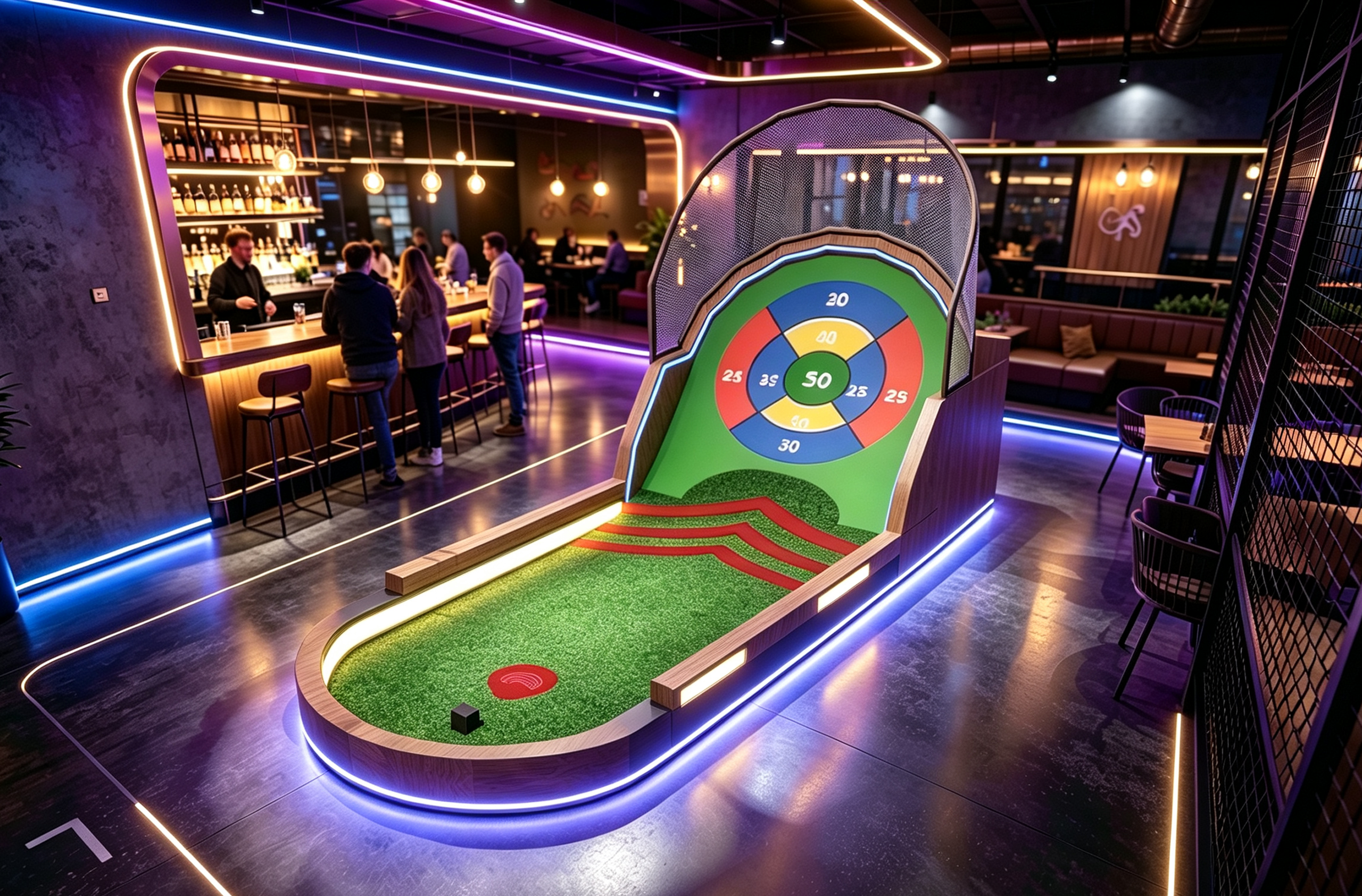
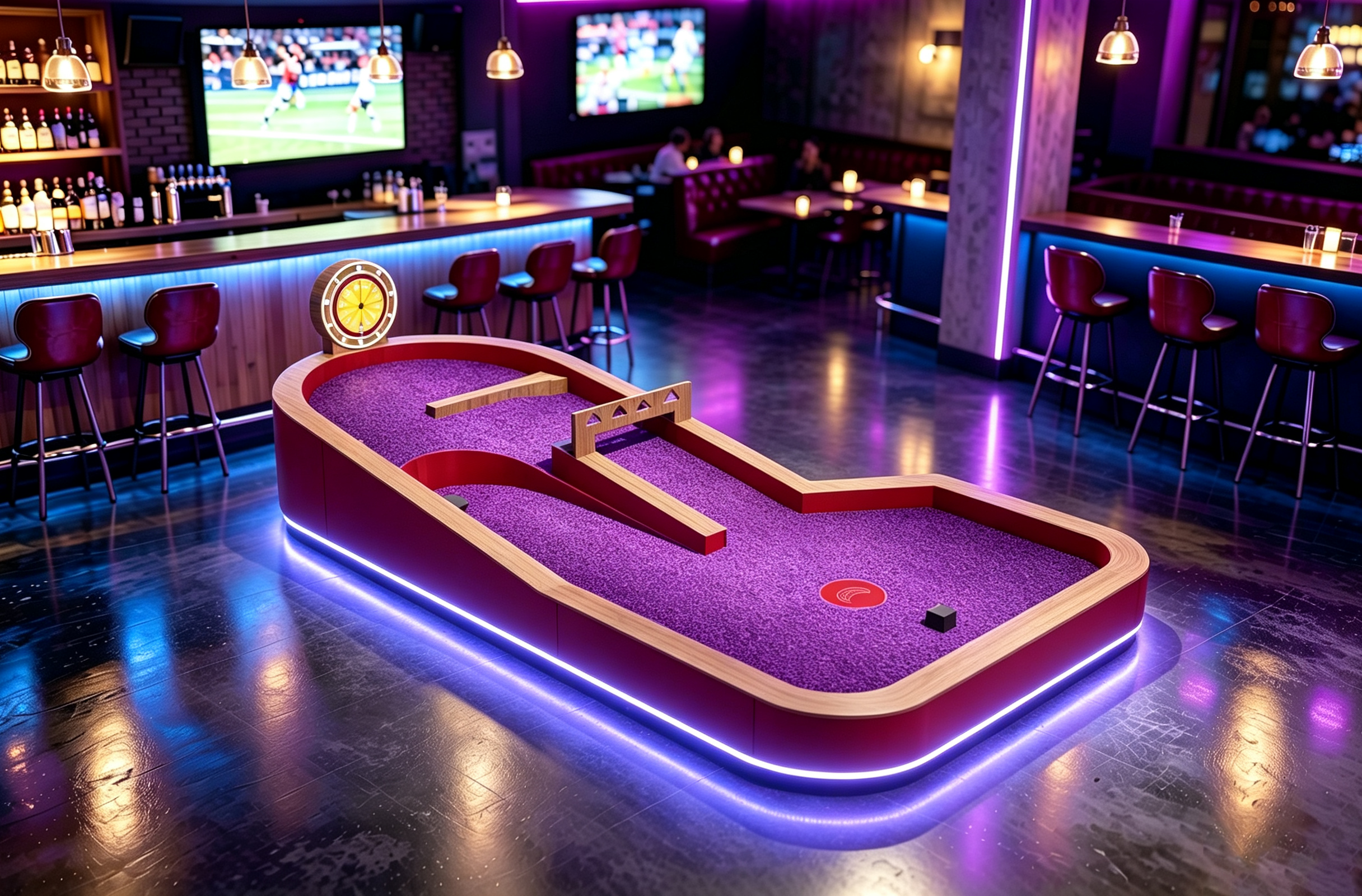
The question operators bring to a supplier is usually a single number: how hard should our course be? There is no such number, and chasing it is how a course ends up either boring or punishing. What a course has is a shape - nine or eighteen separate difficulty values, arranged in a particular order. This page is about choosing that shape on purpose: where the easy holes belong, which four levers actually move difficulty, how to keep a five-year-old, a date-night couple and a league player on the same circuit, and the exact line where a hole stops being hard and starts being random.
Mini golf course difficulty is not one setting you pick before you build. It is nine or eighteen separate values, one per hole, arranged in an order that players walk through in a fixed sequence. Two courses with the same average difficulty will play completely differently if the values are arranged differently, because nobody experiences an average - they experience the third hole, then the fourth, then the fifth, and they carry the feeling of each one into the next.
This is why the standard buying question, how hard should our course be, produces no usable answer. A supplier who replies easy, medium or hard is describing a mood rather than a plan. What you can actually specify is the distribution: how many holes sit at each level, where the hardest hole lands in the running order, and whether the sequence rises, falls or holds flat. That distribution is the design decision, and it is made once, on a drawing, before anything is poured or welded.
Before going further, it is worth naming what this page is not. Our own library already carries a per-hole design sheet that works out the difficulty of a single hole in numbers - lane envelope, start-of-play geometry, mechanism band and a par value you can compute from them (the hole-by-hole design sheet that turns one hole into a par number). That page answers what par this hole is. This page starts one level up and answers a different question: given the par values, how do you arrange them across a whole course so that the course works for the people who will actually pay to play it. We will use that sheet as an input and will not repeat its arithmetic.
Assumption. You are designing or re-planning a commercial indoor course of six, nine or eighteen holes, and you have some freedom over the running order. If the holes are already built and bolted down, the curve is mostly fixed and your levers shrink to signage, scoring format and target values.
Formula. Treat the course as a sequence of difficulty values, not a total. For each hole, write down two things: the par you expect an average player to take, and the share of first-time players you expect to fail the hole outright. Sort the holes by the second number, and look at where the spikes fall. A course with one spike at hole nine and none before it is a course that saved all its difficulty for the moment players are most tired and least patient.
Result. In practice, the distribution that fails most often is not the all-hard course or the all-easy course. It is the flat course - every hole built to roughly the same medium challenge, because each hole was designed on its own and nobody checked the sequence. Flat courses do not read as easy. They read as forgettable, and forgettable courses do not produce the second visit that makes the model work.
Limitation. A distribution is a plan, not a measurement. Nothing in this page tells you how many strokes a real player will take, because no such published data exists for commercial mini golf. The curve is a set of intentions that you then check against your own course in its first month, using your own scorecards.
One structural fact shapes everything below. In standard play, one ball is in the hole at a time, and a group moves on only when the last player has finished. That rule, not venue custom, is what converts a difficult hole into lost minutes at the till. Every section that follows is really about the same trade: difficulty buys engagement and costs throughput, and the balance point is different for a bar with a six-hole loop than for a family centre with eighteen.
The running order is the cheapest design decision you will make and the one most often left to chance. The general principle is not controversial and is repeated by design houses across the trade: difficulty should build gently, with early holes that let players settle in and later holes that add challenge or a visual payoff (the same principle appears in published mini golf design guidance, for example the layout and hole-planning notes at minigolfspots.com). The interesting part is what gently means in numbers.
There are three arrangements worth naming, because most courses accidentally land on the first one. The flat course holds every hole at roughly the same medium difficulty. The rising course starts easy and gets harder, so the hardest holes sit at the end. The twin-peak course puts a deliberate challenge around the second or third hole and a second one near the finish, with a calm middle. None of the three is universally right, but they fail in different ways, and knowing which one you built tells you what to watch in the first month.
The flat course fails by being forgettable. Nothing is hard enough to produce a story, and nothing is easy enough to produce the small win that keeps a weak player in the game. On a nine-hole course, the flat arrangement usually shows up as an average round that nobody remembers and a review that says it was fine.
The rising course fails at the far end. It reads as good design on paper because it matches the intuition that things should get harder, and for a strong player it does exactly that. The problem is the last two holes, which arrive when a group with children is already tired, already behind the group in front, and now facing the two hardest holes on the property. A slow finish compounds: the queue that builds at holes eight and nine is the queue that decides whether the next group starts on time.
The twin-peak course is the arrangement that tends to survive contact with real players, because it puts difficulty where attention is highest - early, when a group is fresh and reading the course, and near the end, when the finish is close enough to be worth a push. It also gives the middle of the round a purpose other than difficulty: this is where a themed sequence, a photo moment or a signature visual can sit without competing with a hard shot.
One useful anchor when placing the easy holes: a compact format already runs in this market at a much lower difficulty than a full course. Our own guide to bar lanes describes a six-hole loop played at par 2 that clears in about twenty-five minutes (the compact lane formats that fit a hundred square metres). That is a course built almost entirely from easy holes, and it is the correct answer for a venue where the mini golf is a social side dish to the bar. The same choice would be wrong for a family centre where the course is the reason people came.
The other anchor is time. Our capacity guide publishes a band of three to five minutes per hole for a group of three to four players (the capacity guide where the per-hole band is published). That band is the budget you are spending when you raise difficulty. Every hole you push above par 2 spends more of the hour, and a course that spends its whole budget on difficulty has nothing left for the queue at the till.
There is a persistent belief that difficulty comes from obstacles - more obstacles, harder hole. It is not true, and the belief is expensive because it leads to courses crowded with props that are visually busy and genuinely easy to play. Difficulty is produced by four levers, and obstacles are only part of one of them.
The first lever is length. A longer lane gives the ball more distance to travel and more chance to drift, and it also raises the number of strokes a hole needs. Our per-hole sheet models length as a band rather than a measurement: nothing at or under four metres scores zero, above four and up to nine metres scores one, and above nine metres scores two. The exact thresholds are our own model and should be tested against your own course, but the shape of the idea holds - length is a lever with a floor and a ceiling, not a dial that keeps paying out.
The second lever is mechanism: what the hole makes the ball do. A single visible plane that a player can read from the start of play is the easiest. One deflection, or one narrow gated passage, adds a step. A maze, a branch, a loop or a blind exit adds another, because the player can no longer see the whole solution from the start. This is the lever most often confused with decoration. A hole can carry a large themed structure and still sit at the easiest level if the structure is beside the line of play rather than across it.
The third lever is geometry under the player, and it is the one you do not fully control. Accessibility rules set a minimum clear floor space of 48 by 60 inches at the start of play, at a slope no steeper than 1:48, and they require that every place a ball can come to rest sits within 36 inches of a standing space at no more than 1:20. Those are floors, not targets, but they shape what a designer can do with a rising floor or a sunken green, and they are also, as the next section argues, a fairness requirement rather than a compliance chore.
The fourth lever is target and route choice, and it is the newest. On a hole where the ball can go to one of several targets or down one of several branches, the player chooses the difficulty. A short risky line and a long safe line on the same hole produce two different pars depending on which one is taken. This is the lever that lets a single physical hole serve a beginner and a league player at the same time, and it is the reason interactive holes matter to this discussion at all.
| Lever | How you move it | Who it hits hardest | What it costs you |
|---|---|---|---|
| 1. Length | Extend the lane in the drawing, before anything is built | Weak players and children, who need more strokes to cover the distance | Cycle time rises with every stroke added |
| 2. Mechanism | Add one deflection, one narrow gate, a loop, a maze or a blind exit | First-time players, who cannot read the solution from the start | Cycle time rises and the frustration risk rises with it |
| 3. Geometry under the player | Change the slope, the bowl depth or the ball-rest zone - inside the accessibility floor | Anyone with limited reach or balance; also anyone whose ball stops in an awkward spot | Design cost, and a compliance review you cannot skip |
| 4. Target and route choice | Add a second target or a second branch and set different values | Nobody, if you also publish a safe line; it redistributes difficulty rather than adding it | Almost none in cycle time, which is why it is the best-value lever |
There is one input to this table that is worth treating with suspicion: the star ratings printed on product pages. In a scan of eighteen commercial mini golf product pages, seventeen carried a star rating - eleven at four stars, five at three, one page printing both two and four stars, and one printing none. Not one of those pages states what the scale is, who set it, or what a four-star hole is being compared against. Vendor star ratings are evidence that the market knows buyers want a difficulty signal. They are not a difficulty signal you can design to.
The practical consequence is that you cannot outsource difficulty to the product catalogue. Two suppliers can both print four stars for holes that play at different pars, and the same supplier can print the same star count for a long straight lane and a maze. If you are comparing units for a course you are balancing, ask each supplier for the lane length and the mechanism in plain terms, and compute your own value rather than reading theirs. The question to ask at a demonstration is covered in more detail on the hole demonstration evaluation page, where the same point is made about specifications generally: a number that the supplier will not put on paper is not a number.
One more caution on the mechanism lever. A hole that is hard because it is unpredictable is not the same as a hole that is hard because it is demanding, and only the second one is a design choice. This distinction is the whole subject of section five, and it is the single most common way a balanced course quietly becomes an unfair one.
A commercial indoor course does not serve one player. On a typical Saturday it serves at least three populations with different needs, and the difficulty distribution has to hold all of them or the venue picks one and loses the others. The design guidance in the trade is consistent on the goal even where it is vague on the method: courses should be designed with varying difficulty so they stay fun without frustrating players, and playability for all ages is usually the first design principle a builder lists.
The three populations are not a marketing invention, they are an operational fact. Families with young children dominate weekend daytime and they stop playing a course the moment it stops being winnable. Social adults dominate evenings and they stop playing the moment it stops being interesting. Competitive players, including league and tournament entrants, arrive in smaller numbers but they are the population that generates repeat visits and word of mouth among adults, and they stop playing the moment it stops being a test.
The first two populations pull in opposite directions on almost every lever. Families want short, forgiving and fast. Social adults want a course that gives them something to talk about, which usually means at least one hole that beat them. The third population wants to be measured. A distribution that serves only the first is a course that adults outgrow. A distribution that serves only the third is a course that families try once.
The design answer is not a compromise in the middle, which is how you get the flat course from section two. It is to give different holes different jobs. A course can carry two or three genuinely easy holes, two or three that are hard for everyone, and a middle that is hard in a way that scales - that is, holes where the difficulty is a matter of how well you play rather than whether you understood the hole.
| Player type | Where they get stuck | What compensates on the course | What compensates in the format |
|---|---|---|---|
| Families with young children | Long lanes, blind exits, anything that adds strokes without adding fun | Short holes with a visible line of play; a ball return that does not need a walk | A junior par, a family scorecard, a maximum-strokes rule |
| Social adults, evening groups | Courses where nothing ever beats them; flat difficulty with no story | One or two holes with a real risk-reward choice and a memorable finish | A leaderboard or a season score, so a single hard hole becomes a talking point |
| Competitive and league players | Courses that cannot be measured, or that reward luck over skill | Consistent geometry, published pars, no hidden randomness | Tournament format with a stroke cap, so slow holes do not stall the field |
The format column matters as much as the design column, and it is the cheaper of the two to change. Competition rules in this sport already solve the slow-player problem in a way you can borrow for casual play: association rules stop a player after six strokes and score the hole as seven, and set a maximum of forty-five seconds to play each shot. A separate tournament rule sheet used by a US operator caps a hole at seven strokes with a goal of under ninety seconds per stroke. You do not have to adopt either as your house rule, but a published maximum stroke count on the scorecard does something a design change cannot - it bounds the damage of your hardest hole without removing it.
A hole with a short risky line and a long safe line, a hole where the target value depends on which zone you hit, a hole whose difficulty comes from reading a slope rather than from a hidden mechanism. These holes give a beginner a route and give a strong player a reason, and they cost almost nothing in cycle time because the number of strokes does not rise for the weaker player.
A blind exit that sends a good putt and a bad putt to the same place. A maze whose correct path is invisible from the start of play. A mechanism whose outcome depends on where the ball happens to land after a bounce. These holes are not hard in a way a player can improve at, and they are the ones that make a course feel unfair rather than difficult.
If you want the cheapest possible version of this section, it is this: put your two easiest holes first, put one genuinely hard hole around the third position while everyone is still fresh, keep the middle readable, and put your most memorable hard hole second-to-last so the finish is worth the effort. Then publish a stroke cap. That arrangement, plus a cap, is most of what a balanced course needs.
Where this becomes easier than it used to be is technology. Holes with an interactive element - a scoring target, a lit reaction, a changing obstacle - can be re-tuned after installation without moving a single wall, which means the difficulty curve is no longer frozen at the moment of build. The technology split between a traditional lane and a tech-driven hole is covered on the interactive mini golf explainer, and the design consequence is simple: the more of your course is interactive, the more of your curve you can still adjust once you see real players on it.
There is a line on every course between hard and random, and it is the most consequential line in this page. On the hard side of the line, a player who plays well gets a better result, and a player who plays badly can see why. On the random side, the outcome depends on something the player could not have read and could not have controlled, and the result is the same whether they played well or badly. A hole on the hard side produces engagement. A hole on the random side produces the specific frustration that ends rounds early.
The test is visibility plus predictability. Can the player see, from the start of play, what the hole is asking? Can they form a plan that a competent shot would execute? If both answers are yes, the hole can be as difficult as you like. A long lane with a visible narrow gate is fair at almost any difficulty. A short lane with an invisible trap is unfair at almost any difficulty, because the failure teaches the player nothing.
This is why blind exits and mazes need to be used with care, and it is not an argument against them. A maze that a player can read from the start of play is a puzzle and belongs on the hard side of the line. A maze whose correct path only becomes visible after the ball is already committed is a lottery. The mechanism is identical; the placement of the reveal is what decides which side of the line the hole sits on.
There is a useful second test that comes from an unexpected place. Accessibility rules require that every place a ball can come to rest sits within 36 inches of a standing space that is almost flat, at no more than 1:20. That rule exists for wheelchair users, but it produces a by-product that matters to everyone: it forbids the design where the ball dies somewhere a player cannot comfortably stand and address it. A hole that passes that rule cannot have an unreachable pocket that swallows good putts, which means the accessibility floor is also, incidentally, a fairness floor.
Route choice is where the two concepts most easily collide. A hole that offers a short risky line and a long safe line is a fair and interesting design, but only if the par is written against the safe line. If the par is set against the risky line, the player who correctly chose safety is scored as if they failed, and the scoreboard starts arguing with the design. Our per-hole design sheet makes the same point about branch holes: par becomes unstable when two competent players can leave the same hole with different stroke counts by choosing different routes, and the fix is to publish the par against the route you expect most players to take.
The practical version of this section is a short review you can run on your own course in an afternoon. Walk the holes in order and ask, for each one, whether a player who has never seen it before can form a plan from the start of play. Any hole where the answer is no is a candidate for the random side of the line, and the fix is usually not to make the hole easier but to move the reveal earlier - shift the obstacle, raise the sightline, or light the route. If you are evaluating a hole at a supplier demonstration, the same questions apply and are covered on the demonstration evaluation page, where the point is made that a mechanism you cannot see and cannot ask about is not a feature.
Difficulty is not a free good. Every point of it you add is paid for in minutes, and the minutes are the ones your till depends on. The chain is short and mechanical: difficulty raises strokes, strokes raise the time one group spends at a hole, time at a hole sets how many groups clear the course per hour, and groups per hour is revenue. A course that is ten percent harder than it needs to be is a course that turns away a fraction of a queue it could have served.
The arithmetic is not mysterious once you have per-hole values. Our per-hole design sheet builds a hole cycle from a fixed overhead plus a per-stroke term, and the results it produces for a group of three are the ones worth holding in mind: a par 2 hole runs about 3.9 minutes, par 3 about 5.3, par 4 about 6.6 and par 5 about 8.0. Read those against the three-to-five minute band our capacity guide publishes for a group of three to four and the constraint becomes visible: par 2 sits inside the band, par 3 is already at its ceiling, and a course built at par 4 or 5 will not schedule at the rate the venue needs.
That chart is the argument for the twin-peak arrangement over the rising one. A rising course and a twin-peak course can contain the same total difficulty, but the rising course spends its hardest holes at the end, where a slow group blocks the whole queue behind it. The twin-peak course spends its hardest holes earlier, when a group is fresh and moving, and finishes on a hole that is memorable without being slow. Same difficulty, different throughput.
There is a second cost that is easier to miss, and it is the one that shows up on the P&L before the queue does. Difficulty and repeat play are not in a simple more-is-better relationship. Too little difficulty produces no story and no reason to return. Too much produces a course that people describe as hard rather than fun, and the description spreads. The design guidance in the trade lands on the same word every time, which is balance, and the reason it keeps landing there is that both extremes are commercially expensive in ways that only show up after opening.
The last piece of the chain is the one operators control most cheaply: what happens after the round. A course with a score that is recorded and comparable turns a single hard hole from a frustration into a talking point, because the hard hole is now the thing a group compares itself on. This is why the scoring decision belongs next to the difficulty decision rather than in a separate conversation, and why a course with an automatic scoring layer behaves differently from one without: the score gives the difficulty somewhere to go. The comparison between scoring approaches is set out on the automatic scoring system checklist.
There is one more input to this section that is worth stating plainly because it is the most commonly missed. Your hardest hole is not only a design object, it is a scheduling object. If you know which hole your groups back up on, you can price around it, staff around it, or redesign around it. What you cannot do is discover it in month three, which is what happens when a course is built without a difficulty plan and the first data arrives from a queue.
The course-level view of how a mini golf zone sits inside a larger venue - where the entry, the queue and the exit sit relative to the rest of the floor - is set out on the mini golf course solution page, and if you would rather see your own difficulty curve drawn against a real floor before you commit, a free 3D layout of your floor will show the running order, the sightlines and the queue path as one drawing.
One last point about format, because it decides which lever does the work. The three hole types we supply most often into courses that need a deliberate difficulty spread - the Golf Target Shooting Hole, which redistributes difficulty through target choice; the Cube Maze Golf Hole, which sits at the high end of the mechanism lever; and the Balance Challenge Golf Hole, whose challenge comes from the shot rather than from an obstacle in the path - lean on different parts of the curve above, and the notes on each one below say which.
It is a distribution, not a single setting. A nine-hole course carries nine separate difficulty values arranged in a fixed running order, and players experience the sequence rather than the average. Two courses with identical average difficulty can play completely differently if the values are ordered differently, which is why the design decision is the shape of the curve rather than a difficulty level.
Put one genuinely hard hole early, around the third position, while a group is still fresh and reading the course, and put your most memorable hard hole second-to-last so the finish is worth the effort. A rising course that saves its hardest holes for the end spends them at the moment players are most tired and the queue behind them is longest, which costs throughput as well as goodwill.
Enough that a first-time family finishes with a win. A compact six-hole bar loop in this market runs entirely at par 2 and clears in about twenty-five minutes, which is the right answer where mini golf supports a bar. On a course that is the main attraction, the same all-easy arrangement is a mistake, because a flat easy course produces no story and no reason to return.
Lack of visibility and predictability. If a player can see what the hole is asking from the start of play and can form a plan that a competent shot would execute, the hole can be very difficult and still be fair. If the outcome depends on something they could not have read or controlled, the failure teaches them nothing, and that is the frustration that ends rounds early.
Not in any usable way. A scan of eighteen commercial product pages found seventeen carrying star ratings, but not one states what the scale is or what the rating is measured against, and the same count appears against very different hole types. Ask each supplier for lane length and mechanism instead, and compute your own difficulty value rather than reading theirs.
No, and past a point it makes less. Difficulty raises strokes, strokes raise the minutes a group spends at each hole, and minutes per hole sets how many groups clear the course per hour. A par 2 hole runs about 3.9 minutes for a group of three while a par 5 runs about 8.0, so a course built too hard spends its session capacity on difficulty and has nothing left for the queue.
Send us the room and the hole count you are planning and we will return the running order with a difficulty value against each hole - which holes carry the challenge, which carry the win, where the queue will build, and which of the four levers does the work on each one. If you are still choosing the units themselves, ask for the lane length and the mechanism in plain terms and we will put both next to a par value you can check.