Automatic scoring is the easiest upsell in mini golf and the hardest line item to compare, because every maker sells a different bundle and almost none of them sell the same bundle twice. This page is the nine-check sheet we run before a scoring system gets signed off: what the technology routes actually are, what a published package does and does not include, and the four numbers nobody in this category publishes at all.
There are three published ways to make a mini golf hole keep score by itself, and they are genuinely different technologies rather than three brands of the same thing. Route one uses self-scoring LED golf balls that track strokes as you putt, with sensors in the cup and scores pushed to digital hole markers and a live leaderboard. Route two has players scan their putters and tracks the movement of the ball, with the maker describing the scoring as completely automated. Route three puts the tracking inside the ball itself and is used operator-side at scale.
The routes are different; the questions are not. Whichever route you buy, the same nine checks decide whether the system will still be working in year three - accuracy and error handling, cups per hole, sensor placement and replacement, software licence and renewal, data ownership and export, the mismatch between electronics and surface warranty, consumable pricing, lead time, and spare parts response. That list is the spine of this page, and it is deliberately route-agnostic.
If your question is still which of the two operating models to run - paper scorecards or a sensor leaderboard - that decision belongs to a different page, and we link to it rather than repeat it: manual scorecards versus sensor leaderboards covers the operating trade-off. This page assumes you have already decided to automate and are now deciding what to sign.
Assumption. You operate, or are building, an indoor mini golf course with an existing lane structure, and you are pricing a scoring layer to sit on top of it rather than a scoring system bundled into new lane construction.
Formula. Package price divided by hole count gives a cost per hole for the scoring layer only. That figure is only comparable to another scoring package - never to a course construction cost, because the two cover different scopes.
Result. A published 9-hole scoring package at USD 61,400 works out at roughly USD 6,800 per hole, and the same maker's 18-hole package at USD 106,400 works out at roughly USD 5,900 per hole (our arithmetic on the two published package prices; the vendor notes that exact pricing varies with course materials, hole count and options). The per-hole cost falls as the hole count rises, which is the first thing to know before you negotiate: the 18-hole configuration is the better unit economics and the 9-hole configuration is the easier capital approval.
Limitation. That package is electronics, software and hardware only. It does not include lane construction, surfacing, themed props or site work, so the per-hole figure above cannot be added to a construction quote to produce a total. It is a scope, not a share of a budget.
One framing note before the detail. These holes are a different product class from a traditional lane, and if you have not yet separated the two in your own head, what interactive mini golf actually means covers the technology split in plain terms. This page picks up at the commercial end of that split.
This is the most fully documented route, so it makes a useful baseline. The published description is specific: self-scoring LED-lit golf balls that track strokes as the player putts, with scores displayed at each hole on digital hole markers and on live leaderboards. The same package documentation lists what physically arrives, and that list is worth reading closely because it is the closest thing this category has to a bill of materials.
| Package element | Published specification | Why it matters at sign-off |
|---|---|---|
| Scoring cups | Up to 3 electronic scoring cups per hole | Cups per hole sets the multi-player ceiling and the spare-parts count you will reorder |
| Golf balls | 250 colour-changing LED golf balls included | The ball is a consumable with a battery in it - the reorder rate is the running cost |
| Leaderboard | 42 inch leaderboard TVs and media players | Screen size and count drive the mounting and power plan, not just the entertainment value |
| Perimeter lighting | Hole perimeter LED lights and diffuser conduit, up to 100 ft per hole | 100 ft per hole is a linear allowance - long or curved holes consume it faster |
| Warranty | 12-month electronics warranty | Sits inside a course whose surface may carry a five-year fade and wear warranty |
| Lead time | Around 12 weeks, per the maker's current homepage | Twelve weeks is a season in a seasonal venue - it belongs in the opening plan |
Two things about this route deserve emphasis, because they are the parts buyers underweight. First, the ball is the sensor. A system that tracks strokes through the ball means the ball is both the game piece and the data carrier, which makes it a consumable with a failure mode that a plain golf ball does not have. Ask what happens to scoring when a ball is lost, dropped in a water feature, or simply runs out of charge - and ask it as an operational question, because the answer determines whether staff can fix it during a shift.
Second, the multi-course management layer is where the real operational value sits, and it is described in the same documentation: the ability to see how many players are on a course at any given time, which hole they are on, and how long they have been on their current hole. That is a throughput instrument, not a novelty. If your venue's problem is pacing and queue visibility rather than scoring novelty, this feature is the reason to choose the route - and if pacing is not your problem, it is the reason you may not need the top package.
One published claim on this route needs a label rather than a quotation. The same vendor describes the technology as retrofitting to an existing indoor course without overhauling the entire attraction, and describes players being able to run it with one attendant. The first is verifiable in the sense that the package is sold as a retrofit; the second is a staffing claim made by a party with a commercial interest, and we flag it as such rather than repeat it as an operating fact.
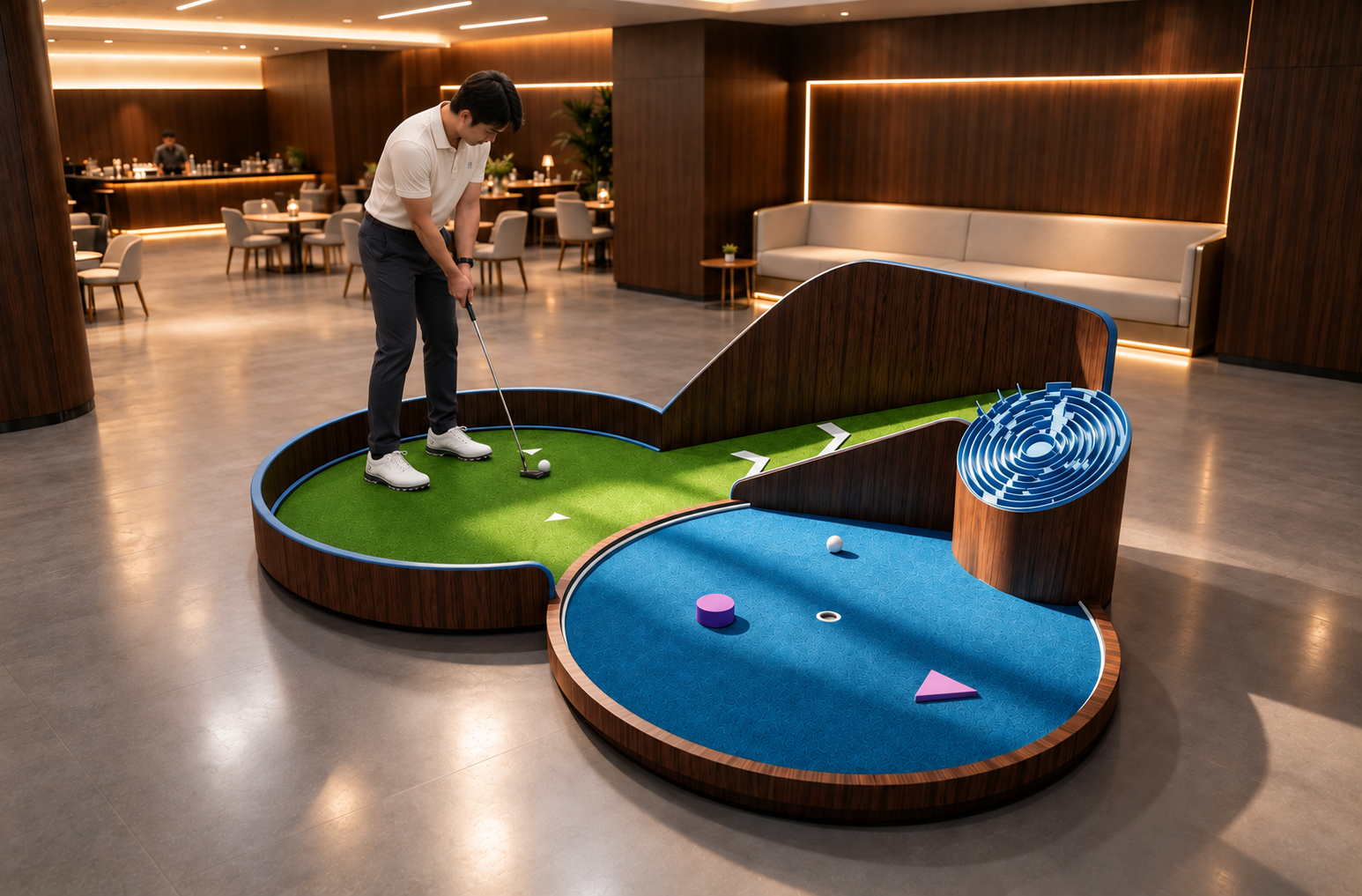
The natural companion to a scoring layer is the hole it is installed in. An interactive putting unit is the cleanest place to start, because the reward event is built into the game rather than bolted onto a plain lane: Labyrinth Challenge, which combines skill-based putting, maze obstacles and reward challenges, is the format we specify when a venue wants the score to be visible in the hole itself.
A second companion consideration is sequencing. Scoring retrofits sit on top of lanes that already exist, which means the electrical and data work happens in a room that is already finished. If your venue is still at the design stage, the cheaper order is to plan the scoring layer before the floor is poured - and the broader question of what a course actually costs to build, with site work quoted separately from equipment, is set out on the indoor mini golf cost page.
The second route moves the sensor off the ball and onto the club. Players scan their putters, the system tracks the movement of the ball, and scoring is described by the maker as completely automated. The advantage of this approach is that the consumable with the battery in it disappears from the equation - the putter is already a wear item, and a scanner does not have to survive being hit.
The same maker publishes the number that matters most for planning: an average space requirement of about 400 square feet per challenge, with the caveat that it depends on the layout of the facility. That figure is higher than a bare lane footprint because it accounts for the challenge format and its circulation. If you are comparing a tech hole against a traditional lane on a square-metre basis, this is the number that decides the comparison - and it is published, which is more than most of this category offers.
The same source also publishes a design library figure of 28 hole designs, which is a meaningful procurement detail rather than a marketing one. A larger design library means a venue can refresh its course over time without new tooling, which changes the economics of a refresh year - and it is the sort of claim you should ask to see listed rather than described.
The third route puts tracking inside the ball and is used by an operator running a chain of tech mini golf venues, which publishes the technology name and nine holes per venue. This is the most useful reference point in the whole category because it is operator-side rather than vendor-side: it shows what a scaled business actually runs, and it is a reminder that the three routes are not competing for the same venue type. A single-site indoor course and a multi-venue chain have different tolerances for ball loss, staff training and service response.
There is one boundary that must be drawn hard, because it is the most common confusion in this category. A twin-cabinet arcade unit that lets players putt at seven scoring holes on a video screen, and which can link three pairs together, is an arcade machine. It is not a full-size lane scoring system, and its seven scoring holes are not comparable to electronic cups installed in real turf. Both are legitimate products; they are not substitutes, and a quote that mixes them is describing something other than what you asked for.
For venues whose attraction mix is still open, the useful comparison is not between scoring vendors but between hole formats - and the 2026 overview of what venues are adding to interactive holes, at the interactive hole feature overview, is the right page to read before this one turns into a vendor shortlist.
This is where most scoring decisions go wrong, and it goes wrong in a specific way: the package price gets read as a course price. It is not. The published packages in this category are electronics, software and hardware bundles, and the vendor states plainly that exact pricing varies based on course materials, number of holes, and options selected - which is the vendor telling you, in its own documentation, that the number is a scope rather than a total.
Computer system and software, a backup server and ball charger, electronic hole markers, electronic starter tees, up to three electronic scoring cups per hole, hole perimeter LED lighting and diffuser conduit up to 100 ft per hole, 42 inch leaderboard televisions and media players, 250 colour-changing LED golf balls, and a 12-month electronics warranty.
Lane construction, playing surface, themed props and scenery, plus the site electrical work to the panel and the data cabling to the leaderboard positions. Installation labour and freight are separate lines again, and so is anything the venue needs in order to have a room to install into.
The chart above is deliberately narrow, because this is the misunderstanding that costs the most money. A venue that reads a package price as a course price has approved a scoring layer while believing it has approved a project - and the two are separated by everything in the right-hand column above. Keeping the scoring decision and the construction decision in separate meetings is not bureaucracy; it is the only way the two numbers stay honest.
Two smaller price facts belong in the same conversation. The published package documentation includes the 12-month electronics warranty inside the bundle, which means the warranty is priced in - and a competing quote that excludes it is not cheaper, it is differently scoped. And the same vendor publishes an uplift claim of two to four dollars more per game for an interactive course. That is a claim made by a party with a commercial interest in the answer, and we mark it as a marketing figure rather than an operating one; if you want to model uplift, model it from your own ticket price and your own conversion rate.
If you want the construction side of the arithmetic in its own terms - what a course costs with site preparation quoted separately, and where the equipment price stops and the building work starts - that is set out on the indoor mini golf cost page. This page keeps the scoring layer separate on purpose.
Here is the sheet, in the order we run it. The middle column is the part that matters: for each check, the deliverable you should be holding before the order is placed. A check without a document behind it is a conversation, and conversations do not survive a change of account manager.
| Check | Evidence to hold before signing | Red flag |
|---|---|---|
| 1. Scoring accuracy and error handling | Stated method for detecting a stroke, and a written procedure for a mis-scored hole | The only accuracy statement is that the scoring is automatic |
| 2. Cups per hole and player ceiling | Cups per hole, players per hole simultaneously, and the group size the system is rated for | A group-size figure quoted for the course but not for the hole |
| 3. Sensor placement and replacement | Where the sensor sits, whether it is field-replaceable, and the spare price | Sensors described as internal with no replacement procedure |
| 4. Software licence and renewal | Licence term, renewal price, and what stops working if the licence lapses | Software included in the package with no term stated |
| 5. Data ownership and export | Who owns the round data and whether it can be exported in a usable format | A dashboard with no export function described |
| 6. Warranty clocks | Separate terms for electronics, surface and structure, in writing | A single warranty term covering everything |
| 7. Consumables | Reorder pricing for balls and putters, and the expected consumption per 1,000 rounds | Consumables described as included with no reorder price |
| 8. Lead time and installation window | Lead time from order, plus what the clock starts on | A lead time quoted without stating whether it starts at deposit or at drawing approval |
| 9. Spare parts and response | Response time commitment and the parts that must be stocked on site | Support described as remote technical support with no response commitment |
Check six deserves a paragraph of its own because it is the one that most often gets waved through. A scoring package documented with a 12-month electronics warranty, installed on a course whose surface carries a five-year fade and wear warranty, produces two warranty clocks running at different speeds. In year two the electronics are out of warranty and the surface is not. That is not a defect in either product; it is a budgeting fact, and the only way to handle it is to have both terms in writing before you sign so the maintenance reserve is sized correctly from the start.
Check seven is where the running cost actually lives, and the category publishes more here than people expect. Putters are sold as a wear item, with softer heads sold specifically to reduce damage to fairway carpet, landscaping and obstacles. Balls are a reorder SKU in two-piece Surlyn construction, sold in dozens. Both are ordinary operating lines - but a scoring system adds a third consumable that a plain course does not have, and it is the one with a battery in it. The full list of what wears out on an indoor course, and in what order, is on the spare parts and wear items list.
Checks four and five are the two that did not exist a decade ago and are the two most likely to be missing from a quote. A software licence that lapses and disables scoring, or round data locked in a vendor dashboard with no export, are both avoidable and both expensive to discover after installation. Ask for the licence term in months and for a sample export file. If the answer is a demo dashboard rather than a data file, that is the answer.
Finally, checks eight and nine close the loop with installation. The documentation you will use to accept the system on installation day is the same set of numbers you negotiated here, which is why the handover checklist is worth reading before the order rather than after the delivery.
When the scoring layer is specified alongside new holes, the cleanest configuration we install is an interactive putting unit where the score event belongs to the game itself rather than to a sensor added afterwards: Labyrinth Challenge, built around skill-based putting and reward challenges. When the goal is scoring a themed mechanism rather than a putting lane, Golf Treasure Hunt Hole and Beer Pong Golf Hole are the two formats venues most often pair with a leaderboard, because both already have a score worth displaying.
There are four numbers this category does not publish, and a buyer who knows that in advance negotiates differently.
The first is scoring accuracy. There is no third-party test of stroke detection in this category that we could find - not for cup sensors, not for putter scanning, not for ball tracking. Every accuracy statement in circulation is made by a party selling the system. That does not make the systems inaccurate; it means accuracy is a contract term, not a specification. Put it in the agreement as a definition of a scoring error and a remedy.
The second is session length and throughput. No vendor publishes a round time for a tech-scored course, and there is no neutral source either. The traditional baseline is commonly cited at about 45 minutes to an hour for 18 holes, or roughly two to three minutes per hole - but that is a traditional course, and a tech hole with a scoreboard changes the dwell time in ways nobody has measured publicly. If your revenue model depends on rounds per hour, measure it yourself in the first month rather than accept a projection.
The third is per-hole replacement pricing. You will get consumable prices - putters and balls are catalogue items - but not a per-hole price list for lane sections or sensor assemblies. Ask for it as a schedule attached to the order. A supplier who will not schedule it is telling you something about the next three years.
The fourth is the repeat-visit claim. The argument that interactive scoring produces more repeat visits is made by vendors with a commercial interest, and we could not find an independent repeat-visit or return-rate study for tech mini golf. Treat it as a hypothesis to test in your own venue, not as a planning input. For context on the segment you would be differentiating from, the commercial research house IBISWorld puts US miniature golf at 441.6 million dollars of revenue across 919 businesses with growth of 0.4 percent CAGR from 2019 to 2024, and that figure covers traditional miniature golf including outdoor courses. It is a useful anchor for how flat the legacy segment is, and it is not a measurement of the tech segment.
The way to price around four unpublished numbers is to convert each into something you control. Accuracy becomes a contractual definition and remedy. Throughput becomes a first-month measurement you own. Replacement pricing becomes an attached parts schedule. Repeat visits become a metric you track from your own booking data. None of that requires the vendor to publish anything - which is fortunate, because they will not.
If you are still assembling the wider attraction plan around the scoring decision, the solution-level view of how a mini golf zone fits a multi-activity floor - circulation, zoning and how the scoring layer interacts with the rest of the venue - is set out on the mini golf course solution page. And if the next step is a layout, a free 3D layout of your floor will show where the holes, the leaderboard positions and the electrical drops land before you commit to a package.
A published 9-hole scoring package is listed at USD 61,400 and an 18-hole package at USD 106,400, which is roughly USD 6,800 and USD 5,900 per hole respectively. That is electronics, software and hardware only - it does not include lane construction, surfacing, themed props or site work, so it cannot be added to a construction quote.
Three published routes. One uses self-scoring LED golf balls that track strokes as you putt, with sensors in the cup and scores pushed to hole markers and leaderboards. One has players scan their putters and tracks the ball's movement, with scoring described as completely automated. One puts the tracking inside the ball itself and is used by an operator running a chain of tech mini golf venues.
The published package documentation allows up to three electronic scoring cups per hole and describes groups of up to six players playing the same hole at the same time. The cup count and the group-size figure are separate limits and both should be in writing, because they set your spare-parts count and your throughput ceiling respectively.
The published packages include a computer system and software, but the licence term and renewal price are not part of the published specification. That is check 4 on the list, and the deliverable is a written licence term in months plus a statement of what stops working if the licence lapses.
The published package carries a 12-month electronics warranty. The playing surface on the same course may carry a five-year fade and wear warranty, so the two clocks expire at different times. Both terms should be in writing before the order, so the maintenance reserve is sized from the start.
A published electronics retrofit lead time is around 12 weeks, and custom course manufacturing is quoted at around 4 weeks subject to the existing order queue. The two clocks are different products. Whichever applies, confirm what starts the clock - a deposit or a drawing approval - because that single detail moves the opening date.
Ask for a scoring package specification that states cups per hole, the licence term, the export format, and separate warranty figures for electronics, surface and structure. Or start with a free 3D layout showing where the holes, leaderboards and electrical drops land, so the scoring layer is priced against a real floor rather than a brochure.