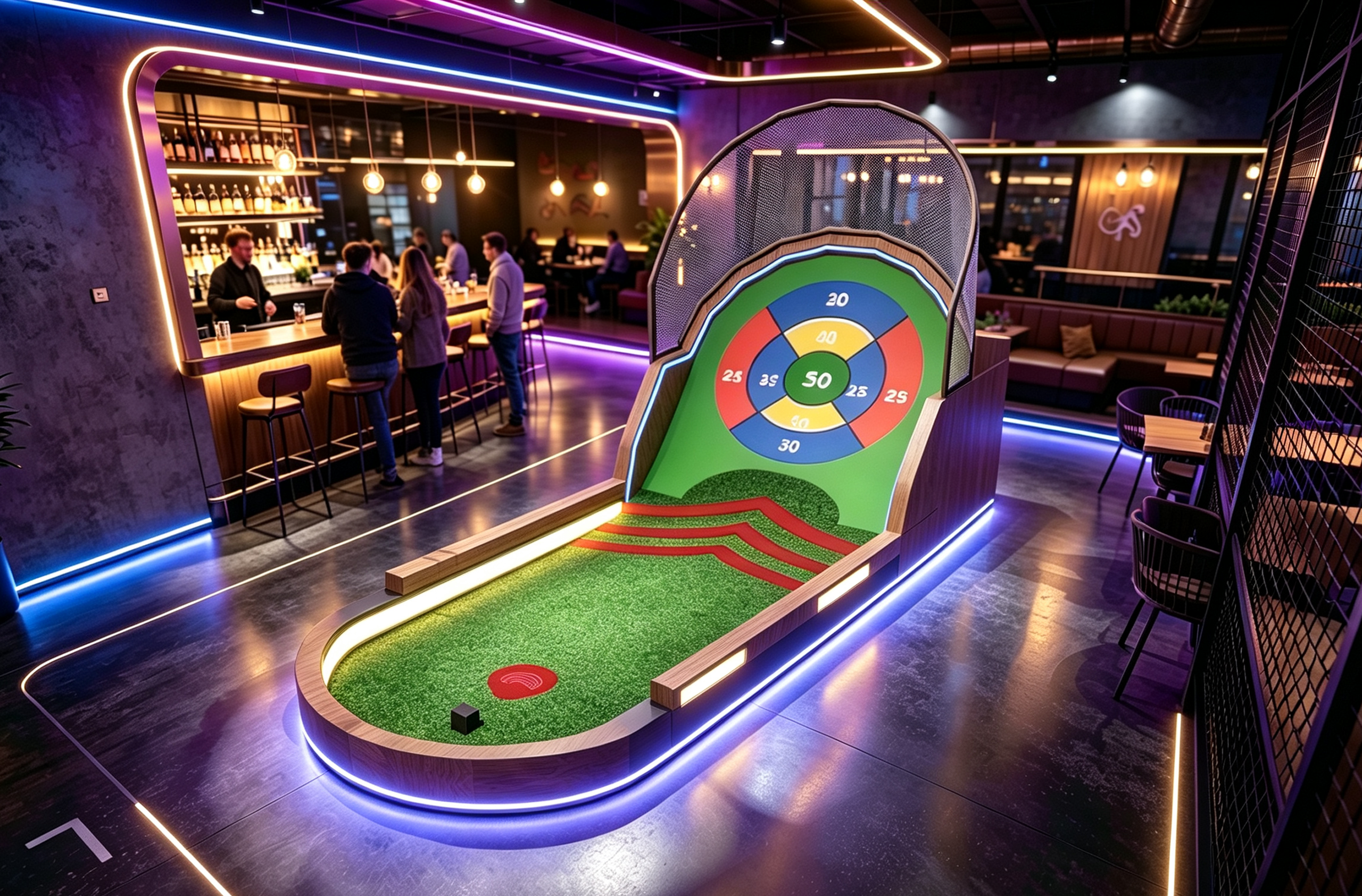
A demonstration is the only hour in the whole buying process where the product is in front of you and the supplier is standing next to it. Most buyers spend that hour watching the ball roll and leave without a single number written down. This page is the sheet we bring instead: six rows that can be settled on the spot, the published figure each reading is compared against, and the four questions that no demonstration can answer because they live in the contract and the code book.
Start with the boundary, because it decides how you spend the hour. A hole demonstration can settle six things: packed dimensions, net weight, nameplate power, input voltage and frequency, what comes in the crate, and the warranty term as the supplier will state it out loud. Everything else you were hoping to learn - how long the surface lasts, how many plays the frame takes, what a replacement lane section costs in year three - is not observable in a showroom, and no amount of standing around the unit will produce it.
That split is not our opinion. It falls out of what suppliers actually publish. Take our own Cyclone Spin Hole page, which prints its full specification: packing size 2.1 by 2.0 by 2.1 metres, net weight 280 kg, power 100 W, input voltage 220 V at 50 Hz, and a parts list of 20 golf balls and one putter (the Cyclone Spin Hole page where those six rows are printed). Five of the six are visible on a spec sheet. The sixth - warranty - is the interesting one, because on that same page it reads only as a comprehensive warranty with remote technical support. No term. No years. That gap is exactly what the demonstration hour exists to close.
The four items that cannot be settled on the day are worth naming before you walk in, so you stop expecting them from the wrong person. Rated cycle life: not published by any maker we have found, and one portable course builder answers the question on its own page with we do not know yet (Big Sky Miniature Golf, bigskyminiaturegolf.com). Measured or duty-cycle power: only nameplate figures exist. Per-hole replacement part pricing: the suppliers who sell into this market put it behind a login or block the page. And a US safety standard that names miniature golf equipment: we searched ASTM, UL and CPSC and found nothing, which leaves the ADA text and the general electrical rules as the only written standards that apply.
Assumption. You have already decided the theme and the hole count, and the demonstration is a shortlist event - two or three makers, one hour each - not a first look at the category.
Formula. Score each maker on six rows, three of them numeric (dimensions, weight, power) and three of them documentary (crate contents, warranty term, price basis). A maker who will not put a number or a term in writing on the day scores zero on that row rather than being given the benefit of the doubt.
Result. On a recent shortlist of three makers, the numeric rows separated the units cleanly and the documentary rows did all the real work. Two of the three could quote packing size from memory. Only one could state a warranty term in months, and it took a follow-up email to get it in writing. The third had the lightest unit and the fastest lead time and still lost the order, because a lane section it had promised as universally interchangeable turned out to be one of the obstacles the maker itself describes as not universal across all courses.
Limitation. Six rows is a floor, not a framework. It tells you whether two quotes are describing the same physical thing. It does not tell you whether the thing is good, and it cannot, because the evidence that would settle that question does not exist in published form. Treat a clean six-row sheet as permission to move to the contract stage, not as a verdict.
If you are still at the stage where the question is what these tech-driven holes actually are, read the 2026 interactive hole overview first - it covers what venues are adding, and this page picks up where that one stops: you have seen the options, now you are evaluating one of them in a room.
Here is the sheet, written the way we use it. The third column is the part most buyers skip: what a failing reading actually changes. A number that does not move anything downstream is trivia. Every row below moves something - a quote line, a layout drawing, a delivery date or a safety file.
| Row | What you read on the day | Compared against | What a failure rewrites |
|---|---|---|---|
| 1. Packed dimensions | Tape the crate or the unit: length, width, height, in metric and in the local building unit | The door opening, the freight lift and every turn on the route to the room | Crate route and rigging plan - a unit that will not clear the lift becomes a crane quote |
| 2. Net weight | Read the spec plate, then ask for the shipping weight separately | Slab capacity and the crew size needed to set the module | Floor load review and installation labour days |
| 3. Nameplate power | Read the plate on the unit, not the brochure | The circuit available at the wall and the spare ways in the panel | A new feed, and a licensed electrician in the schedule |
| 4. Input voltage and frequency | Read the plate; confirm 220 V and 50 Hz or whatever the destination actually supplies | The destination supply, which is not always the same as the showroom supply | Transformer or a different SKU, quoted per unit |
| 5. Crate contents | Open the crate list and count: balls, putters, hardware, spares | What the quote line claimed was included | Consumables reorder budget from month one |
| 6. Warranty term | Get months, in writing, for the frame, the surface and the electronics separately | The warranty printed on competing quotes | Whole-life cost model, and who pays for a lane section in year three |
Two of these rows have a physical reference point worth carrying with you. A single lane on a European-built modular system is published at 3.3 metres long and 0.6 metres wide, with a target circle 1.05 metres across, and the same maker recommends roughly 300 square metres for an 18-lane installation (Mini Golf Construction, minigolfconstruction.eu). Those are the numbers to hold a demo unit against, because a lane that measures short in the room will measure short in the drawing.
The other reference point is the one that catches people out: tech-driven holes are quoted by footprint per hole, not per course. The maker of Lucky Putt publishes an average space requirement of about 400 square feet per challenge, with the caveat that it depends on the layout of your facility (Creative Works, wearecreativeworks.com). That single sentence is why two quotes for the same hole count can differ by a third of a floor.
One more thing belongs on the sheet before you walk in: the demonstration is not the same event as a quote review or a handover. If your shortlist stage is already done and you are reading three bids side by side, the page you want is how to read three mini golf bids line by line, because the skills are different - a demo is about physical facts, a bid review is about arithmetic and exclusions.
Every category has a set of questions that get asked at demonstrations and cannot be answered there. Naming them is not cynicism; it is how you avoid signing a contract on the strength of a conversation that was never going to settle the point.
Durability is the first. There is no rated cycle count in this category. Makers describe materials in detail - hot-dip zinc coated frames, 15 mm cement fibre playing boards, asbestos-free construction, conformity to EU standards (Mini Golf Construction, minigolfconstruction.eu) - and then stop. The portable course sector is even more candid: one builder states plainly that its foam-core and polymer-coated courses are built for relocation, and its proof is elapsed time rather than a number, citing an installation at the Adventuredome at Circus Circus from May 2013 that is, in its words, still operating today (Big Sky Miniature Golf). That is a real data point and it is also a sample of one.
Power is the second. You will get a nameplate figure - 100 W at 220 V on our own tech hole - and nothing measured. Nobody publishes a duty-cycle figure, because a hole with a sensor, a light ring and a moving obstacle does not draw its nameplate rating continuously, and no maker has put an instrument on it and published the result. Ask the question anyway; the useful outcome is not a number but the supplier's reaction to being asked.
Replacement part pricing is the third, and it is the one that most changes the ten-year number. The makers who publish a catalogue put consumables on it: putters are sold as a wear item, with softer heads sold specifically to reduce damage to fairway carpet, landscaping and obstacles, and balls are a reorder SKU in Surlyn two-piece construction, sold in dozens (Turf Net Sports Supplies catalogue). Repair materials are a standing aftermarket line, and at least one maker notes that two people can easily handle the sections (City Golf Europe brochure). What none of them publish is a per-hole price list for lane sections. You will get it, but you will get it by asking, and the answer belongs in the contract as a schedule rather than in a conversation.
Fourth, and most often missed: nothing at a demonstration tells you what a failure costs. If row 1 fails - the crate will not clear the lift - the consequence is not a discount, it is a different freight plan. If row 4 fails, the consequence is a transformer. Suppliers quote equipment; the room around the equipment is quoted case by case, and that is the line that moves (the indoor mini golf cost page where site preparation sits outside the equipment quote).
What you can do instead is turn each unanswerable question into a documentary deliverable. Cycle life becomes a maintenance log requirement. Measured power becomes a metered first-week reading, which you can take yourself once the unit is installed. Replacement pricing becomes a parts schedule attached to the order. And the spares you will actually consume - putters, balls, surface patches - are covered in detail on the spare parts and wear items list, which is the right page to read before you ask a supplier to commit to a three-year supply price.
The phrase commercial grade gets used at every demonstration and is defined at almost none of them. Rather than argue about it, here is what can be checked, sorted by whether you can verify it yourself or have to take the supplier's word.
Frame finish and surface build-up: hot-dip zinc coating and 15 mm cement fibre board are described in published material, and asbestos-free construction is a statement you can ask to see in writing. Surface is sold by face weight, gauge and pile height, with fade and wear warranties separated - a 24 oz product at 3/16 gauge and half-inch pile carrying a 5 year fade warranty and a 5 year wear warranty is a typical published line.
Anything about how the unit behaves in year five. The obstacle caveat is the sharpest example: one maker states that under no circumstances should the golf obstacles be stood or jumped on, because they are not structurally designed for that purpose. That sentence tells you the limits of the term commercial grade better than any brochure.
There is a second materials question that belongs in this section because it decides whether a course can grow: interchangeability. The same maker that warns about standing on obstacles also notes that not all its obstacles are universal on all courses, though the majority are. If your expansion plan involves adding two holes in year two, that sentence is the difference between a plug-in module and a redesign.
A third point, less obvious and more expensive: the surface and the electronics do not age on the same clock. A tech hole carries a sensor, a light ring and a control board; the playing surface under it carries a five-year fade and wear warranty. Those two warranties expire at different times, which means the maintenance budget has two cycles in it, not one. The demonstration is the right place to ask which components are user-replaceable and which require a service visit - and the answer should go into the same file as the acceptance criteria you will use on installation day, which is what the handover checklist is for.
One more materials fact worth carrying into the room: obstacles are not structural and are not universally interchangeable, which is why a demonstration unit that has been set up for a show may not be representative of what arrives. Ask to see the crate list for the exact SKU you are buying, not the demo unit. The two can differ, and the crate list is the only document that settles it.
There is a set of commercial terms that nobody mentions at a demonstration and everybody meets at signature. They are standard in this supply chain, they are published by the distributors who serve it, and knowing them before you demo means you can ask the questions while you still have leverage.
| Term | What it says | The question to ask at the demo |
|---|---|---|
| F.O.B. shipping point | All prices are F.O.B. shipping point, and once a bill of lading is signed the customer bears all liability | At what point does risk transfer, and who insures the crates in transit? |
| Warranty scope | Items manufactured by the supplier carry a one year warranty; warranties on non-Wittek products vary by manufacturer | Which parts of this unit are your own manufacture and which are bought in? |
| Custom order policy | Custom or special order products are not returnable, and all returns are subject to a 15% restocking fee | If the theme finish is wrong on arrival, what is the remedy? |
| Lead time | Electronics retrofit makers quote around 12 weeks; custom course makers around 4 weeks, subject to the order queue | Which of those two clocks does my order sit on, and what starts it? |
Those four lines come from published distributor and maker documentation, and they are worth reading twice because they are the terms that decide what happens when something goes wrong. The F.O.B. line in particular surprises buyers who assume delivery means delivery to the room. It does not; it means delivery to a point, after which the crates are your problem. For a unit at 280 kg per module, that is not a small problem.
One term is not on that table because it is not published anywhere we could find: who pays for a site visit if the room turns out to be unable to take the course. Ask it. The answer separates a supplier who has done this before from one who has not.
If your procurement stage is further along and the demonstration is behind you, the arithmetic that follows - comparing the quotes themselves, line by line, including the exclusions - is covered on the quote comparison page. This page deliberately stops at the demo, because the two skills do not transfer.
The last section is short and it is the one that can stop a project after everything else has passed. Two written standards apply to a commercial mini golf installation, and neither can be satisfied by looking at a demo unit.
The first is accessibility, and miniature golf is named in the standard rather than covered by analogy. At least 50 percent of holes on miniature golf courses must comply with section 1007.3, and the compliant holes must be configured so that they are consecutive, with the start of play on an accessible route (2010 ADA Standards, sections 239.1 and 239.3, access-board.gov). At the hole itself, a clear floor space of 48 inches by 60 inches minimum, with slopes not steeper than 1:48, is required at the start of play. The practical consequence for a demonstration is that the hole you are looking at has a footprint question attached to it that has nothing to do with its own dimensions: the accessible route runs through your floor plan, not through the product.
There is a second accessibility rule that surprises buyers at the renovation stage. Where an alteration touches a primary function area, the path of travel to the altered area must be made accessible to the maximum extent feasible, and that obligation is triggered when the cost of doing so exceeds 20 percent of the cost of the alteration (Title III regulations, 36.403(f)(1), ada.gov). There is no dollar floor in that test. The widely repeated figure of a fixed minimum spend does not appear in the rule, and we do not print it.
The second written standard is electrical, and it is narrower than most buyers expect. Listed or labeled equipment must be installed and used in accordance with any instructions included in the listing or labeling (OSHA 1910.303(b)(2), osha.gov). In plain terms: the listing and its instructions travel with the unit, and installing it another way is not a matter of preference. For an imported tech hole with a sensor and a light ring, the question at the demonstration is therefore not does it work, but what listing does it carry for this market, and does the documentation arrive with it.
Neither of these is a reason to walk away from a demonstration. Both are reasons to leave the demo with a document request rather than a handshake - and if you want the bigger picture of how these holes differ from a traditional lane before you start shortlisting, the interactive mini golf explainer covers the technology split, while the scoring technology comparison covers what changes once a hole starts keeping score by itself.
One last piece of preparation pays for itself: bring a floor plan, not just a shortlist. The accessibility requirement above is a floor plan requirement, and so is the crate route. The venue-level view of how a mini golf zone sits inside a multi-activity floor - zoning, circulation and how the hole formats interact with everything else - is set out on the mini golf course solution page, and if the demonstration has already convinced you, a free 3D layout of your floor will show the lane geometry, the accessible route and the electrical drops before you commit to a configuration.
One thing format does change is which row of the sheet does the talking. The three hole types we supply most often for this kind of assessment - the Golf Target Shooting Hole, the Cube Maze Golf Hole and the Interstellar Crossing Golf Hole - lean on different parts of the list above, and the notes on each one below say which. What they have in common is that none of them can be assessed from a brochure, which is the reason the demonstration hour exists at all.
Six rows: packed dimensions, net weight, nameplate power, input voltage and frequency, the crate contents list, and the warranty term stated in months. Everything else - rated life, measured power, per-hole replacement pricing, and a US safety standard naming the equipment - is not observable in a showroom and has to be obtained as a document.
Long enough to tape the unit and read the plate, which is usually under an hour per maker. The bottleneck is not the inspection, it is the documentary follow-up: the crate list for the exact SKU and a written warranty term with separate figures for the frame, the surface and the electronics.
Two published anchors. A single modular lane is about 3.3 m by 0.6 m with a 1.05 m target circle, and a European builder recommends roughly 300 square metres for 18 lanes. Tech holes are quoted differently - one maker publishes about 400 square feet per challenge - so two quotes for the same hole count can describe very different floor areas.
Not in published form. Makers describe materials in detail - hot-dip zinc frames, 15 mm cement fibre boards, asbestos-free construction - but no cycle count. Portable course builders point to installations still running more than a decade later as their evidence, which is real but is a sample of one.
The 2010 ADA Standards name miniature golf directly. At least 50 percent of holes must comply, the compliant holes must be consecutive, the start of play must be on an accessible route, and each compliant hole needs a clear floor space of 48 by 60 inches at the start of play.
Three documents: the crate contents list for the exact SKU, a warranty term in months split across frame, surface and electronics, and a replacement parts schedule. If the supplier will not put a number or a term in writing on the day, that is the answer for that row - not a reason to guess.
Ask for a free 3D layout with the lane geometry marked on it, or for a specification sheet that prints the six rows we measure - packed size, net weight, nameplate power, voltage and frequency, crate contents and warranty term. If you have not shortlisted yet, send the floor plan and we will tell you which hole formats fit the circulation you already have.