The 2026 mini golf boom in operator terms: holes bought as products, revenue earned beside the game, and interactive courses that extend sessions without extending staffing.
Indoor mini golf is having a visible 2026 - new courses in bars, hotels, family centers and hybrid sportainment floors - but the interesting story is not the count of new courses. It is the economics underneath: a format that went modular, social and re-themable at exactly the moment venues started buying wings instead of buildings. The published 2026 material - the marketing playbook, the interactive-format guide, the sportainment trends list - lets an operator read the boom the way an accountant would: as line items, not headlines.
This piece walks that income statement: what the format costs now that holes ship as products, where the revenue actually sits (the game ticket or the tab beside it), and why interactive holes changed the margin structure. The rider-side coaching - greens, bank shots, putting - stays in the published tutorial trio; this one stays on the money.
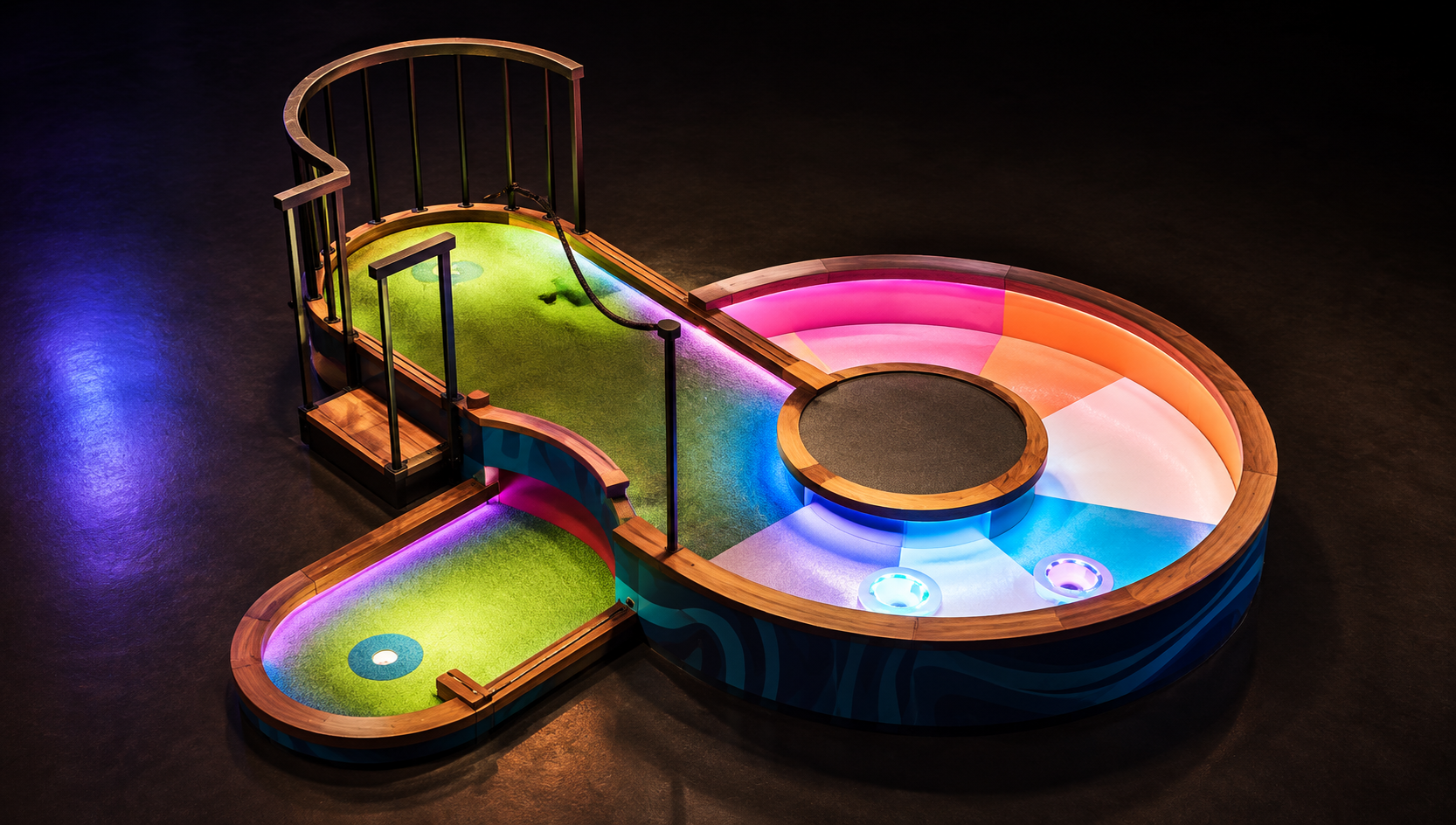
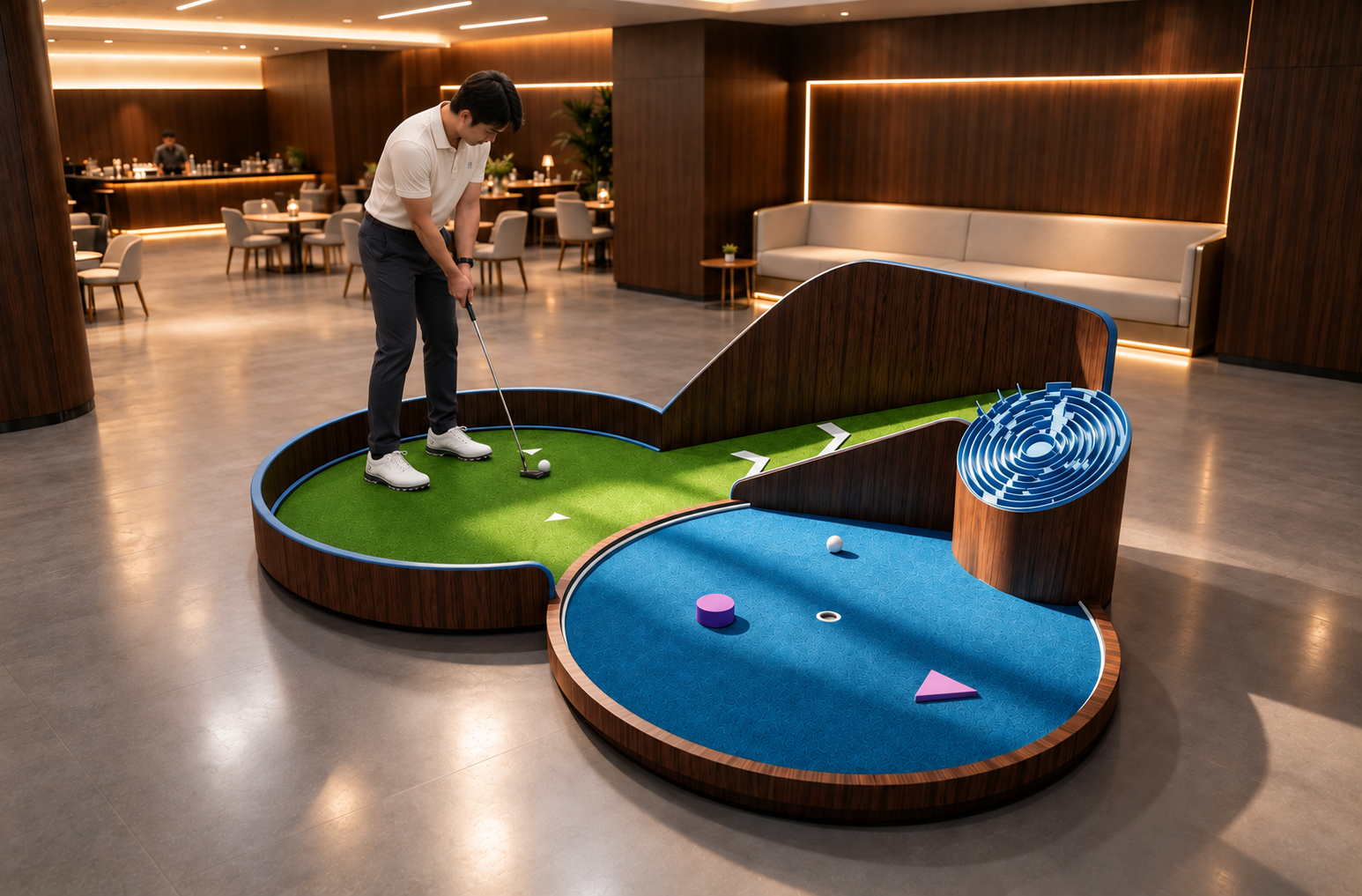
The structural change behind the boom is on the cost side. A generation ago a themed course was a build - contractors, theming artists, a season of dust. The 2026 catalog ships holes as products: the Golf Parkour Hole arrives as a fixed-footprint obstacle run, the Cyclone Spin Hole as a 360 loop module, the Labyrinth Challenge as an interactive putting attraction with sensors and scoring. Each hole is an order line with a published footprint - which is why the published venue cases show courses added two holes at a time into rooms that already exist.
Modularity also changed the risk shape. A venue can flagship-test three holes, read the traffic, and scale to nine - the published marketing guide treats the course expansion as a marketing beat in itself. The free 3D layout service closes the loop by testing the hole mix on the actual floor plan before the order moves. The result is a build cost curve that looks like the seat-market curve in VR: low entry, queue-fed, scales by unit.
The published venue cases agree on where the money sits: beside the game. In bar-adjacent footprints, the round is the excuse and the tab is the business - nine holes of group competition stretches a visit across the evening, and the published marketing guide prices that dwell time as the real product. In hotels, the published golf-attraction revenue guide shows the course filling the checkout-to-dinner gap with a family activity the concierge can sell. The game ticket matters, but it is the admission to the higher-margin hour that follows.
Interactive holes strengthen the tab economics in a specific way the published interactive guide documents: they extend session length without extending staffing. Sensors keep score, themed obstacles keep the group talking, and the queue entertains itself - the labor-light profile is what makes the format work in venues whose main business is something else. The boom is not really about golf; it is about a self-running social anchor that sells the room around it.
| Economics signal | Published 2026 anchor | Operator takeaway |
|---|---|---|
| Per-hole modular pricing | Interactive hole catalog, fixed footprints | Scale 3 holes to 9 by order, not by build |
| Dwell-time revenue | Bar-venue marketing playbook | Price the tab, sell the round as entry |
| Labor-light operation | Interactive format guide | Sensors score; the queue self-entertains |
| Hybrid-floor module | Sportainment trends list | Mini golf rides the mixed-floor spec |
| Marketing value | Top-10 marketing plays | The course is the campaign |
Depth from the family: the top-10 marketing plays carries the calendar-fill side, the interactive format guide explains what sensors and scoring change, the green-reading and bank-shot tutorials show the skill depth that drives replays, and the sportainment trends guide places mini golf in the hybrid-floor pattern. The golf-simulator-adjacent numbers sit in the 2026 golf simulator cost guide and the hotel golf revenue guide.
The published 2026 material points at three compounding causes: the footprint got smaller (a nine-hole interactive course fits where a bowling pair would not), the content got repeatable (interactive holes rotate difficulty, so the course plays differently every visit), and the format got social (the published sportainment trends guide lists mini golf wings as a standard hybrid-floor module alongside golf bays and dart walls). A format that is cheap to build, cheap to re-theme and easy to photograph is the correct product for the current venue cycle.
The honest published-anchor framing: revenue follows the calendar-fill playbook rather than a fixed per-hole figure. The published marketing guide shows the levers - weekday league nights, holiday events, party packages - that turn a course from a walk-by attraction into a booked venue line. EXAMPLE planning bands operators work with: a nine-hole interactive course in a bar-adjacent footprint targets the evening dwell-time window, where the game ticket is only the entry fee to a longer food-and-beverage tab.
The published material keeps this answer modular rather than quoting one number: the course is bought hole by hole - the interactive hole catalog ships as published product lines with fixed footprints, and venues scale from a flagship three-hole wall to a full nine-hole layout. The per-hole pricing model is why the boom spreads through existing venues: adding two holes is an order, not a construction project. The free 3D layout service tests the hole mix on your actual floor before any order.
The published venue cases say the margin lives beside the game. In bars, the course extends dwell time and the drink tab carries the P&L; in hotels, the published hotel-revenue guide shows golf attractions filling the evening gap between checkout and dinner. Interactive holes strengthen both cases because the published interactive-format guide documents what they change: replay, competition and a queue that entertains itself while it waits.
The published layouts suggest the three-hole flagship as the entry move: one showcase hole (a 360 loop or a parkour obstacle run), one skill hole, one social hole - enough to test traffic without committing the floor. The coaching trio on this site shows why the mix matters: reading greens, banking shots and putting technique each give players a different game, and the same logic applies to buying holes.
The published interactive guide frames it as content economics: a flat course is one product, an interactive course is a subscription - sensors, scoring and themed obstacles turn the same square meters into rotating game modes, league formats and social clips. The published marketing guide treats the course itself as the top marketing play, which is the strongest economics argument: the attraction advertises the venue every time a guest posts it.
The free 3D layout design tests the hole mix on your floor before the first order line moves.