
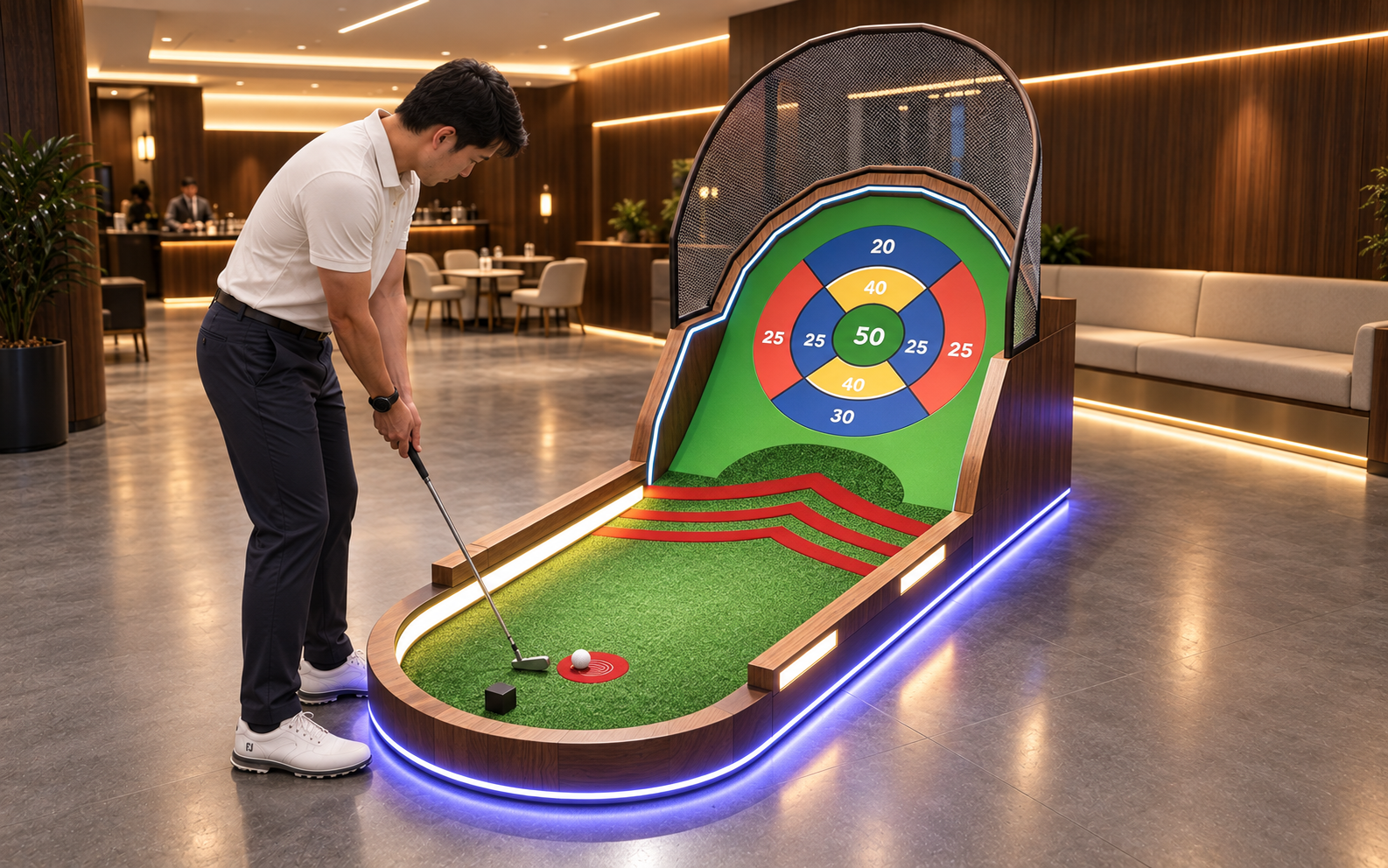
On a stroke-counting course, the aim is to finish each hole in as few strokes as possible. Before you start, ask where to place the ball, how turns work and how to record an unfinished hole. Follow the venue's rules for the round; a target-points game may use a different scoring method.
Before the first hole, settle these four questions
Ask the team for a putter you can hold comfortably, a ball and the scoring method used on that course. Take a moment to read the start signs and any instructions about where you may stand or walk. If you need help with access, equipment or the playing sequence, discuss it before joining the start.
Putt-Putt is also a brand name. A visit to one of its locations comes with that location's instructions; people also use the term informally for miniature golf. The Putt-Putt and mini golf naming guide explains the distinction. The steps here are for a casual stroke-counting round, with house rules controlling the details.
| Ask before starting | What you need to know |
|---|---|
| How do we take turns? | Who plays next and when to approach the ball |
| What happens at the attempt limit? | When to stop and the score to enter |
| What if a ball leaves the lane? | Where to replace it and any score adjustment |
| How do we record and finish? | Card or screen procedure, course order and equipment return |
Use the chosen venue's current instructions. This checklist does not replace its house rules.
Agree who will keep the card or enter the results. If a screen is involved, ask for a demonstration of how to identify your player and confirm an entry. Sorting that out before play is easier than reconstructing several holes afterwards.
Play the first hole one action at a time
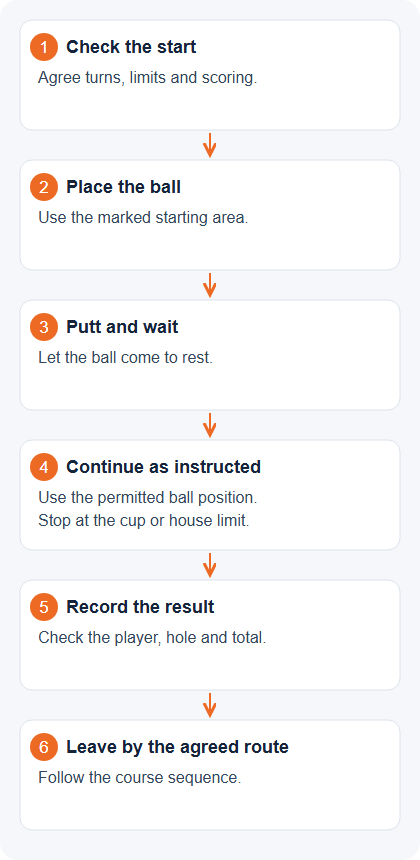
Wait until the venue's start arrangement allows you to begin and the playing area is clear. Place the ball in the marked starting area as instructed. Look at the intended route to the cup and choose an aim point. For your first attempt, use a short, controlled putting movement rather than a large swing.
Let the ball come to rest before approaching it. Continue from the position permitted by the course rules; an edge, marked relief area or out-of-bounds ball may need a different procedure. Keep other players clear of the person making a stroke and leave installed obstacles in place.
In its competition-rule summary, the German Minigolf Federation describes the aim as getting the ball from the start into the target with as few strokes as possible. That explains the stroke-play objective; it does not make every competition procedure the rule for your leisure venue. Confirm how the venue handles unfinished holes and attempt limits.
Keep the scorecard simple and check the total
For a stroke-counting game, keep track of the shots as they happen. Record the hole result at the agreed point in the playing sequence, then check that it is beside the right player and hole. If a ball goes out of bounds or a limit is reached, use the venue's stated score or penalty procedure rather than guessing.
Here is an invented three-hole practice card. The player finishes in three, two and four strokes, with no penalties or unfinished holes in this example. The total is 3 + 2 + 4 = 9. It is a counting exercise, not a real venue's scorecard, a par standard or a target for beginners.
| Invented practice hole | Completed strokes | Running total |
|---|---|---|
| 1 | 3 | 3 |
| 2 | 2 | 5 |
| 3 | 4 | 9 |
Teaching example only: 3 + 2 + 4 = 9. No penalties, attempt caps, par values or target-points rules are modelled.
In this particular stroke-counting example, a lower total means fewer strokes. Do not transfer that rule to every interactive game. NextPlay describes its Golf Target Shooting Hole with target zones carrying different point values. Read the displayed scoring instructions for the game you are actually playing. The scoring guide explains what to check with manual or digital entry.
When a ball or obstacle causes uncertainty, pause
A ball against a border, outside the lane or caught near an obstacle needs the course's own procedure. Look for a marked instruction or ask the team where to replace the ball and what to record. Do not assume that every course permits the same distance of relief or the same penalty.
Do not move an installed obstacle to create a route. If the ball is inaccessible, stop and ask staff for help instead of reaching into equipment or crossing an area you have been told not to enter. Use the permitted route to retrieve a ball; a putting surface is not automatically a walkway.
Before starting, ask when to stop taking attempts and what result to enter if the hole remains unfinished. The venue's attempt limit and recorded score can be different.
Agree turns and respect the venue's group sequence
Use the turn order explained at the start. If you are unsure whether one person completes the hole or players alternate strokes, ask before taking another shot. Stand where you do not obstruct the current player's movement or the next group's designated waiting area.
Do not automatically wave a faster group through. The Putt-Putt Memphis play page explicitly says there is no playing through behind a slower group. That is an example of one location's policy, not a rule claimed for all courses. Ask the team how to handle a delay or a group that has stopped playing.
For an operator introducing new players, rehearse the explanation with a small group: show the starting area, demonstrate one stroke, show where to wait and ask someone to enter a sample result. Watch which step causes a question. Put that instruction at the relevant decision point, then repeat the trial.
Use your early strokes to learn pace and direction
Start by choosing a visible aim point and making a repeatable, controlled stroke. Watch where the ball stops. If it repeatedly finishes short of the intended point, adjust the next stroke gradually; if it passes well beyond it, reduce the movement. Change one thing at a time so you can see what happened.
Read the route before trying a rebound or a more complicated shot. Ask which surfaces or targets are part of the intended play. A themed object or a light effect does not itself explain the scoring rule. These are practice suggestions, not a promise of a particular score.
Plan the rest of the visit separately. Check the chosen venue's round estimate, arrival instructions and any booked activity afterwards. The round and visit-time guide shows why time on the course and time at the venue are different.
Three hole concepts to demonstrate before play
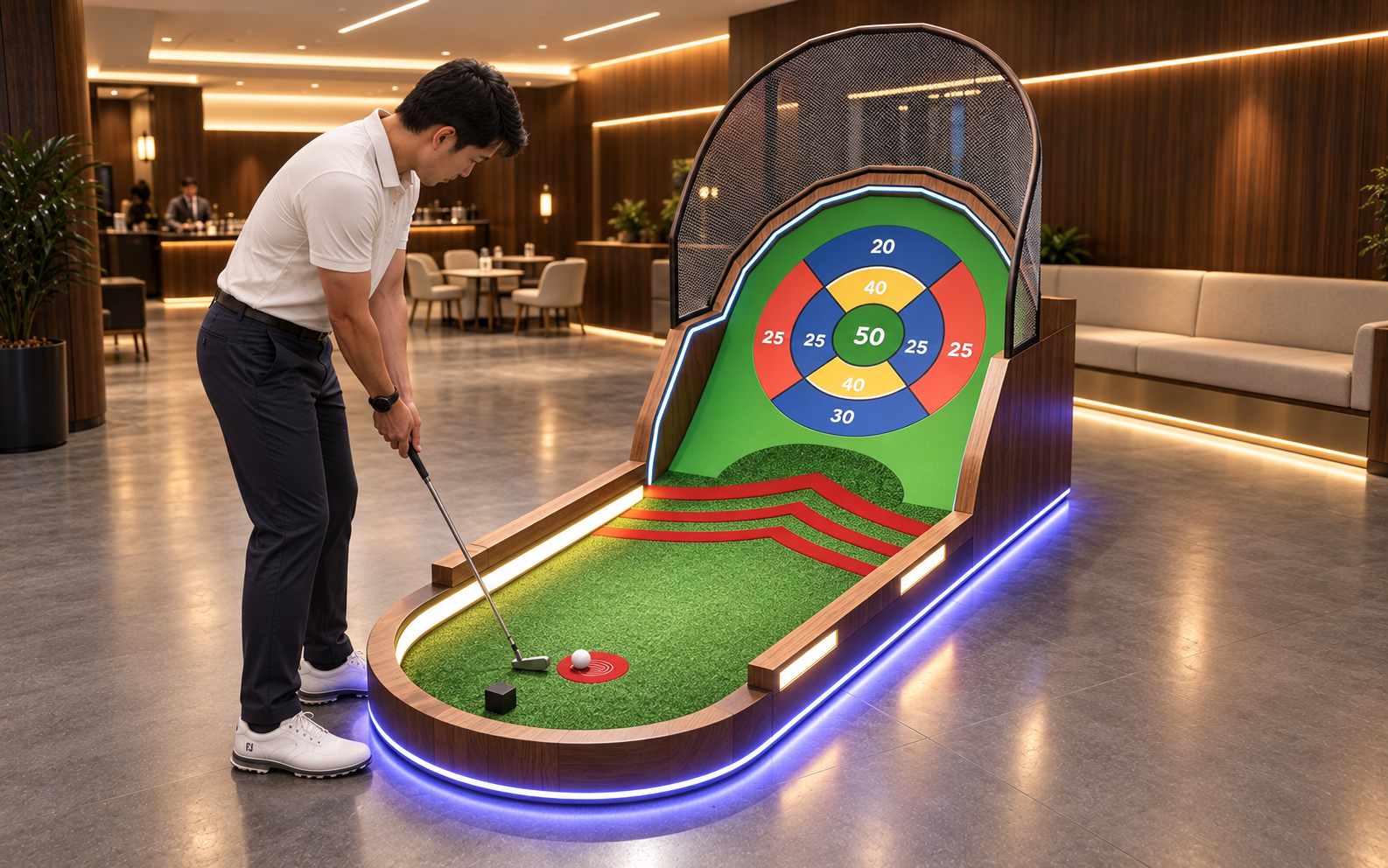
Golf Target Shooting Hole
Target zones carry different point values. Demonstrate the displayed values and the recording procedure before a guest uses a stroke-counting scorecard for this game.
View Details ›
King's Ultimate Golf Hole
A branching layout offers several target holes. Show the intended route and explain which target completes the task before the first putt.
View Details ›
Golf Parkour
Ramps, turns and obstacles shape this putting challenge. Demonstrate the intended ball path and the permitted retrieval procedure before guests try an obstacle.
View Details ›Make the first hole easy to explain
Planning a course for new players? Share the intended audience and game format so the starting instructions, scoring and movement between holes can be discussed with the equipment proposal.