
The weekends run themselves. The problem is the other five days, and the advice you get for them is always the same list: run promotions, post more, add a membership. What none of those lists tell you is which line of the business actually moves when you do it. An indoor mini golf course earns money through exactly one identity: core play revenue, which is the share of your open hours that groups actually occupy times the price per round you charge; plus what each visit sells beyond the round, which is food, drink, merch and add-ons; times how often the same guests come back in a year; and finally the size of the product surface you offer them, meaning holes, themes and formats. Four doors. Every tactic you have ever been sold sits behind one of them, and most venues push the wrong door because nobody wrote the line down.
Writing the line down changes the order of work. If the Tuesday house is empty, a higher-margin snack menu multiplies zero, and a clever email campaign to guests who already visit monthly does nothing for the door that is shut. The identity forces a sequence: first the occupancy of dead hours, then the spend of the visits you already have, then the return rate of those guests, and only then the capital moves that grow the surface itself. This article walks the four doors in that order, names the evidence behind each lever, and hands every full model to the cluster article that already owns it, because the pricing math, the throughput band and the payback clock each deserve their own guide and none of them should be restated here.
The boundary is deliberate. Plan-time questions - what the course costs, what it earns, when it pays back - belong to the business plan revenue-costs-ROI guide, the indoor mini golf ROI article and the payback-by-hole-count model. The price list itself belongs to the off-peak pricing guide. How many groups your lanes can turn belongs to the capacity guide with its published per-hole band. What this piece owns is the operating map between them: which lever to pull first, what each one is worth according to named evidence, and where the full arithmetic lives when you are ready to run your own numbers.
| Lever (in order) | The first move | Where the full model lives |
|---|---|---|
| 1. Occupancy of dead hours | Give the empty weekday a paying crowd before touching the price list | Off-peak pricing guide, capacity band, event format articles |
| 2. Spend per visit | Bundle and place the second sale while the guest is still on the floor | Bar format article, concessions practice named below |
| 3. Visits per guest per year | Build the event calendar and the return triggers | Date, team, corporate, tournament, party, school articles |
| 4. Product surface | Retheme, add holes, or mix formats only after doors 1 to 3 earn | Retheme and add-a-hole guides, cost and payback models |
The first door is occupancy, because an empty hour cannot be upsold. The weekday valley between about lunch and the evening rush is where indoor venues lose the week, and the instinctive fix - a discount - is the last move, not the first, because discounting an empty room mostly concedes margin you were never earning. The correct first move is programming: decide who the weekday is for, and give that crowd a reason to book the slot. As of September 2026, according to Golf Digest, the operator interview with Jimmy Vukanovich of the Indoor Golf Club in New Jersey puts the rule bluntly for the adjacent simulator industry: know whether you are an event space or a practice facility, because running both well at once does not work. The mini golf translation is the same: a weekday built for school groups looks nothing like a weekday built for corporate buyouts, and a calendar that tries to serve everyone serves the dead hours worst of all.
Pick the crowd, then book the crowd. The formats that eat weekday hours already have full guides in this cluster, each one aimed at a different empty slot. Schools and after-school programs fill the late afternoon strip that nothing else touches, and the school group playbook covers the rate card and session design for exactly that window. A corporate buyout owns the entire evening: our own format runs a documented corporate night as a 4K buyout package, which converts a quiet Wednesday into a single high-value booking rather than eight hopeful walk-ins. Tournament nights (tournament night guide) program a recurring weekday with a leaderboard reason to return, birthday parties (birthday party design article) stack into the after-school and weekend-adjacent blocks, and a date night playbook gives the couple crowd a reason to arrive when families do not. The lever is not promotion; the lever is a named crowd per slot.
Pricing still matters, which is why the cluster owns it as a separate article: the off-peak pricing guide builds the actual price ladder for filling afternoons, and this piece will not restate a single number from it. What belongs here is the arithmetic of why occupancy comes first. Using our published capacity band of 3 to 5 minutes per hole per group from the capacity guide as the stated assumption, a lane clears roughly 12 to 15 groups an hour at the slow end of the band. A dead three-hour Tuesday block filled at even half that rate - call it 6 to 7 starts an hour, stated as a worked assumption you should re-run with your own demand - converts zero group-rounds into something near 20 group-rounds an evening. That is 20 times whatever your price list already says, earned before a single price changes. The pricing article then decides what each of those rounds should cost; the capacity guide decides how many the lanes can honestly turn; the job of this lever is only to make sure the lanes are turning at all.
Two operator-side mechanics finish the door. First, inventory control: as of September 2026, according to Golf Business Monitor, the recommended practice for indoor venues is to take control of the time-slot inventory and structure pricing and packaging off actual demand data, because one-size-fits-all is named as a top operator mistake. Second, the promo pattern for the emptiest slot: as of September 2026, according to the ROLLER data article, a Two-for-One Tuesday style offer against the lowest-attendance afternoon is the working example they publish (their lift figures inside that article are explicitly hypothetical scenarios, cited here as the tactic, not as evidence). Run both mechanics against the slots the calendar article in lever 3 has already claimed, and the price article has the data it needs to ladder the rest.
The second door monetizes the visits you already fought for. A guest who plays one round and leaves having bought nothing else has given you the ticket line and nothing more, and the gap between the ticket and the total per-visit take is where the soft margin lives. The order of the doors matters again: spend-per-visit tactics are worth running only once the floor has bodies to work on, which is why this lever sits second. As of September 2026, according to Mini Golf Creations, dwell time is itself a revenue mechanism - the longer guests stay on site, the more their spend leaks into the cafe, gift shop and bar around the round - and a mini golf round is unusually good at stretching a visit because groups linger between holes, argue over scores and queue for photos at the themed holes. The floor is already holding them; the second sale has to be placed where the holding happens.
Bundling is the cleanest placement. As of September 2026, according to ROLLER, their mini golf revenue article observes that venues bundling popular items into packages sold through online checkout see around a 30 percent lift in online revenue, and their named pattern example is a drink bundled with the round as a single pre-paid package - the Sip and Swing style offer, where the guest pays once for the pair instead of deciding on the drink at the counter. The mechanism is not discounting; it is removing the second decision. A bundle priced as a package with a small concession to the guest converts an optional purchase into a pre-committed line, and it moves the decision to the moment of booking, when spending intent is highest, rather than to the counter, when the group is already tired and heading for the door.
Food and drink is the largest single line behind the ticket, and the strongest published figure for it comes from the adjacent simulator industry, labeled as such. As of September 2026, according to National Golf Foundation research cited in the Indoor Golf Direction Playbook, facilities that offer food and beverage see up to a 73 percent increase in revenue per visit - a simulator-venue result, published in a playbook about simulator venues, shown here as the scale of the lever rather than a promise about a mini golf floor. The mini golf reading is structural: groups that drink stay longer, larger groups book when food is available, and return rates rise when the visit includes a meal moment. If your course already sits inside a bar or lounge, the compact bar format article documents the six-hole loop designed around exactly that dependency, where the round feeds the bar tab instead of competing with it.
The environment taxes every one of these lines. A course whose turf is worn, whose themes are five years stale and whose weekly upkeep has slipped will quietly nullify the bundle, the menu and the campaign, because guests do not spend freely in a space that feels neglected. The two cluster guides cover the mechanics: LED hole themes that keep the course fresh for the refresh cycle, and the weekly maintenance checklist for the upkeep that keeps the spend environment credible. This is the quiet half of lever 2 - not a new sale, but the preservation of the conditions under which the other sales happen.
The third door is frequency: the same guest, more times per year. A venue that serves each guest twice a year has half the revenue of a venue that serves them four times at identical traffic, which is why the event calendar is not marketing decoration but a product line of its own. The ladder in this cluster is built slot by slot, each article owning one recurring appointment: the date night playbook claims the couple evenings, the team building formats claims the midweek corporate blocks, the corporate buyout package claims whole evenings at once, the tournament night guide claims a recurring leaderboard slot, the birthday party design claims the childrens weekends, and the school group playbook claims the weekday afternoons. Read together they are a seven-day grid: every dead slot on the grid is a format waiting to be booked into it, and a guest who came for the Tuesday tournament has a reason to return the following Tuesday that a random discount code never gives them.
Some formats sell themselves as replay value rather than one-off bookings, and the equipment can carry that job. The Beer Pong Challenge hole is built for exactly the social replay pattern: a bar-format game that a group understands in one look, scores in minutes and wants to beat next time, which is the mechanic behind a returning Tuesday crowd rather than a once-a-year novelty. Pair the format with a themed refresh so the reason to come back still looks new, and the frequency lever starts compounding on its own calendar instead of on your promotion budget.
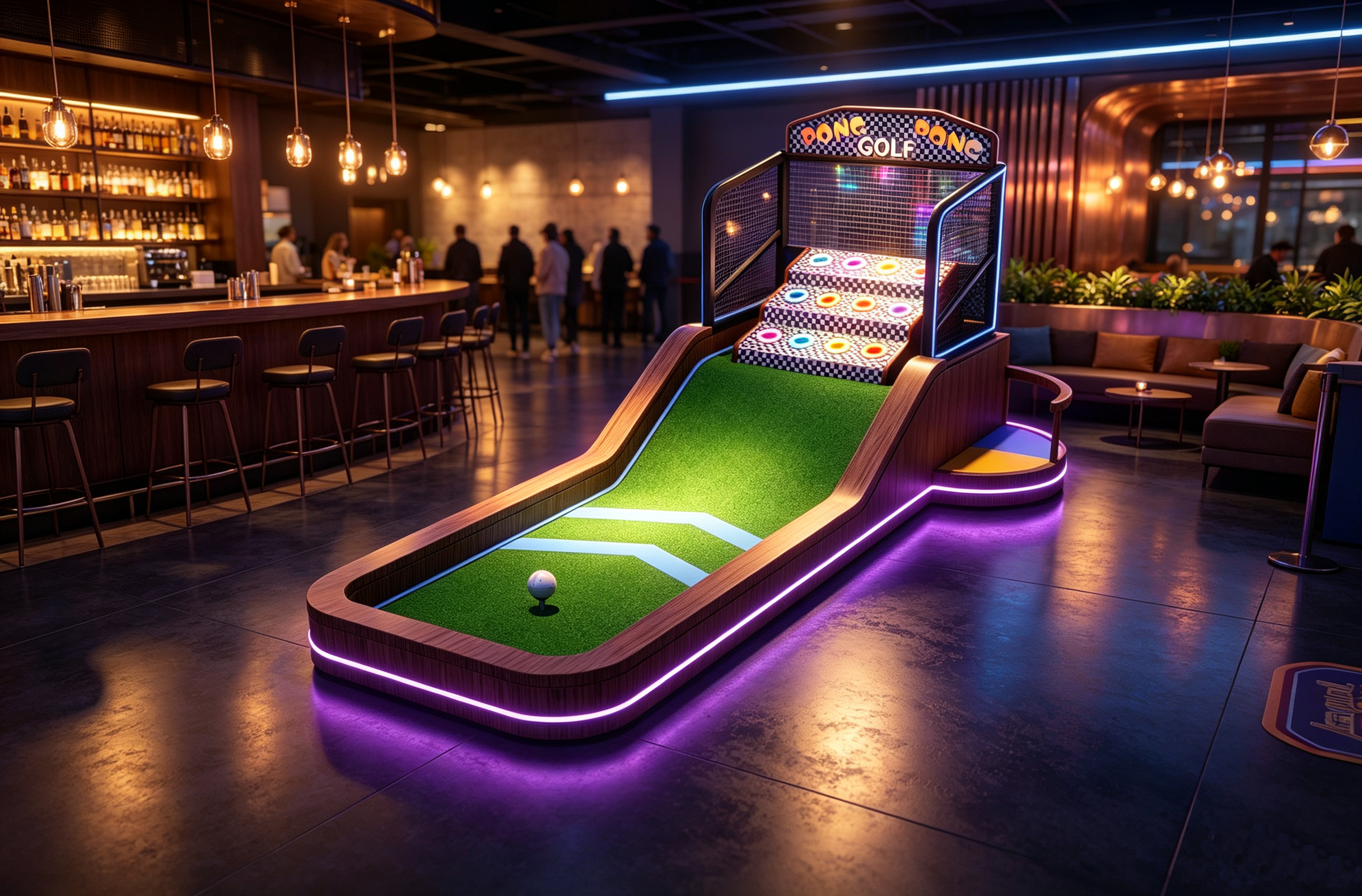
Data is the return-trigger layer above the calendar. As of September 2026, according to ROLLER, their data article recommends reading quiet-time attendance against targeted offers - the named working example is a two-for-one against the lowest-attendance afternoon - and using guest history for tailored reactivation, with memberships and gift cards offered as steady-revenue streams that offset the quiet periods. Their embedded campaign numbers are labeled hypothetical inside the article and are cited here only as tactics. The operator discipline underneath is the Golf Business Monitor point from lever 1, restated here only as a boundary: read your own slot data, then structure the offer. Membership pricing itself, and the question of what a return visit should cost, stays with the pricing guide, because a membership is a price instrument before it is a marketing one.
The fourth quarter is where frequency either holds or leaks, and the cluster owns that battle separately: the winter profitability playbook covers the off-season stretch with its own numbers and formats, so a calendar built in this section should visibly extend into it rather than stopping at the holiday parties. A guest acquired in October and re-won in January is a guest the venue keeps; a guest acquired in October and silent since has been rented for one evening. Frequency is the door where the calendar, the data and the seasonal playbook finally multiply each other.
The fourth door is capital: changing what the floor physically offers. It is listed last on purpose, because surface moves are the only levers here that write a check, and a retheme bought while the weekday is still empty funds a prettier version of the same problem. The evidence that the lever works when the product is genuinely stale is unusually clean. As of September 2026, according to Creative Works, Coconut Bowl at Wild Island in Nevada - a 125,000 square foot entertainment facility whose indoor blacklight mini golf had run for 16 years - renovated and rebranded the course expecting a 20 to 25 percent revenue lift, and general manager Craig Buster reports roughly 40 percent instead, quoted in the interview as the number they are seeing. Read the case correctly: it is not proof that any renovation returns 40 percent; it is proof that a dated product has a quantified ceiling on every other lever, and that removing the ceiling is worth measuring when the rest of the machine is already running.
The refresh side of this lever has two forms. A retheme repaints the experience you already own: LED hole themes, new narratives per hole and glow treatments cycle the course without touching structure, exactly the pattern the LED theme freshness guide documents and the pattern the Coconut Bowl case paid for at scale. The Rainbow Golf Challenge hole is a built example of the same idea - a color-driven challenge hole whose appeal is the photograph guests take of it - which matters for lever 2 as much as lever 4, because a course that looks current is a course guests photograph, share and return to. Structure stays, surface resets, and the capital stays inside a measured refresh rather than a rebuild.
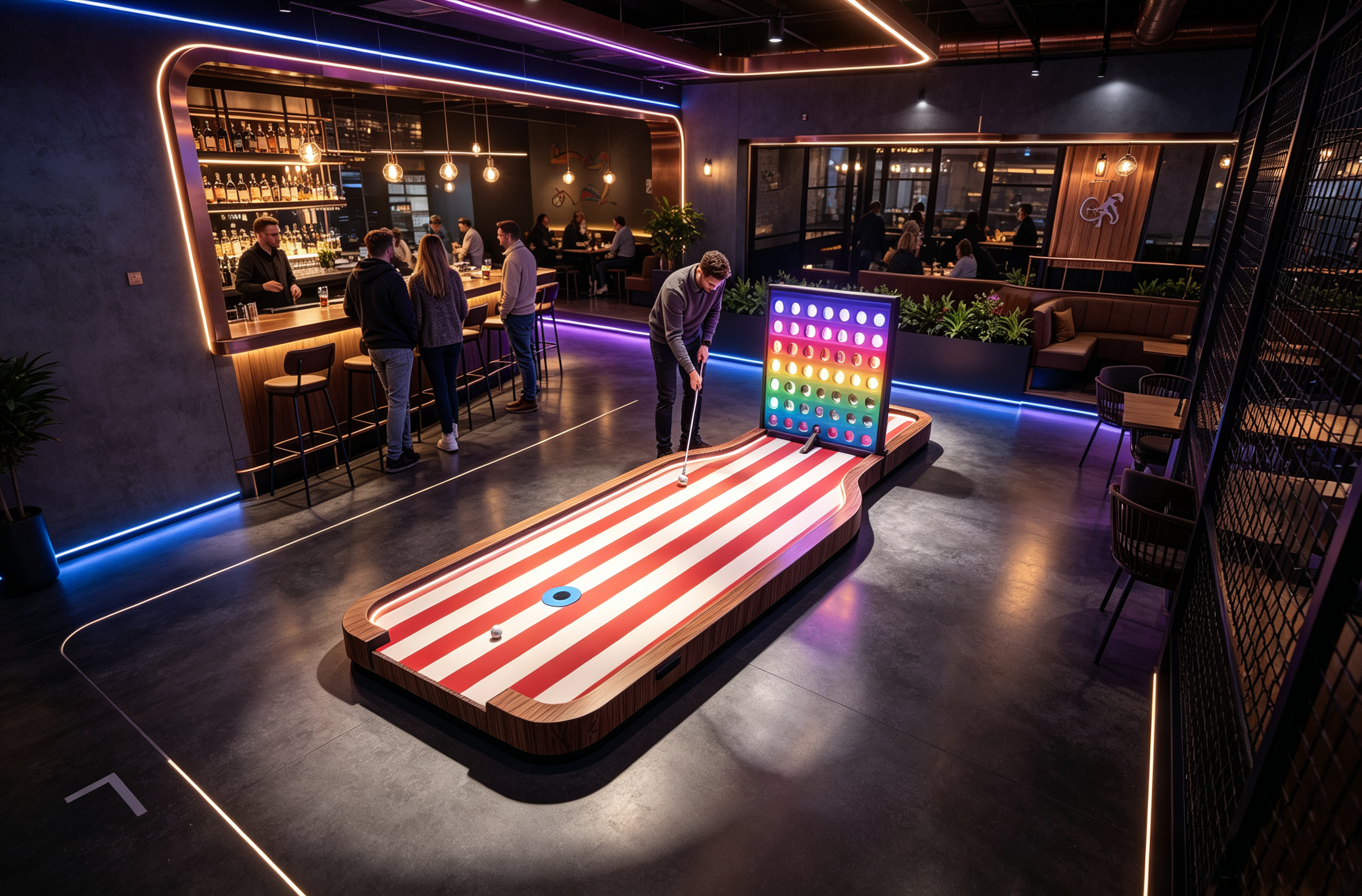
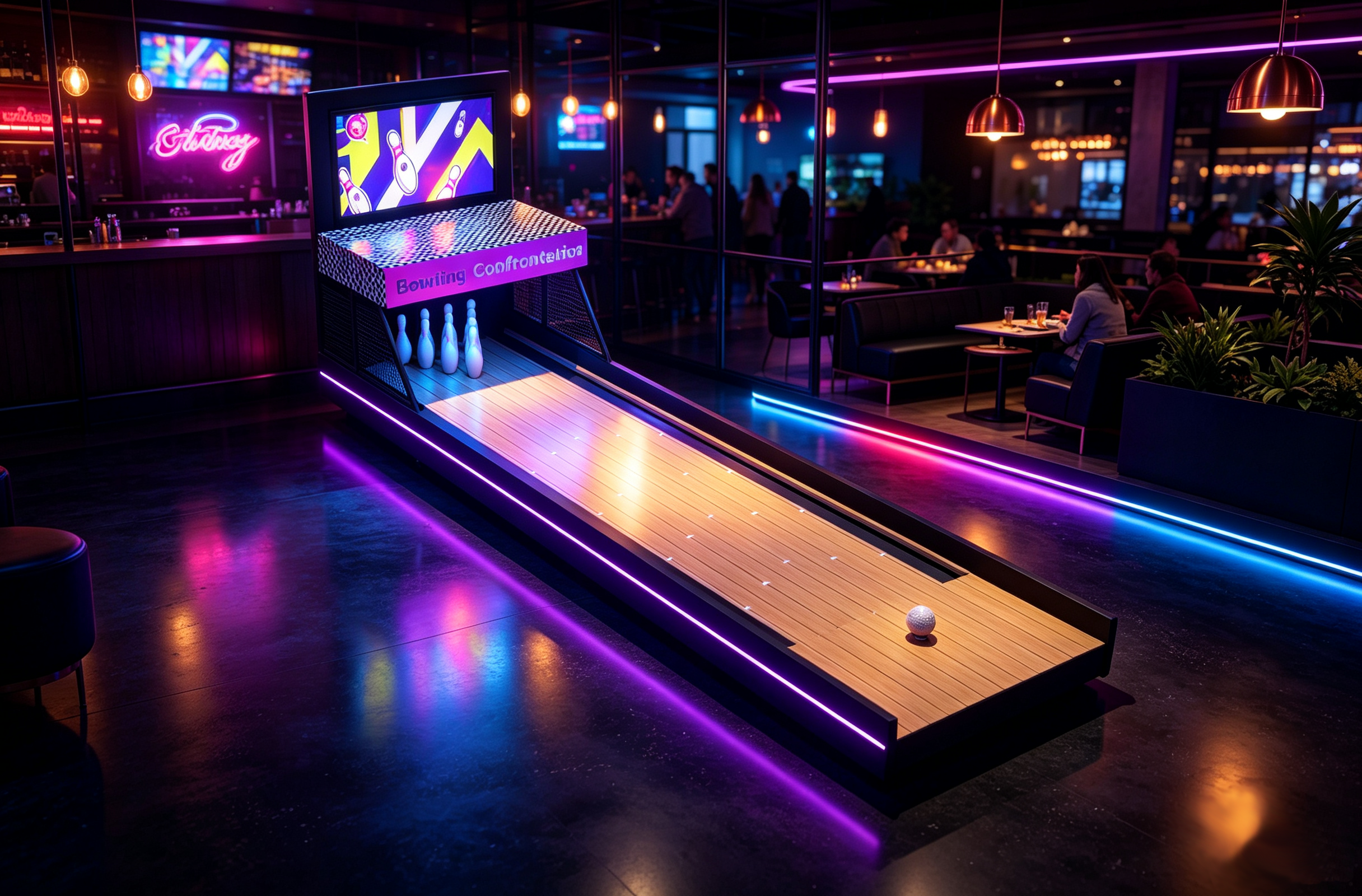
The expansion side adds units instead of repainting them. The five-step add-a-hole path documents growing the course one hole at a time once demand justifies it, and the hole count sizing article - the newest piece in this cluster - owns the decision of what N should be before the first unit is ordered. When the growth question is not more holes but a different mix, the mini golf versus arcade per square meter and mini golf versus bowling per square meter comparisons hold the mix arithmetic, and the Bowling Theme Mini Golf Challenge hole shows the crossover move inside the course itself - borrowing the bowling audience onto the turf - which is a surface play that reads as a theme. Design-time rearrangements of the whole floor belong to the design for maximum revenue article; this lever only decides when the next capital dollar is justified.
The boundary closes the section: every move behind door 4 spends money, so the cost and payback models ride along to the signature. The course cost guide prices the refresh, the payback model times it against the hole count, and the rule of the four doors stands - if doors 1 to 3 are not yet earning their named targets, the correct next dollar belongs to occupancy, not to paint. When the first three doors are running, however, the surface lever is the one that resets the ceiling the Coconut Bowl case measured, and it becomes the cheapest growth in the building relative to what the operating machine can push through the new ceiling.
Put the four doors on one floor for a quarter and the order becomes operational rather than theoretical. Month one works the calendar grid from lever 3 into the dead slots of lever 1: schools claimed for the afternoon strip, one corporate buyout booked for the midweek evening, a tournament night standing every other week. Month two layers the second sale onto that traffic: the round-plus-drink bundle at checkout, the concessions placed at the counter groups already queue at, the menu photographed next to the leaderboard. Month three runs the return triggers: targeted quiet-time offers to the guest history the first two months built, the date night and team formats booked forward, the winter extension already on the calendar. Only in month four, with two months of honest slot data behind it, does the venue decide which surface move is justified - a theme refresh, one added hole, or nothing - because by then the decision has evidence instead of a brochure.
| Lever | First move on this floor | Named evidence | Guide that owns the full model |
|---|---|---|---|
| 1. Occupancy | Claim each dead slot with a named crowd and format | GolfBizMonitor inventory control; GolfDigest positioning quote | Off-peak pricing guide + capacity guide + event articles |
| 2. Spend per visit | Bundle round plus drink at checkout; place concessions | ROLLER about 30% online lift (vendor); NGF up to 73% F&B per visit (simulator venues) | Bar format guide + pricing guide |
| 3. Frequency | Build the seven-day event grid with return reasons | ROLLER tactics (lifts hypothetical); cluster event formats | Date / team / corporate / tournament / party / school + winter |
| 4. Surface | Measure the stale ceiling, then refresh or expand | Coconut Bowl roughly 40% after retheme (Creative Works) | Theme, add-a-hole, hole count, cost and payback guides |
Running lever 2 and lever 3 while door 1 is shut. A beautiful bundle, a clever email and a themed night all multiply the guests who happened to walk in, while Tuesday keeps its lights off. This is why the discount reflex fails: it prices the empty room instead of programming it.
Fill first, sell second, return third, spend fourth. Each door earns the right to the next: occupancy funds the bundle data, the bundle funds the calendar tests, the calendar data funds the surface decision. The sequence costs nothing until door 4, and every earlier move is reversible.
The order is the whole argument. Venues that skip to door 4 buy a renovation that the empty weekday then taxes; venues that stop at door 1 run full rooms at prices and spends the pricing and bundle levers could have lifted for nothing. When the four doors run in sequence on one floor, the identity at the top of the article stops being a line and becomes the operating report - occupancy, spend, frequency, surface, each with its named guide, its named evidence and its honest share of the month. The floor plan questions that surface moves raise - does the refresh fit, does the added hole route, does the mix hold the throughput - are answered by the mini golf course solution team with a free 3D layout on your footprint, which is also where door 4 gets priced before it gets signed.
The six operating questions venue owners ask before they touch a lever.
Fill the dead hours first. An empty slot cannot be upsold, bundled or emailed back to life, so the first move is giving each dead block a named crowd and format - schools, corporate buyouts, tournament nights - before any price changes. The off-peak pricing guide then ladders the price of the slots that now have a crowd, and the capacity guide confirms the lanes can turn what you book.
That question belongs to the money models, not to this operating map: the indoor mini golf ROI article works the earning line, the business plan guide builds revenue-cost-ROI from scratch, and the payback article times the return against the hole count. What this article adds is that the earning line itself has four movable doors, and their order decides how much of the theoretical number a real week produces.
No, and the order of the doors says why. Occupancy, spend and frequency are operating levers that cost programming time rather than capital, and they should run first. The Coconut Bowl case shows what capital is worth when the product is genuinely stale - about 40 percent reported lift after a 16-year-old blacklight course was rethemed - but that is the fourth door, opened only after the first three are earning.
The lever is large and the best published figure is adjacent: National Golf Foundation research cited in the Indoor Golf Direction Playbook reports up to a 73 percent increase in revenue per visit for facilities offering food and beverage, in the simulator-venue context that playbook covers. Structurally the reading transfers - groups that drink stay longer and book larger - and if the venue is already a bar, the compact bar format article documents the six-hole loop built around the tab.
Treat a membership as a price instrument first: ROLLER recommends memberships and gift cards as steady-revenue streams that offset quiet periods, which suits a weekday valley more than a weekend. What the membership should cost, and whether it undercuts your ladder, is decided in the off-peak pricing guide - the membership is lever 3 mechanics sitting on a lever 2 price.
Two guides answer in order: the hole count sizing article decides N from the round length you sell and the lanes you need at peak, then the five-step add-a-hole path grows the course one unit at a time so each addition carries its own demand evidence. Adding holes is door 4 - run it after the calendar, the bundle and the triggers have shown the floor is constrained by count rather than by traffic.
Send the floor you run, the weekday slots that sit empty and the round length you sell: the team will map your four doors on a free 3D layout, price the surface moves against the cost guide, and return a written quotation per hole so door 4 stays a measured decision - start with the mini golf course solution or book a free 3D layout directly.