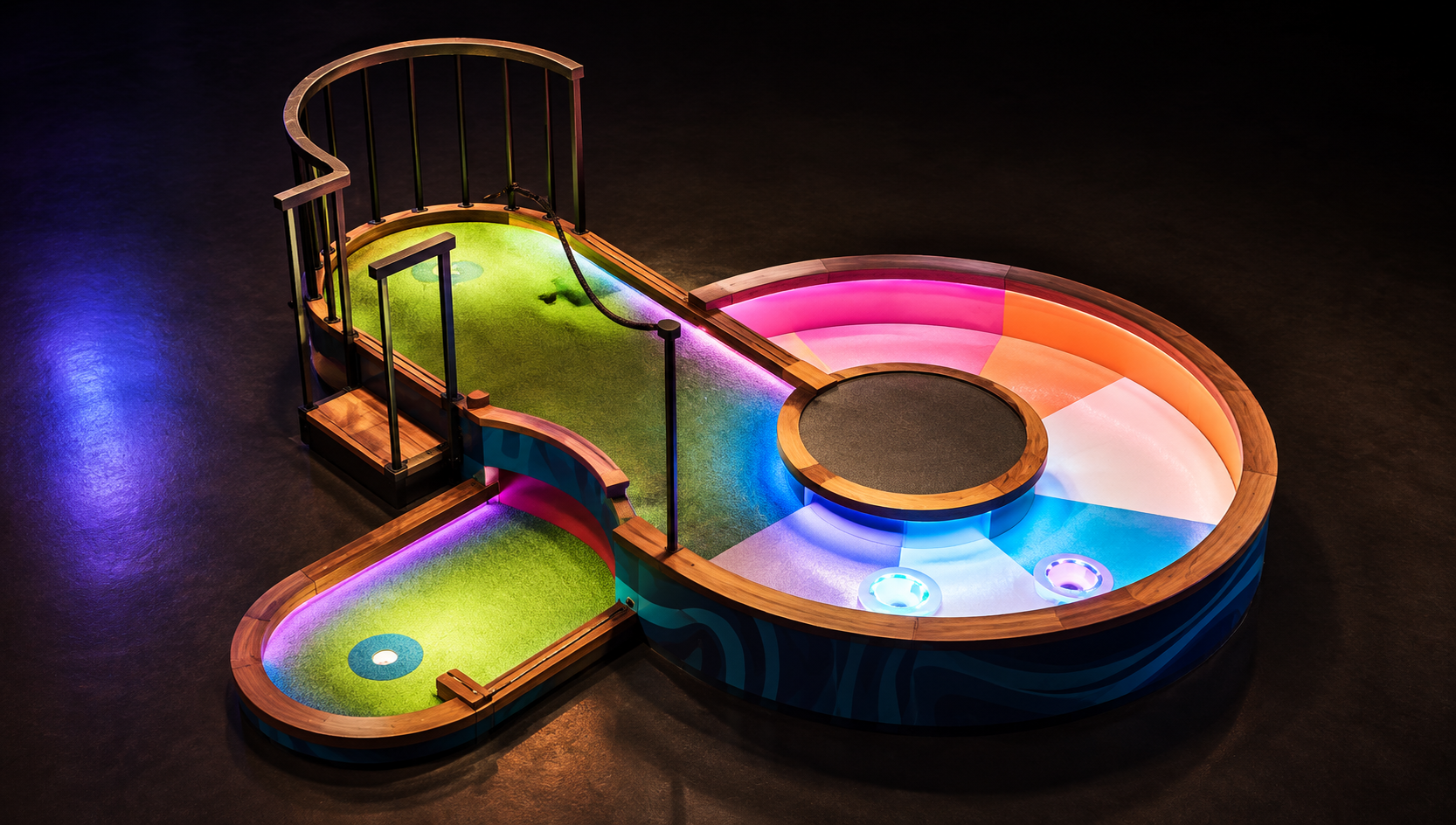
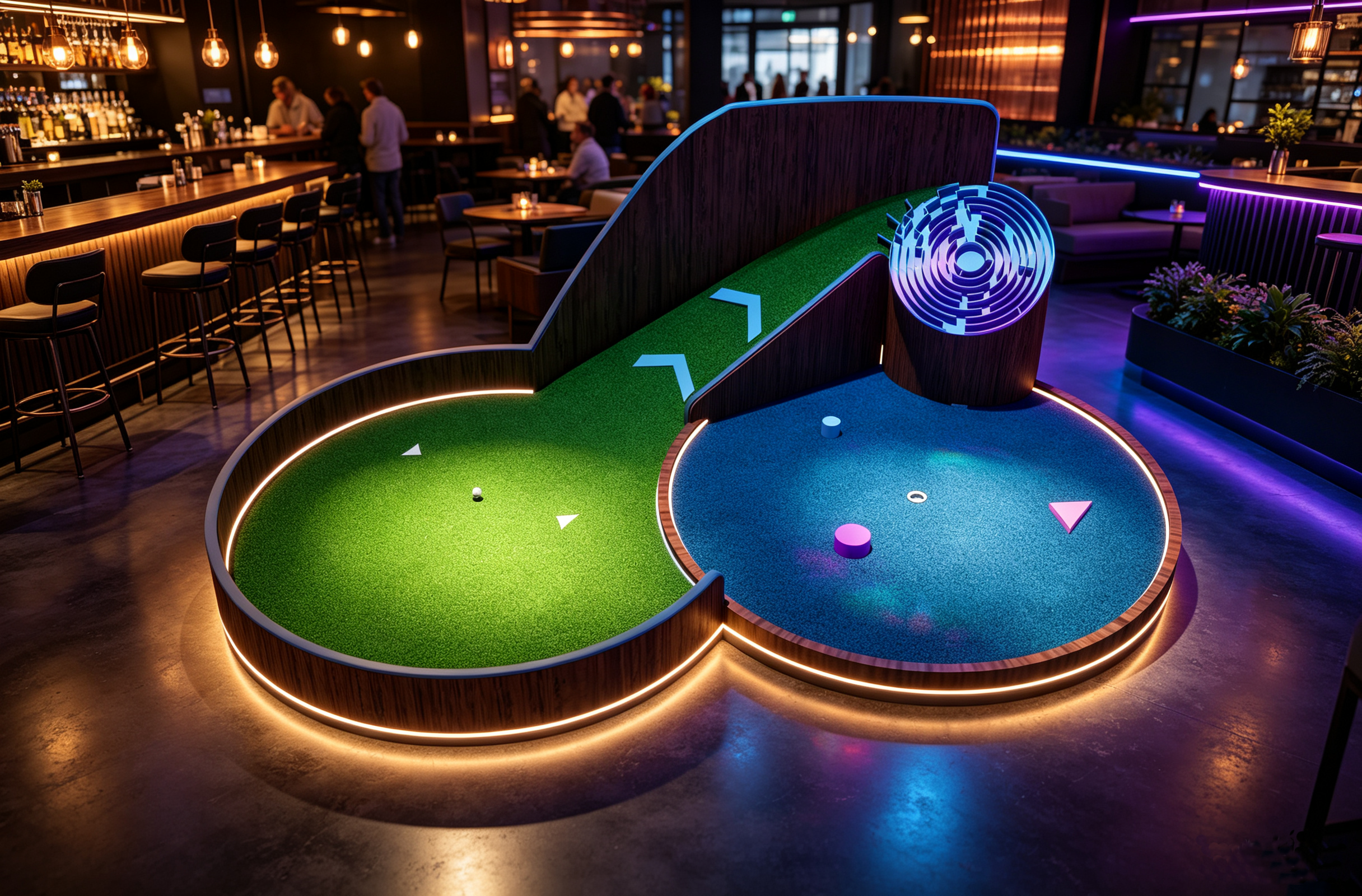
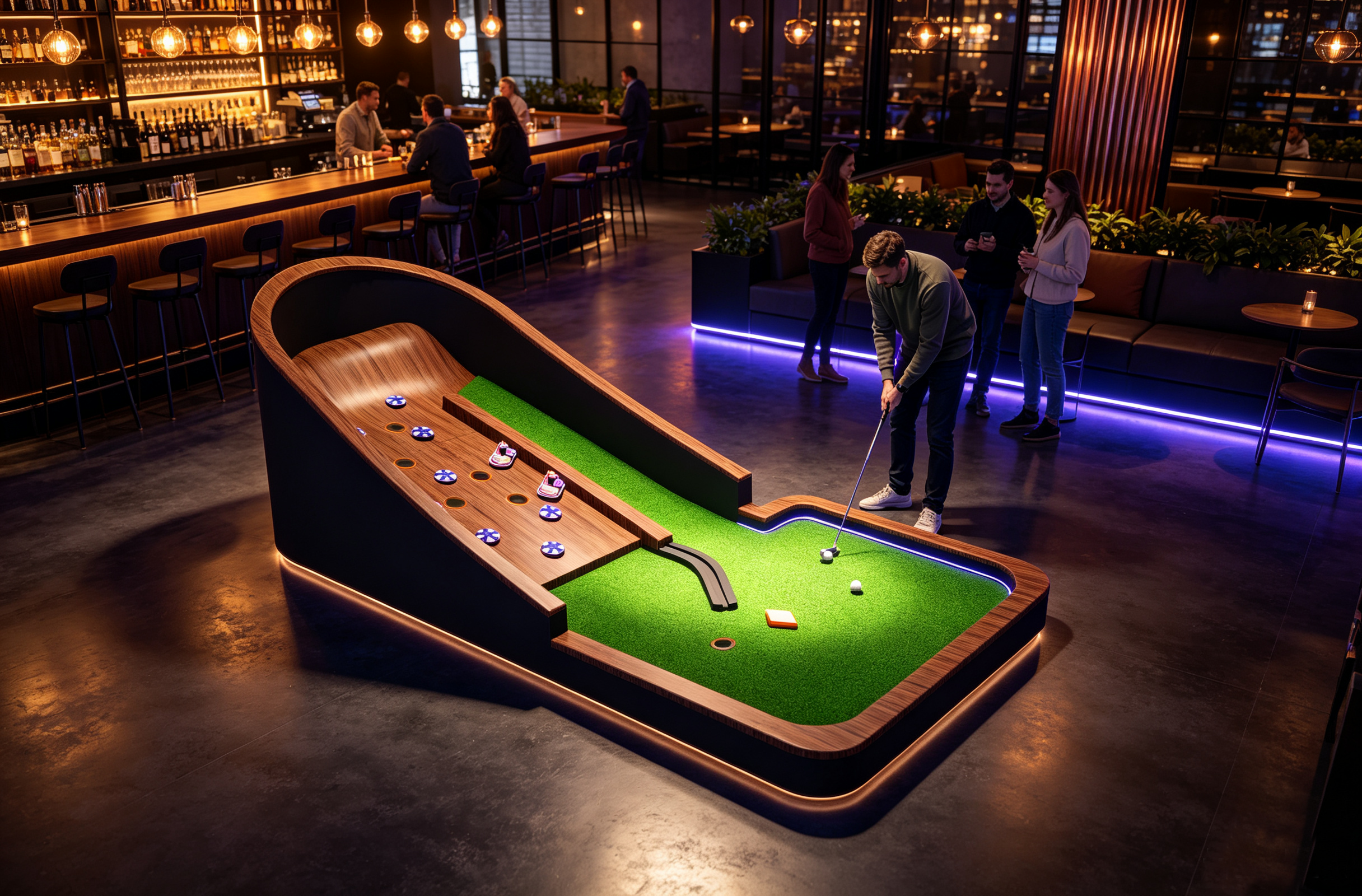
Mall atriums are judged on footfall and dwell time, and the published mall-attraction analyses make the pattern explicit: a visible, low-barrier attraction on the concourse pulls spectators and converts them into players (the concourse footfall analysis). Mini golf is the lowest-barrier version of that logic - every shopper already knows how to putt, the published capacity analysis (mini golf course capacity) puts a compact course at 16 to 24 players per course-hour with one attendant, and the published hole-count analysis (how many mini golf holes you need) times 9 holes at 20 to 30 minutes. What follows are the ten plays, ordered along the shopper journey, each anchored to a published figure.
Play 1 - The three-direction sightline. The published concourse analysis attributes footfall lift to visibility; an atrium course should sit where escalators and balcony railings see it from multiple directions. The spectacle hole does the advertising: the Cyclone Spin Hole 360-degree loop ramp is the shot every balcony phone records.
Play 2 - The glanceable storefront. A shopper decides in one glance whether an attraction is for them. Mini golf needs no tutorial, no headset, no change of clothes - the published space analysis (how much space a mini golf course needs) shows the compact course reads as a playable landscape, not an enclosed ride, which is exactly what a concourse needs.
Play 3 - The mid-journey round. The 20-to-30-minute 9-hole loop is the dwell-time product: long enough to extend the visit past a coffee, short enough to fit between shops. The published loop timing makes it schedulable - the mall can sell the slot, not just the round.
Play 4 - The service-elevator test. Mall installs live or die on logistics. The published equipment-buying guide (commercial mini golf equipment) compares freight cubes across hole types - the compact unit ships in the smaller cube, which is the difference between a course that fits the service elevator and one that needs a crane booking.
| Play | What it converts | Published anchor |
|---|---|---|
| Three-direction sightline | Balcony spectators into players | Published concourse visibility logic |
| Glanceable storefront | Passers-by into entrants | Compact course reads as playable landscape |
| Mid-journey round | Coffee stop into 30-min dwell | 9 holes, 20-30 min (published timing) |
| Service-elevator test | Leasing square meters into installed course | Published freight-cube comparison |
Play 5 - The weekday morning program. Malls empty on weekday mornings; the published rate card (the time-tier rate card) prices the USD 4.50 morning tier exactly for school groups and seniors. The atrium course turns the quiet concourse into a school-program venue - the published school playbook shows the group math.
Play 6 - The weekend family queue. Weekend footfall is the mall premium, and the published capacity math absorbs it: 16 to 24 players per course-hour with continuous loops. The queue is itself the show - spectators on three sides watching the loop ramp convert into the next booking.
Play 7 - The evening league. The published rate card prices the evening tier at USD 8.00, and the published winter analysis shows leagues replacing fair-weather walk-ins in the dead hours. A mall league runs the same bracket format in the food-court hours - the concourse earns after retail closes.
Play 8 - The campaign re-skin. The published light-scheme rotation guide (LED hole themes) shows a themed rotation keeps the course fresh. For a mall this is the leasing pitch: the atrium course re-skins per season or per campaign - a rotating window display that charges per round and gives the marketing calendar a new backdrop quarterly.
Play 9 - The party and buyout slot. The published buyout analysis prices a three-hour buyout at about USD 4,500 versus about USD 1,040 walk-up - roughly four times. The atrium course rents evenings for birthdays and corporate nights on the same one-package structure: slot, rotation, food, one decision.
Play 10 - The competitor-store traffic loop. The published concourse analysis shows attractions spreading dwell time across the surrounding tenancy. A course placed at the dead-end wing entrance pulls traffic past the shops that leased for footfall they never received - which is the leasing argument that gets the course installed: the mall is not renting square meters to an operator, it is buying a traffic loop for its own vacancies. The Labyrinth Challenge cooperative puzzle and the Customized Obstacle Challenge brandable course are the two anchors that carry the loop.
Close with the numbers the leasing committee will run. The published space analysis takes a compact 9-hole course down to 150 square meters; the published capacity analysis puts it at 16 to 24 players per course-hour; the published rate card prices the day from USD 4.50 to USD 8.00; the published buyout analysis prices a rental evening at about 4x walk-up. Against a dead-end wing of empty square meters, the course is the tenant that pays per round and delivers traffic to the neighbors - every figure above is a published planning reference.
| Planning line | Value (published basis) | Where it comes from |
|---|---|---|
| Compact footprint | From 150 square meters (9 holes) | Published space analysis |
| Course capacity | 16-24 players per course-hour | Published capacity analysis |
| Rate ladder | USD 4.50 / 5.00 / 8.00 | Published weekday rate card |
| Buyout vs walk-up | About 4x (USD 4,500 vs USD 1,040) | Published buyout analysis |
| Sensor throughput | About 18 rounds per hour | Published scoring comparison |
| Freight fit | Compact unit ships in smaller cube | Published equipment-buying guide |
If the atrium floor plan is still open, the free layout service at free 3D layout design maps the sightlines, the queue flow and the service-elevator route onto your actual square meters before a single hole is ordered.
The questions leasing managers and atrium operators ask, answered with the published references.
Atrium attractions live on visibility and throughput. The published capacity analysis puts a compact course at 16 to 24 players per course-hour with one attendant, and the published hole-count analysis times 9 holes at 20 to 30 minutes - a dwell-time product that every shopper can watch, understand in one glance, and join mid-journey.
The published space analysis takes a compact 9-hole course down to 150 square meters, and the freight math matters as much: the published equipment-buying guide shows the compact unit ships in the smaller freight cube, so the course fits the service elevator and the leasing square meters at the same time.
The published rate card runs USD 4.50 morning, USD 5.00 afternoon and USD 8.00 evening - a ladder built to move demand into the quiet slots, which is exactly the weekday-traffic problem a mall course is hired to solve.
The published rate-card logic prices the off-peak tiers to fill first - school groups and seniors own the USD 4.50 morning, the USD 5.00 afternoon absorbs the weekday shoppers, and leagues own the evenings. Weekend peak stays premium; weekday slots get filled by program.
One attendant. The published scoring comparison shows sensor leaderboards run about 18 rounds per hour versus about 12 on manual cards - auto-scoring removes the scorecard desk, which is the staffing line a mall concession cannot carry.
The published light-scheme rotation guide shows an LED theme rotation keeps a course fresh - a mall re-skins per season or per campaign, which turns the atrium course into a rotating window display that charges per round.
Send us the atrium floor plan and the footfall map: we will return the sightline placement, the queue flow and the campaign calendar through the free 3D layout design - anchored with the Cyclone Spin Hole, the Labyrinth Challenge or the Customized Obstacle Challenge.