Community centers compete on renewal, and renewal is decided by one question: does the facility give every age group a reason to keep the card? A gym answers the adults, a pool answers the families in summer - and the after-school hour, the senior morning and the weekend grandparent visit have historically been answered with nothing. Indoor mini golf answers all three with one course: the published capacity analysis (mini golf course capacity) puts a compact course at 16 to 24 players per course-hour with one attendant, the published hole-count analysis (how many mini golf holes you need) times 9 holes at 20 to 30 minutes, and the published rate card was built for exactly this demand ladder. What follows are the ten reasons, ordered by the retention argument, each anchored to a published figure.
Reason 1 - The senior morning. The published school playbook (mini golf for schools and after-school programs) prices the morning tier at USD 4.50 explicitly because school groups and seniors are the only demand in that slot. A center already owns the senior audience; the course turns the quiet morning into senior programming - low impact, social, 30 minutes - at the tier the rate card already publishes.
Reason 2 - The after-school hour. Kids land at the center between 3 and 6 PM with nowhere structured to go. The 20-to-30-minute loop is the after-school activity that fits before dinner, the published capacity math absorbs a full class rotation in an hour, and the same USD 4.50 morning-tier logic extends to the school-partnership programs the playbook describes.
Reason 3 - The multi-generational weekend. The weekend grandparent visit is the renewal moment: three generations play one 9-hole loop together, which no gym class or swim schedule can stage. The published hole-count analysis shows 9 holes at 20 to 30 minutes for a small group - the round that ends with the whole family in the lobby cafe instead of leaving the building.
Reason 4 - The price ladder fits without new pricing work. The published rate card (the time-tier rate card) runs USD 4.50 morning, USD 5.00 afternoon and USD 8.00 evening - a ladder built on off-peak demand, which is exactly what a center has. Members round inside it or the center bundles rounds into the membership; either way the pricing work is done.
| Slot | Audience | Published anchor | Rate-card fit |
|---|---|---|---|
| Morning | Seniors, school groups | USD 4.50 morning tier | Priced as the quiet-slot tier |
| Afternoon | Members, drop-ins | USD 5.00 afternoon tier | The standard member round |
| After-school hour | Kids programs | 16-24 players per course-hour | Class rotation inside one hour |
| Weekend | Multi-generational visits | 9 holes, 20-30 min (small group) | The family renewal round |
Reason 5 - Leagues fill the dead months. The published winter analysis (indoor mini golf through winter) shows the pattern: fair-weather walk-ins shrink, leagues and packages replace them, and the published tournament-night bracket format is the recurrence engine. A center that runs an 8-week bracket league has a renewal argument every week of the season - the gym league model, at miniature golf staffing costs.
Reason 6 - Auto-scoring makes it one-staff. The published scoring comparison (manual scorecards vs sensor leaderboards) shows sensor leaderboards run about 18 rounds per hour versus about 12 on manual cards - and the difference is the scorecard desk. Auto-scoring removes the staffing reason most centers give for skipping an attraction; one attendant supervises the floor.
Reason 7 - Rotation defeats the novelty cliff. The published light-scheme rotation guide (LED hole themes) shows a themed LED rotation keeps a course fresh. A center that re-skins quarterly gives members a new course four times a year - the retention mechanic that costs a lighting schedule instead of a renovation.
Reason 8 - Rentals become a revenue line. The published buyout analysis prices a three-hour buyout at about USD 4,500 versus about USD 1,040 walk-up - roughly four times. A center rents the course for birthday loops and club socials on the same published structure: one package decision covering the slot, the rotation and the food.
Reason 9 - Accessibility is designed in. The published hole-design analysis (mini golf hole design, hole by hole) documents the accessible-hole standards centers must meet for public programming. A course that serves the senior morning and the school hour has to serve mobility-limited players too - and the design analysis shows which holes do.
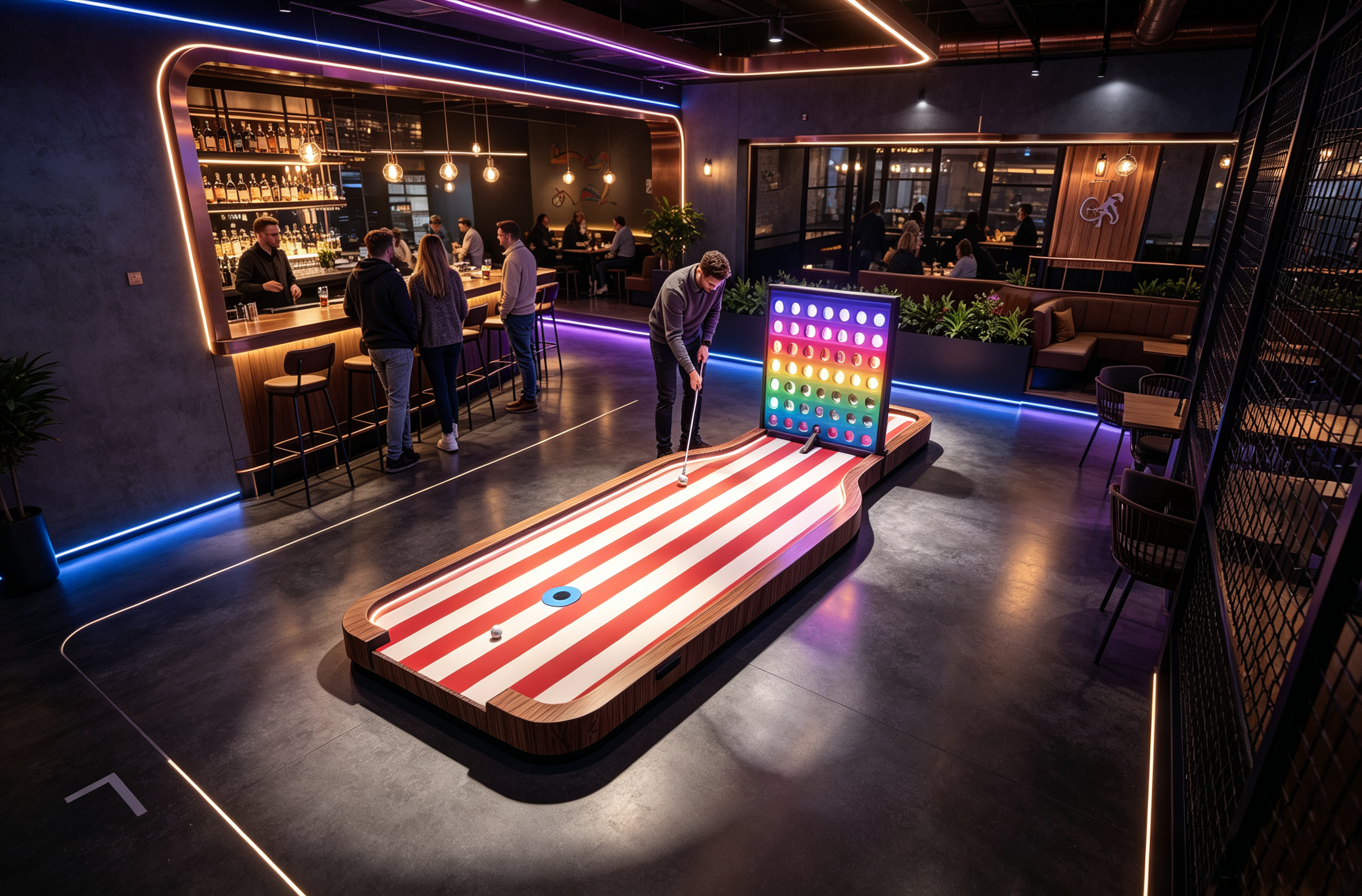
Reason 10 - The footprint answers the space committee. The published space analysis takes a compact 9-hole course down to 150 square meters - the meeting room, the underused racquet court or the lobby extension. The committee debate ends when the floor plan shows the course in the room the center already pays for. That is the hardware decision: the Rainbow Golf Challenge auto-scores at sensor speed with no marshal; the Customized Obstacle Challenge takes the center brand and fits the compact footprint.
Close with the numbers the board will ask for. The published capacity analysis puts the course at 16 to 24 players per course-hour; the published rate card prices the day from USD 4.50 to USD 8.00; the published buyout analysis prices a rental evening at about 4x walk-up; the published league format turns the dead months into a bracket season. One compact course, one attendant, three generations - and every published figure above is a planning reference the center can put in the proposal.
| Planning line | Value (published basis) | Where it comes from |
|---|---|---|
| Course capacity | 16-24 players per course-hour | Published capacity analysis |
| Loop time, 9 holes | 20 to 30 minutes | Published hole-count analysis |
| Rate ladder | USD 4.50 / 5.00 / 8.00 | Published weekday rate card |
| Rental buyout vs walk-up | About 4x (USD 4,500 vs USD 1,040) | Published buyout analysis |
| Sensor throughput | About 18 rounds per hour | Published scoring comparison |
| Compact footprint | From 150 square meters (9 holes) | Published space analysis |
If the floor plan is still open, the free layout service at free 3D layout design maps the demand ladder - senior morning, after-school rotation, weekend family loop - onto your actual square meters before a single hole is ordered.
The questions center and club directors ask, answered with the published references.
The published capacity analysis puts a compact course at 16 to 24 players per course-hour with one attendant, and the published hole-count analysis times 9 holes at 20 to 30 minutes. That is an all-ages attraction a volunteer desk can run - no coach, no marshal at sensor speed, and a footprint that starts where a gym expansion would end.
The published rate card runs USD 4.50 morning, USD 5.00 afternoon and USD 8.00 evening - and it was built exactly for this demand mix: school groups and seniors own the morning, members fill the afternoon, and the evening tier carries the after-work crowd. A center prices its member rounds inside the same ladder.
Yes, and the morning slot is built for it. The published school playbook prices the morning tier at USD 4.50 explicitly because school groups and seniors are the only demand - a low-impact, social, 30-minute activity is the senior programming slot, and the rate card already prices it as such.
Indoor play has no weather risk, so the off-season is a utilization problem, not a demand problem. The published winter analysis shows leagues and packages replacing fair-weather walk-ins - a center runs the same bracket league its gym leagues already model.
One attendant across the day. The published scoring comparison shows sensor leaderboards run about 18 rounds per hour versus about 12 on manual cards - auto-scoring removes the scorecard desk entirely, which is what makes a one-staff model work.
Rotation. The published light-scheme rotation guide shows an LED theme rotation keeps a course fresh - a center that re-skins the course quarterly gives the membership a new course four times a year for the cost of a lighting schedule.
Send us the floor plan and your demand ladder: we will return the course placement, the hole mix and the program calendar through the free 3D layout design - anchored with the Rainbow Golf Challenge, the Customized Obstacle Challenge or the Beer Pong Challenge.