The bar's pricing stack for a golf simulator: the 73% F&B uplift and the $100 per-visit build, dayparts and event tiers aimed at the weekday afternoon, leagues as recurring revenue, and the margin discipline that keeps the kitchen paid.
A bar prices a golf simulator differently from a golf business, because the bay is not the product - it is the table. The numbers behind that claim are published: the National Golf Foundation surveyed 354 facility operators and 569 golfers in late 2024 and found the average session runs just over one hour at a $55 fee, with $40 of food-and-beverage spend attached to every visit. That is a 73% uplift on bay time, and it takes total per-visit value toward $100. More than 40% of public-facility customers exceed $70 per session in total spend. Every dollar of bay time drags roughly 73 cents of bar revenue behind it - the highest-margin 73 cents in the building.
The honest caveat comes with the source: Tabski, which compiled the survey, notes the NGF sample is 74% public golf courses and 26% private clubs adding simulators - not standalone urban golf bars. Read that two ways. A venue with a real kitchen and a cocktail program likely attaches more than the survey average, because the sample understates its kind; an unmanned bay with no F&B attaches none of it. The strategy in this page is written for the first kind - the bar that can actually bank the uplift.
| Per-visit line (published averages) | Value | What the bar does with it |
|---|---|---|
| Session fee (just over one hour) | $55 | The anchor rate, set per the market card |
| F&B spend per visit | $40 | The engine: menu and pacing designed for it |
| F&B uplift on bay time | 73% | The number the pro forma is built on |
| Total per-visit value | Approaching $100 | The real per-seat-hour yield |
| Club rental (where offered) | $10-$15 per session | Near-pure margin in the rack |
The demand data says a bar's worst hours and a simulator's best hours barely overlap, and the published shape is specific: weekday demand peaks at 6pm (13% of booked weekday hours) and 7pm (10%), weekends peak at 1pm with no evening spike at all, and the 9am-to-4pm weekday block is 57% of available bay-hours that almost nobody books. Peak-season day-of-week shares run Saturday 44%, Friday 44%, Sunday 39% down to Monday 32%. A bar holds the evening peak naturally - it is already full of the right crowd at 6pm - which means the simulator's inventory problem is the bar's quiet problem too: the weekday afternoon.
The published event pricing turns that inventory into a product line. A two-hour partial buyout runs $400-$800; a full four-bay venue buyout runs $2,500-$6,000; and a venue landing two to four events a month adds $8,000-$40,000 a year. Corporate afternoons, watch parties and league finals are all ways to sell the dead block at a premium instead of discounting it by the hour. The daypart rates themselves come from the sibling piece - the golf simulator rate card carries the three-rate structure and its published anchors.
A worked EXAMPLE event calendar shows the arithmetic on published tiers only. Two corporate afternoons a month at the $400-$800 partial-buyout tier books $800-$1,600 a month; one full buyout a quarter at the $2,500-$6,000 tier adds $833-$2,000 a month averaged; and a standing league night (next section) converts one evening a week into recurring revenue. None of these numbers is a forecast - each is a published price times a stated frequency - but the shape is the strategy: the venue that sells its dead afternoon as a package earns from inventory the rate card had already written off.
A league is a reservation book that fills itself, and the published economics are simple. X-Golf charges $199 per player for an eight-week league, or $300 per team for summer leagues; the start-up guide's band for weekly leagues runs $20-$30 per player per week. Run the EXAMPLE arithmetic on a modest 16-player league: 16 times $199 is $3,184 booked per eight-week cycle before the first drink is poured, and at $25 a week the same league banks $400 a week in bay time alone. The players arrive on the same night for eight straight weeks - the operating definition of forecastable revenue.
The scheduling detail decides whether a league builds or cannibalizes: a league night books the evening social block - the 6pm and 7pm hours where weekday demand already peaks - at recurring rates instead of leaving it to one-off bookings, while corporate events and lessons take the true dead block from 9am to 4pm. Run the league across the peak and it costs nothing: the players would have come anyway, and the commitment just makes them bookable. Run it in the afternoon dead zone and it earns twice: recurring revenue on inventory nobody else wanted. Both schedules work; the second one works harder.
Leagues also solve the two problems the rate card cannot. They fill weekday slots - the hardest inventory in the business, per the operator survey where filling weekday time is the single most-cited challenge - and they manufacture the social layer that turns a simulator into a regular's habit rather than a one-time novelty. Lessons slot into the same structure at $75-$150 per hour published, and club rentals at $10-$15 a session ride along on every league night without a separate marketing push.
| Recurring format | Published pricing | What it books |
|---|---|---|
| Eight-week league | $199 per player (X-Golf) | EXAMPLE: 16 players = $3,184 per cycle |
| Summer team league | $300 per team (X-Golf) | Weeknight recurring block |
| Weekly league band | $20-$30 per player per week | $400-$480 per week at 16 players |
| Private lessons | $75-$150 per hour | Off-peak daytime fills |
| Club rentals | $10-$15 per session | Attach on every league night |
The uplift only pays if the bar does not give it away. Published F&B margins run 65-75% gross on beer and spirits and 55-65% on food - which is exactly why the 73% uplift matters more at a bar than at a golf business: the attached dollars carry the best margins in the venue. The discipline is to price the bay as the anchor of the whole visit, not to discount it against the kitchen: the commercial guidance for bar-and-restaurant time lands at $40-$60+ per bay-hour (21foregolf), above the $40 all-venues median, precisely because the experience includes the room, the service and the menu.
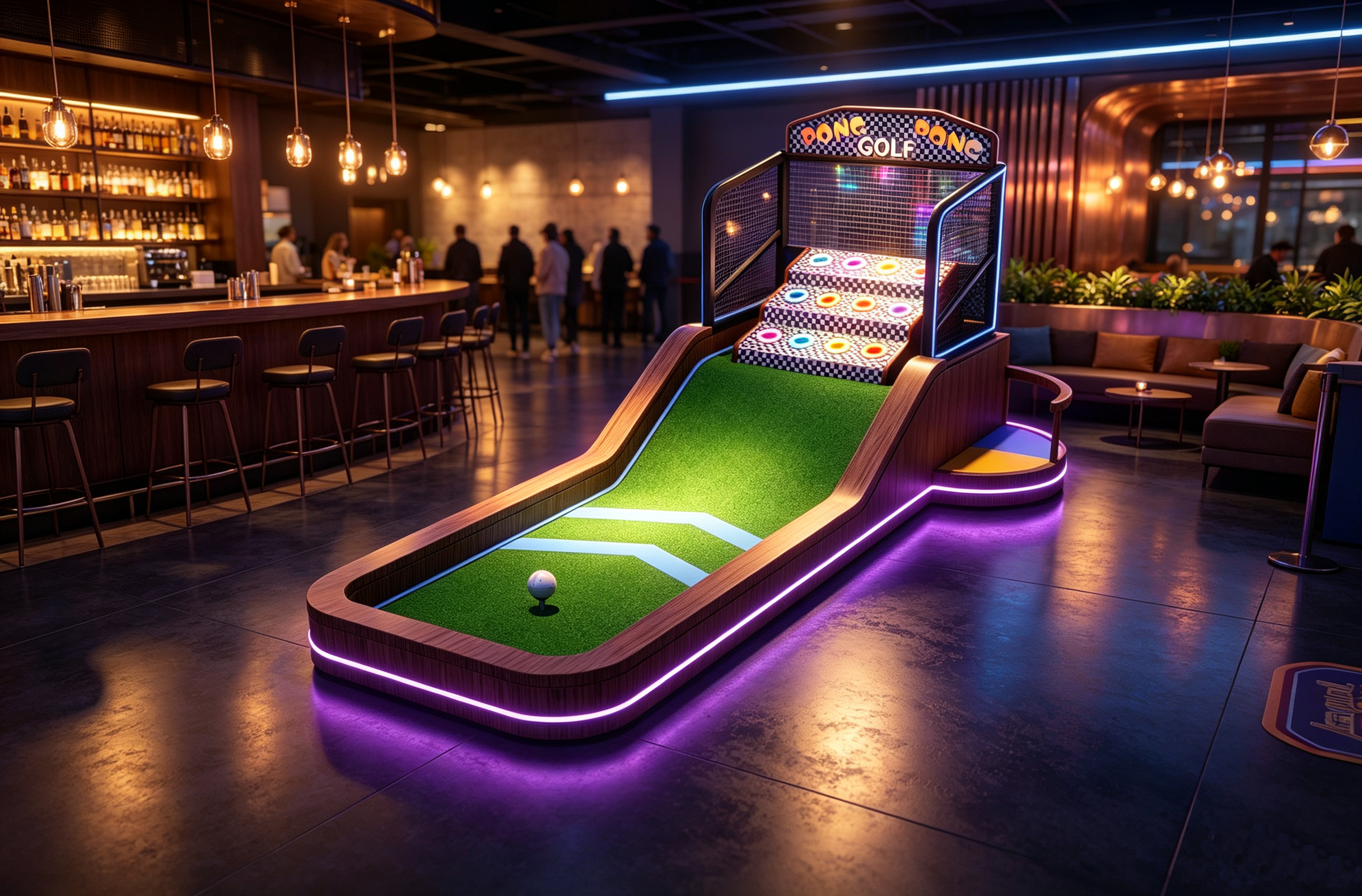
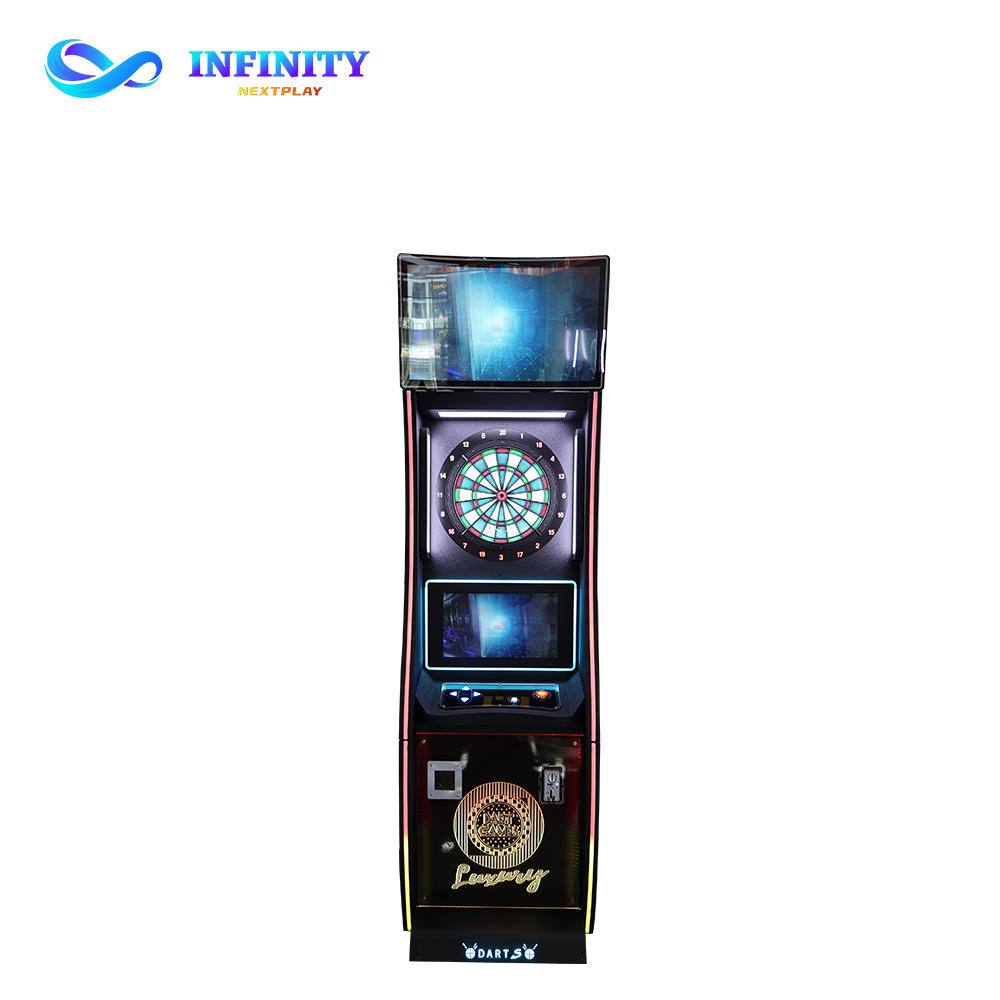
The published case work shows the ceiling of the same discipline: the cluster's venue case documents a +35% F&B lift once a simulator anchor took over the room's dwell, and the 15-square-meter bay work prices the blended bay-hour at about $38 with 14-20 months to payback. A bar running the daypart card, two league nights and the event calendar is building the same case with a better F&B line than either reference. The pricing mechanics transfer across formats - the mini golf rate-card architecture and the multisport zone planning guide (duckpin near $45 an hour) run the same published-anchor method. The bar-floor formats prove the transfer: the Beer Pong Golf Hole runs the same group-party logic at mini-golf prices beside the bays, and the online electronic dart machine carries its own league book between sim rounds - both priced from published anchors, both feeding the same $40 attach.
The tracking discipline is the last layer, and the published averages double as its dashboard. Per-visit value approaching $100 is the headline KPI - decompose it weekly into the session fee, the F&B attach and the rental line, and each decomposition localizes the problem: a $55 session fee with a $20 attach is a menu-pacing problem, not a pricing problem; a thin rental line on a three-player average is a rack and a script, not a discount. The NGF benchmark that more than 40% of customers exceed $70 per session gives the review a concrete bar: a venue whose visits mostly clear $70 is running the uplift the survey describes, and a venue whose visits cluster at the session fee alone is running a golf business with a bar attached - backwards.
Put the layers in order and the stack reads like a menu. Base layer: the daypart bay rates from the published card structure ($40-$60+ per bay-hour with F&B in the room). Second layer: the F&B engine - a menu and service pace designed around a just-over-one-hour session and a $40 attach, with club rentals at $10-$15 riding on every group. Third layer: the recurring book - one or two league nights at $199 a head per eight weeks. Fourth layer: the event calendar - corporate afternoons and buyouts at $400-$2,500-$6,000 tiers, aimed at the 57% weekday block. Fifth layer: the per-person arithmetic printed on every sheet, because the group of three to six players is how the bay rate becomes an easy yes.
Two handoffs finish the page. The model-choice question - whether to sell any of this by the hour at all, versus a monthly membership - is the sibling comparison on membership versus pay-per-play. And when the floor plan needs to make room for the kitchen queue, the party staging and the bay line together, the multisport zone planning work carries the layout frame, and the build starts from the free 3D layout design anchored on the Indoor AR Golf Simulator - the six-player format that keeps the per-person price honest while the kitchen does the rest.
The unmanned exception closes the page, because the whole stack inverts the moment the room has no staff. Without a bar, the 73% uplift is zero - there is no kitchen to pay - and the published unmanned cards ($18-$25 at the 24/7 self-serve venue) price accordingly, roughly half of the staffed urban median. The unmanned model earns by selling hours to nobody-else-open markets: the shift-worker pockets that one 150-location unmanned chain reported at 11pm to 3am near plants and hospitals. A bar reading that card as a competitive threat has misread its own model - the two sell different products at different hours, and only one of them has a kitchen.
The 73% uplift is not weather; it is engineered, and the published averages describe the engineering target precisely. The average session runs just over one hour - so the service pace has to fit a single visit: ordering at the bay, delivery inside the first half-hour, no course-by-course structure that assumes a two-hour table. The average attach is $40 against a $55 session fee - roughly two rounds of drinks plus shared plates at most venue menus - which sizes the offer: a short menu that a group of three can order from without deciding, priced so the natural order lands at the benchmark, not above it.
The margins say why the kitchen earns the effort: 65-75% gross on beer and spirits and 55-65% on food mean the attached $40 carries more gross profit than the session fee it rides on. The published survey adds the upside distribution - more than 40% of public-facility customers exceed $70 per session in total - and the caveat keeps it honest: the sample understates a real bar's attach. Design the pace, size the menu to the benchmark, print the $40 target next to the session fee on the staff sheet, and the uplift stops being a survey statistic and becomes the shift's number.
Start above the bare-bay market: the published guidance for commercial time with a bar and restaurant lands at $40-$60+ per bay-hour (21foregolf), against the $40 national median for all venue types. The bar then earns roughly 73 cents of food and beverage per dollar of bay time (NGF survey), so the bay is priced as the anchor of a per-visit value approaching $100 - not as a standalone hourly rental.
The NGF operator survey puts the average F&B spend at $40 per visit against a $55 session fee - a 73% uplift on bay time, taking total per-visit value toward $100. The survey's own caveat: its sample is 74% public golf courses, so a venue with a real kitchen and a cocktail program likely attaches more, and an unmanned bay with no F&B attaches none.
They are the cheapest recurring revenue on the menu: published league pricing runs $199 per player for an eight-week league (X-Golf) or $20-$30 per player per week, and a league night fills the hardest inventory in the business - weekday hours, which is where 57% of weekday bay-hours sit unsold. An EXAMPLE league of 16 players at $199 books $3,184 per eight-week cycle before anyone buys a drink.
Published anchors: a two-hour partial buyout runs $400-$800 and a full four-bay venue buyout runs $2,500-$6,000 (Tabski). Two to four events a month therefore adds $8,000-$40,000 a year on floor that evening demand already peaks against - events are priced as premium inventory, not as a discount for filling the calendar.
The published evidence runs the other way: the average customer spends $40 on food and beverage per simulator visit, and more than 40% of public-facility customers exceed $70 per session in total. The bay holds the group in one place for just over an hour - the dwell that bar economics wants - and the +35% F&B lift documented in the cluster case work is the same effect at venue scale.
Send the floor plan and the kitchen layout and we will return the bay line, the party staging and the six-player format check via the free 3D layout design, anchored on the Indoor AR Golf Simulator.