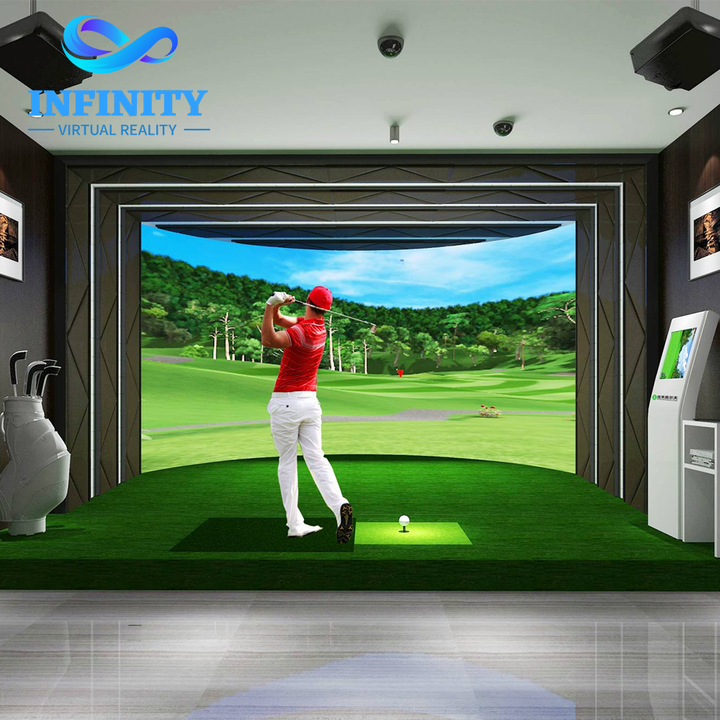
Indoor golf is the real sport played against a simulated world: you swing a real club, strike a real ball, and a room full of sensors and software answers with the shot's flight, bounce and score on a projected course. The experience runs in a bay of 10-15 square meters - a screen, a high-speed camera detector, a 4K laser projector, turf, netting - and it plays 18 holes in the time a front nine takes outdoors, in any weather, at any hour. For venues, that last clause is the business case: golf becomes an attraction that trades every day the doors open.
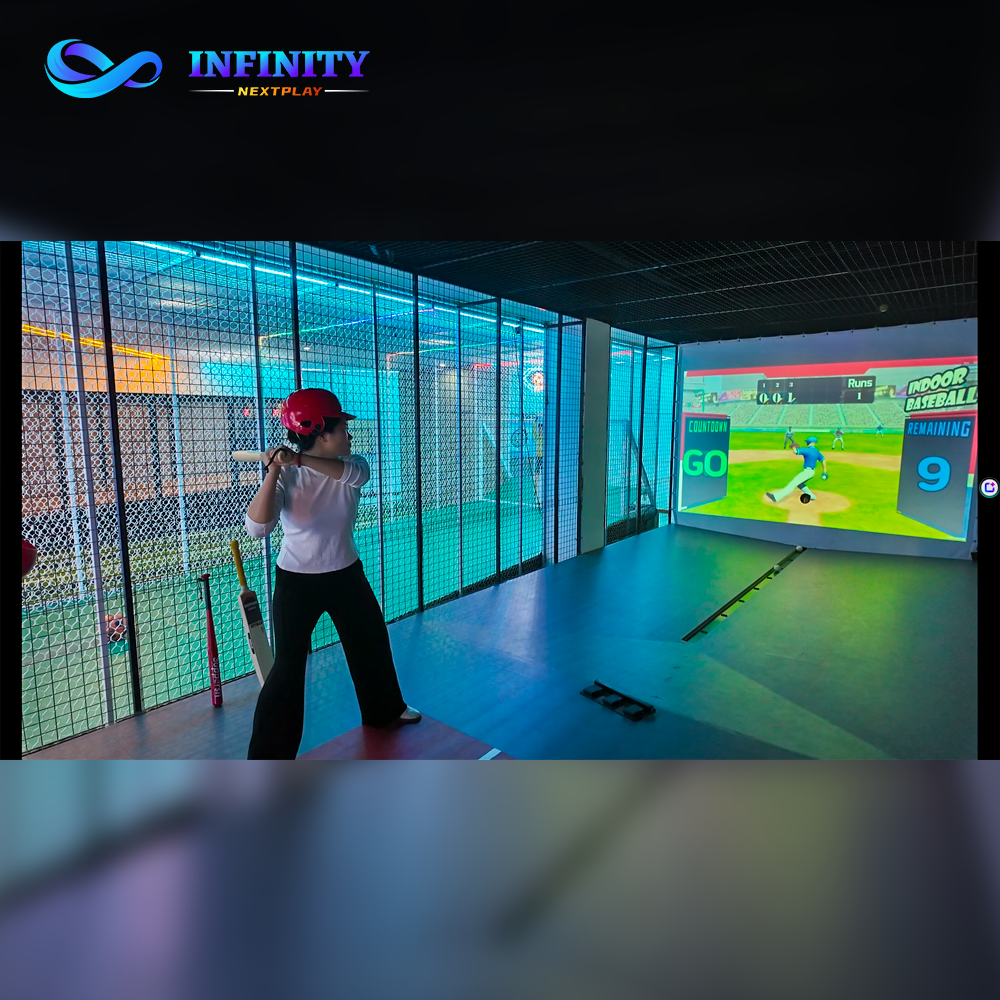
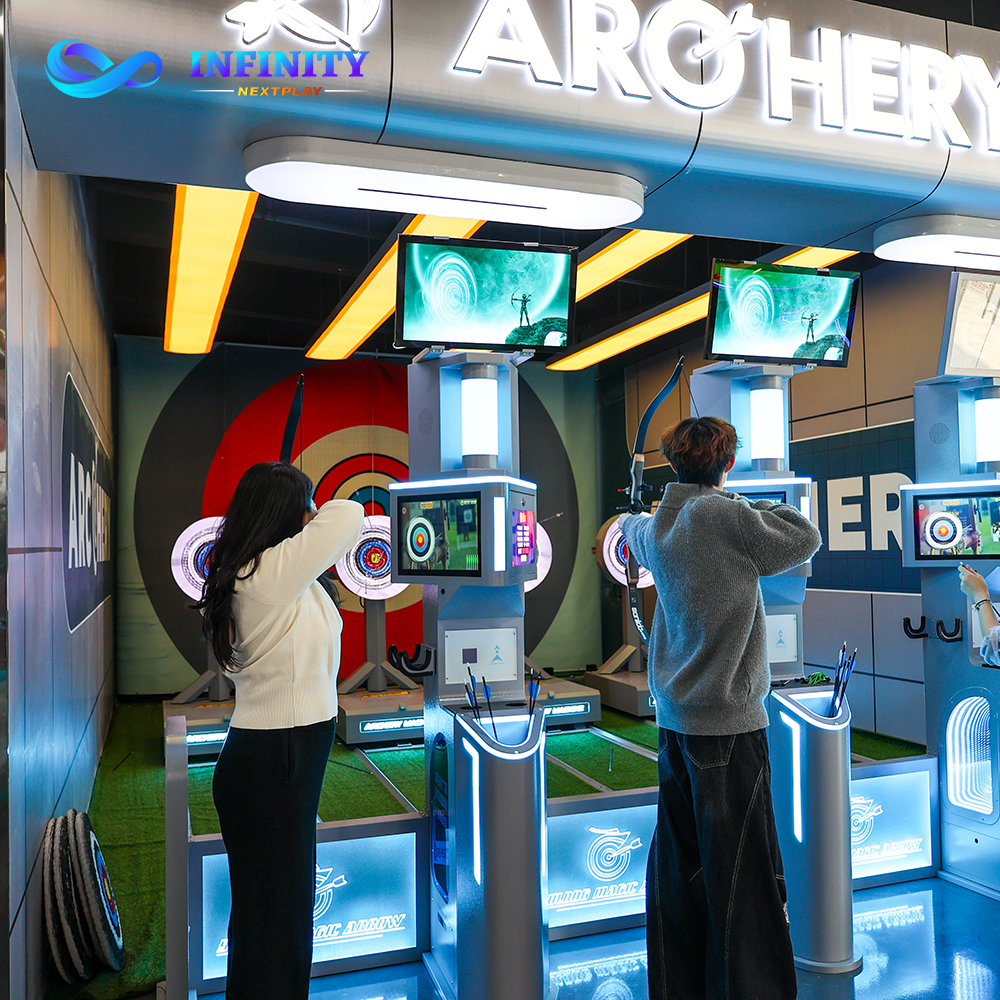
The format sits in the precision-bay family the published cluster tracks - batting bays, archery lanes, golf bays - screen-and-sensor builds on compact footprints with session pricing in the $12-25 published band. This guide explains the machine end-to-end for buyers: what the systems are, how a swing becomes a score, what the bay needs physically, and what the format earns in a commercial floor. No scenario math in this one - the published models already cover the zone economics; the questions here are the buyer's questions: how it works, who it serves, where it fits.
System one - the sensor layer. The shot is won or lost in the first millisecond after impact, which is why commercial bays use a high-speed camera detector: the camera reads ball speed, launch angle, spin rate and direction at the moment the ball leaves the face. The AR golf simulator in the NextPlay line pairs its camera detector with commercial-grade training software - the sensor layer is where accuracy lives, and it is the component that separates a training tool from a toy.
System two - the projection layer. A 4K laser projector renders the course onto the impact screen: bright enough for a lit room, sharp enough to read a green's undulation, instant enough that the image answers the swing within a second. System three - the software layer - turns the captured shot into simulated physics: flight, bounce, roll, and the scorecard that turns a bucket of balls into a round. Courses, driving ranges, closest-to-pin contests and shot-trainer drills all live in this layer; the software also carries the multiplayer formats that fill party calendars.
System four - the enclosure. Turf, netting, impact screen and sound treatment make a real swing safe indoors: the enclosure absorbs the shot, contains the miss, and keeps the bay conversation-friendly for the group watching. Buyers should price the bay as a system, not a sensor with accessories - the published cost-analysis pattern prices the fit-out lines around the core machine, and the enclosure is where cheap builds fail first.
| System | What it does | The buyer's check |
|---|---|---|
| Sensor layer | High-speed camera detector reads ball speed, launch, spin and direction at impact | Commercial/training grade? Published product spec: high-speed camera detector |
| Projection layer | 4K laser projector renders the course onto the impact screen | Bright enough for a lit room? Laser, not lamp |
| Software layer | Physics engine flies the shot; scorecard, contests, multiplayer formats | Training drills + party formats included? |
| Enclosure layer | Turf, netting, impact screen, sound treatment make a real swing safe | Priced as a system, not an accessory |
The loop is the product, so it is worth walking. Address: the player sets up on the turf with the projected hole ahead. Impact: the camera detector captures the ball in flight's first instant. Read: the system computes speed, launch, spin and face angle. Simulation: the physics engine flies the shot - over the water, against the wind, onto the green. Answer: the projected world shows the result and the scorecard updates. Total elapsed time from strike to answer: about one second. The loop repeats immediately, which is why a bay can move a foursome through nine holes in under an hour.
The session formats layer on top of the loop: driving-range practice for the training customer, full rounds for the golf faithful, closest-to-pin and longest-drive contests for groups and parties, and shot-trainer drills for the coaching program. The format mix is what turns a machine into a zone - the published zone pattern books singles, duos and scheduled events, and golf adds the league and the lesson, two recurring formats most attractions cannot sell.
The format serves four audiences with one machine. The training customer: adults and juniors drilling a repeatable swing on camera-read feedback - the commercial-training use the full set is built for, and the reason teaching pros anchor their programs on it. The social golfer: groups that want the round without the four-hour commitment. The party and corporate market: bay-side contests that need zero golf skill to enjoy. And the multi-activity guest: the published survey's 57% who prefer venues with variety - a golf bay chains into batting, archery and duckpin like a sentence in the same language.
Placement follows the precision-bay pattern: 10-15m2 per bay plus about 3 meters of ceiling for the driver swing, sited where the shared counter can run it - beside the batting and archery bays in an FEC, or as the anchor of a sports-bar build where the bay doubles as a stage. The published attraction-mix study shows the stacking logic at venue scale: golf books the weekday adult calendar, the party formats fill weekends, and the shared counter keeps staffing flat.
The economics close the buyer's picture, and the published anchors carry it: session pricing in the $12-25 precision-bay band, bays priced per bay-hour for groups, margins in the published 50-55% simulator-zone window, and a per-square-meter yield checked against the published $88-135/m2 ceiling. The published earnings model frames the venue-level destination and the published attraction-mix study shows where the bay sits in the stack - the full buyer math lives in those two published pieces, and the free 3D layout service turns it into a floor plan for your shell.
Indoor golf is golf played against a screen instead of a fairway: you hit a real ball with a real club inside a bay, sensors capture the shot the instant it lands, and software simulates the flight, the bounce and the hole on a projected course. A full commercial setup - like the AR golf simulator with its high-speed camera detector and 4K laser projector - runs the whole loop inside 10-15 square meters, in any weather, any hour.
Four systems in a loop: the sensor layer (a high-speed camera detector reads ball speed, launch angle, spin and direction at impact), the projection layer (a 4K laser projector renders the course onto an impact screen), the software layer (the physics engine turns the captured shot into simulated flight and score), and the enclosure layer (netting, turf and sound treatment that make a real swing safe indoors). The player swings; the room answers within a second.
Commercial-grade camera systems read the shot parameters that decide simulated flight - speed, launch, spin, face angle - closely enough that teaching pros use them for training, which is the standard that matters. The simulated course adds its own tolerances, so treat the score as a session scoreboard, not a handicap certificate. For venue economics, what matters is that players trust the read and come back for the rematch.
Plan 10-15 square meters per bay - enough for the swing arc, the screen standoff, the camera field and guest seating - per the published precision-bay footprint pattern. Ceiling height matters as much as floor: about 3 meters keeps a full driver swing safe. The free 3D layout service maps the bays into your shell.
The published precision-bay family books $12-25 per session, and golf sits naturally at a $20-40 half-hour bay rate on the scenario ladder for group play - priced per bay, not per player, so a foursome splits the ticket. The published earnings model checks the yield: the bay's per-square-meter result has to land inside the $88-135/m2 ceiling, and bay-based pricing is how it gets there.
Yes - as a precision-sport zone in the published mix pattern. Golf books steady adult, corporate and training traffic into weekday off-peak hours that impulse rides never fill; the published survey found 57% of players prefer multi-activity venues, and a golf bay chains perfectly with batting, archery and duckpin formats. The scenario economics mirror the batting model: bays at session pricing, margins in the 50-55% published window, payback inside the published compact-simulator window.
Send us your space and audience: we will spec the bay count, the enclosure and the software package through the free 3D layout design - anchored with the Indoor AR Golf Simulator Full Set and the precision-bay siblings: the Baseball Batting Simulator and the Digital Archery Simulator.