
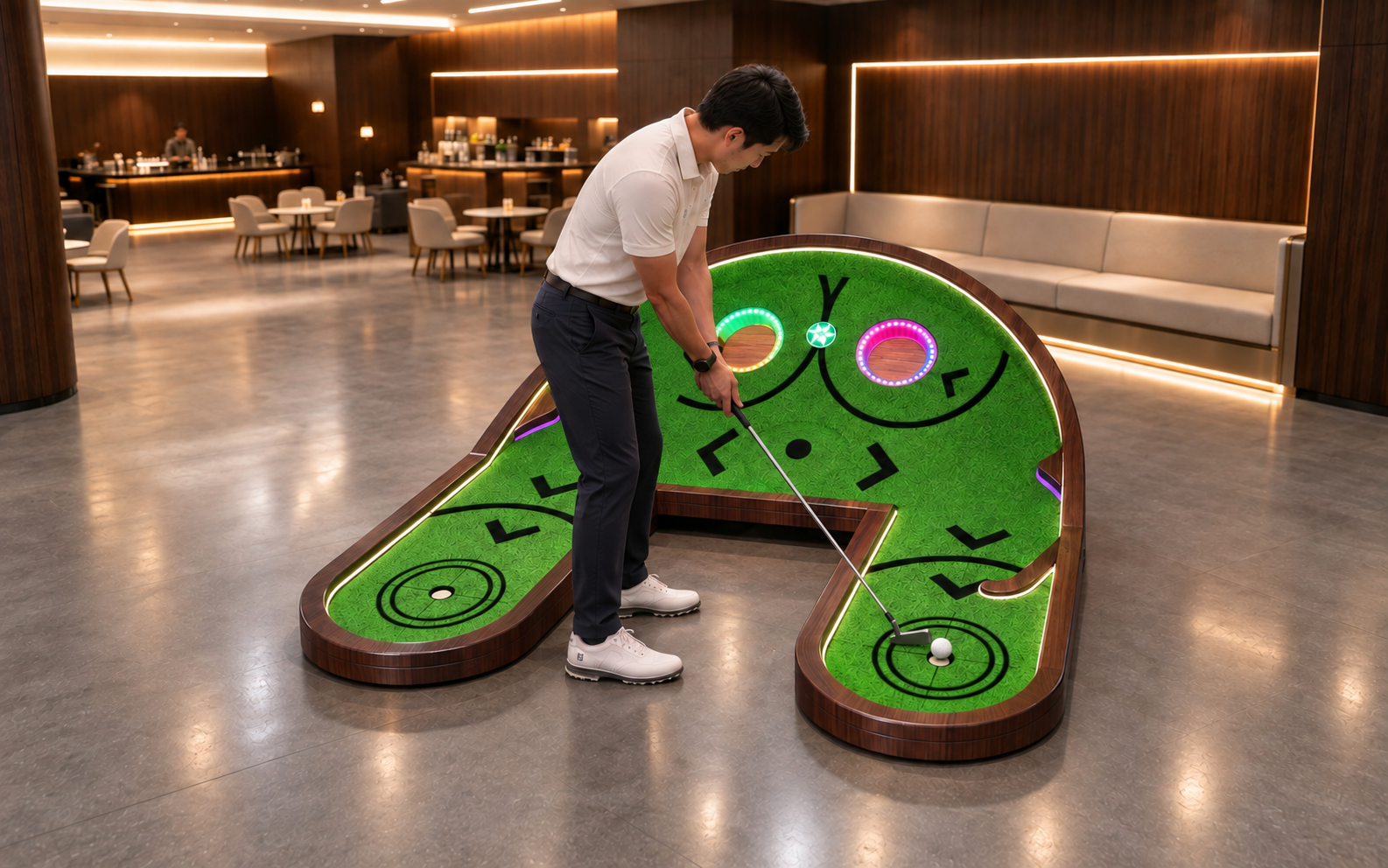
Every miniature golf hole ends on the same square metre of surface: the green. It is where the ball stops, where the score is written down and where most strokes are lost. This is how a green is played, how strokes become points, and what to look at before the putter moves.
The green is the last metre, and it keeps the score
On a miniature course the green is the smoothed end of the lane around the target. On a leisure course it is a patch of artificial turf with a cup in it. On a competition lane it can be a fibre-cement plate with a hole, a concrete slab with a cup, or a felt carpet with an octagonal target circle up to 2.4 metres wide. The obstacle gets the attention; the green decides the number on the card.
The difference matters to a player because the target is not always a hole. A felt-golf target is a marked circle, and the ball has to come to rest inside it rather than drop into anything. A miniature lane has a cup, usually with a liner and a return. Adventure golf, which the German federation groups under Minigolf Open Standard, mixes cups, rings and ramps from course to course.
The German Minigolf Sport Federation describes the standard lanes in enough detail to plan a round around them. The table below follows its own description; it is not a specification for every leisure course.
| System | Lane length and width | Playing surface | Target |
|---|---|---|---|
| Concrete | 12 m x 1.25 m (one drive lane up to 25 m) | Concrete slab with flat-iron or pipe borders | Cup |
| Miniature (fibre cement) | 6.25 m x 0.90 m | Fibre-cement plates in steel angle frames | Cup |
| Felt | 6-18 m x 0.80-0.90 m | Thin carpet-like felt on a solid base | Octagonal circle, 1.60-2.40 m wide |
| Open standard (MOS) | Set per course | Artificial turf, concrete or a mix | Cup, ring or hole by design |
Lane dimensions and targets as described by the German Minigolf Sport Federation (minigolfsport.de), read 24 October 2026. The target, not the obstacle, is what the score is measured against.
A player who knows which of these they are standing on plays the first hole differently. On a 6.25-metre miniature plate the whole green is one or two putts from the tee. On an 18-metre felt lane the first stroke is a positional shot, and the green only begins once the ball is past the obstacle.
How one hole is played, from tee mark to cup
Start from the tee mark. On a standard lane it is a 30-centimetre circle set in the middle of the borders, its centre 40 centimetres from the start of the lane. The ball is placed inside that mark, not behind it.
A player uses one ball on a lane. In competition a ball may not be swapped before the lane is finished, and the ball only moves through a stroke with the putter. Touching it by accident without addressing it is not a stroke; a stroke begins once the player has taken the stance and draws the putter back.
Every stroke that puts the ball in play counts. A ball that fails to cross the boundary line is played again from the tee mark, and the stroke stays on the card. A ball that leaves the lane after crossing the line is replaced where it left. A ball resting against a border or an obstacle may be lifted by hand and placed square to the border, and a ball that has stopped inside an obstacle structure is placed back in the direction it came from.
The hole is over when the ball comes to rest in the target, or when six points have been recorded. That second ending is the one beginners forget: you do not keep putting until it drops. You pick up, take the penalty point and walk to the next lane.
The score: one stroke, one point, seven at the top
Miniature golf is scored in strokes, and the German rules count them as points: every stroke is one point. If the ball has not reached the target after six points, one additional point is charged, so the highest score on a lane is seven. That is the whole arithmetic of a card.
The cap is not a punishment, it is a design. It stops one stuck ball from eating a group's evening, and it hands the player a decision: on a green that has already cost four strokes, a safe line to the cup is worth more than a brave one that may roll back.
Lanes are played in order, one to eighteen, and a group keeps the same playing order on every lane for the whole round. The card is a column per player and a row per lane. Two numbers matter at the end: the total, and the count of sevens. A round with three sevens and no other damage usually beats a round with one disaster and a string of twos, because the cap limits what a single green can cost.
Leisure courses often print a par instead. Treat that par as a house number: it describes the course, not the sport. The only figure that comes from a rulebook is the cap.
Five greens, and the read each one asks for
Most of the greens a player meets in a season fall into five shapes. The shape tells you where the ball will go before the slope does.
| Green | What you see | What the ball does | The play |
|---|---|---|---|
| Uphill | Cup above the ball | Slows early, then holds its line | Firmer stroke, line almost straight |
| Downhill | Cup below the ball | Accelerates, break grows at the end | Softer stroke, start it high of the cup |
| Side slope | One border sits lower | Drifts to the low side all the way | Start outside the cup on the high side |
| Bowl | Surface dips toward the middle | Curves in, then circles the cup | Enter from the high side with pace to pass the cup |
| Crown or ridge | A high line across the green | Slows on the ridge and falls away | Cross the ridge with pace and expect the fall |
Five shapes cover most miniature greens. The read changes the starting line, not the target.
The pattern is the same in all five: the ball leaves the putter face and then obeys the surface. The read is the estimate of how much. A player who reads the shape but not the slope will still be surprised by the speed.
Read the green before the putter moves
The PGA's glossary defines break as the amount a putt curves because of slope, grain and wind, and reading the green as the whole process of judging break and path. Both definitions are useful because they separate two jobs: finding the line, and choosing the speed that makes the line work.
Three looks are enough on a miniature green. First, stand behind the ball and look along the line at surface level; a low eye catches the tilt that a standing view hides. Second, walk to the side of the cup and look back across the last metre, because the lip sits in the surface and the surface around it is a contour map. Third, look at where the lane drains. Water leaves a lane at its low corner, which is a hint about the fall, not a rule.
Carpet and felt have a direction. The pile leans one way, and a ball rolling with the nap runs further than a ball rolling against it. On an older green the nap can change between lanes; on a new one it runs the length of the roll. Two lanes can therefore play differently even when the surface looks identical.
Obstacles add a fourth read. The exit of a tunnel or the mouth of a ramp sets the line the ball arrives on, and that arrival line decides which side of the cup you are putting from. Read the obstacle and the green as one surface, not two.

Pace is the other half of the read
A line without speed is a guess. The cup accepts a narrow band of pace: too firm and the ball horseshoes or runs a metre past; too soft and it dies on the last ten centimetres and takes the break with it.
The practical target is a putt that would finish about a hand's width past the cup if the cup were not there. That leaves a return short enough to be a formality and gives the ball enough speed to hold its line through the break. On a downhill green the same stroke runs further, so the target shrinks; uphill it grows.
Two putts is not a failure on a miniature green. The cap turns a three-putt into a seven, and a seven is the most expensive number on the card. The player who leaves the first putt below the hole and taps in has done the arithmetic better than the player who charges at it.
Use the border, the bank and the obstacle
A miniature lane is a closed box, and the borders are part of the shot. A ball can be banked off a side border to reach a cup tucked behind a block, and on some lanes that is the intended line rather than a trick.
A bank costs speed: part of the energy goes into the border instead of the cup. Aim it so the ball arrives with enough left to hold the line, and read the border as a slope of its own, because a border that is not vertical kicks the ball up or down.
The same arithmetic applies to the obstacle. A tunnel mouth that spits the ball out at an angle is a bank shot with a fixed angle, and the only variable left is pace. Learn one lane's exit once and it becomes the easiest green on the course.
What a fair green looks like from the operator's side
A green that reads true is a maintenance result, not a design accident. The cup liner sits flush with the surface; a liner standing proud rejects a correct putt. The surface around the cup is level enough that a ball placed a hand away does not roll; a dip at the lip turns every putt into a local read.
The nap needs a consistent direction across the course. On artificial turf the pile has a grain, and a green laid in mixed directions gives players two different games on the same lane. Rotate or replace worn sections before the fibre flattens into a track.
Print the cap on the card. A group that knows the lane ends at seven plays faster and argues less than a group still trying to hole out. The scorecard is the cheapest pace-of-play tool a venue owns.
Finally, watch where groups bunch. It is almost always the green of the hardest lane, not the obstacle. A bench, a ball return or a spare putter at that point costs less than a redesign.
Three lanes where the green carries the shot
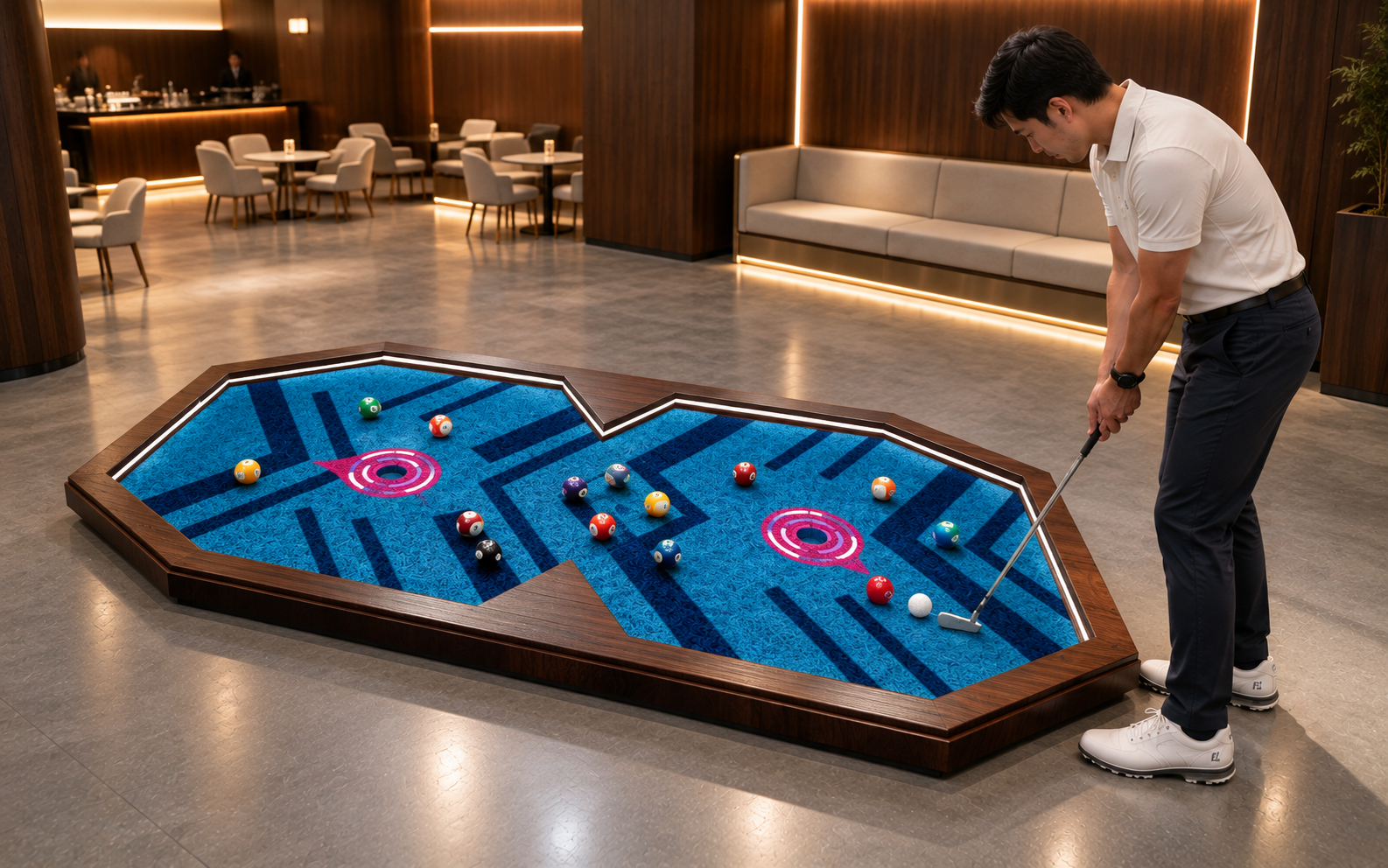
Billiard Golf Hole
The bank shot as a product. Angles are built into the borders, so the green asks for pace control rather than power.
View Details ›
Cyclone Spin Hole
A green that adds rotation after the ball arrives. The read starts at the obstacle exit and continues to the cup.
View Details ›
Curve Block Hole
A curved block in the middle of the lane. Play the ball into it and it leaves on a second line toward the cup.
View Details ›Is a miniature golf putting green the same as a practice putting green?
No. A practice green is a grass surface built for real golf balls and a full-length putter. A miniature green is a built surface with a cup, a ring or a target circle, played with a hard ball and a short putter. The read is similar; the speed and the ball are not.
Does a ball that rolls over the cup count?
No. The target is reached when the ball comes to rest in it. A ball that crosses the hole and stops behind it is still in play, and the next stroke is a putt back.
What is a good score for eighteen lanes?
There is no universal par, and the only figure that comes from a rulebook is the cap: seven points per lane, so 126 is the worst possible round. Most leisure courses print a par of two or three per lane. Judge your card against the one you were given, not against a number from another course.
Design a green that still reads true on day 400
Send a floor plan or a lane list and we will show how the greens, cups and target surfaces are detailed, and where a surface has to be replaced before it develops a track.