

Both games ask for the fewest strokes. Almost everything else differs: the surface, the distance, the equipment, the rule book and what a single mistake costs. Here is the comparison that matters to a player, and the parts that matter if you are building a course.
Two games, one word
Golf is a long game. A player carries a set of conforming clubs - no more than 14 under Rule 4 of the equipment rules - and covers a course hole by hole, from tee to green, against par.
Mini golf is a putting game on a built lane. The player takes one ball and a putter, faces an obstacle that everyone must pass the same way, and moves to the next lane when the target is reached or the points run out.
The two share a stroke, a target and a scoring habit. They do not share a surface, a scale or a rule book, and that is where most of the confusion in a search result comes from.
The shortest way to hold the difference: one is played on a surface that is maintained, the other on a surface that is manufactured. Everything from the build budget to the maintenance roster follows from that sentence.
The scale gap: one green against one lane
Start with area, because it explains almost everything else. A USGA study cited in green-building coverage puts the average American putting green at about 5,500 square feet, roughly 511 square metres. The federation's course atlas gives a concrete mini golf lane 12 m and an Eternit lane 6.25 m.
| Golf | Mini golf | |
|---|---|---|
| Playing area | A course of holes, played over long distances | A built lane: 12 m in the Beton system, 6.25 m in Eternit |
| Target | A hole in the putting green | A cup or target zone at the end of the lane |
| Obstacles | Natural hazards: bunkers, water, rough, trees | Built obstacles that every player passes the same way |
| Equipment | Conforming clubs and balls, at most 14 clubs (Rule 4) | One ball and a putter per player |
| Rule book | The Rules of Golf | Federation playing rules in competition, house rules in casual play |
| Scoring | Every stroke counts against par | Every stroke counts, but a lane is capped at seven points |
Lane lengths from the DMV Minigolf Atlas legend (checked 2026-10-19); green size from a USGA study quoted in green-building coverage.

Set those side by side and the ratio is brutal: at 12 m by about 1.25 m, one concrete lane covers roughly 15 square metres, so a single average green is the area of around 34 lanes.
That ratio drives the rest. A golf hole needs land, irrigation and turf care between tee and green. A mini golf lane needs a level substrate, a surface that can be replaced, an obstacle that survives daily use and a route for maintenance.
Why the scoreboard looks different
Golf counts every stroke against par, and a bad hole is simply expensive. Mini golf counts strokes too, but the rules cap a lane at seven points: once six points are recorded without reaching the target, the seventh is added and the group moves on.
That cap is a design decision, not a scoring quirk. It bounds the worst case on a lane, which is what lets a first-time group finish a course without holding the queue behind them.
Golf has no such ceiling. The distance between tee and green is the variable, and the player absorbs the cost of it - in strokes, in time and in lost balls.
What the two games demand from a venue
For an operator the difference is not sporting, it is logistical. Golf needs a landscape and a maintenance regime; mini golf needs a building or a plot, a fabrication plan and a cleaning routine.
| Requirement | Golf | Mini golf |
|---|---|---|
| Space | A landscape with room between holes | A hall or a plot, filled with lanes |
| Build trades | Earthworks, drainage, irrigation, turf | Lane bodies, surfaces, obstacles, electrics |
| Weather | Seasonal across most of Europe | Indoor formats run year-round |
| Staffing | Pro shop, marshals, greenkeeping | Counter, cleaning, ball return, parties |
| Revenue driver | Green fees, membership, food and drink | Per-round tickets, groups, event bookings |
A planning comparison, not a cost model: it lists what changes when a site chooses one format over the other.
That is also why mini golf appears inside family entertainment centres while golf does not. A course of lanes can sit next to a bar, a bowling lane or a party room, because the lanes are built objects rather than growing turf.
The maintenance logic follows the surface. The competition rules state that Miniaturgolf lanes may not be walked on as a matter of principle, so cleaning, ball retrieval and obstacle repair need access designed from the side or from above rather than by walking the lane.
Why the two formats price differently
A golf quote is dominated by land and by what happens under the grass: drainage, irrigation, shaping and the time the turf needs before it can be played. The clubhouse is a separate budget line.
A mini golf quote is dominated by fabricated objects: lane bodies, surfaces, obstacles, ball returns and the labour to install them. The building usually exists already, which is why a hall can be converted without waiting for a growing season.
That difference shows up in the first questions each supplier asks. The golf builder asks about soil, water and permits. The mini golf builder asks about floor level, ceiling height, the delivery route and where the power comes from.
Time and skill: what the rules actually bound
Golf time is a function of course length, group size and how often the ball leaves the fairway. Mini golf time is a function of lane count and points per lane, which is why a lane cap matters more than a stopwatch.
Skill works the same way. A golfer needs a repeatable swing across clubs and distances; a mini golfer needs a putting stroke and the ability to read one obstacle. That lower entry bar is the reason mini golf works for families, corporate groups and school trips in the same week.
It also explains why the two formats rarely compete for the same booking. A round of golf is the event; a mini golf course is usually one stop inside an evening out.
Where the words get mixed up
The confusion is mostly linguistic. "Golf" is used as a shorthand for the sport, for a simulator session and for a putting evening, and "mini golf" absorbs everything from a themed indoor course to a hotel putting green.
If you write about your own venue, name the format and the surface. A reader who books a golf simulator expecting an outdoor course, or a mini golf course expecting a driving range, becomes a refund request rather than a review.
The same discipline helps procurement. A supplier who answers "golf course" will quote fairway construction and turf; one who answers "mini golf" will quote lane bodies, surfaces, obstacles and a ball return. The words are not interchangeable on either side of the invoice.
The short answer to give a customer
Golf is played from a tee to a green with a set of clubs, over a course measured in hundreds of metres. Mini golf is played with one putter on a constructed lane of 12 m or 6.25 m, past an obstacle, with the score capped at seven points per lane. Same target instinct, different sport, different building.
Three lanes that show the miniature format
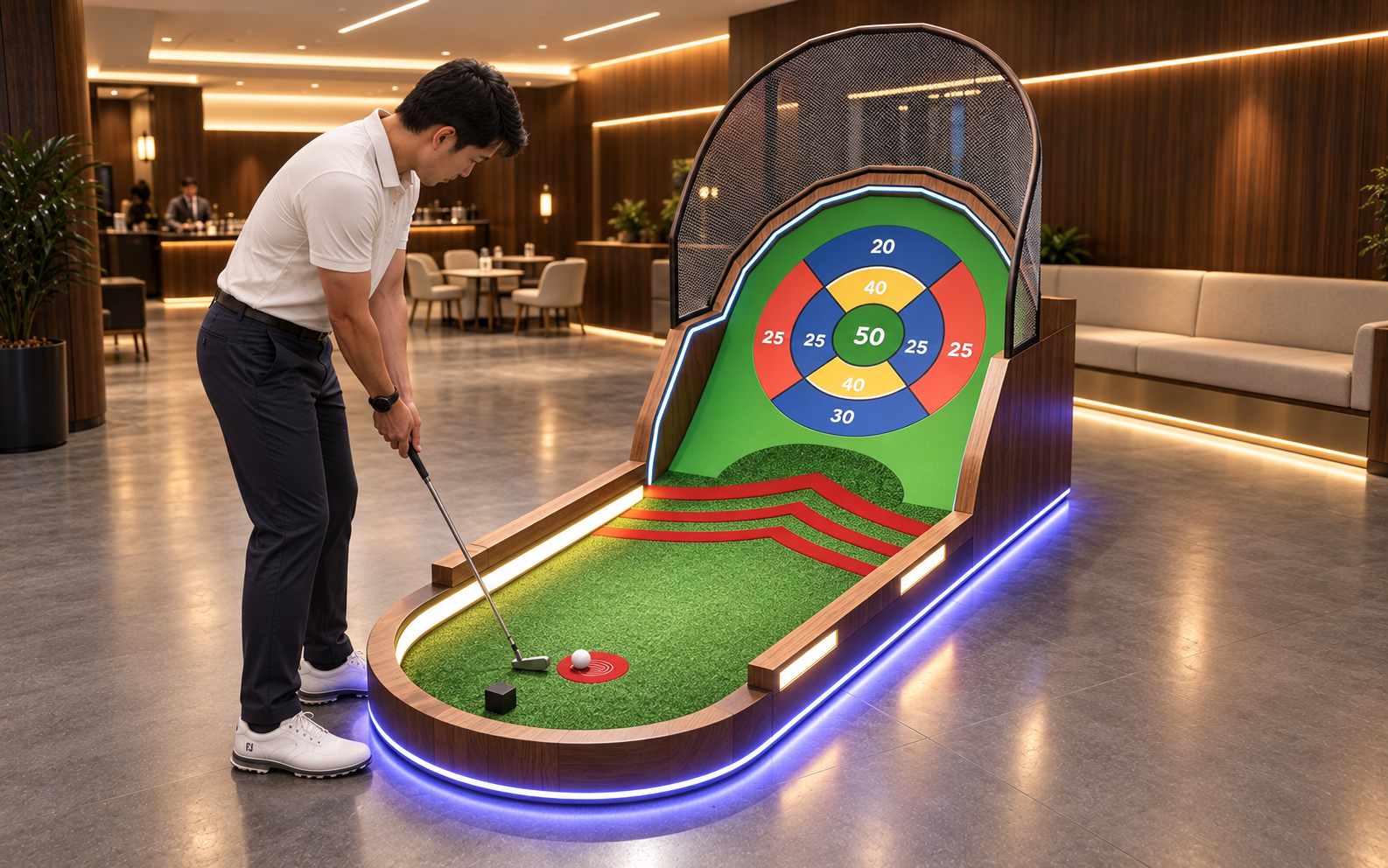
Golf Target Shooting Hole
Closest to the golf instinct on the list: line matters more than power. Ask how the target registers a hit and how a group resets it between rounds.
View Details ›
Curve Block Golf Hole
A curved block asks the player to read a slope the way a green does. Ask for the approach angle and how the block is anchored to the lane.
View Details ›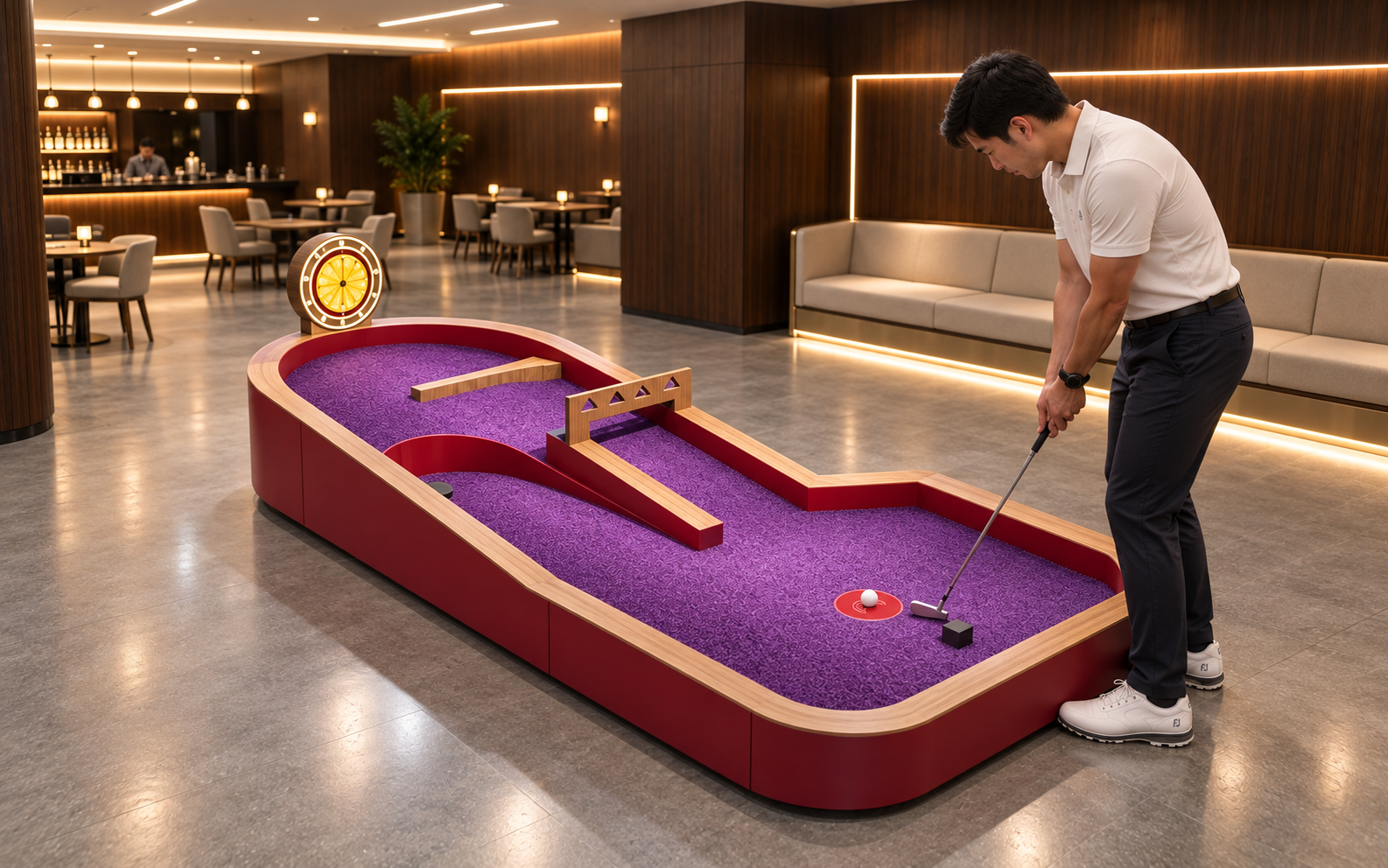
Balance Challenge Golf Hole
A balance lane turns a flat putt into a decision. Ask what happens if a player steps on the lane edge and how the surface is repaired.
View Details ›Is mini golf real golf?
No. It shares the putting stroke and the aim of using as few strokes as possible, but it has its own lanes, its own obstacles and its own rule book. A lane is a built surface, not a fairway.
Why is a mini golf lane capped at seven points?
The federation rules set a maximum of seven points at a lane, and the seventh is added once six are recorded without reaching the target. In practice the cap bounds the worst case, so a slow group cannot hold the course for long.
Can mini golf be played indoors?
Yes. The lanes are constructed rather than grown, so a building works as well as a plot - which is why indoor courses sit inside family entertainment centres next to bowling, arcades and bars.
Comparing formats for a site?
Send the floor plan or the plot size and the audience you expect. We reply with a lane layout, the system options and what each format would require from the building.