
When we designed the Seoul Cyber Arena, the market was saturated with standard PC rooms and sit-down consoles — we needed active, multiplayer virtual reality experiences that created physical and social gravity. In a city like Seoul, where technological infrastructure is incredibly advanced, youth and adult crowds are constantly exposed to the newest gaming technologies. Traditional internet cafes, widely known as PC bangs, have saturated every commercial block in metropolitan areas like Gangnam and Mapo. While these venues once generated reliable cash flows, renting out PC stations has degenerated into an aggressive race to the bottom, marked by razor-thin margins, high energy rates, and rapid depreciation of expensive graphic processing hardware. A typical 2,500 square foot venue cannot survive on simple seat rentals anymore; operators must evolve or face bankruptcy. Our vision was to completely replace the passive, sit-down gaming model with active, physical, and highly social virtual reality attractions. By partnering with NextPlay, we curated a multi-activity competitive socializing lineup, centered around the Free Roaming VR Arena 2.0, the Shooting Simulator Q4, and the VR Motorcycle Simulator. The combination of these advanced devices transformed our space into a premium socializing hub, earning $26,000 in monthly revenue and hitting full payback in just 6 months.
The traditional PC bang market in Seoul is suffering from acute commercial saturation. For the past two decades, local operators relied on a simple formula: lease a large basement or second-floor commercial space, install 100 to 150 high-end desktop computers, offer low-cost hourly rentals, and sell instant noodles and sodas to players who sit for hours playing competitive multiplayer online games. However, several critical macroeconomic and cultural shifts have disrupted this business model. First, the cost of commercial real estate in prime entertainment districts in Seoul has skyrocketed, making a passive model with low yield per square meter unsustainable. Second, players have grown tired of sitting at isolated desk stations staring at flat computer screens. They can play these same games on their high-end setups at home, or play mobile games on their smartphones during their daily commute. What they truly crave is active, physical, and shared experiences — an immersive form of entertainment that gets them out of their seats, moving their bodies, and laughing with friends. This is known as competitive socializing, and it represents the most profitable trend in the modern global hospitality and entertainment industry. By turning gaming into an active spectator sport, we can command premium ticket prices, attract lucrative corporate group bookings, and dramatically increase food and beverage sales.
When we analyzed our 2,500 square foot facility in Seoul, we knew we had to break away from the traditional sit-down arcade model. We needed to create a 'social gravity' that would draw diverse crowds — not just hardcore competitive gamers, but also couples on dates, corporate team building groups from nearby technology firms, and families seeking weekend fun. Traditional physical games like pool tables or cheap plastic dartboards were too passive and lacked the tech-forward, high-fidelity premium feel that modern South Korean consumers demand. On the other hand, heavy theme park rides were too expensive, required massive spatial heights, and had extremely high maintenance requirements. The sweet spot was a curated combination of NextPlay's modular virtual reality and digital target shooting simulators. These systems are extremely space-efficient, highly automated, and visually spectacular. They turn active gameplay into an intense, high-energy spectator event, drawing in crowds and keeping them in the venue longer, which in turn drives secondary food and beverage sales. By integrating these systems into a unified 'Play & Dine' layout, we completely turned our business around, shifting from an unstable, low-margin PC cafe to a high-yield, premium competitive socializing landmark in Seoul.
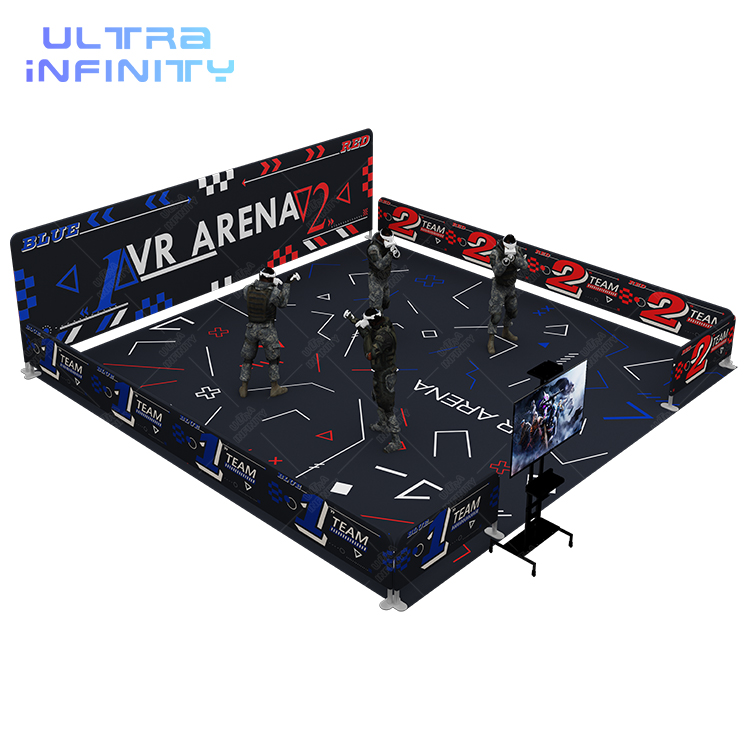
The undisputed anchor of our venue's social gravity is the Free Roaming VR Arena 2.0. This is not a standard VR arcade cabinet where a single player stands isolated inside a small metal cage, wearing a heavy headset and waving controllers at a virtual wall. Instead, the Free Roaming VR Arena 2.0 is an entire multiplayer virtual walking and shooting environment. It allows up to four players to put on ultra-lightweight, high-resolution VR headsets, hold precision haptic replica rifles, and walk completely unrestricted in a physical space. The system utilizes advanced inside-out tracking cameras and high-precision spatial positioning algorithms to map the physical room directly into the virtual battlefield. When a player walks, runs, crouches, or aims their weapon in the real world, their virtual avatar mirrors those movements instantly and with millimeter-level precision. This eliminates the sensory disconnect that causes motion sickness in lesser VR systems, providing a completely smooth, deeply immersive, and highly active shooting experience that feels incredibly realistic to players of all ages.
From an engineering and operational perspective, the Free Roaming VR Arena 2.0 is a masterpiece of commercial optimization. Traditional large-scale VR setups required heavy, expensive haptic backpacks that players had to wear like heavy armor. These backpacks were prone to overheating, required constant battery swaps, and were highly intimidating to casual players, children, and female customers. NextPlay's VR Arena 2.0 completely eliminates these heavy backpacks. The system utilizes lightweight, high-performance standalone headsets that stream graphics wirelessly from a local server. This drastically simplifies the onboarding process, allowing our staff to suit up a group of four players in less than two minutes. The haptic rifles are built from high-impact composite alloys, featuring localized vibration motors that simulate the physical recoil of firing different weapon classes. Because the tracking system is built directly into the headsets and haptic weapons, there is no need to mount expensive, delicate external optical cameras around the walls of the arena. This reduces installation complexity, minimizes the risk of hardware damage during high-intensity games, and ensures an incredibly low operational fault rate of less than 0.4% over hundreds of hours of continuous play.
The financial and social throughput of the VR Arena 2.0 is outstanding. A standard session lasts for 10 minutes, including a brief safety video and equipment fitting. We charge $15 per player per session. On a busy weekend, groups of friends and corporate teams book sessions back-to-back, keeping the arena operating at 90% capacity for 10 consecutive hours. This allows us to process 6 sessions per hour, generating up to $360 per hour from a single 400 square foot space. More importantly, because the arena is completely open and surrounded by secure, low-profile safety barriers, the physical movements and excited shouts of the players create a massive 'spectator effect.' Passersby and lounge patrons gather around to watch the action, record videos on their smartphones to share on social media, and queue up to play next. This organic marketing effect has driven a 4.5x increase in foot traffic to our venue, turning our active VR arena into a powerful customer acquisition engine that works entirely on autopilot.
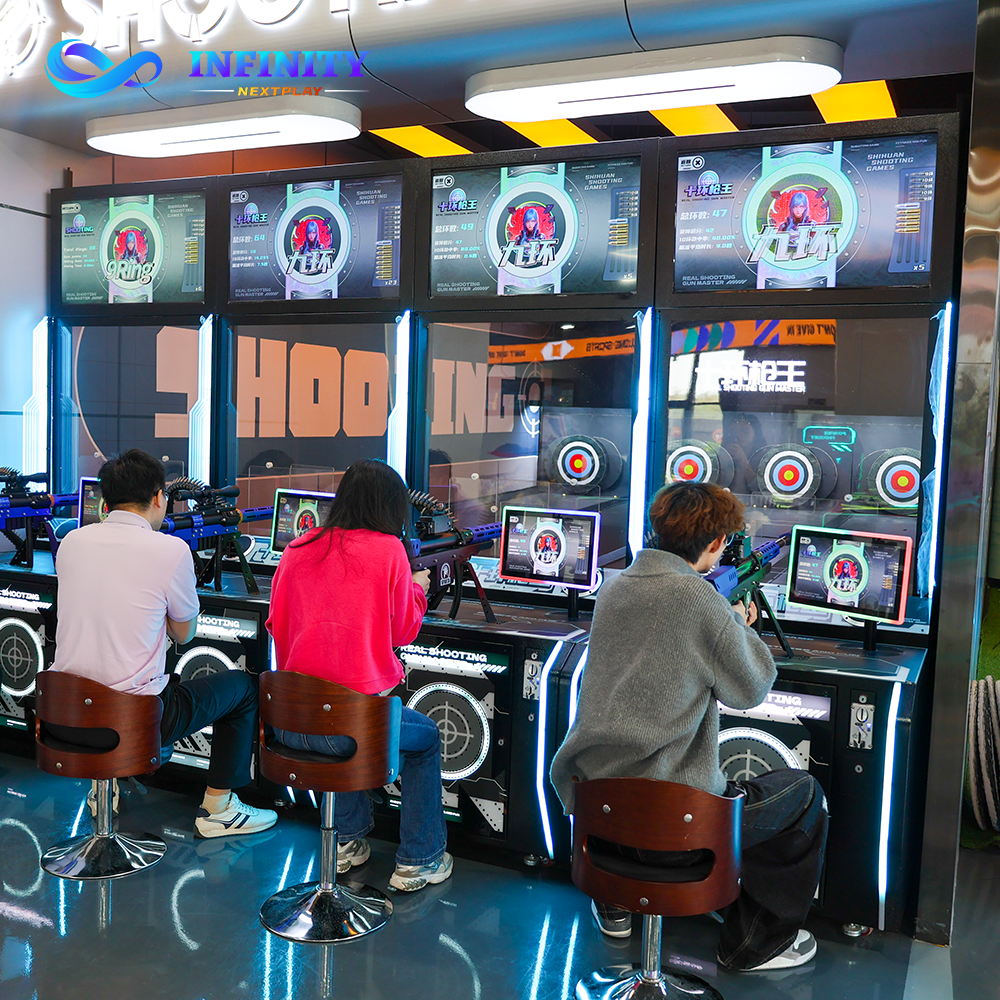
While the VR Arena 2.0 acts as our high-intensity, physical anchor, we needed a highly accessible, rapid-turnover attraction to engage corporate groups and casual competitive players. This is where the Shooting Simulator Q4 comes into play. The Shooting Simulator Q4 is a professional digital scoring shooting simulator that blends physical realism with advanced gamified software. It features a complete 10-ring target scoring system and moving targets projected onto a high-durability, acoustic impact screen. Players stand at a sleek alloy shooting counter and use highly realistic alloy replica firearms that fire precise, safe laser pulses. The system captures the impact of the laser on the screen using a high-speed camera sensor mounted on the ceiling, calculating the exact target rings hit with sub-millimeter precision. The visual feedback is displayed instantly on the screen with explosive graphical effects and a live, professional voice announcement that states the score of each shot, simulating the atmosphere of an elite Olympic shooting range.
The key feature that makes the Shooting Simulator Q4 an absolute powerhouse for corporate team building and private group bookings is its massive 39-inch Top Display. This display is mounted high above the shooting cabinet and serves as a real-time, high-visibility leaderboard. During corporate tournaments or friendly bar competitions, the top display projects live rankings, highlighting the names of the top shooters, their accuracy percentages, and their total points. This simple mechanical addition completely changes the social dynamic of the game. It is no longer an isolated shooting experience; it is a shared spectator event. Players do not just play once and walk away — they stand in groups, buy drinks, watch their coworkers or friends shoot, and immediately pay for additional sessions to reclaim their position at the top of the leaderboard. This highly addictive loop drives repeated play rates of over 60%, making the Shooting Simulator Q4 one of the highest-yielding attractions per square foot in our entire facility.
Dieter, our general manager, designed a highly successful corporate package that centers around Shooting Simulator Q4 tournaments. We charge local technology companies a flat fee of $1,500 for a three-hour exclusive venue rental, which includes organized target shooting competitions, craft beer taps, and gourmet Korean fried chicken. Because the Q4 simulator features a fully automatic bullet loading system and digital self-service payment terminal, it requires zero staff intervention to run. The tournament software manages the player brackets, score tracking, and winner announcements automatically. This allows our staff to focus entirely on serving high-margin food and beverages to the corporate guests, maximizing our operating margins. During weekends, we operate the Q4 simulator on a pay-per-play basis, charging $8 per 3-minute session. A single unit easily generates up to $7,000 per month in high-margin supplementary ticket sales, with negligible operating overhead.

To round out our active entertainment lineup and capture the high-velocity solo walk-in market, we integrated the VR Motorcycle Simulator. Motorcycle racing games have always been a staple of traditional arcades, but they are often limited by static cabinets and low-immersion screens. NextPlay's VR Motorcycle Simulator completely redefines this genre by mounting a physical, full-scale racing motorbike chassis onto an advanced 9D VR dynamic motion platform. When a player puts on the VR headset and grips the handlebars, they are instantly transported into the cockpit of a superbike, racing down neon-lit futuristic cityscapes or winding mountain passes at over 200 miles per hour. The dynamic motion platform tilts, sways, and vibrates in perfect synchronization with the physics of the virtual environment. When a player leans hard to the left to drift around a tight corner, the entire physical bike chassis tilts dynamically, providing realistic centrifugal force feedback that deceives the player's inner ear and creates an unparalleled rush of adrenaline.
The immersion of the VR Motorcycle Simulator is further enhanced by localized physical effects. Built-in high-speed fans project dynamic wind effects directly onto the player's face, simulating the sensation of acceleration. Leg sweep mechanisms and localized vibration motors in the seat and handlebars mimic the engine rumble and physical bumps of the road. Because the graphics are rendered in high-definition 360-degree VR, players can turn their heads to look at their competitors racing alongside them or check their side mirrors. The combination of intense speed, physical motion, and rich sensory feedback makes the VR Motorcycle Simulator a massive draw for teenagers, young adults, and racing enthusiasts. From an operational standpoint, it occupies a tiny footprint of just 40 square feet, making it perfect for maximizing the yield of narrow corners and alcoves that would otherwise be wasted. It is equipped with a self-service coin and card payment system, allowing players to start their races instantly without staff assistance. With an average game duration of 3 minutes and a ticket price of $10 per ride, this single simulator generates a reliable $5,000 in monthly revenue.
Let us dive deep into the real financial metrics and ROI analysis of our 2,500 square foot Seoul facility. Before we renovated our space with NextPlay's active gaming solutions, our monthly revenue from traditional PC cafe rentals hovered around $9,500, with operating expenses (primarily high electricity bills for 120 computers, high-speed fiber internet, and 24/7 staffing) eating up more than $8,000 of that amount. Our net profit margins were dangerously thin, and we had no capital to upgrade our aging computers. After decommissioning our PC stations and installing the VR Arena 2.0, the Shooting Simulator Q4, and the VR Motorcycle Simulator, our financial landscape transformed completely. Our monthly ticket sales from these three active attractions stabilized at a consistent $26,000. Because these advanced systems are highly automated and self-operating, we were able to reduce our staffing requirements from four full-time employees to just two, drastically reducing our monthly wage bill. Our electricity costs also fell by 40% because we were running three high-margin dynamic gaming setups instead of 120 power-hungry desktop computers. This combination of increased revenues and reduced operating expenses pushed our net profit margin to an outstanding 72%.
Furthermore, the high-energy active environment created by our NextPlay equipment had a massive cross-selling effect on our food and beverage sales. When groups of friends or corporate teams gather to play VR Arena 2.0 or compete on the Shooting Q4 leaderboard, they tend to stay in our venue much longer. The average dwell time of our customers increased from 45 minutes to an outstanding 2.5 hours. During this extended stay, they consume high-margin craft beers, customized cocktails, and Korean pub snacks, which added an extra $12,000 in high-margin monthly sales to our bottom line. With a total initial capital expenditure of approximately $120,000 for the NextPlay equipment, spatial custom renovation, and marketing launch, we generated enough net cash flow to fully recover our entire investment in exactly 6 months. Today, our venue stands as a highly profitable, self-sustaining competitive socializing business that continues to grow month-over-month.
To help other cyber zone operators, family entertainment centers (FECs), sports bars, and boutique venues achieve similar commercial success, we have outlined the exact 7-step implementation guide we followed during our transformation. First, conduct a thorough market and spatial feasibility analysis. Ensure your venue has at least 2,000 to 3,000 square feet of open space with a ceiling height of at least 9.5 feet to accommodate the high-angle projection systems of the Shooting Simulator Q4 and the physical movements of the VR Arena 2.0. Second, curate your equipment mix from NextPlay based on your target demographic. Combining a high-intensity physical anchor like the VR Arena 2.0 with a high-turnover competitive system like the Q4 target simulator and a high-impact solo simulator like the VR Motorcycle creates a balanced, highly lucrative ecosystem. Third, plan your electrical and physical infrastructure carefully. Install dedicated, stable 220V power lines for the motion platforms and set up proper ceiling mounts for the projectors and camera sensors.
Fourth, focus heavily on venue aesthetics and branding. We utilized NextPlay's signature luxury color scheme, combining deep navy blue (#0A1628) and charcoal backgrounds with vibrant copper-orange (#D4782F) accents and warm gold-yellow (#fbbf24) highlights. This premium visual style elevates the venue, distancing it from cheap, noisy arcades and making it attractive to high-spending corporate clients and couples. Fifth, simplify your operational workflows. NextPlay's software features intuitive touchscreens and self-service payment integration. Teach your staff how to suit up players, manage game queues, and perform simple daily hardware checks in under 15 minutes. Sixth, leverage the power of gamification. Host weekly shooting and VR tournaments, establish local leaderboards with physical rewards, and actively market these events to local businesses and student groups. Seventh, establish a proactive relationship with NextPlay's tech support. Their remote diagnostics and software update channels ensure that your systems remain 100% operational with fresh game content and seamless performance, securing your venue's long-term competitive edge.
The future of the retail entertainment and hospitality industry is active, physical, and deeply social. Traditional static entertainment concepts, such as movie theaters, standard bowling alleys, and desk-bound computer cafes, are rapidly losing their market appeal to high-tech, immersive experiences that cannot be replicated at home. Modern consumers are willing to pay a premium price for the thrill of physical competition, the wonder of high-fidelity virtual reality, and the joy of shared social achievements. By integrating NextPlay's modular competitive socializing solutions, venue owners can breathe new life into underutilized real estate, turning empty or unprofitable areas into high-margin revenue engines. The success story of our Seoul Cyber Arena proves that with the right combination of Free Roaming VR, gamified target shooting, and dynamic motion simulators, any local venue can transform into a dominant commercial landmark. Do not wait for your traditional revenues to decline further — take action today, consult with NextPlay's engineering team, and unlock the massive commercial potential of your space.
A: This complete multi-attraction lineup is incredibly space-efficient, requiring a total combined physical footprint of about 1,000 square feet, leaving plenty of room in a 2,500 square foot facility for traffic flow, seating, and food and beverage services. Specifically: the VR Arena 2.0 requires a flat, open area of 400 to 500 square feet; the Shooting Simulator Q4 fits perfectly into a 150 square foot lane; and the VR Motorcycle Simulator operates on a compact 40 square foot footprint, allowing operators to maximize their revenue per square foot in any commercial setting.
A: NextPlay's systems are designed with high-level industrial automation to minimize labor costs. Both the Shooting Simulator Q4 and the VR Motorcycle Simulator are equipped with digital self-service payment terminals and automated start/stop software, meaning they can run 100% unattended by staff. The Free Roaming VR Arena 2.0 requires a brief 2-minute onboarding process to help clients put on headsets and weapons, allowing a single general staff member to easily supervise and manage the entire gaming zone while also serving drinks or food.
A: Maintenance requirements are extremely low because of NextPlay's durable commercial-grade materials. Daily maintenance consists of a simple 5-minute visual check of the headset battery charges, cleaning the VR face cushions with sanitizing wipes, and checking the laser weapon calibrations. NextPlay provides comprehensive remote technical support, allowing their engineering team to perform remote diagnostics, fix software glitches, and push game content updates directly via the cloud to keep your systems running smoothly.
Unlock the full commercial potential of your space. Speak with our specialized NextPlay engineering team to receive a free custom 2D/3D physical layout design, detailed product pricing, and a bespoke ROI projection tailored to your venue's size and target market.