I opened a 3,500 sq ft mall entertainment anchor in March 2025 in a former clothing retail unit at a 1.2 million sq ft regional mall in Istanbul with one question: can a venue built around duckpin bowling and a shooting simulator — not a cinema, not a food court, not a VR arcade — generate enough revenue to justify $32,000 in equipment and build-out costs in a space that had been vacant for 14 months? By month five the answer was $21,200 a month, with 45% of revenue from walk-in mall traffic, 25% from birthday party packages, and 30% from after-school programs and weekend family packages. The format works because both activities are compact, low-staff, and appeal to the 12 to 35 demographic that malls are losing to online shopping. This is the full breakdown of how I built it, what it costs, and the three revenue models that make a mall entertainment anchor profitable.
A mall entertainment anchor needs three things that most mall attractions cannot deliver simultaneously: a footprint small enough to fit in a standard retail unit (3,000 to 5,000 sq ft), activities that turn 20-minute shoppers into 90-minute stays, and a revenue model that works on weekdays when mall traffic drops 60%. A 10-pin bowling alley requires 26-meter lanes that do not fit in most retail units. A cinema needs 20,000+ sq ft. A food court generates $0 in entertainment revenue. Duckpin bowling and a shooting simulator together solve all three problems: duckpin fits in 600 sq ft for 4 lanes, the Q4 simulator needs only 120 sq ft, and together they create a 90-minute stay that drives food court and retail sales for the entire mall.
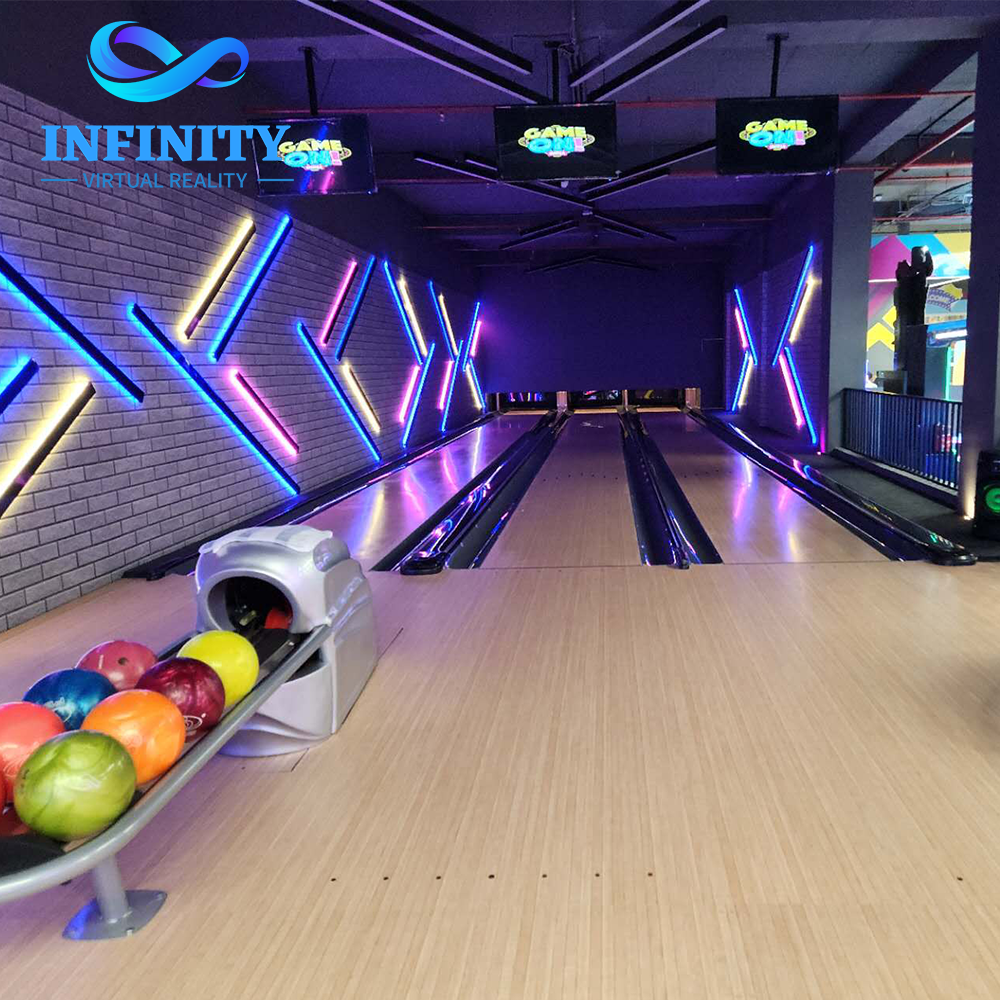
The Duckpin Bowling System is the anchor I recommend for malls because it uses smaller balls and pins than standard 10-pin, which means shorter lane lengths (18 ft vs 60 ft) and 60% less floor space per lane. That is the critical difference: a standard 10-pin lane is 60 feet long and does not fit in a retail unit, while a duckpin lane is 18 feet long and fits easily. My four duckpin lanes run 60 to 90 games per day at $6 per game per person, and the compact size means I can fit 4 lanes, a shooting simulator, a dart cabinet, and a party room in 3,500 sq ft — something that would be impossible with 10-pin.
Duckpin bowling uses the same scoring system as 10-pin but with smaller balls (4.75 inches vs 8.5 inches) and shorter, squatter pins. What makes it work for a mall is the space efficiency: four duckpin lanes fit in 600 sq ft, compared to 2,400 sq ft for the same number of 10-pin lanes. The smaller balls also mean no special footwear required — players bowl in their own shoes, which eliminates the shoe rental counter and staff. My four lanes generate $8,400 to $11,200 a month, with Saturday walk-in traffic accounting for $3,200 of that. The space-saving design also means the lanes run along one wall, leaving the center of the unit open for the shooting simulator and party space.
If your mall unit is larger and you want the authentic 10-pin experience, String Bowling is a good middle ground: it uses standard 10-pin balls and pins but with mechanical string pinsetters that cut maintenance by 60%. But for a mall where space is at a premium, duckpin is the right choice. The compact 18-foot lane length is the single biggest advantage — it lets you fit a complete entertainment venue in a standard retail unit.
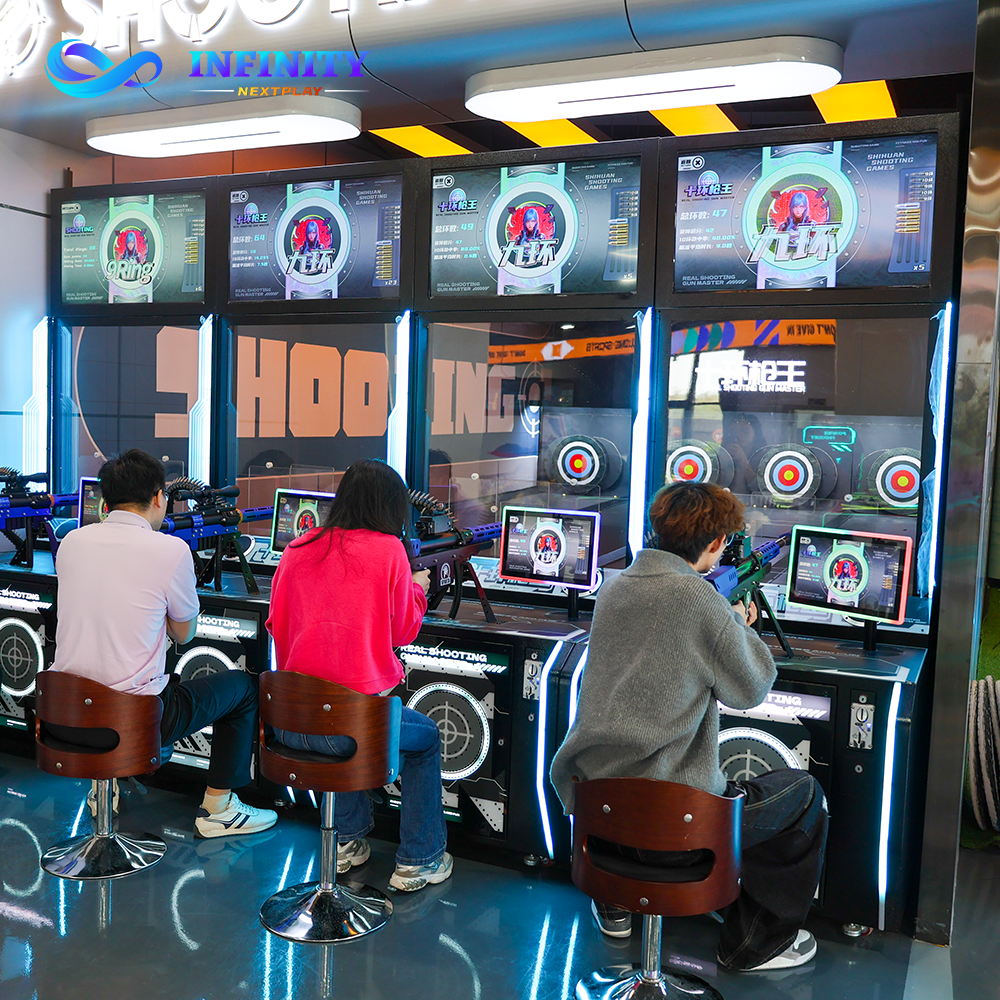
The Digital Scoring Shooting Simulator Q4 is the second anchor and it does something no other mall attraction can: it creates a competitive, repeatable experience that brings teenagers and young adults back weekly. The real-time leaderboard system displays scores on a public screen, which creates a "gaming arcade meets sports bar" atmosphere that the 16 to 28 demographic cannot get from online gaming. My Q4 generates $4,800 to $6,400 a month, and the Wednesday "Teen Night" (4pm to 8pm, $15 unlimited) accounts for $1,400 of that. The Q4 also requires only 120 sq ft, which means it fits in the dead space at the back of the retail unit that would otherwise be wasted.
The Q4''s digital scoring system is the key differentiator. Unlike a traditional shooting gallery, the Q4 tracks every shot in real time and rewards accuracy with points that players can redeem for free games. That creates a loyalty loop: a teenager plays once, sees their name on the leaderboard, and comes back the next week to beat their score. For a more family-friendly option that uses rubber bullets instead of digital simulation, the Automatic Rubber Bullet Shooting Machine C4 is a good alternative, but for a mall targeting teens and young adults, the Q4''s digital leaderboard creates the repeat-visit behavior that drives long-term revenue.
Space-saving 18ft lanes, no special shoes required. Ideal for malls, bars, and boutique venues.
View Details →Real-time leaderboard, rewards system. Built for teen and young adult repeat traffic.
View Details →I opened my mall entertainment anchor in March 2025 in a former clothing retail unit at a 1.2 million sq ft regional mall in Istanbul. The unit had been vacant for 14 months — the mall management was offering 3 months free rent to any tenant who could drive foot traffic. Build-out cost was $32,000 total: $14,400 for four duckpin bowling lanes with automatic pinsetters, $7,200 for the Q4 shooting simulator, $3,200 for the X4 dart cabinet, $4,800 for party room partitions and seating, and $2,400 for POS, signage, and a 2-month operating buffer. I staffed it with 2 part-time attendants at $640 per month each, covering the 10am to 10pm operating hours.
The breakthrough was the birthday party package. I offer a 90-minute party for 12 kids at $280, which includes 2 lanes of duckpin bowling for 60 minutes, 30 minutes in the shooting simulator, and a dedicated party room with table decorations. I book 8 to 12 parties per week, which is $2,240 to $3,360 per week from parties alone. The walk-in mall traffic generates $9,500 per month from shoppers who see the duckpin lanes through the storefront glass and come in spontaneously. The Wednesday "Teen Night" promotion (4pm to 8pm, $15 unlimited bowling plus shooting) adds $2,800 per month. By month 5, total revenue was $21,200 and payback was 9 months. The mall management renewed my lease at a 15% discount because the anchor drives food court and adjacent retail sales.
James opened in February 2025 in a 4,200 sq ft unit at an 800,000 sq ft shopping centre in Manchester. The space was previously a mobile phone shop that had been empty for 8 months. Total startup was $34,800: the same duckpin and Q4 setup plus an Electronic Dart Board Cabinet X4 as a third anchor, a larger party room that seats 20, and a small cafe counter selling snacks and drinks. He staffed it with 2 part-time attendants at $720 per month each.
James''s model is different from mine: he runs an "After-School Club" Monday through Thursday from 3pm to 6pm at $12 per child, which includes 30 minutes of duckpin bowling, 20 minutes on the shooting simulator, and 20 minutes on the dart cabinet. He averages 18 kids per day, which is $864 per week from the after-school program alone. Walk-in mall traffic adds $7,200 per month, and birthday parties on weekends generate $4,800 per month. The X4 dart cabinet adds $1,200 to $1,800 per month and gives kids a third activity during the after-school program. By month 6 he was doing $19,800 per month with 35% from the after-school club, 36% from walk-ins, 24% from parties, and 5% from the cafe. His payback was 10 months. The after-school club is the differentiator — it turns dead weekday afternoon hours into the most profitable time slot.
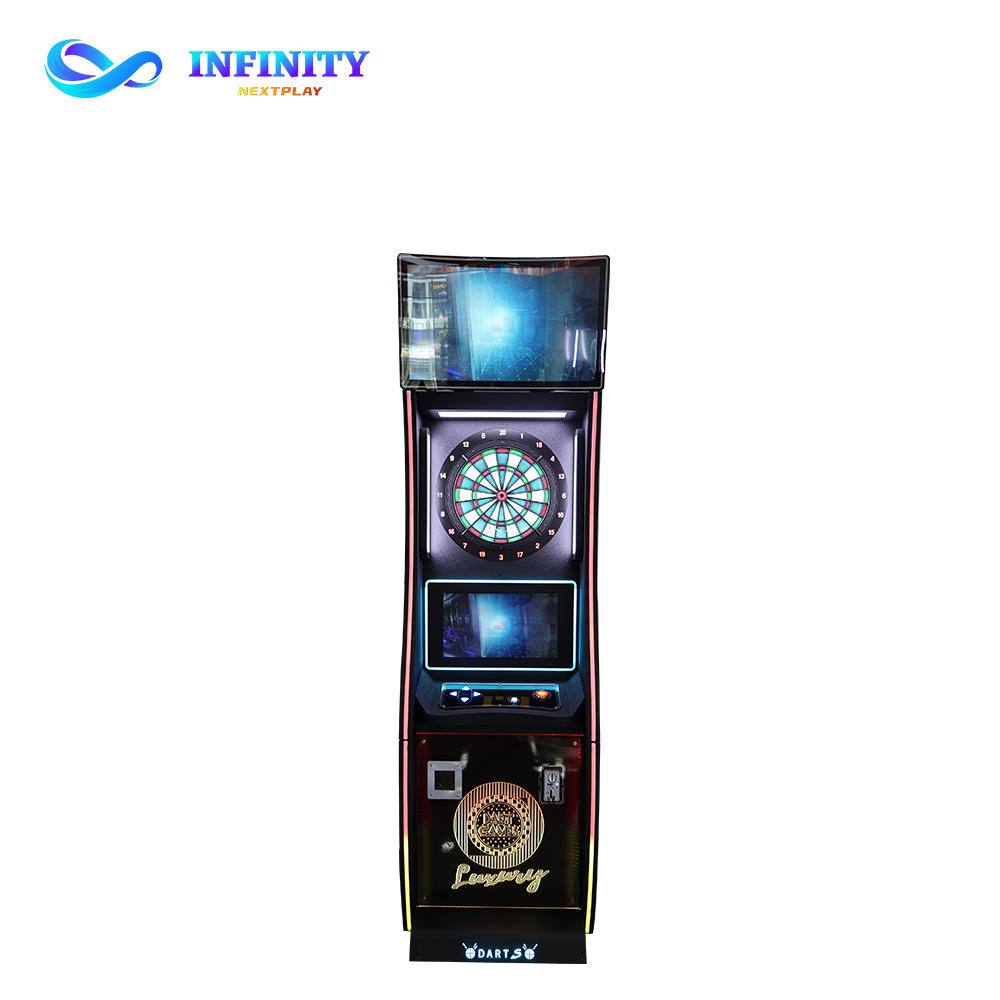
If your mall unit is 4,000 sq ft or larger and you run after-school programs or birthday parties, a third anchor machine solves the "what do the other kids do?" problem. James added the Electronic Dart Board Cabinet X4 in Manchester and it gave his after-school program a third activity station, which meant he could handle 18 kids per session instead of 12. The X4''s durable soft-tip design is safe for kids aged 8 and up, and the electronic scoring means no staff supervision is needed. He makes $1,200 to $1,800 per month from the dart cabinet alone, with zero additional staff.
For a mall that wants competitive online play for older teens, the Online Electronic Dart Machine X7 adds global matchmaking, but for a family-friendly mall venue the X4''s durability and soft-tip safety are a better fit. If budget is tighter, the Coin-Operated Dart Machine X5 is a mid-range option with card-reader readiness. For a mall targeting families and after-school programs, the X4''s cabinet design and soft-tip safety justify the price point.
Durable soft-tip target, electronic scoring. Ideal for family entertainment centers and after-school programs.
View Details →The minimum viable space is 3,000 sq ft: four duckpin lanes (600 sq ft), one Q4 shooting simulator (120 sq ft), one X4 dart cabinet (40 sq ft), a party room (400 sq ft), and open floor space for circulation and seating (1,840 sq ft). If you have 4,000 sq ft or more, add a cafe counter and expand the party room to seat 20. The key advantage of duckpin is that the 18-foot lanes fit along one wall, leaving the center of the unit open.
A VR Arena 2.0 requires expensive headsets that break and need sanitizing between uses. A cinema needs 20,000+ sq ft and only generates revenue from ticket sales. Duckpin and the Q4 are physical activities that do not break, need no sanitizing, and generate revenue from both walk-in traffic and party bookings. The 90-minute stay also drives food court sales, which mall management values more than a cinema that keeps shoppers in one room.
Yes, if your unit is 5,000 sq ft or larger. The Digital Archery Simulator A4 adds a premium activity that appeals to older teens and adults. For a smaller unit, the Q4 shooting simulator is a better fit because it requires less depth (10 ft vs 15 ft for archery). I would add archery only in a second expansion phase, after the core duckpin-plus-Q4 format is proven.
Two duckpin lanes, one Q4 shooting simulator, and a small party area. That is $16,000 in gear and $4,000 in build-out. Skip the third and fourth bowling lanes and the dart cabinet initially. The minimum viable format still generates $12,000 to $15,000 a month if you execute the birthday party package and after-school program correctly. The key is the business model, not the number of machines. A mall unit with great packaging and two machines outperforms a unit with five machines and no packaging every time.
Mall management cares about three things: foot traffic, dwell time, and cross-shopping. Bring data: show them that a duckpin-plus-Q4 anchor generates 90-minute stays (vs 20 minutes for retail), drives food court sales (35% of my customers buy food after playing), and fills vacant units that have been empty for 6+ months. Ask for 2 to 3 months free rent as a tenant improvement allowance. Management is increasingly open to entertainment tenants because traditional retail is contracting.
A mall entertainment anchor built around duckpin bowling and the Shooting Master Q4 is the highest-margin use of vacant retail space I have operated, and the birthday party package is what makes it work. Duckpin''s 18-foot lanes fit in standard retail units where 10-pin cannot, and the shoe-free design eliminates the biggest operational headache of traditional bowling. The Q4''s real-time leaderboard creates the repeat-visit behavior that turns one-time mall shoppers into weekly customers. Together they generate $21,000+ per month in a 3,500 sq ft space, with 45% of revenue from walk-in mall traffic that the unit would not otherwise capture. If you have a vacant mall unit and want to turn it into a revenue-generating entertainment destination, this is the format I would build today.
If you want a free layout for your specific mall unit — with lane placement, simulator positioning, party room design, and a revenue projection based on your mall''s foot traffic and demographic — I will build one for you. No commitment, no sales call, just a layout and a payback calculation you can take to your mall management.
Get a free layout for your mall unit. No commitment required.