I opened a 2,800 sq ft family entertainment center in a suburban Bangkok mall in November 2024 with one question: can a venue built around duckpin bowling and archery — not arcade games, not VR, not a trampoline park — generate enough family traffic to justify $24,000 in startup costs? By month five the answer was $17,200 a month, with 45% of revenue from birthday party packages and 30% from after-school programs. The format works because both activities are skill-based, safe for kids aged 6 and up, and naturally social: parents bowl while kids shoot archery, then they switch. This is the full breakdown of how I built it, what it costs, and the three revenue models that make it profitable.
A family entertainment center needs three things that most formats cannot deliver simultaneously: activities that are safe for children but engaging enough for parents, a footprint small enough for a suburban mall location, and a revenue model that works on weekday afternoons — not just weekends. Full-size 10-pin bowling requires 26-meter lanes and a minimum 4,000 sq ft footprint. Trampoline parks need 10,000 sq ft minimum and carry high insurance costs. Arcade game rooms have low margins and no recurring revenue. Duckpin bowling and archery together solve all three problems: both fit in under 3,000 sq ft, both are safe for ages 6 and up, and both support structured programming that fills weekday afternoons.
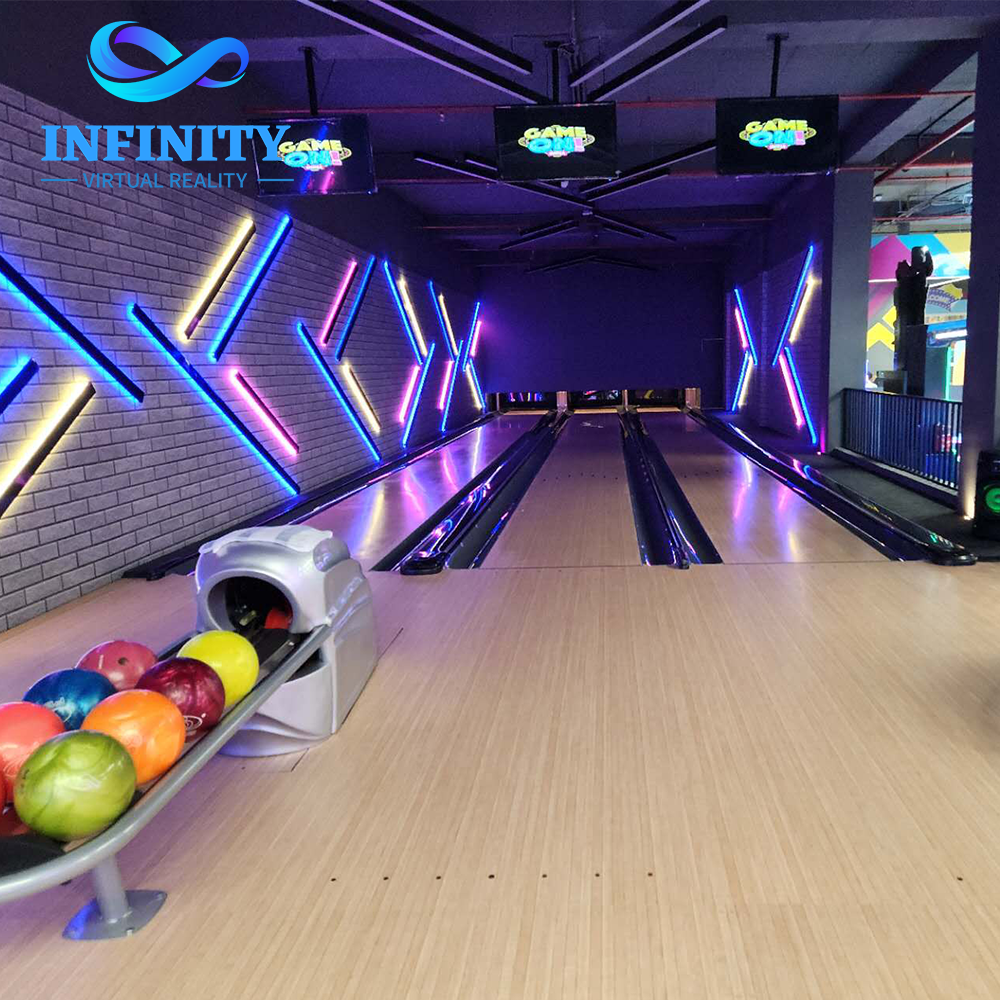
The Duckpin Bowling System is the anchor I recommend because it uses a compact lane design that fits in 60% less space than standard bowling. The smaller balls and pins are easier for children to handle, and each game takes only 10 minutes — perfect for a birthday party rotation where 12 kids need to cycle through in 90 minutes. My two duckpin lanes run 40 to 60 games on a Saturday at $6 per game per person, and birthday party bookings add $380 per event with a guaranteed 15 guests.
Duckpin bowling uses a shorter lane, smaller pins, and palm-sized balls that children can easily grip. What makes it work for a family FEC is the turn speed: a full game takes 10 minutes with 4 players, compared to 45 minutes for standard 10-pin. That means in a 90-minute birthday party slot, 12 kids can each bowl 2 full games — no one is standing around waiting. My two lanes generate $6,800 to $8,400 a month, with Saturday birthday parties accounting for $2,200 of that. The space-saving design also means I fit two lanes into 600 sq ft, leaving 2,200 sq ft for archery, a party room, and a snack bar.
If your venue is larger and you want a premium bowling experience, string bowling is an alternative that uses mechanical string pinsetters instead of traditional pin boys, reducing maintenance costs by 60%. But for a family FEC under 3,000 sq ft, duckpin is the right choice because of its compact footprint and kid-friendly ball size.
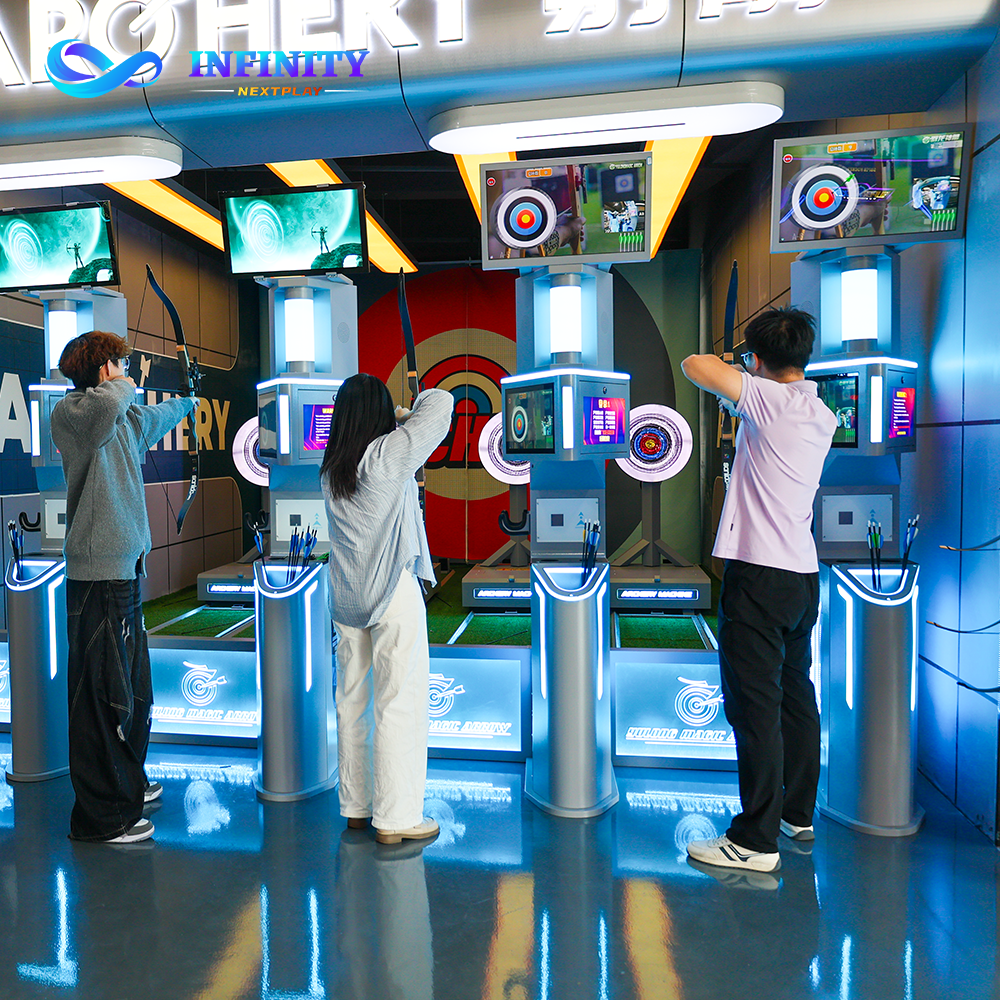
The Professional Arcade Archery System A6 is the second anchor and it does something no other product in the venue can: it teaches a real skill. The auto-voice scoring system calls out each shot, which creates an atmosphere that feels like a real archery range — kids love hearing their score announced. The dual display lets parents watch from the snack bar while their kids shoot, which is a key safety and comfort factor for family bookings. My A6 generates $4,800 to $6,200 a month, and the after-school archery program (Tuesday and Thursday, 4pm to 6pm) accounts for $1,600 of that.
The A6 is the larger model designed for high-volume FECs. If your venue is smaller (under 1,800 sq ft) or you are testing the concept first, the Digital Archery Simulator A4 is the compact version with adjustable track distance. For a family FEC targeting kids aged 6 to 16, the A6''s auto-voice scoring and larger display create a more immersive experience that justifies the higher price point.
Space-saving design, easy installation. Ideal for bars, hotels, boutique venues, and family FECs.
View Details →Auto-voice scoring, dual display. Built for large FECs and amusement parks with high family traffic.
View Details →I opened my family FEC in November 2024 in a 2,800 sq ft second-floor unit at Seacon Square, a suburban Bangkok mall with heavy weekend family traffic. Rent was $2,800/month — reasonable for a mall location with built-in foot traffic. I spent $24,000 total: $9,600 on two duckpin bowling lanes, $5,800 on the A6 archery simulator, $3,400 on a party room with tables, chairs, and decorations, $2,200 on a snack bar with a popcorn machine and drink station, and $3,000 on marketing, staffing, and a 2-month operating buffer. I staffed it with one full-time manager (me) and three part-time attendants at $380/month each for weekend and after-school shifts.
The birthday party model was the breakthrough. I charge $380 for a 2-hour birthday package for up to 15 children, which includes 45 minutes of duckpin bowling, 30 minutes of archery, 30 minutes in the party room for cake and food, and a trophy for the birthday child. I booked 8 parties in month 2 and 18 parties in month 5 — that alone is $3,040 to $6,840 in high-margin revenue. The after-school archery program adds $1,600/month (Tuesday and Thursday, 4pm to 6pm, 12 kids per session at $16/session). Weekend walk-in bowling and archery fill the remaining revenue. By month 5, total revenue was $17,200 and payback was 9 months.
Carlos opened in January 2025 in a 3,200 sq ft ground-floor unit in Alcobendas, a residential suburb north of Madrid with dense family housing. Rent was $2,200/month — lower than Bangkok, but the build-out was more expensive because of EU safety regulations for children''s entertainment venues. Total startup was $26,400: the same duckpin and A6 setup, plus a Coin Operated Dart Machine X5 as a third anchor for older kids and parents, a larger party room that seats 24, and a full snack bar with hot food. He staffed it with two part-time attendants at $350/month each.
Carlos''s model is different from mine: he runs an after-school program Monday through Friday (3:30pm to 6:30pm) that combines archery instruction, duckpin bowling, and homework time in the party room. He charges $180/month per child and has 34 enrolled kids — that is $6,120 in predictable monthly revenue before a single walk-in. Birthday parties on Saturdays add $4,560/month (12 parties at $380), and Sunday walk-in play generates $5,720. By month 6 he was doing $16,400/month with 37% from the after-school program, 28% from parties, and 35% from walk-in. His payback was 10 months. The X5 dart machine adds $1,200 to $1,800 a month and gives parents something to do while their kids are in the after-school program.
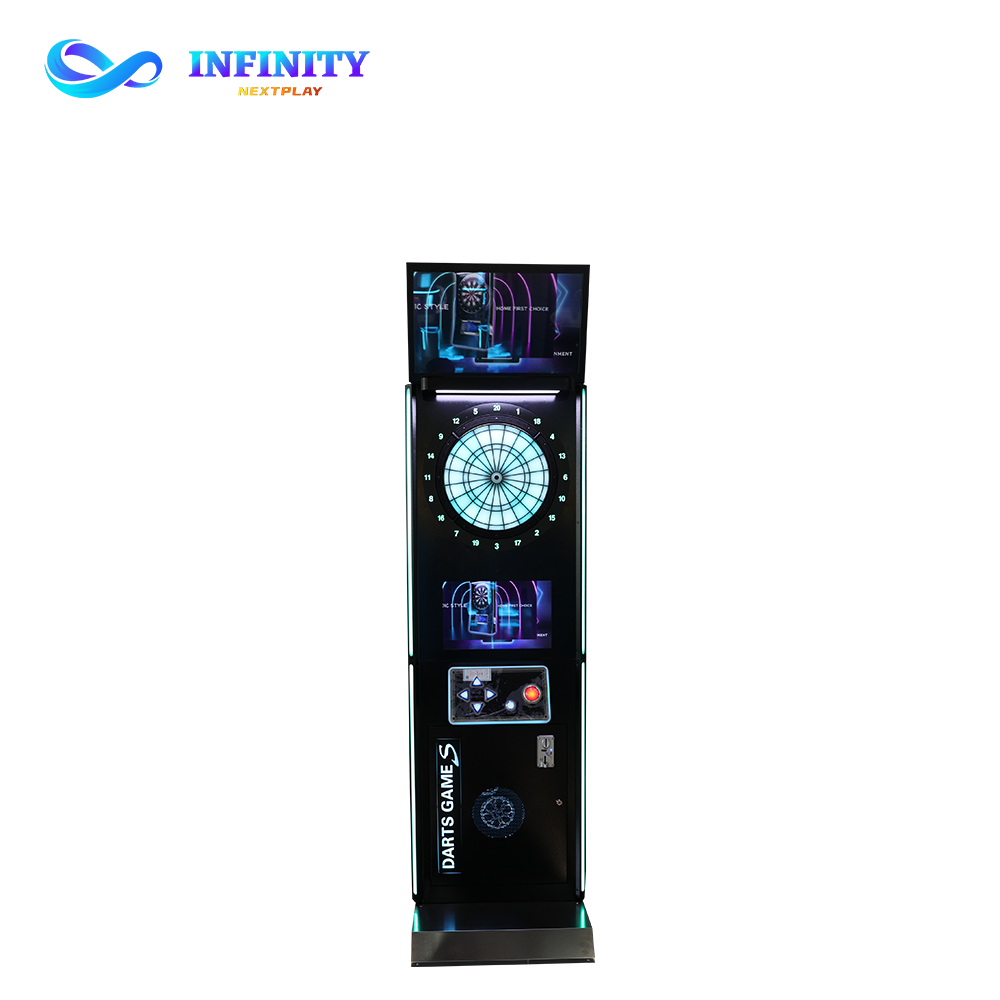
If your venue is 3,000 sq ft or larger and your after-school program includes kids aged 10 and up, a third anchor machine solves the "what about the older kids?" problem. Carlos added the Coin Operated Dart Machine X5 in Madrid and it gave his after-school program a third rotation station, which let him enroll 34 kids instead of capping at 24. The X5''s coin-operated, card-reader-ready system also generates walk-in revenue from parents waiting during after-school sessions — he makes $1,200 to $1,800 a month from the dart machine alone, with zero staff time required.
For a premium venue targeting competitive teens and adults, the Online Electronic Dart Machine X7 adds global online matchmaking, but for a family FEC the X5''s simplicity and coin-operated model are a better fit. If budget is tight, the Electronic Dart Board Cabinet X4 is the most affordable option and is specifically designed for family entertainment centers.
Card reader ready, coin-operated. Ideal for amusement parks, gaming zones, and family FECs. Zero staff time required.
View Details →Start with local parent WhatsApp groups and school community boards. Every parent knows 10 to 15 other parents with kids the same age. Offer a 10% early-bird discount for bookings made 3 weeks in advance. Once you host 5 good parties, word-of-mouth takes over — parents book the same venue their child attended as a guest. My venue now gets 60% of party bookings from referrals.
Duckpin bowling works for ages 6 and up — the small balls fit child hands. Archery with the A6 works best for ages 8 and up with parental supervision, because the bow requires some upper-body strength. For the after-school program, I accept ages 7 to 14, and I group them by age: 7 to 10 in one session, 11 to 14 in another. The dart machine (if you add one) is best for ages 10 and up.
One full-time manager (you) and two to three part-time attendants. The duckpin and A6 are self-running — no staff needed to operate the machines. The attendants'' job is to supervise kids, reset lanes, run the snack bar, and manage birthday party rotations. I pay $380/month per attendant for 20 hours per week, which covers all weekend and after-school shifts.
Yes, but be careful with age range. The Digital Scoring Shooting Simulator Q4 is better suited for teens and adults, so it does not fit a pure family FEC targeting ages 6 to 14. If your venue targets families with older kids (10 to 16), the Automatic Rubber Bullet Shooting Machine C4 is a more family-friendly option with rubber bullets and moving targets. I would add it only after the core duckpin-plus-archery format is profitable.
One duckpin lane, one A4 archery simulator, a party room, and a snack counter. That is $11,000 in gear and $4,000 in build-out. Skip the second duckpin lane and the A6 initially — you can upgrade once the format proves itself. The minimum viable format still generates $9,000 to $11,000 a month if you execute the birthday party and after-school models correctly. The key is not the number of machines; it is the programming. A venue with great programming and two machines outperforms a venue with five machines and no programming every time.
A family entertainment center built around duckpin bowling and the Archery Simulator A6 is the highest-margin family venue format I have operated, and the birthday party angle is what makes it work. Duckpin''s fast game rotation solves the birthday party throughput problem that kills standard bowling venues. The A6''s auto-voice scoring creates a skill-learning experience that parents value for after-school programs. Together they generate $17,000 a month in a 2,800 sq ft space, with 45% of revenue from birthday parties that book weeks in advance. If you have a space in a suburban mall or residential neighborhood and can build a party room, this is the format I would build today.
If you want a free floor plan for your specific space — with machine placement, party room layout, and a revenue projection based on your local family density — I will build one for you. No commitment, no sales call, just a layout and a payback calculation you can take to a landlord.
Get a free floor plan for your space. No commitment required.