“I have $20K and a 1,200 sq ft room. Can I open something that competes with the bowling-and-darts crowd without buying a lane?” That is the exact text I got from a client in Krakow last fall. He did not want a spec sheet. He wanted to know if precision sports — archery and shooting — actually pay.
Short answer: yes, and you can do it for well under $20K. The combo I keep recommending is a Digital Archery Simulator A4 plus a Shooting Master Q4. Together they form what I call a “combat sports zone” — two attractions built around aim, focus, and leaderboards. That Krakow room now clears about $14,000 a month. Here is the full breakdown, with the real numbers.
Most operators think of archery and shooting as two separate worlds. In a venue, they are the same product: precision entertainment. Both are skill-based, both reward repeat practice, and both naturally produce a leaderboard. That matters because a leaderboard is the single most powerful retention tool in casual entertainment — it turns a one-time try into a weekly habit.
When I plan a combat sports zone, I put the Digital Archery Simulator A4 and the Digital Scoring Shooting Simulator Q4 side by side. A guest who loves the bow often tries the rifle next door, and vice versa. You are not selling two machines; you are selling a “combat sports” identity for your venue. That identity is what lets you charge a premium session price and run tournaments.
The Krakow client called his corner “The Range.” Within six weeks it had its own Instagram hashtag and a Friday-night league. That is the goal: not just revenue per machine, but a community that owns a piece of your floor.
Adjustable track distance and dual-screen play. Safe, indoor, no real arrows. Built for sports bars and clubs that want a skill game with a competitive edge.
View Details →Real-time leaderboard and rewards, team-building friendly. Digital scoring means zero ammo, zero range safety overhead, pure repeat-play revenue.
View Details →Here is what surprises first-time buyers about a digital archery simulator: it is not a toy. The A4 uses a real bow with a safe, sensor-tracked arrow and an adjustable track distance that mimics 10 to 40 meters. Two players stand at dual screens and compete on accuracy and speed. Because it is digital, there are no loose arrows, no range safety certification, and no staff training beyond “hand them the bow.”
That safety-and-staffing story is exactly why I put archery in bars and clubs. A traditional archery range is a liability nightmare. A digital simulator is a video game you stand up to play. The Krakow client ran it inside a bar with zero additional insurance beyond his standard liability policy. His busiest hours were actually the slow ones — Tuesday and Wednesday — because the archery league gave regulars a reason to show up midweek.
And the repeat-play economics are the point. A guest who scores 80 on their first try comes back to beat 90. The machine does not care how many times they play; each session is a fresh charge. That is the difference between a one-time novelty and a subscription-like revenue line.
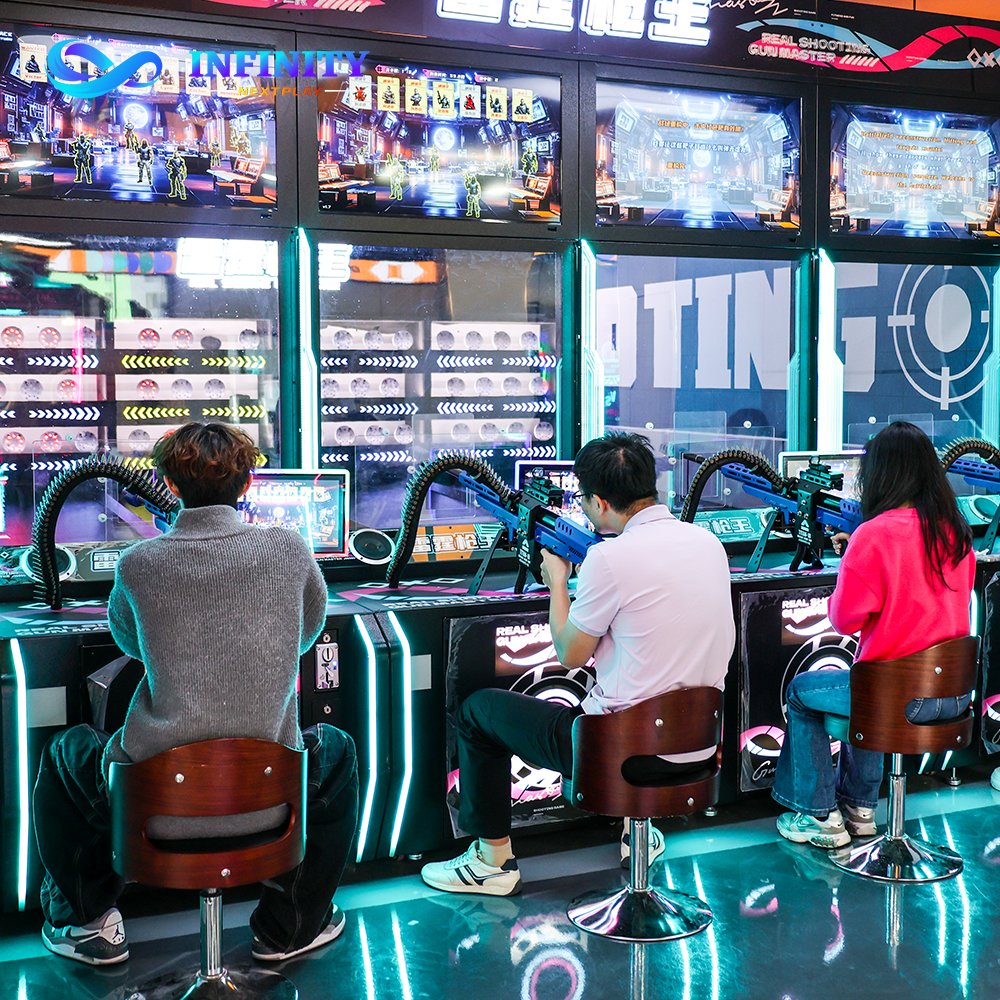
If archery is the skill hook, the Shooting Master Q4 is the social engine. Its standout feature is a real-time leaderboard with rewards — top scores of the week get a free drink, a discount, or a spot in the monthly final. I have seen Q4 units drive more return visits per square foot than almost anything else in a venue, because the score is public and the shame of a low score is a powerful motivator to try again.
A venue in Porto, Portugal ran a Q4 as the centerpiece of a corporate team-building package. Companies booked the room for 90-minute “sharp-shooter challenges,” and the Q4’s team mode turned coworkers into rivals. The room averaged roughly €3,400 a month just from those bookings — and that is before the walk-in plays from regulars. Team-building is a high-margin, low-frequency revenue layer that pairs perfectly with the high-frequency, low-ticket walk-in play of archery.
Let me lay out the Krakow numbers, because “under $20K” only matters if the payback is sane. This assumes a 1,200 sq ft room, two attractions, in a mid-size European city.
| Line item | Upfront cost | Monthly revenue |
|---|---|---|
| Digital Archery Simulator A4 | $9,500–$11,500 | $5,800 |
| Shooting Master Q4 | $6,800–$8,200 | $4,600 |
| Incremental F&B (tournaments, leagues) | — | $3,600 |
| Total | ~$19,000 | ~$14,000 |
Subtract roughly $1,600–$2,000 a month for utilities, consumables, and payment processing, and your net contribution lands near $12,000. Against a $19,000 all-in investment, the payback is about 11 months, with everything after that pure margin. The reason it pencils under $20K is simple: digital precision sports have almost no per-play consumable cost. No balls, no pins, no ammo. The machine is the whole cost.
| Metric | Before | After |
|---|---|---|
| Weekday (Tue/Wed) utilization | ~20% | ~68% |
| Return-visit rate (monthly) | 12% | 41% |
| Avg. group size | 2.1 | 3.8 |
| Corporate / team bookings | ~2/month | 11–14/month |
The standout number is weekday utilization. A combat sports zone lives or dies on repeat play, and repeat play is a weekday habit — not a Saturday-night splurge. By giving regulars a reason to come on Tuesday, you smooth your revenue curve and stop renting expensive space that sits empty half the week.
The Porto venue I mentioned was a hotel event room, not a bar. The lesson transfers cleanly: precision sports are perfect for groups. Hotels, coworking spaces, and even bowling centers with dead side-rooms can drop an A4 + Q4 pair and sell “team challenge” packages. The Porto hotel charged a flat €280 for a 90-minute private block and resold it to corporate clients at least a dozen times a month. Equipment that pays for itself through group bookings is the safest investment in this category.
Once the A4 + Q4 core is paying, the natural scale-up is a Free Roaming VR Arena 2.0. It extends the “aim and compete” theme into full-body multiplayer — guests walk, duck, and shoot in a free-roam space. It is a bigger ticket and a bigger footprint, but it slots into the same combat-sports identity and lets you upsell the group that already loves archery and shooting.
Multiplayer VR walking-and-shooting simulator. Full-body combat play that extends your precision-sports identity into a premium group experience.
View Details →If your floor skews social rather than competitive, a LED Dance Floor or a rubber-bullet Shooting C4 are easy add-ons later. But start with A4 + Q4 — they are the cheapest path to a real, repeatable combat-sports community.
Is a digital archery simulator actually safe in a bar?
Yes. There are no real arrows — the bow is sensor-tracked and the arrow is virtual. No range certification, no loose-projectile liability. Most operators run it under standard venue liability insurance.
How much space do I need for the two machines?
Roughly 250–400 sq ft for both units plus a small spectator area. Both are screen-based, so you need power and a wall, not special flooring.
What does it really cost to start?
All-in equipment for an A4 + Q4 combat zone lands around $19,000, comfortably under the $20K target. Payback is typically 10–12 months once leagues and team bookings ramp.
Do I need dedicated staff?
No. Both are self-service with card or token billing. Your existing bar staff handle setup and the leaderboard rewards. Most owners spend under an hour a week on maintenance.
How do I keep people coming back?
A public real-time leaderboard with weekly rewards. The scoreboard is the retention engine — guests return to beat their own number and their friends’. Pair it with a midweek league and corporate team packages.
Get a free 3D layout for your space. No commitment required.