I opened a 1,600 sq ft competitive social hub near Singapore''s Raffles Place in October 2024 with one question: can a venue built around archery and darts — not bowling, not VR, not arcade games — generate enough corporate team-building business to justify $18,000 in startup costs? By month four the answer was $12,800 a month, with 60% of revenue from corporate events and 40% from a weekly dart league that fills the venue every Thursday night. The format works because both sports attract the same customer: a working professional aged 28 to 45 who wants a competitive, social, alcohol-optional activity after work. This is the full breakdown of how I built it, what it costs, and the two revenue models that make it profitable.
A corporate team-building venue needs three things that most entertainment formats cannot deliver simultaneously: a skill-based activity that levels the playing field across ages and fitness levels, a format that supports 8 to 24 people at once, and an atmosphere that feels adult enough for a post-work gathering. Bowling is too casual. VR is too isolating for group bonding. A shooting simulator is great but skews male. Archery and darts together solve all three problems: both are skill-based, both support group play, and both have a 300-year competitive tradition that feels grown-up.
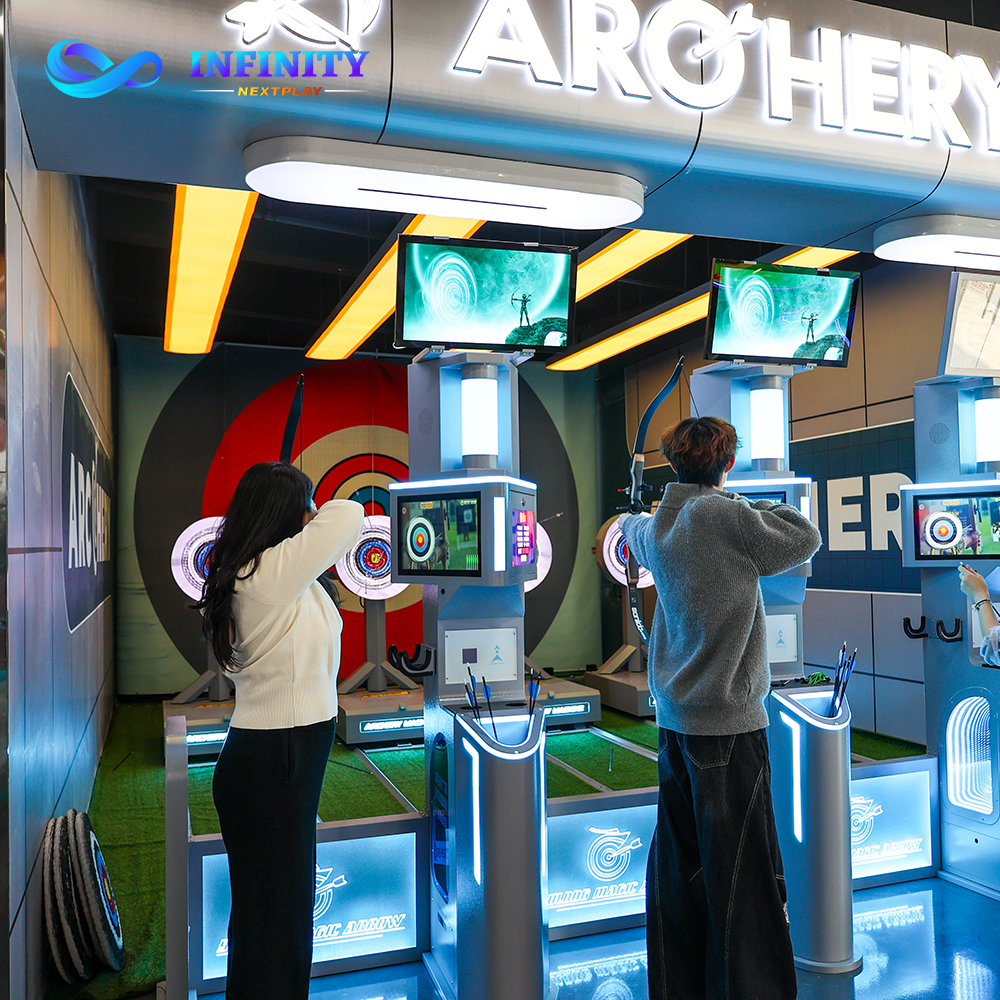
The Digital Archery Simulator A4 is the anchor I recommend because of one feature that matters more than any other for corporate events: adjustable track distance. A group of 12 engineers from a fintech firm will include people who have never held a bow and people who shoot competitively on weekends. The A4 lets you set the target at 8 meters for beginners and 18 meters for experienced archers, all from the same lane, without moving equipment. That single feature is what makes a mixed-skill corporate group work.
The A4 uses a digital dual-screen system with real-time scoring and adjustable track distance. What makes it work for a social hub is the visual feedback: both screens display a live leaderboard, so even non-participants standing at the bar can follow the competition. My A4 lane runs 14 to 20 sessions on a weekday evening at $8 per session, and during a corporate event it runs continuously for 90 minutes at a flat $320 booking fee. The dual-screen setup means I can run two archers simultaneously on the same lane, which doubles throughput compared to a single-screen system.
If your venue is larger and you expect high-volume FEC traffic rather than corporate bookings, the Professional Arcade Archery System A6 is the step-up model with auto-voice scoring and a larger dual display. For my 1,600 sq ft corporate-focused venue, the A4 was the right choice. For a 3,000 sq ft venue targeting walk-in families and large groups, the A6 handles the volume better.
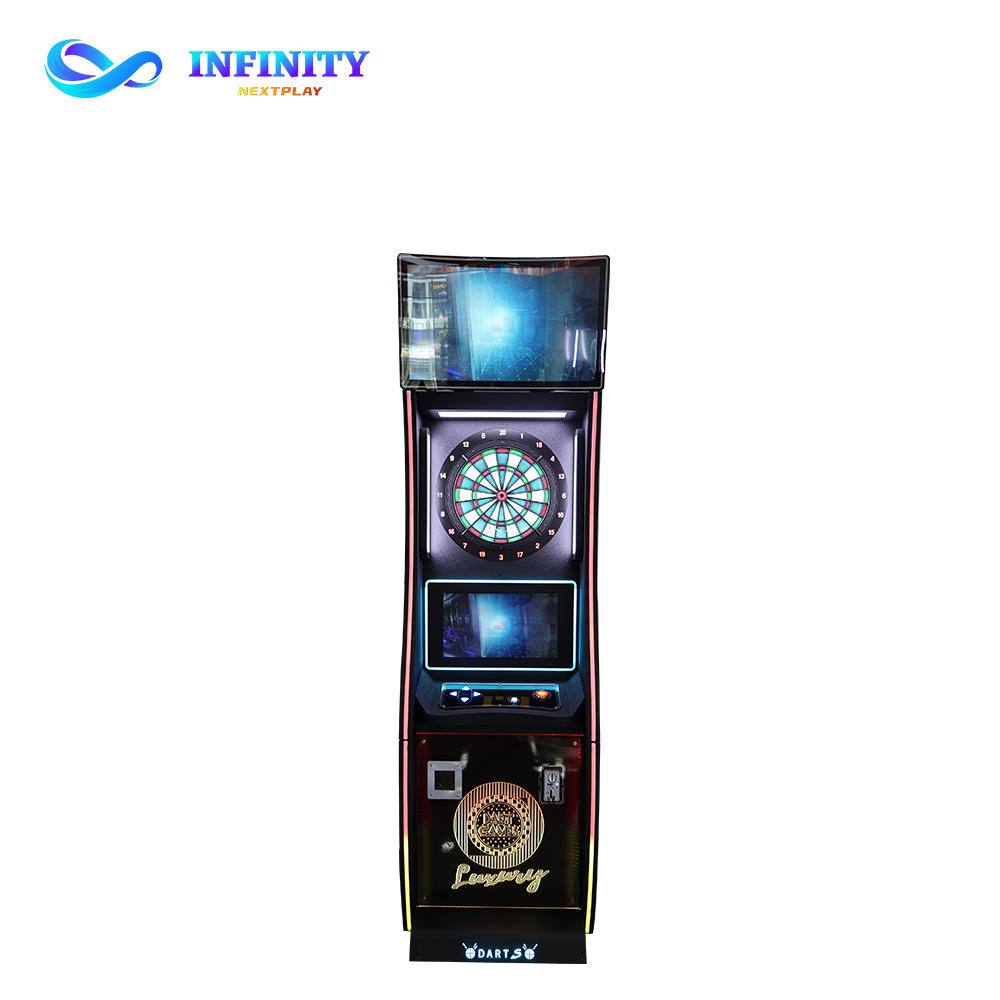
The Online Electronic Dart Machine X7 is the second machine and it does something no other product in the venue can: it connects to a global online matchmaking network. That means on a slow Tuesday night, my regulars can play against opponents in London, Tokyo, or Sao Paulo. The automatic scoring and online leaderboard give the venue a "sports bar meets esports" atmosphere that attracts the 28-to-45 professional demographic. My X7 generates $3,400 to $4,600 a month, and the Thursday night league alone accounts for $1,800 of that.
The X7 also solves the corporate event problem of what to do with the 6 people who are not currently on the archery lane. While 2 people shoot archery, 4 play darts, and the rest watch the leaderboard screens with a drink. Nobody is standing around waiting. For a family-oriented venue where price sensitivity is higher, the Electronic Dart Board Cabinet X4 is a more affordable alternative, but for a corporate social hub the X7''s online play and premium feel are worth the upgrade.
Adjustable track distance, dual-screen live leaderboard. Ideal for sports bars, clubs, and corporate team-building venues.
View Details →Global online matchmaking, automatic scoring, competitive leaderboard. Built for clubs and competitive gaming venues.
View Details →I opened my social hub in October 2024 in a 1,600 sq ft second-floor unit near Raffles Place MRT. Rent was $3,200/month — high, but the CBD location means I am within walking distance of 400 office buildings. I spent $18,000 total: $8,400 on the A4 archery simulator, $4,200 on the X7 dart machine, $2,800 on a bar counter with two tap lines, seating, and AV for the leaderboard screens, and $2,600 on marketing and a 2-month operating buffer. I staffed it with one full-time manager (me) and two part-time attendants at $420/month each for weeknight shifts.
The corporate event model was the breakthrough. I charge $480 for a 2-hour corporate booking for up to 16 people, which includes 45 minutes on the archery lane, 45 minutes on the dart cabinet, a leaderboard tournament with a trophy, and two rounds of drinks. I booked 14 corporate events in month 3 and 22 events in month 6 — that alone is $6,720 to $10,560 in high-margin revenue. The Thursday night dart league adds another $1,800/month, and walk-in archery and dart sessions fill the gaps. By month 4, total revenue was $12,800 and payback was 7 months.
Lars opened in January 2025 in a 2,000 sq ft ground-floor unit in Berlin-Mitte, walking distance from 30 tech startups. Rent was $2,100/month — lower than Singapore, but the build-out was more expensive because of German fire codes for the bar area. Total startup was $19,400: the same A4 and X7 setup, plus a Digital Scoring Shooting Simulator Q4 as the third anchor for variety, a proper bar with four tap lines, and seating for 30. He staffed it with two part-time attendants at $380/month each.
Lars''s model is different from mine: he runs a weekly dart league on Thursdays (32 league members at $45/month each = $1,440) and a monthly archery tournament on Saturdays ($35 entry, 24 participants = $840). Corporate events are his growth channel — he partnered with three startup accelerators that book team-building events every quarter. By month 5 he was doing $11,600/month with 55% from corporate events, 25% from leagues and tournaments, and 20% from walk-in play. His payback was 8 months. The shooting simulator adds $1,800 to $2,400 a month and gives corporate groups a third activity rotation, which means he can host groups of up to 24 instead of my limit of 16.
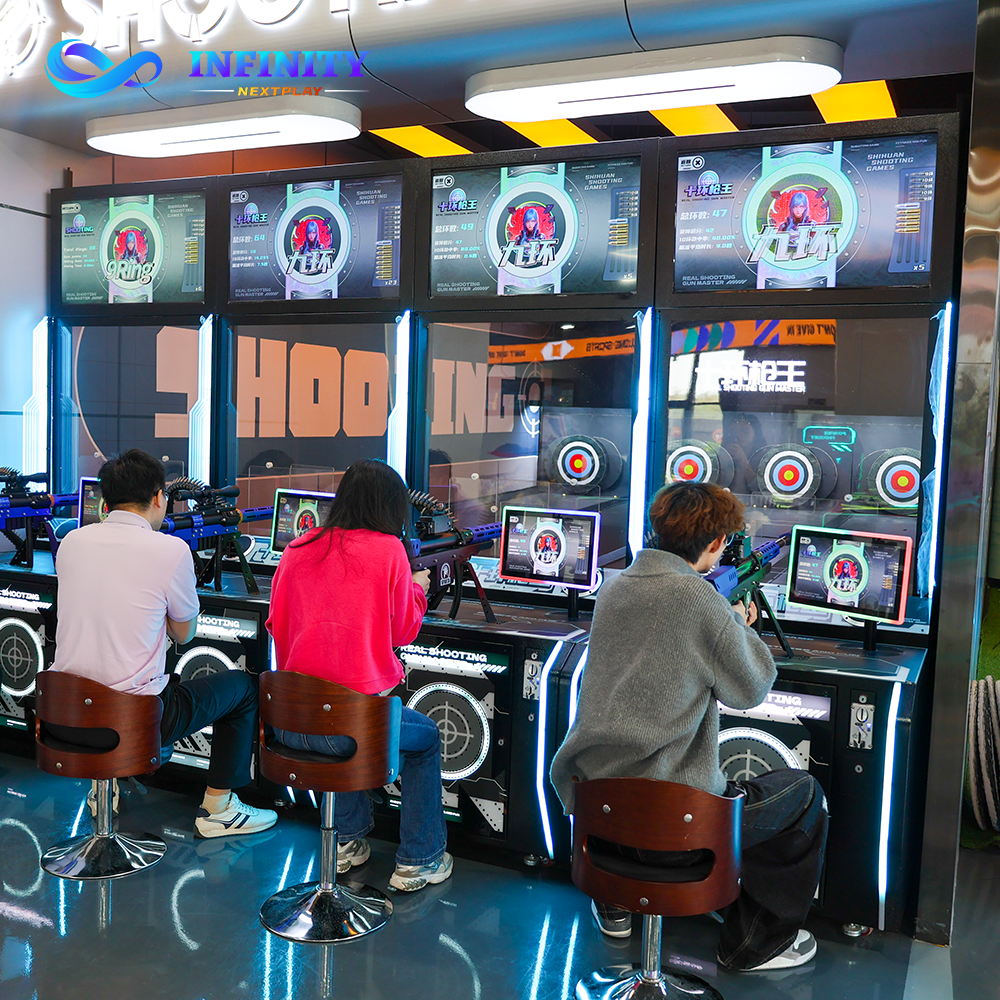
If your venue is 2,000 sq ft or larger and your corporate groups regularly exceed 16 people, a third anchor machine solves the rotation problem. Lars added the Digital Scoring Shooting Simulator Q4 in Berlin and it let him host groups of up to 24 by adding a third 30-minute rotation. The Q4''s real-time leaderboard and rewards system integrate naturally with the competitive format — archery, darts, and shooting all feed into a single tournament scoreboard, which is exactly what corporate HR managers want for their team-building events.
The Q4 adds $1,800 to $2,400 a month in walk-in revenue and increases the average corporate event booking from $480 to $560 because you can host larger groups. If you have the space and the budget, it pays for itself in about 10 months on the event uplift alone. For a family-oriented venue where the budget is tighter, the Automatic Rubber Bullet Shooting Machine C4 is a more affordable alternative, but for a corporate social hub the Q4''s digital scoring system is the right feature set.
Real-time leaderboard, rewards system, team-building tournament mode. Ideal for clubs and corporate venues.
View Details →Start with LinkedIn. Search for "HR manager" or "people operations" within a 5-km radius and send a one-paragraph message offering a free trial event for 8 people. I sent 40 messages, got 6 replies, and 3 became recurring clients. Once you have one corporate client, ask for a referral to their counterpart at another company. The corporate events market is surprisingly relational — one good event leads to three more.
For walk-in play, no. For corporate events, yes. The bar adds $120 to $180 per corporate event in drink revenue, and more importantly, the post-work drink is the social glue that makes corporate clients rebook. Without a bar, your venue is an activity center. With a bar, it is a social hub. If the license process is slow, open without it and add it in month 2 or 3 — but do not skip it.
Thursday nights, 7pm to 10pm. Members pay $45/month and get guaranteed league play plus discounted walk-in rates on other nights. I run a round-robin format where everyone plays 4 games per night against different opponents, and the X7''s automatic scoring handles the leaderboard. The league creates a core community of 25 to 35 regulars who become your best word-of-mouth marketers. It also fills your otherwise-deadest night of the week.
One X7 dart machine, one A4 archery simulator, a bar counter with a liquor license, and seating for 20. That is $13,000 in gear and $3,000 in build-out. Skip the third anchor and the premium AV. You can always add a Coin Operated Dart Machine X5 as a second dart cabinet once the league outgrows one machine. The minimum viable format still generates $8,000 to $10,000 a month if you execute the corporate and league models correctly.
Yes, if you have 2,500 sq ft or more. A 2-lane string bowling setup adds a team activity that works well for larger corporate groups of 24-plus. The bowling lanes also attract a different customer segment (casual social groups) that fills your weekend afternoons. The trade-off is cost: string bowling adds $4,000 to $5,000 to your startup budget and requires 400 sq ft of dedicated space. I would add it only after the core archery-plus-darts format is profitable.
A competitive social hub built around the Archery Simulator A4 and the Dart Machine X7 is the highest-margin small-venue format I have operated, and the corporate team-building angle is what makes it work. The A4''s adjustable distance solves the mixed-skill problem that kills most team-building activities. The X7''s online play creates a league community that fills your venue every Thursday. Together they generate $12,000 to $13,000 a month in a 1,600 sq ft space, with 60% of revenue from corporate events that book weeks in advance. If you have a space near a business district and can get a liquor license, this is the format I would build today.
If you want a free floor plan for your specific space — with machine placement, group rotation flow, and a revenue projection based on your local corporate density — I will build one for you. No commitment, no sales call, just a layout and a payback calculation you can take to a landlord.
Get a free floor plan for your space. No commitment required.