Venue operators choose simulators on the showroom feel, then discover that the real purchase criterion is revenue per square meter. Every bay competes for the same floor, circuits, staff hours and guests, so the question is which station pays for its space fastest. The Archery Simulator A6 bay, the Shooting Simulator Q4 lane and a third-party baseball simulator lane were tracked by NextPlay across venues of 400 to 1,200 m2: the gap between best and worst is about 4 times on revenue per square meter.
The comparison uses four inputs: ticket price, session length, throughput per hour and utilization during peak hours. Margins follow after consumables, calibration and the staff share. A bay that earns $6,700 a month instead of $4,600 is worth $126,000 more over five years. Baseball lanes pull the highest ticket price of the three, but they consume three times the floor.
| Metric | Archery A6 Bay | Shooting Q4 Lane | Baseball Sim Lane |
|---|---|---|---|
| Ticket Price | $10 per 6-arrow round | $13 per 50-shot round | $18-$25 per head, $45-$60 per lane hour |
| Session Length | 6 minutes | 7 minutes | 30-45 min per group |
| Peak Throughput | 7 rounds per hour | 5.5 rounds per hour | 4-6 groups per hour |
| Monthly Revenue | $6,400-$7,000 per bay | $4,300-$4,900 per lane | $2,800-$4,500 per lane |
| Gross Margin | 68% | 62% | 45-55% |
| Area per Station | 7 m2 | 10 m2 | 20-28 m2 with netting |
The table is read on two axes. On revenue per station, the Q4 lane and the A6 bay are close, and the baseball lane trails because its long sessions cap throughput: 4 to 6 groups per hour against 5.5 to 7 rounds. On revenue per square meter the A6 bay produces about $960 per m2 a month, the Q4 lane about $460, a baseball lane about $160 once its netting is counted. The Archery Simulator A6 is the yield winner.
Baseball simulators fit a different venue category. A lane needs a 3.5 to 4.5 m ceiling for swings, 20 to 28 m2 including netting, ventilation for turf dust, and licensed content when it uses real team names or pitcher likenesses. Equipment runs $45,000 to $90,000 per lane, more than the entire four-bay archery and shooting zone. Inside a mixed floor it converts the most floor into the least revenue.
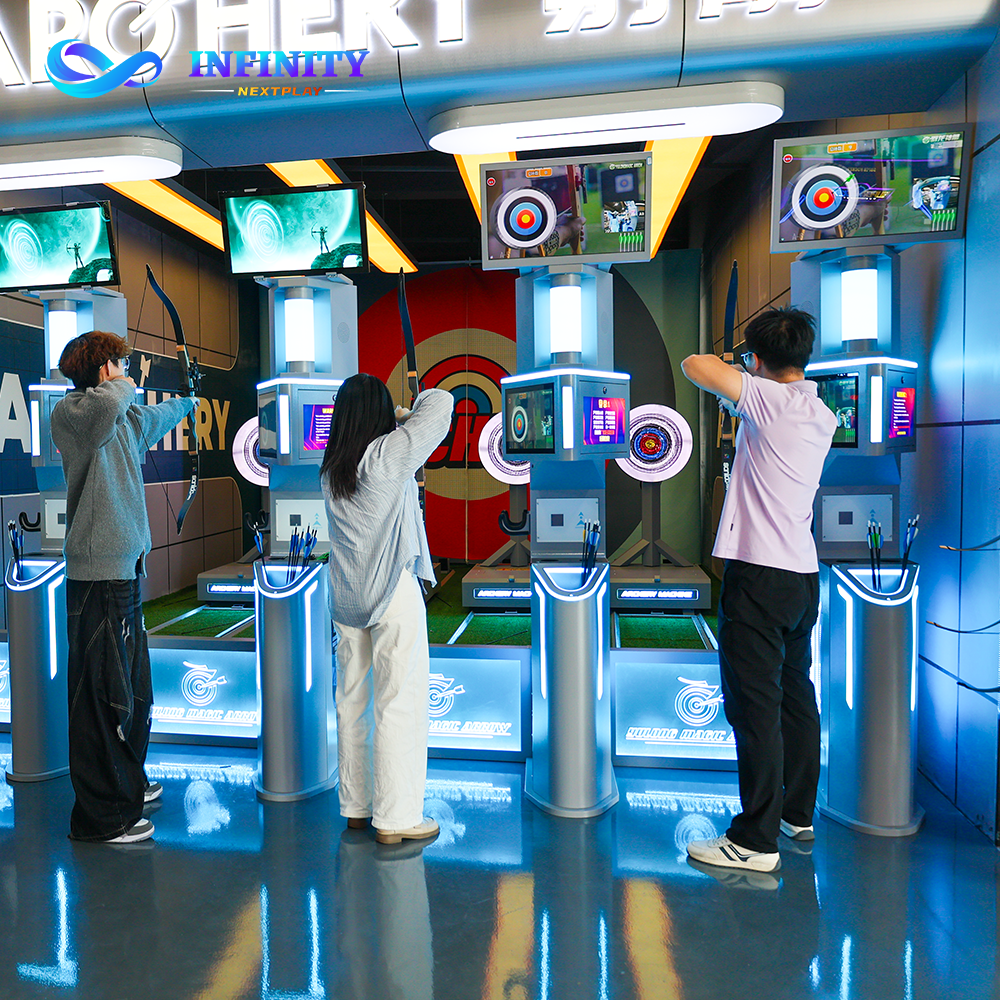
The Archery Simulator A6 runs six-arrow rounds of about six minutes with automatic voice scoring on dual displays, so no staff member needs to stand at the bay. The demographic is the widest of the three: children, families, couples and corporate groups all play. The bay measures about 7 m2, and resets are instant.
The math: $10 by 7 rounds by 5 hours by 26 days at 72 percent utilization lands at $6,400 to $7,000 a month per bay, about $960 per m2.
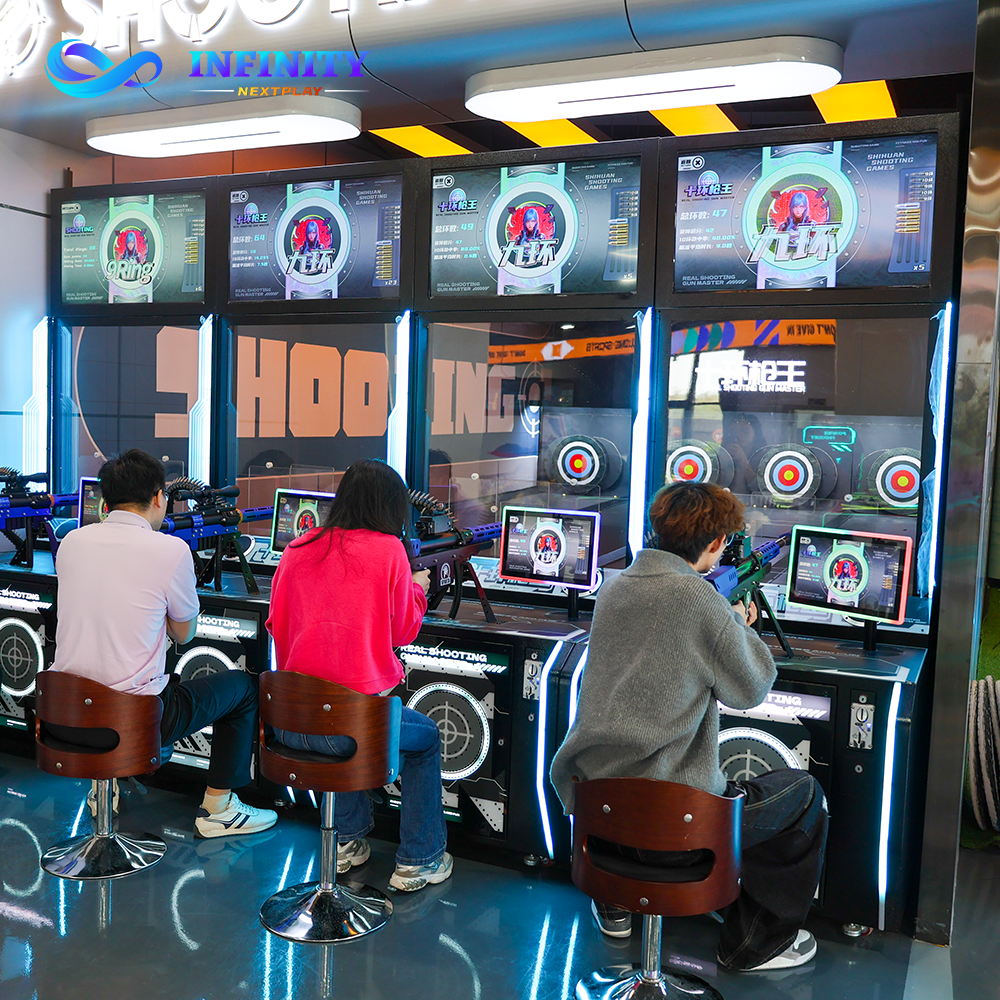
The Shooting Simulator Q4 runs 50-shot rounds of about seven minutes with a real-time leaderboard and reward rounds, the strongest repeat-play engine of the three: players return to defend their rank, and league nights fill the quiet weekdays. The lane needs about 10 m2 including the five-meter sight distance, and each round ends with a manual reset.
The math: $13 by 5.5 rounds by 5 hours by 26 days at 49 percent utilization lands at $4,300 to $4,900 a month per lane, about $460 per m2. The bay earns 2.1 times more per square meter.
| Technical Requirement | Simulator Corridor Need | Operator Checkpoint |
|---|---|---|
| Power | 220V dedicated circuits, 2.5 to 3.5 kW per bay | Never shared with kitchen or HVAC |
| Network | Cat6 to every machine, 1G switch, separate VLAN | Online leagues and cloud leaderboards |
| Ceiling | 3.0 m minimum, 3.5 m near the archery bays | Panel mounting and swing clearance |
| Acoustics | NRC 0.85 ceiling tiles, 20 to 25 dB partitions | Conversation stays possible at 75 to 85 dB |
| Safety | 4 m behind the A6 throw line, 3 m beside Q4 lanes, R10 floor | Backstop panels and clear signage |
The corridor earns more than a single baseball lane on the same floor for a third of the investment, which is why mixed archery and shooting corridors are the standard answer for venues that compare simulators by revenue instead of by spectacle.
The Archery A6 bay. It scores automatically by voice, resets instantly, uses no consumables and needs no staff at the bay, with calibration once a quarter. The Q4 lane runs nearly as lean, but its rifles need periodic maintenance. A baseball lane needs ball handling and supervision in every session.
The A6 bay, because it pairs the lowest equipment cost, $9,200, with the highest margin, 68 percent, and the highest revenue per square meter. The Q4 lane follows at $9,800 with a 62 percent margin. A baseball lane repays in 18 to 24 months even in good locations.
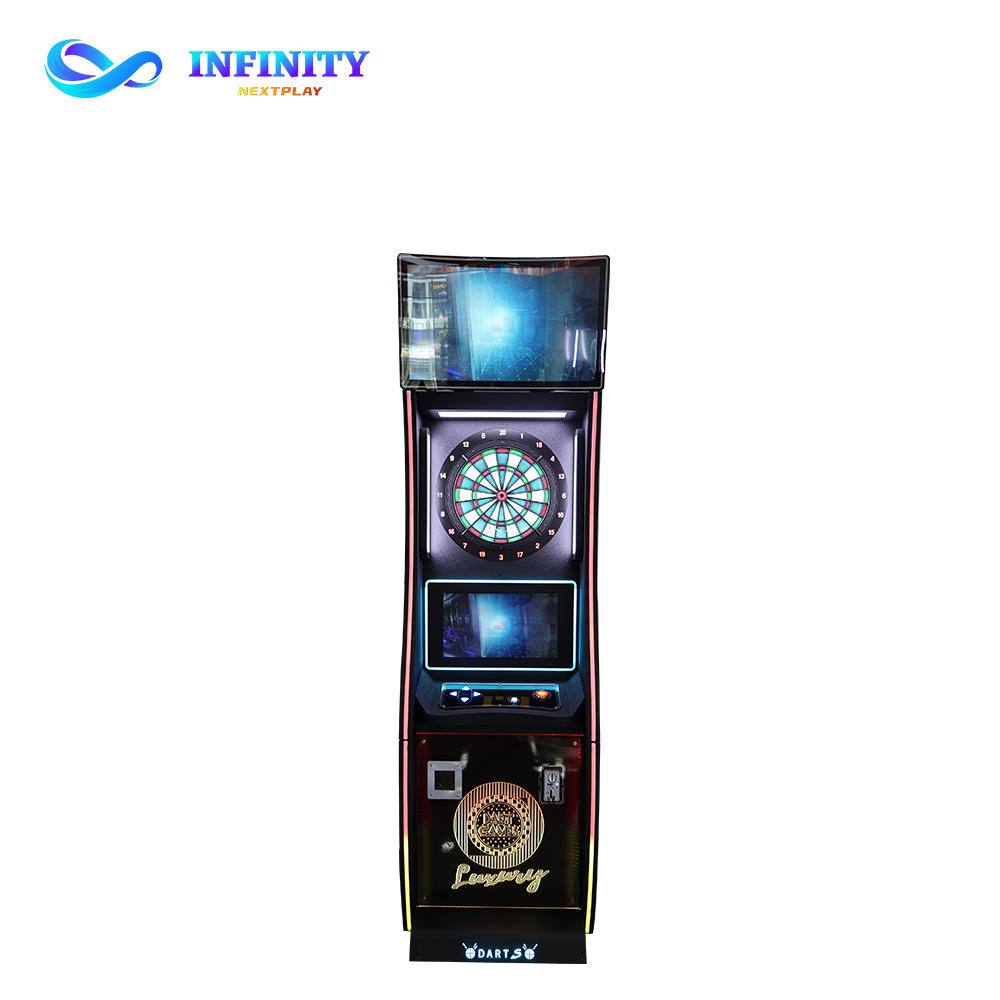
Buy one Archery Simulator A6 bay and one Shooting Simulator Q4 lane together, about $19,000, and open them as a two-station corridor. The pair gives a real revenue reading in two weeks. Most venues add a second archery bay within a quarter and Dart Machine X7 banks when the social end needs a low-cost station.
The A6 bay takes about 7 m2 including the throw line, with 4 m of open space behind the shooter. The Q4 lane takes about 10 m2 including the five-meter sight distance. A baseball lane takes 20 to 28 m2 with netting and a 3.5 m ceiling minimum. A two-bay archery and shooting corridor fits in roughly 40 m2.
One host covers up to four bays during peak hours, handling reward payouts, leaderboard disputes and machine resets; between peaks the bays run unattended. Add one person on league nights for the Q4 lane. The A6 bay never needs a dedicated attendant. Baseball lanes require one staff member per lane per session.
Choose baseball only when the venue is built around it: dedicated space, high ceiling, ventilation and a budget for licensed content and ball handling staff. In a mixed floor the numbers are decisive: archery and shooting produce about $11,300 a month on 34 m2 of bays for $38,000 of equipment, while one baseball lane produces $2,800 to $4,500 on 20 to 28 m2 for $45,000 to $90,000.
The comparison is settled by three numbers. The Archery A6 bay earns about $960 per m2 a month at a 68 percent margin, the Shooting Q4 lane about $460 at 62 percent, and a baseball lane about $160 per m2 once its full footprint counts. Four simulator bays generate about $22,600 a month gross on $38,000 of equipment, repaying in 5 to 8 months; a full NextPlay package of five units stays inside 9 to 12.
Ask NextPlay for a 3D CAD of a mixed archery and shooting corridor drawn for your exact floor, a per-bay revenue model with ticket pricing for your city, and the package price with installation and payback schedule.