
"Modern competitive socializing is no longer defined by separate, isolated gaming hardware pieces. High-income group bookings demand a unified spatial journey where virtual-reality combat, high-speed physical tile racing, and premium automated bowling operate under a single spatial synergy matrix. By combining our compact, foundation-free String Bowling with multiplayer wireless Free Roaming VR Arena 2.0 and pressure-sensitive LED flooring, we enabled the Sydney operator to achieve an elite-tier spatial yield of $65,000 per month."
- Sarah Kim, NextPlay Pro-Tech Director
Location-Based Entertainment (LBE) operators often face a severe yield bottleneck: high initial foot traffic that quickly decays due to low secondary spend and short visitor dwell times. When guest groups play a single attraction and immediately exit, food and beverage revenues suffer, and high real estate lease costs squeeze net profitability. Achieving long-term economic sustainability requires transitioning from a retail machine-operator mindset to an integrated, multi-attraction spatial designer. NextPlay's turnkey competitive socializing model solves this by establishing a strict Spatial Synergy Matrix.
At our landmark 800-square-meter Sydney showcase venue, we eliminated isolated, dead-end gaming spaces by mapping out a cohesive player-movement loop. The layout positions our high-impact, visually striking 30㎡ Infinity Grid LED Floor Game directly near the entrance, acting as an active "spectator engine." Passing crowds are instantly drawn in by the dynamic, glowing floor grid and the intense physical gameplay, feeding a natural marketing loop. Adjacent to this engine, we integrated the high-capacity, space-saving Commercial 2-Lane String Bowling System to anchor casual group play, leading naturally into the high-ticket Esports tech core—the Free Roaming VR Arena 2.0. By weaving sports-entertainment, high-fidelity virtual reality, and beverage-adjacent social tables into a unified layout, we locked in an average customer dwell time of 210 minutes (3.5 hours).
Traditional ten-pin bowling installations represent massive capital and structural hurdles for hospitality venues. They demand deep concrete pit excavations, highly specialized heavy-duty structures, and constant technical oversight to resolve frequent pin jams. For premium city-center real estate, these structural constraints often render standard bowling entirely non-viable. NextPlay's Commercial 2-Lane String Bowling Equipment bypasses these pain points by utilizing a revolutionary foundation-free structural design.
Engineering the bowling alley with a lower foundation height profile—requiring only a minor 20cm to 23cm surface platform—allows for effortless retrofitting into existing commercial structures without floor excavations. Mechanically, the string pinsetter system replaces complex, heavy-duty mechanical sweeps and rotary carousels with direct, high-durability nylon string pulley arrays. This design eliminates over 75% of moving components, effectively preventing common mechanical failures and pin jams. The automated pulley mechanism resets every pin in under 5.5 seconds, ensuring rapid game turnaround and continuous lane turnover. Built upon a robust 36mm+ premium OSB double-layer sub-flooring (substantially exceeding the standard 25mm thickness), the lanes offer superb structural rigidity and moisture protection, maintaining perfect level alignment under constant heavy impact for over ten years.
To capture high-spending corporate and team-building demographics, a modern FEC must deliver a technological marvel that cannot be replicated at home. NextPlay's Free Roaming VR Arena 2.0 represents the pinnacle of location-based multiplayer immersive gaming. Older VR systems utilized heavy, drag-inducing backpack PCs and complex wired sensors that restricted movement, triggered spatial disorientation, and severely limited hourly player throughput.
The Arena 2.0 overcomes these operational limitations by employing a fully wireless, high-frequency laser localization tracking system. Multiple high-precision optical sensors ceiling-mounted across a designated play area track players' physical coordinates in real-time. This tracking data is synced via an ultra-low-latency 5G localized Wi-Fi mesh network to lightweight, standalone VR headsets, achieving an incredible motion-to-photon latency of under 10 milliseconds. This ultra-low lag prevents any motion sickness, making the experience highly accessible across all age brackets. Operationally, the system supports up to 8 players simultaneously in a shared, wireless physical arena, allowing the operator to run quick, 15-minute high-throughput competitive sessions that drive stellar hourly revenue.
While virtual reality captures the high-tech audience, a successful venue must also offer an instantly accessible, physical-active game that captures the "spectator-effect" in social media loops. The Infinity Grid LED Dance Floor Game converts regular commercial flooring into a highly interactive, pressure-sensitive gameplay arena. This physical attraction merges high-energy physical coordination, simple grid-based rules, and striking visual output to form a highly addictive multiplayer social engine.
Engineered for extreme public durability, each tile is constructed with dual-layer, high-impact tempered glass capable of withstanding constant running, jumping, and high-velocity steps up to 500kg per square meter. Below the tempered protective glass sits an array of high-speed capacitive pressure sensors that detect foot impacts with a sub-50ms system response latency, sending immediate feedback to the game controller. The localized control software features over 30 built-in game modes, including grid-evasion, speed-matching, and team target capture, keeping players engaged and eager to replay. The high visual impact of the colorful, glowing LED tiles creates an incredible "social media beacon" inside the venue, encouraging guests to film their sessions and share them online, driving zero-cost organic traffic to the venue.
| Technical & Operational Parameter | NextPlay 3.0 Integrated Flagship Hub | Traditional Multi-Attraction Arcade |
|---|---|---|
| Average Monthly Revenue | $65,000.00 Gross Yield | $18,000.00 to $22,000.00 Average |
| Average Visitor Dwell Time | 210 Minutes (3.5 Hours) | 45 to 60 Minutes Maximum |
| On-Site Mechanical Maintenance | Zero Dedicated Mechanics (Strings/Solid-State) | Requires 1-2 Full-Time Technical Staff |
| Primary Corporate Booking Draw | High (Multiplayer VR Arena + Multi-Lane Bowling) | Low (Individual coin-op arcade focus) |
| Capital Return Period (ROI) | 7 Months (Verified Sydney Performance) | 18 to 24 Months Average |
A truly high-performance social entertainment hub relies heavily on seamless technical execution and rigorous calibration. NextPlay's turnkey delivery protocol guarantees that every structural, optical, and mechanical module is perfectly integrated to maximize operational uptime. Below is the step-by-step installation and calibration sequence executed by our field engineering team at the Sydney showcase hub:
Q1: How do string pinsetters compare to traditional mechanical sweeps in terms of operating costs?
A1: Traditional free-fall pinsetters use complex assemblies with thousands of moving parts, requiring continuous lubrication, adjustment, and on-site mechanics. NextPlay's string pinsetters replace these with solid-state nylon string pullies, reducing moving parts by over 75%. This eliminates pin jams, slashes power consumption by 50%, and removes the need for an on-site technician, lowering monthly operating costs by thousands of dollars.
Q2: What happens if a player drops heavy objects or spills liquids on the Infinity Grid LED floor?
A2: Each Infinity Grid tile is hermetically sealed and rated with an IP67 waterproof structure, protecting the electronics from heavy spills and cleaning chemicals. The surface glass is constructed from dual-layer, high-impact tempered protective glass designed to withstand continuous, localized physical impacts up to 500kg, easily handling dropped glasses, high-heels, and extreme active jumps.
Q3: How does the Free Roaming VR Arena 2.0 prevent player collisions inside the play zone?
A3: The localized software features an advanced, built-in real-time "Spatial Proximity Alert" system. The laser localization tracking coordinates are continuously calculated. When two physical players approach within 1.5 meters of each other, a bright, highly visible virtual boundary wall is projected inside their VR headsets, alerting them of their real-world proximity and ensuring complete guest safety.
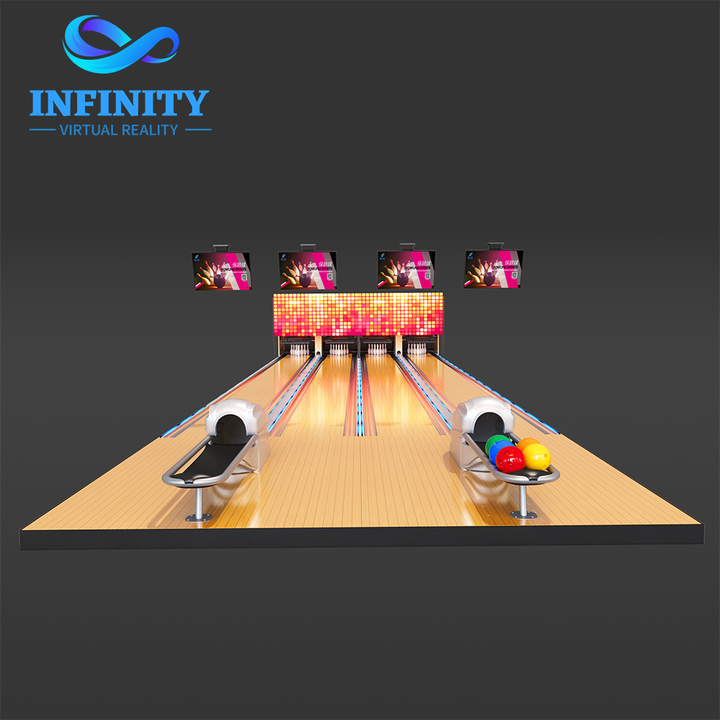
🎳Maximum Space Efficiency: Foundation-free 20cm platform design with low maintenance nylon string resetting.
View Details →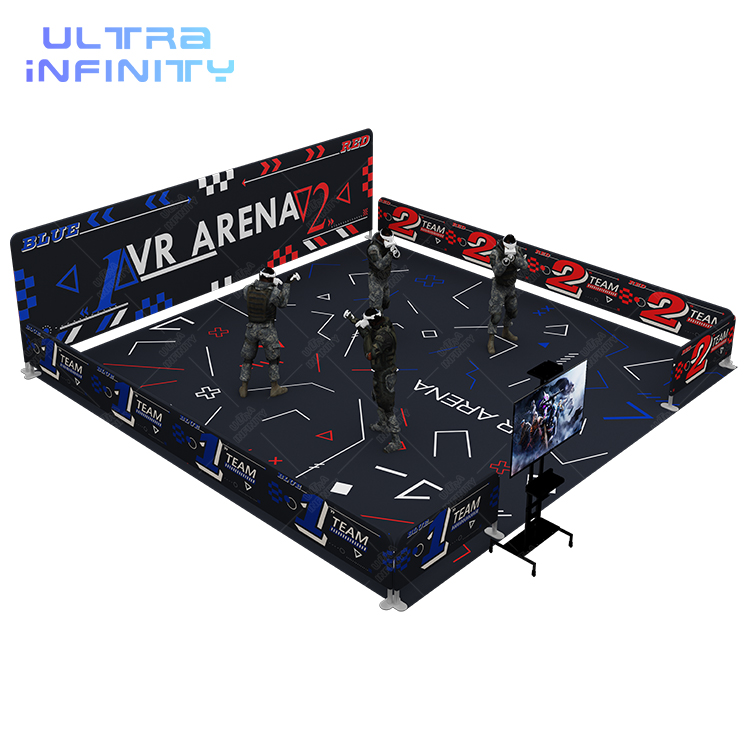
🎮Multiplayer Tech Core: High-frequency wireless tracking with standalone headsets and sub-10ms response lag.
View Details →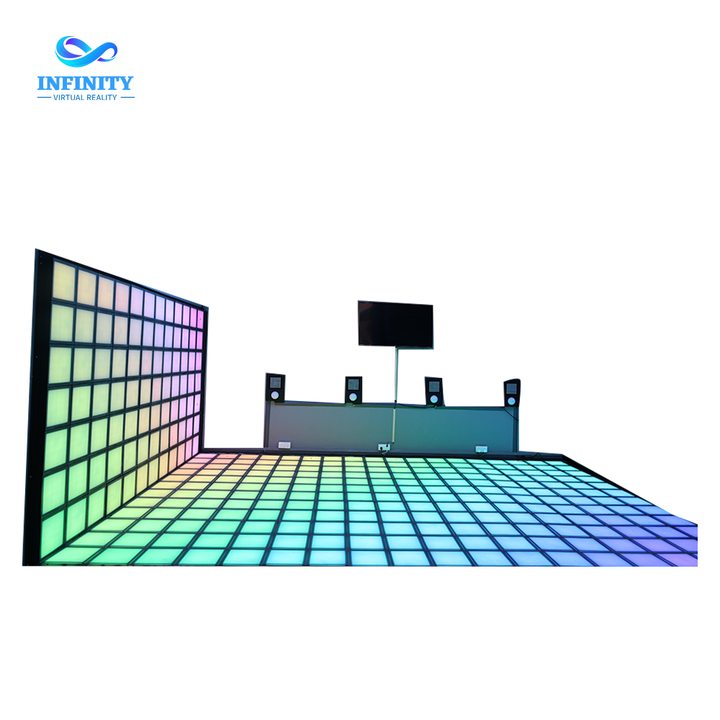
🚀Spectator Attraction: Pressure-sensitive interactive tiles with IP67 waterproofing and 30+ gamified modes.
View Details →Discover how NextPlay's turnkey multi-attraction spatial matrix can turn raw real estate into high-yield, high-dwell-time competitive socializing hubs.