I opened my first combat sports zone in a Manila mall in 2023 with 1,900 sq ft, two shooting lanes, and one archery lane. The landlord told me I was crazy — "nobody pays to shoot arrows next to a food court." Fourteen months later that same landlord offered me the adjacent unit so I could add a third lane. The difference between skepticism and a second lease was a single P&L sheet showing $14,200 in monthly revenue from roughly 1,180 paying players. This is the breakdown I wish someone had handed me before I signed the lease.
Every mall I walk into has the same problem: the back corner is full of claw machines, photo booths, and a sad air hockey table that eats tokens. The dwell time is terrible. A kid plays one round, the parent stands around, and after eight minutes they leave. A combat sports zone flips that economics completely. Shooting and archery are session activities — people stay 25 to 40 minutes, they buy a drink, they come back next weekend to beat their score, and they bring a friend. My average ticket per player is $11.40, but my average session value is $31 because groups of three or four book together.
The other thing nobody tells you: leaderboards are the retention engine. When a player sees their name slip from #3 to #7 on the weekly board, they come back. I run a free ranking system through the Shooting Simulator Q4 and the Professional Archery System A6, and both push scores to the same in-venue screen. Roughly 38% of my monthly players are return visitors from the previous 30 days. That is the number that makes a mall landlord renew your lease at a discount.
I run three attractions in the zone, but two of them generate 82% of the revenue. The third is a dart machine I added as a social anchor. Let me walk through each one honestly, including the things that annoyed me in the first 60 days.
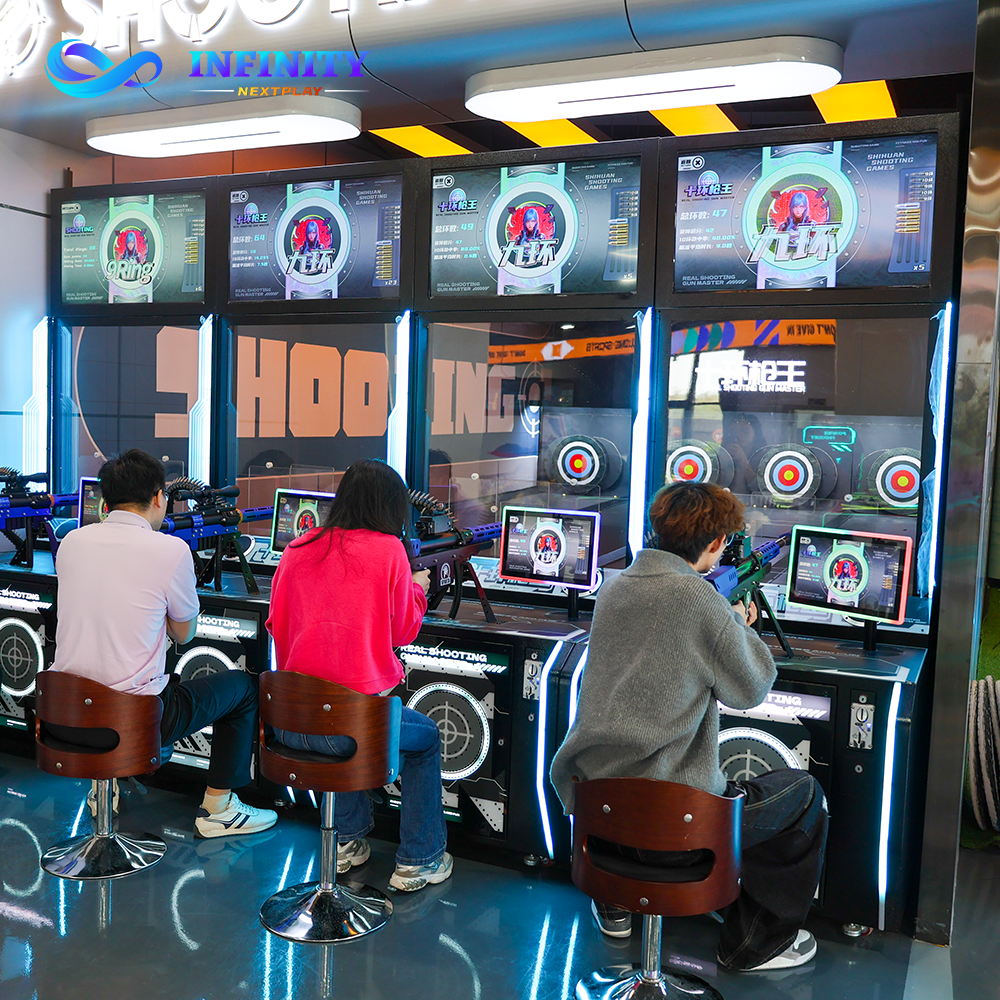
The Q4 is the unit I tell every new operator to start with, and the reason is boring: it just runs. The 10-ring scoring system with moving targets means a beginner can hit the board and feel good, and a sharpshooter can chase a perfect 100. That range is what makes it sellable to families on Saturday morning and to a corporate team-building group on Wednesday night. The 39-inch top display is non-negotiable — do not buy a shooter without a top display, because the crowd that gathers to watch is half the reason the player pays for a second round.
My Q4 lane did $6,800 in its best month and $4,100 in its worst (a typhoon week in August). On a normal Friday evening it turns 22 to 28 sessions at $9 to $12 each depending on the package. The thing I underestimated was how much corporate booking revenue it would drive — HR departments love "precision shooting" as a team exercise, and they pay $180 for a 90-minute private block that costs me nothing extra in gear.
If you want the lighter rubber-bullet feel for a younger-skewing venue, the Automatic Rubber Bullet Shooting Machine C4 is the sibling model I would pair with the Q4 in a family-entertainment-center layout. Same scoring philosophy, gentler feedback, lower per-unit cost.
10-ring scoring, moving targets, 39" top display, real-time leaderboard. Ideal for team building and clubs.
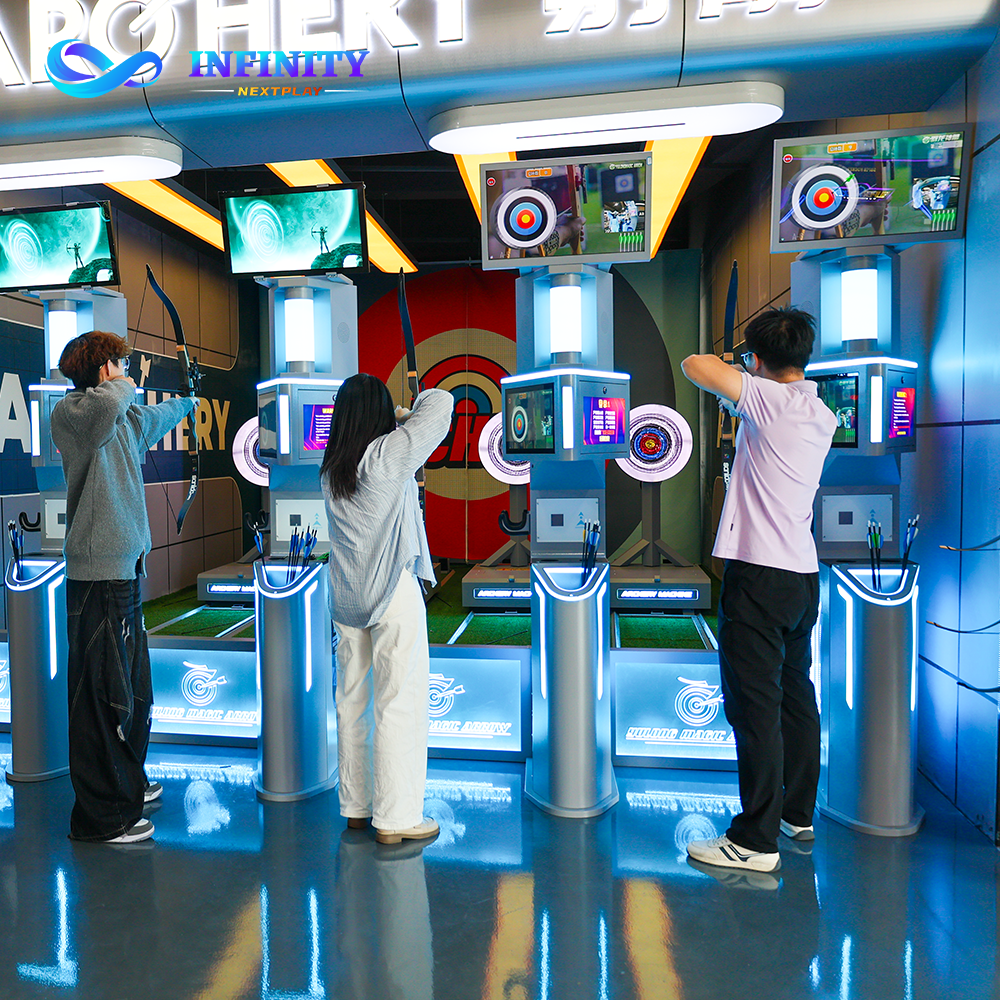
View Details →Auto voice scoring, dual display, 1VS1 online matchmaking. Built for large FECs and amusement parks.
View Details →Archery is what makes your zone photographable, and photographable means free marketing. The A6 was the unit I added in month three, and within two weeks my Instagram tags tripled. The dual display matters more than I expected: one screen faces the shooter for feedback, the other faces the walkway so passers-by stop and watch. That second screen is a customer-acquisition channel disguised as a feature.
The A6 supports 1VS1 online matchmaking, which sounds like a gimmick until you watch two strangers book back-to-back sessions because they want to settle a score. My archery lane does about $5,400 in a normal month and spikes to $7,800 during school holidays. Average session is 14 minutes at $9 per player. The shorter session length compared to shooting is actually an advantage — it means more turns per hour, and more turns per hour is what pays the rent on a small footprint.
For tighter footprints I would also look at the Digital Archery Simulator A4 — the adjustable track distance lets you fit it into a sports-bar layout where you cannot commit to a full competitive archery lane.
Carla opened her zone in October 2023 in a 1,900 sq ft space on the third floor of a mid-tier Manila mall. Rent was $2,150/month including common-area charges. She spent $19,400 on the gear package: one Q4 shooting lane, one A6 archery lane, a Coin Operated Dart Machine X5 for the social corner, plus seating, scoring screens, and a small reception counter. She staffed it with two part-time attendants at $380/month each.
Month 1 was $3,900. Month 3 crossed $9,000. By month 7 she was at $14,200 and had landed a recurring Wednesday corporate booking worth $1,440/month. Her payback on the gear package was 7.5 months. The single decision she credits most: putting the archery dual-display screen facing the mall corridor instead of facing inward. Walk-in conversion went from 8% to 23% the week she rotated it.
Andres opened in March 2024 in a 2,400 sq ft anchor unit in a Bogota strip mall. Rent was $1,650/month. He went bigger on gear: two Q4 shooting lanes, one A6 archery lane, and two dart machines (an Online Electronic Dart Machine X7 for competitive leagues and an X5 for casual play). Total gear investment: $28,900 including installation and a 3-month spare-parts kit.
His revenue ramped slower — $4,200 in month 1, $7,100 in month 3 — because Bogota''s league dart scene took time to find him. But by month 9 he was doing $18,600/month, with $4,200 of that coming from a Thursday league night he runs on the X7. His payback stretched to 11 months because of the larger gear spend, but his floor is higher: he has never dropped below $13,000/month since month 6.
If you are serious about opening one of these, here is the exact sequence I would follow, in the order that actually matters. Skipping step 2 is the mistake I see most often — people fall in love with a location before they have run the unit economics.
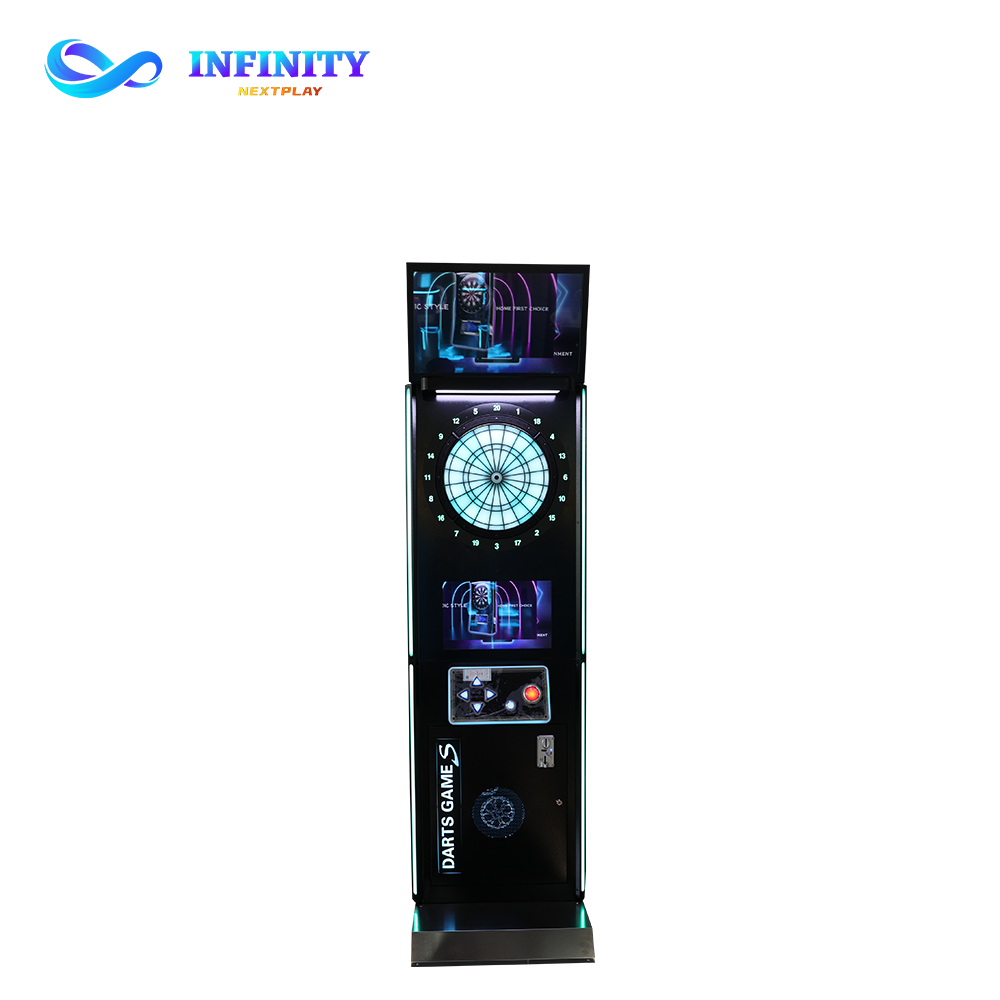
I added the dart machine in week four mostly because I had a 60 sq ft corner I did not know what to do with. It turned out to be the highest revenue-per-square-foot unit in the zone. The X5 takes coins or card, runs unattended, and generates $1,300 to $1,600 a month at $3 per game. That is roughly $25 per square foot per month — better than either of my headline lanes on a per-area basis.
The hidden value is queue management. When a family of four arrives and the shooting lane has a 15-minute wait, the dart machine gives the other three members something to do. Without it, I was losing groups who did not want to stand around. With it, average group dwell time went from 22 minutes to 38 minutes, and per-group spend went from $24 to $41.
Card-reader ready, unattended operation, ideal as a social anchor for high-traffic zones.
View Details →For a 2-lane zone (one Q4, one A6, one dart anchor, build-out and signage), budget $22,000 to $26,000 all-in including shipping and a 3-month spare-parts kit. For a 3-lane zone with two dart machines, budget $32,000 to $38,000. Do not cut the spare-parts kit — a 4-day downtime on a shooting lane costs you more than the kit.
Underestimating the value of the spectator screen. I have seen three operators put the archery display facing the wrong way and then blame the product for low walk-in conversion. Rotate the second screen toward your highest-traffic walkway before you open, and re-measure walk-in conversion every two weeks for the first three months.
Yes for the first 60 days, if your dart machine is card-reader ready and your shooting and archery lanes are auto-scoring. I ran my Manila zone solo for the first eight weeks. Past month three, you will want a second person on Friday evenings and weekends purely to manage the queue and onboard walk-ins.
You sell a 90-minute private block for $150 to $220 depending on market. The block includes both lanes reserved, a printed score sheet at the end, and a soft drink per player. Margin is roughly 85% because your only incremental cost is the drinks and the staff time you were already paying for. Aim for one recurring weekly booking — that single contract covers 10–15% of your monthly rent.
My worst month was a typhoon week in August where the mall closed for four days. Revenue was $7,400 against $2,150 rent and $760 labor. I still cleared $4,490 net. The floor on this business is high because the variable cost per session is almost zero — no consumables, no licensed ammunition, no per-round labor. The ceiling is set by your session throughput, which is why lane depth and screen placement matter so much.
A 2,000 sq ft combat sports zone built around the Shooting Simulator Q4 and the Archery System A6, with a dart anchor for queue management, is one of the highest revenue-per-square-foot small-venue formats I have operated. The gear is durable, the scoring systems drive retention, and the format works equally well in a mall third floor and a strip-mall anchor. My Manila unit paid back in 7.5 months and has not had a sub-$10,000 month since month five. If you are evaluating a location right now, the two questions to answer are: (1) does the math clear rent by 3x at 60% capacity, and (2) can I orient an archery spectator screen toward my highest-traffic walkway? If both answers are yes, you have a viable combat sports zone on your hands.
If you want a free 3D layout for your specific space — with lane placement, screen orientation, and a revenue projection based on your foot traffic — I will build one for you. No commitment, no sales call, just a floor plan and a payback calculation you can take to a landlord.
Get a free 3D layout for your space. No commitment required.